Now we know: the earth doesn’t move.

Take that headline with about a metric ton of salt.

Once upon a time, Islamic scholars made significant contributions to science, mathematics (algebra is an Arabic word), philosophy, medicine, and other fields.

Today? I’ll let you judge for yourself. Saudi preacher Bandar Al-Khaybari demonstrates that the earth does not revolve around itself, using deeply flawed logic, the absence of scientific understanding, and the Qur’an. Oh, and astronauts never landed on the moon, either.

http://youtu.be/-9Jp_XCvVto

If you don’t want to take the time to watch the video, here’s the transcript:

Someone is asking whether the Earth moves or whether it is fixed in place. Does it move or remain fixed? The Truth, as described by our scholars Imam Ibn Baz and Sheik Saleh Al-Fawzan, is that the Earth is fixed and does not move. This is in keeping with the Quranic text, and it makes sense as well. […]

There is ample Quranic evidence that it is the sun that revolves around the Earth. As for evidence based on reason… The (Westerners) present all kinds of theories, but we Muslims also have theories and brains.

First, let’s say that we go from here to Sharjah Airport and take a plane to China. Are you with me? Concentrate now. Let’s say that this is the Earth, and let’s assume that it is turning… If we take an international flight from Sharjah to China… You say that the Earth is turning, right? If the plane stopped in mid-air, wouldn’t China come to it? Am I right or not? If the Earth really does turn – China should come to the plane. Now, let’s assume that the Earth revolves the other way – the plane will never catch up with China no matter how long it flies. Since China is also revolving, you will never get there. Secondly, Allah talked about the (celestial) house frequented (by angels). This house is located in the seventh heaven. The Prophet Muhammad said that if it fell from the sky, it would fall on the Kaaba. But if the Earth revolves, it would not fall on the Kaaba. It would fall in the ocean or somewhere on dry land. This proves that the Earth is fixed in place.  […]

The (Americans) say that they landed on the moon, but they never set foot or laid their eyes on it. They produced it all in Hollywood or I don’t know where. They said that they had gone to the moon and we just took their word for it.

Now, please don’t get me wrong. I’m not saying that Muslims in general are stupid or scientifically ignorant, or that nothing good comes out of the middle east. But what we have here is the equivalent of letting Mike Huckabee or Pat Robertson teach K-12 science. This guy wears the robes of authority, he gets on television, he spouts this phenomenally ignorant nonsense, and millions of people believe him. This is not good for humanity.

To give equal time to another brand of fanaticism, I refer you to the Creation Museum in Petersburg, Kentucky, a $27 million facility devoted to the concept of an earth that’s younger than 10,000 years old, and which contradicts science at every turn.

I’ve said it before and I’ll say it again – science and faith don’t mix. I’m not against faith; I have a spiritual walk of my own. But I keep those beliefs separate and apart from the empirical evidence of the universe around me. We get in trouble when we try to make observable facts conform to religious belief, or vice-versa. You can’t shove one into the other’s box.

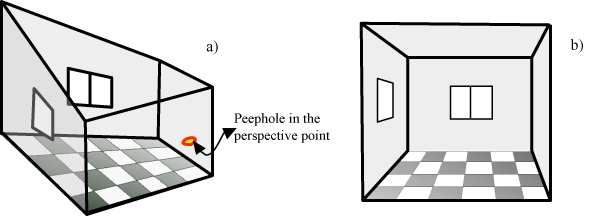
For myself, I liken our perception and knowledge of the universe around us to an Ames room:

O4 Ames Room with Birgit and Ingrid Brill 1

O4 Ames Room with Ingrid and Birgit Brill 2

In this common illusion, two people who change places in a room appear to change size drastically. Looking at them through a peephole destroys our sense of depth perception and allows the illusion to work:

Fig12-FigurativeArt

The room is actually severely distorted.

Fig13-FigurativeArt

For all we know from empirical observation about our environment – and we have learned a lot – I’m entirely convinced that we know next to nothing, and that we’re looking at our universe through a peephole. Were we to be able to see the “big picture,” a lot more things would make sense.

In the meantime, denying scientific reality makes a body look like a gibbering loon. Don’t do it. As for me, I do my best to live a good and productive life according to principles which I hold sacred and which inform my life, and gaze in wonder at the awesomeness and complexity of the world around me.

The Old Wolf has spoken.

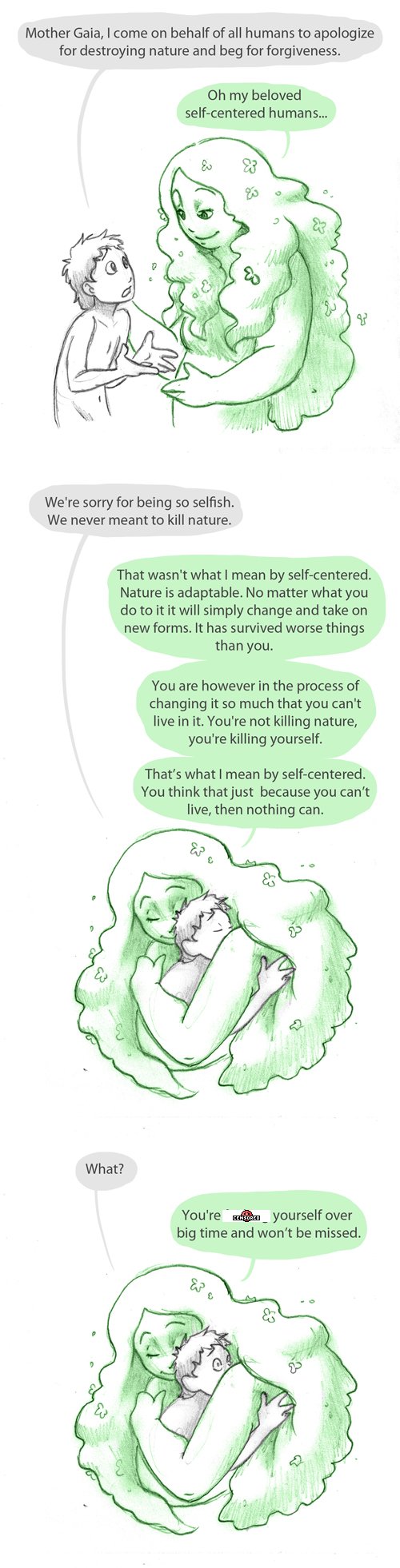
It’s not nice to fool with Mother Nature.

In the moving and beautiful video below, Julia Roberts voices Mother Nature and reminds us that from the point of view of the earth, we as humans are not needed.

Humon, the pen-name of the artist who draws Scandinavia and the World did a beautiful comic on the same theme:

Gaia

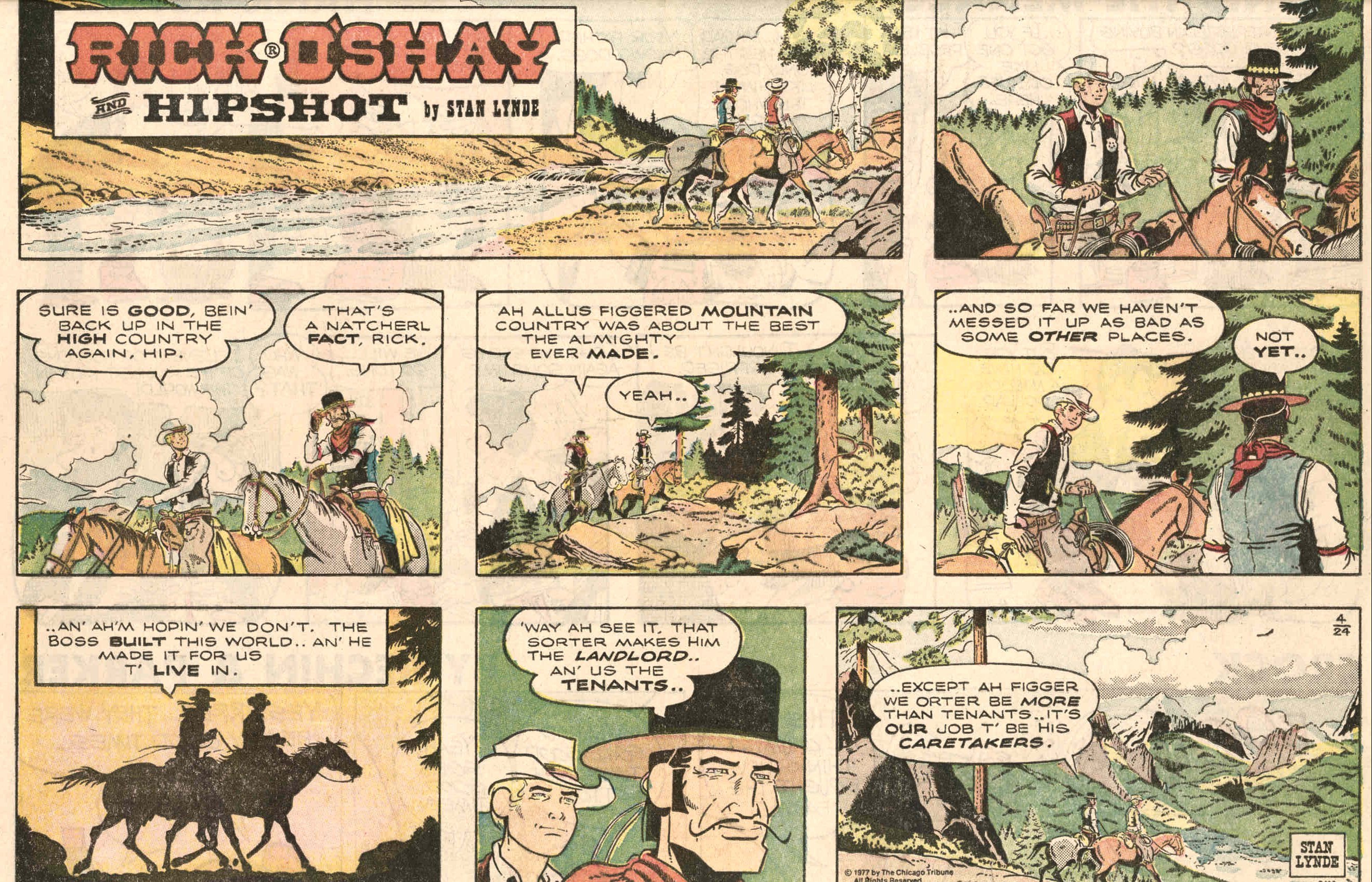
Lastly, I repeat a comic I have posted or referred to a few times in this blog, by the inimitable Stan Lynde:

RickOShay2

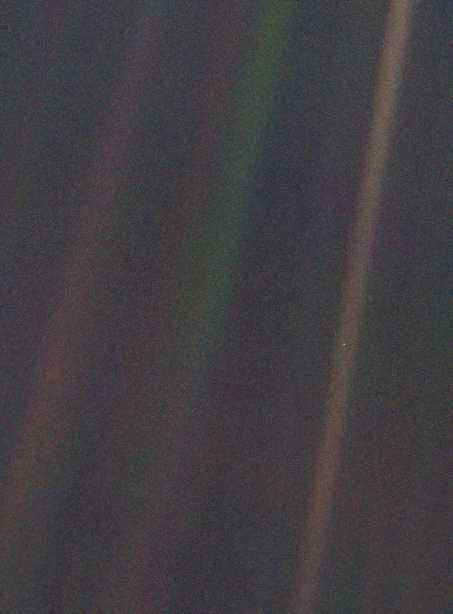
Whether one are a person of science or a person of faith, it behooves us all to take care of this one and only spaceship earth that we have to live on. There is no getting off it in the foreseeable future. and we’re soiling our nest so rapidly that there will be unavoidable consequences down the road; the concept is underscored in Carl Sagan’s thoughts on The Pale Blue Dot, which I mentioned earlier.

Let’s please not forget:

The Old Wolf has spoken.

Things you may not have known about Apollo 11

Originally posted at craignelson.us in 2009, the original post appears to be gone, but thanks to the Wayback Machine, I present it for your consideration.

24 – During Apollo liftoffs, NASA VIPs sat 3.5 miles away from the pad, since if the rocket exploded, it would do so with 4/5ths the power of an atomic bomb, meaning 100-pound shrapnel thrown a radius of 3 miles. Neil Armstrong recently commented that today, Americans are shocked when the Shuttle doesn’t work every time, but during Apollo, NASA employees were always surprised when the Saturn did.

23 – The threat of pad catastrophe was so imminent that NASA engineered a number of methods to rescue the crew. There was an entirely separate 3-rocket assembly attached to the nose cone of the capsule, ready to launch the men off their booster, deploy the chutes, and drift into an Atlantic splashdown. There were 600-feet-per-minute high-speed elevators which would be met by armored personnel carriers, and a cable car attached to a slide wire which could carry all three men 2500 feet at 50 mph away from the immolating missile to a rubber-walled below-ground bunker.

22 – There was one prayer at the start of every NASA mission shared by astronaut crew and ground control engineers alike: “Dear Lord, please don’t let me [screw] up.”

21 – During countdown, Neil Armstrong, Buzz Aldrin, and Mike Collins sat in absolute silence for 30 minutes.

20 – As his rocket rose into the sky, Saturn V overseer Wernher von Braun recited, aloud, the Lord’s Prayer with tears in his eyes. He then turned to a colleague and offered, “You give me $10 billion and 10 years and I’ll have a man on Mars.”

19 – The computers aboard each of the Apollo 11 spaceships had less power than today’s cellphones.

18 – Those who believed American astronauts were daredevil cowboys would be surprised by what Neil Armstrong and Buzz Aldrin made sure to bring with them on this mission: Slide rules.

17 – Instead of watching his dad on television during the flight, Mike Collins only wanted to play with his pet bunny, Snowball; after ignoring almost everything about Apollo 11, Marky Armstrong looked up from what he was doing at one point, realized that it was his dad who was on the TV screen, and ran over to hug it.

16 – Much of the heroics needed by astronauts went into enduring what was arguably the world’s worst camping trip. Drinking water was a fuel-cell by-product, but Apollo 11’s hydrogen gas filters didn’t work, making every drink so bubbly that some believe the bravest man on the mission was the Navy frogman who opened the hatch after splashdown. NASA meals were vacuum-sealed in plastic. Cubes of cereal and cookies were eaten straight out of the bag, while freeze-dried entrees (a process that combined flash-freezing with vacuum-s*cking to remove all moisture) needed to be rehydrated through a nozzle with either hot or cold (and gassy) water and kneaded into a mash, which was then squeezed out like toothpaste and was as delicious as it sounds. Of the 2500 calories they were supposed to eat each day, an Apollo crewman averaged 1400. Urinating and d3fecating in zero gravity, meanwhile, were never successfully addressed by any NASA engineering triumph; the latter was so troublesome that agency doctors prescribed foods that produced as little waste as possible, and more than one astronaut spent their entire mission on lomotil to avoid the procedure entirely.

15 – As Aldrin and Armstrong monitored the landscape of their landing path, it became clear that something was off, that they were going to overshoot NASA’s carefully-plotted landing site by about 4 miles. Instead of a computer-controlled touchdown, Armstrong would have to land on the moon himself. During one of his lunar lander training sessions, however, he’d almost died, with 3/5ths of a second to spare. In the Apollo 11 touchdown, he would almost wholly run out of fuel. Astronaut Don Lind: “At the end, all we knew was that the LM was descending at 1 foot per second and scooting across the surface at 47 feet per second, with only about 60 seconds’ worth of descent fuel left. My heart was pounding so hard I was afraid they’d kick me out of the Astronaut Corps.”

14 – NASA’s simulator training worked so well that many astronauts would calm themselves during real-world crises by thinking, “This is just like a simulation.”

13 – In case of disaster, William Safire prepared a speech which President Nixon would have given as the astronauts lived out their final hours. It began: Fate has ordained that the men who went to the moon to explore in peace will stay on the moon to rest in peace. And it concluded: For every human being who looks up at the moon in the nights to come will know that there is some corner of another world that is forever mankind.

12 – The “one small step for man” wasn’t actually that small. The commander had set his ship down so gently that the legs’ shock absorbers hadn’t deployed, and the bottom of the ladder was 3.5 feet away from the Moon’s surface. Armstrong first stepped onto one of Eagle’s footpads and hoisted himself back onto the ladder to make sure he could get back to his ship before taking the ’small step,’ and then warned Aldrin about how big a drop it actually was.

11 – Armstrong’s first assignment was to immediately grab a rock just in case there was an emergency abort. Instead, he became so engrossed in taking pictures that Mission Control had to nag him 3 times about the sample. Aldrin, meanwhile, had to remember not to lock the door after exiting the LM, since there was no outside handle. When it was his turn with the Hasselblad, Aldrin took very few pictures of Armstrong, all of them a small figure in a vast panorama featuring the Lunar Module. There is today only one good photograph of Neil Armstrong on the moon — one he took himself, reflected in Aldrin’s gold visor.

10 – Armstrong later confessed to astronaut Alan Bean that their next task was the most difficult and frightening one of all: planting the American flag. It turned out that, contrary to many geologists’ conjecture, the moon’s surface (at least in the Sea of Tranquility where Eagle had landed) was a thin sweep of dust covering hard, dense, impenetrable rock. After pounding and sweating away at the task for much too long, Aldrin and Armstrong could only get their flagpole in a few inches. Both were convinced that, live on television with billions watching, they would step back from the flag — which was torsoed with wires to always wave erect in the vacuum of the moon — only to see it topple over into the dust. Amstrong tried patting a mound of dirt at the base to stabilize it, but the situation was so dicey that he and Aldrin spent the rest of their moonwalk carefully avoiding it. NASA had kept secret the manufacturer of the moon flag, insisting that they were bought anonymously. But the president of flag-maker Annin uncovered that it had come Sears, an exclusively Annin retailer. He begged the agency’s Public Affairs Office to publicly acknowledge this, but NASA refused. They said, “We don’t want another Tang.”

9 – Returning to the LM, Aldrin and Armstrong had now worked for over 24 hours nonstop, and needed to sleep. But there was a constant racket from the interior system pumps and the micrometeorites exploding like hail on the LM’s mylar skin. Aldrin: “It was very chilly in there. After about 3 hours it became unbearable. We could have raised the window shades and let the light in to warm us, but that would have destroyed any remaining possibility of sleeping.” Armstrong found that his hammock put him directly in the line of sight of the craft’s telescope, which at that moment was focused on the Earth. For the exhausted but restless flyer, it seemed as if a huge, unblinking blue eye was staring down at him.

8 – Orbiting overhead in the mothership Columbia, Mike Collins, meanwhile, had spent countless hours peering through the sextant trying to determine his crewmates’ landing spot, but he still didn’t know where Eagle was, exactly … and Houston didn’t know, either. The next morning, Collins radioed, “You’ve given up looking for the LM, right?” and Houston replied, “Affirmative.”

7 – Astronaut Nurse Dolores “Dee” O’Hara: The astronauts “have something, yes, that something that men have for whom death is a toy to play with, or who have seen something you haven’t seen. The ones who have been up, especially. They have something, a sort of wild look, I would say, as if they had fallen in love with a mystery up there, sort of as if they haven’t got their feet back on the ground, as if they regret having come back to us … a rage at having come back to earth. As if up there they’re not only freed from weight, from the force of gravity, but from desires, affections, passions, ambitions, from the body. Did you know that for months John [Glenn] and Wally [Schirra] and Scott [Carpenter] went around looking at the sky? You could speak to them and they didn’t answer, you could touch them on the shoulder and they didn’t notice; their only contact with the world was a dazed, absent, happy smile. They smiled at everything and everybody, and they were always tripping over things. They kept tripping over things because they never had their eyes on the ground.”

6 – In the wake of Apollo 11, the speaker at one NASA scientific banquet was British astrophysicist Fred Hoyle, who had predicted in 1948 that, once a picture of the earth from space had been made, a whole new way of thinking would result. He told the attendees: “You have noticed how, quite suddenly, everybody has become seriously concerned to protect the natural environment. It happened almost overnight, and one can understand how one can ask the question, ‘Where did this idea come from?’ You could say, of course, from biologists, from conservationists, from ecologists, but after all, they’ve really been saying these things for many years past, and previously they’ve never even got on base. Something new has happened to create a worldwide awareness of our planet as a unique and precious place. It seems to me more than a coincidence that this awareness should have happened at exactly the moment man took his first step into space.”

5 – Though JFK had publicly announced, “We choose to go to the moon in this decade and do these other things, not because they are easy, but because they are hard. Because that goal will serve to organize and measure the best of our energies and skills,” privately, he would ask, “Can you fellows invent some other race here on earth that will do some good?” and commented about getting a man on the moon: “The cost, that’s what gets me.” Twice, Kennedy would propose to Khrushchev that the two merge their efforts in a join US-USSR mission to the moon, but the Russians, not wanting the West to see the limits of their military technology, declined.

4 – Lyndon Johnson’s budget director informed the president, in great detail, the vast amount of money that would be saved by not going to the Moon before 1970. But Johnson demurred, insisting he owed it to John Kennedy to make that deadline.

3 – Soon after President Kennedy’s assassination, his widow sat down with Teddy White for an interview which remained unpublished until 1995, a year after her death. Jackie commented on the various memorial plans that, “I’ve got everything I want; I have that flame in Arlington National Cemetery and I have the Cape. I don’t care what people say. I want that flame, and I wanted his name on just that one booster, the one that would put us ahead of the Russians … that’s all I wanted.”

2 – Fearing a public relations calamity, NASA never allowed Armstrong, Aldrin, or Collins to ever fly again.

1 – Since 1981, the Pentagon’s annual space budget has been bigger than NASA’s.

The Overview Effect: Seeing Earth from the Outside

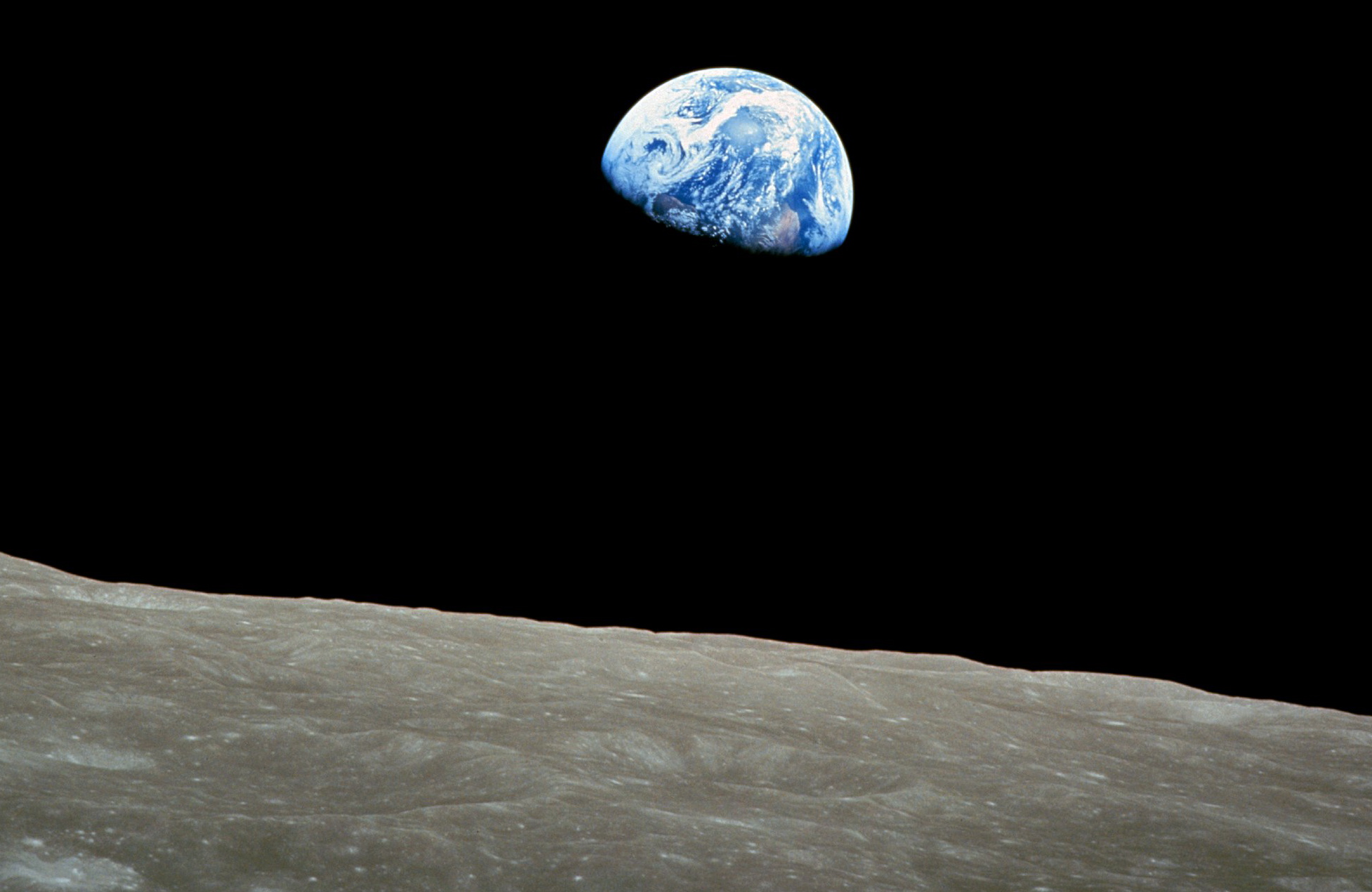
Writer Frank White coined the term “The Overview Effect” to describe the deep changes that astronauts experience once they see Earth from space. He said, “In 1968, Apollo 8 went to the Moon. They didn’t land, but they did circle the Moon; I was watching it on television and at a certain point one of the astronauts casually said: we are going to turn the camera around and show you the Earth. And he did. And that was the first time I had ever seen the planet hanging in space like that. And it was profound.”

nasa-apollo8-dec24-earthrise

Apollo 8: Earthrise. ©Nasa

Astronaut Edgar D. Mitchell said,

“You develop an instant global consciousness, a people orientation, an intense dissatisfaction with the state of the world, and a compulsion to do something about it. From out there on the moon, international politics look so petty. You want to grab a politician by the scruff of the neck and drag him a quarter of a million miles out and say, ‘Look at that, you son of a bitch.”

But you don’t need to have gone into space to have obtained that awareness; some forward-thinking individuals divined the importance of our island earth from their armchairs. In 1948, British astrophysicist Fred Hoyle predicted the change of viewpoint when he said,
“Once a photograph of the Earth, taken from outside, is available, we shall, in an emotional sense, acquire an additional dimension… Once let the sheer isolation of the Earth become plain to every man, whatever his nationality or creed, and a new idea as powerful as any in history will be let loose.”

Subsequent to Apollo 11, Hoyle spoke at a NASA scientific banquet and said,

“You have noticed how, quite suddenly, everybody has become seriously concerned to protect the natural environment. It happened almost overnight, and one can understand how one can ask the question, ‘Where did this idea come from?’ You could say, of course, from biologists, from conservationists, from ecologists, but after all, they’ve really been saying these things for many years past, and previously they’ve never even got on base. Something new has happened to create a worldwide awareness of our planet as a unique and precious place. It seems to me more than a coincidence that this awareness should have happened at exactly the moment man took his first step into space.”
A recent short documentary, Overview, collects statements from many astronauts who have had this unique experience.

With his famous essay on “The Pale Blue Dot,” Carl Sagan captured the essence of this effect, without himself ever having been in space physically, although he probably plumbed the universe more deeply in his mind than the vast body of humanity.

Pale_Blue_Dot

“… Look again at that dot. That’s here. That’s home. That’s us. On it everyone you love, everyone you know, everyone you ever heard of, every human being who ever was, lived out their lives. The aggregate of our joy and suffering, thousands of confident religions, ideologies, and economic doctrines, every hunter and forager, every hero and coward, every creator and destroyer of civilization, every king and peasant, every young couple in love, every mother and father, hopeful child, inventor and explorer, every teacher of morals, every corrupt politician, every “superstar,” every “supreme leader,” every saint and sinner in the history of our species lived there – on a mote of dust suspended in a sunbeam.

The Earth is a very small stage in a vast cosmic arena. Think of the rivers of blood spilled by all those generals and emperors, so that, in glory and triumph, they could become the momentary masters of a fraction of a dot. Think of the endless cruelties visited by the inhabitants of one corner of this pixel on the scarcely distinguishable inhabitants of some other corner, how frequent their misunderstandings, how eager they are to kill one another, how fervent their hatreds. Our posturings, our imagined self-importance, the delusion that we have some privileged position in the Universe, are challenged by this point of pale light.

Our planet is a lonely speck in the great enveloping cosmic dark. In our obscurity, in all this vastness, there is no hint that help will come from elsewhere to save us from ourselves.

The Earth is the only world known so far to harbor life. There is nowhere else, at least in the near future, to which our species could migrate. Visit, yes. Settle, not yet. Like it or not, for the moment the Earth is where we make our stand.

It has been said that astronomy is a humbling and character building experience. There is perhaps no better demonstration of the folly of human conceits than this distant image of our tiny world. To me, it underscores our responsibility to deal more kindly with one another, and to preserve and cherish the pale blue dot, the only home we’ve ever known…”.
– Pale Blue Dot: A Vision of the Human Future in Space

Recently published at YouTube was a video of the final message of Wubbo Johannes Ockels (March 28, 1946 – May 18, 2014), who was a Dutch physicist and an astronaut of the European Space Agency (ESA), riding on Space Shuttle STS-61-A, and becoming the first Dutch citizen in space. After his astronaut career, Ockels was professor of Aerospace for Sustainable Engineering and Technology at the Delft University of Technology. On May 29, 2013 it was announced that Ockels had an aggressive form of kidney cancer (renal cell carcinoma) with a metastasis in his pleural cavity, and a life expectancy of one to two years. He died from complications of cancer on May 18, 2014, one day after making this video.

A transcript in English of Dr. Ockels’ remarks follows.

“We need some luck. Some other spacecraft. Something, because with what we have now, it’s going to be finished. As an astronaut, you feel excluded to a particular group of people. And those are the people in the majority. They are you, not being aware of the danger in which you live.

But now suppose I’m going to change all of you. Suppose I can transfer the experience which I have to you. Then you would go out and see the earth, and you would see the blue sky, not the blue sky which you see when you go outside; in space you see that you are the only one. The only planet. You have no spare. And so you have to take care of this one only planet.

Our earth has cancer. I have cancer too. And most people with cancer, they die. When in fact, everybody will die. If we make enough people to continuously survive mankind on the earth, we need to conserve our own planet, and you when you have the spirit and the insight and the attitude of an astronaut, you start to love the earth in a way that other people can’t. And if you really love something, you don’t want to lose it.

You know, my wife, she doesn’t want to lose me. She wants to do everything to let me stay alive. That’s the love and attitude which human kind should have to the earth. We do not have 50% of our roofs covered with solar. We do not have more than half of our cars electric. We certainly do not have a production in which there is a reasonable amount of material recycled. We don’t have all these things.

And then the question comes, ” OK, well what’s wrong?” Well, what’s wrong is the mindset. I’m sure, but I can’t claim it, but when I heard 18 April 2013 that I had a very bad cancer, damn kidney cancer, and also changed into a sarcomatoid, which means that, you know, which to slip through all kinds of things [by this he meant metastasis], and this, the doctor, beautiful doctor, and he said you have a fair amount of time. And of course each time I asked him, “what does ‘fair’ mean?” and then he was not very accurate, but he said, “Well, months, maybe a year.”

I got over a year, a good year, because I believed that the good future, and I believed, you know, you can do things with the power, with the mind power. We, we people coming from the same molecules out of one bloody strong star which bursted out, we who have developed over billions of years, life, life, is made by we, we humanity are so strong that we can save the earth – but we also can destroy it. Even a small thing does something.

The overwhelming burden of experience from those who have been outside the Earth’s atmosphere is that this little planet we live on is the only home we have, and we need to take care of it. Even if you happen to be a person of faith, taking the chiliastic view that we don’t need to worry about the Earth because God is going to come down and take care of everything strikes me as irresponsible, and unfair to future generations. Western Artist Stan Lynde captured my own sentiments decades ago:

RickOShay2

While efforts are being made by forward-thinking individuals to reduce the damage we’re doing to our planet, there is still much to be done. We owe it to future generations to make a difference now. “Drill, baby, drill” just doesn’t do it for me.

The Old Wolf has spoken.

Memories of the Hayden Planetarium

I grew up in New York City in the 50s. My mother was a Utah girl who had dreams of going to the Big City to become an actress, and by dint of sheer determination she did just that; but while her roots were in the West, she did her best to make sure her offspring (me) was given as much cosmopolitan exposure as possible. This included regular visits to the Museum of Natural History and the Hayden Planetarium.

I have posted a couple of the images below before, but I thought I’d get a few thoughts about this wonderful place of education down in one place. Other images have been gathered from various places around the internet; I have tried to give appropriate attribution where available.

The centerpiece of the Planetarium was the Zeiss projector.

1956, Planetarium 1

Publicity shot for “Pepper Young’s Wife”, TV-Radio Mirror, March 1957, showing the Zeiss Mark II projector in use at the planetarium from 1935 to 1960.

Sitting in the auditorium, watching that behemoth rise up out of the floor, and seeing the stars and planets and nebulæ and galaxies swirling around the ceiling long before Heinlein had written Have Space Suit, Will Travel fired my imagination and gave me a longing to know about what was out there. I remember one show where they gave the audience a little controller and asked them to try aligning two objects in freefall, much the same as a space docking maneuver… it was a great lesson in the nature of inertia.

155034_183077295042955_8272470_n

The control booth of the Star Theatre. I loved that flashlight the operator had which would project a little arrow on the dome – a precursor to today’s laser pointers.

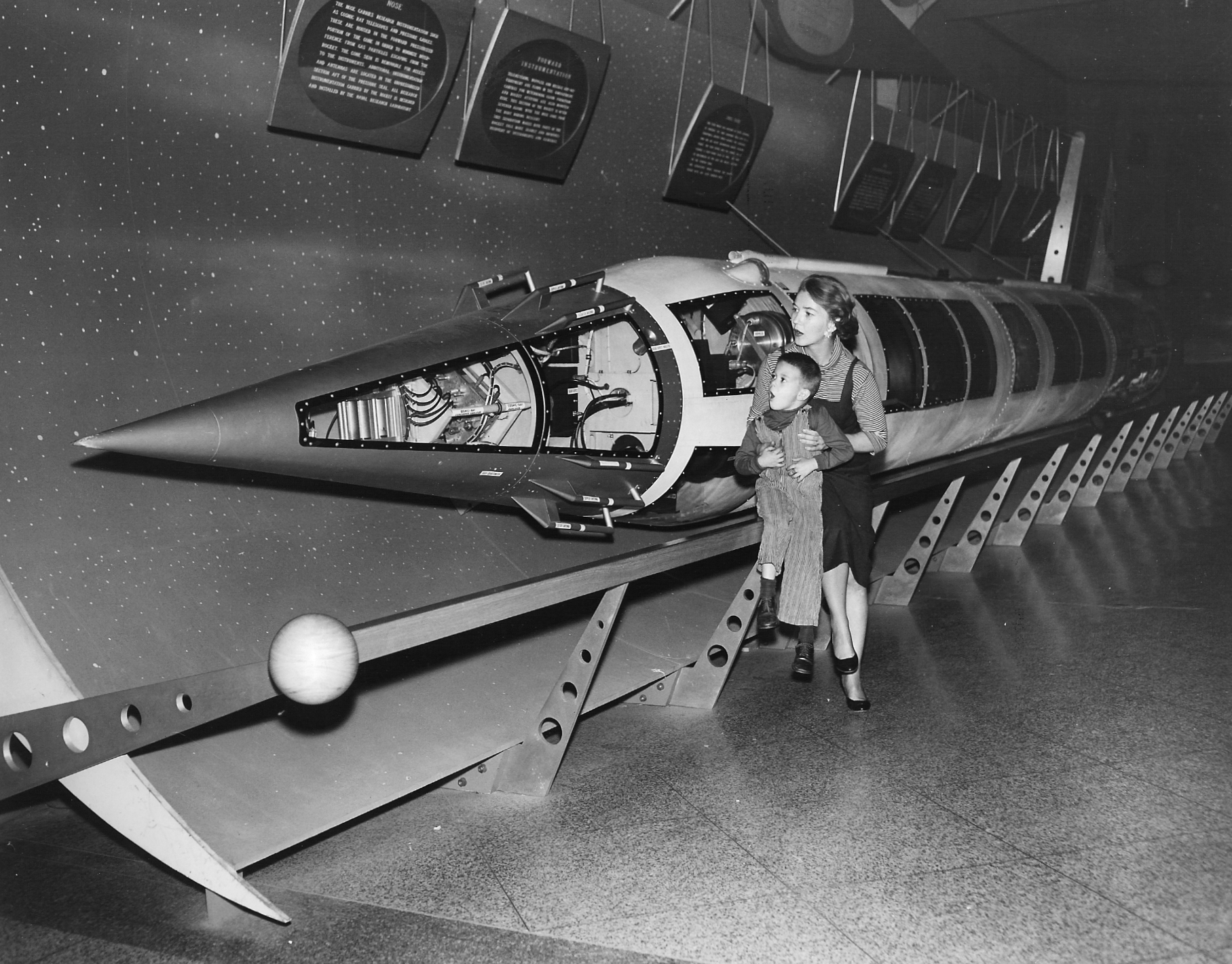
Around the planetarium, as with the modern version and others like it around the country, were scattered various exhibits that I would stare at for hours.

1956, Planetarium 2

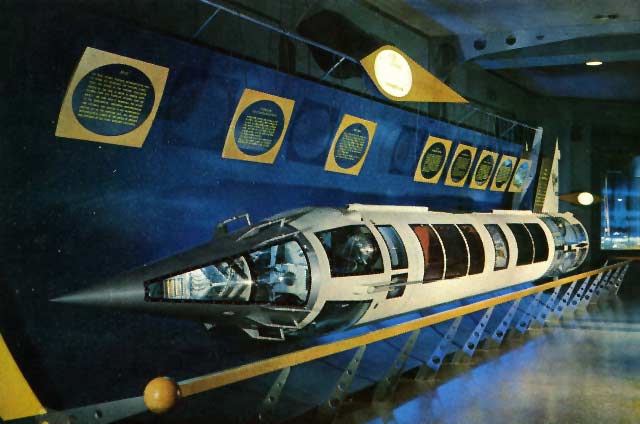
Here I am mugging for the photographer (“Look excited! Look excited!”), but it wasn’t much of an acting job. I loved looking at that rocket. A color postcard of the same scene is below:

HaydenPlan006

Photo of a planetarium postcard by Andy Porter. Caption reads, “THE VIKING ROCKET. This authentic 45 foot precision instrument is an actual rocket composed in part of sections recovered from the wreckage of Vikings built by the Martin Company of Baltimore and used by the Navy to probe the upper atmosphere. A rocket like this reached an altitude of 158 miles in May 1954.”

984.tif

Photo above and text from the archives of the Museum of Natural History: In 1955, the “most notable event of the year” at the Hayden Planetarium was the opening of the Viking Rocket exhibition. “One of the pioneer exploratory vehicles of the Space Age,” according to a 1961 Museum publication, the rocket was one of 12 that launched from 1945 to 1955, allowing new research on Earth’s upper atmosphere to be conducted.

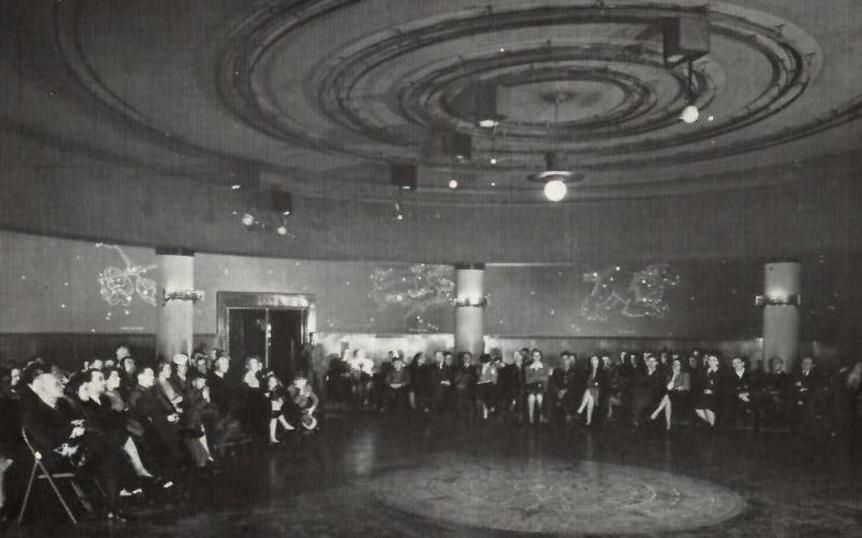
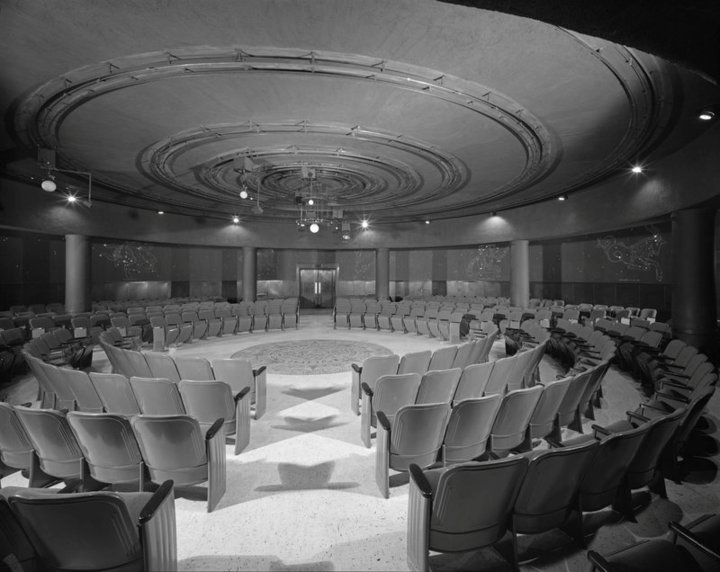
The next exhibit that comes to mind was the orrery in the Copernican room; the original theatre was outfitted with folding chairs.

Orrery

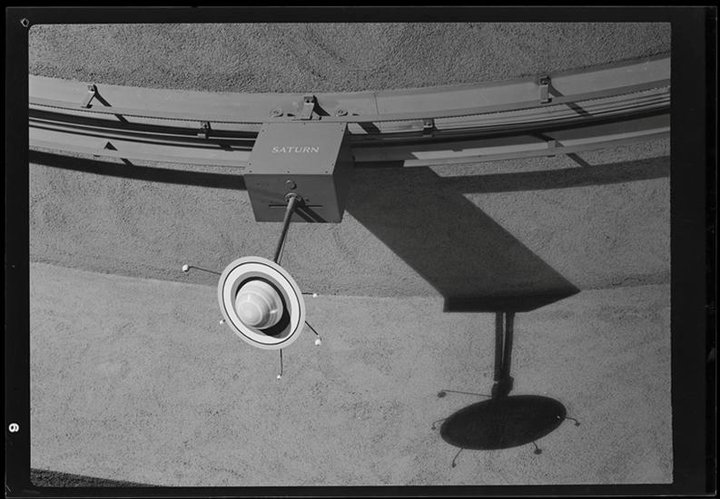
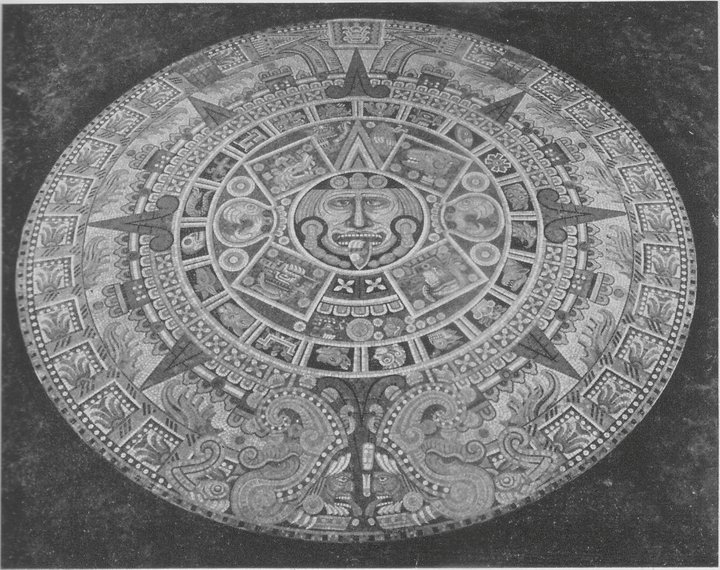
From a postcard. The description on the back reads: “Copernican Room showing solar system. Animated model of the solar system showing the sun in the center, and six of the nine known planets revolving around it. The planets also rotate on their axes as the real planets rotate, moving always at the correct relative speeds. Circling the Earth is a smaller globe, the moon, while Mars has two moons. Jupiter is shown with four of its eleven moons, and Saturn with five of its nine. Around the walls are shown the twelve zodiacal constellations and in the center of the floor a reproduction of the Aztec Calendar Stone.”

This model, while not to scale and not terribly dynamic, was intriguing in that it represented the orbits of the planets in real time. That meant slowly.  The planets would change imperceptibly, with the inner rocky planets changing somewhat between visits, and the outer planets moving hardly at all. The sun glowed a deep orange.

167054_189460954404589_6798595_n

Closeup of Saturn with five of its then-known nine moons, 10/10/1935. From the Collections of the Museum of the City of New York.

It is of interest to note that we have since identified 79 moons of Jupiter, and 62 around Saturn. [As of July 17, 2018]

167079_194043760612975_6406948_n\

American Museum of Natural History Library http://images.library.amnh.org/, image #327132 March 1960. Later, the room was transformed into a more formal auditorium.

164514_186091644741520_3335509_n

The Aztec Calendar Stone

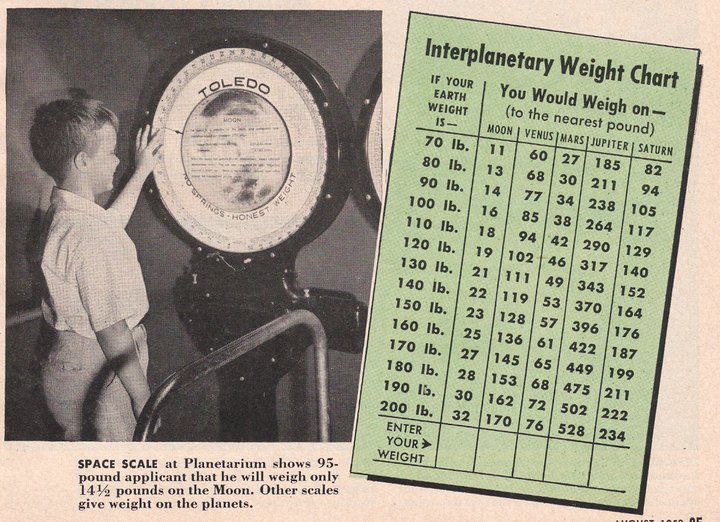
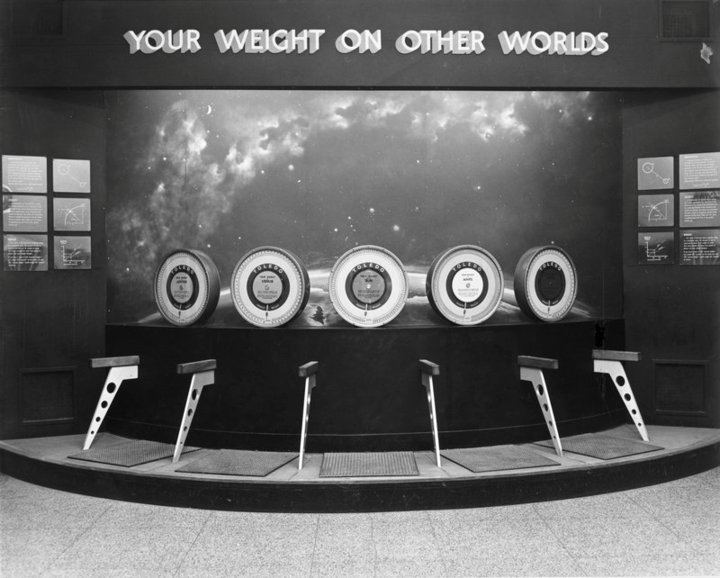
In another room was a place where you could weigh yourself on a series of scales which would show your weight on the Moon, Venus, Mars, Jupiter, and Saturn. Each scale glowed a different color, and to the eyes of a five-year-old, these were some of the most wondrous things in existence. Cards were provided with which to record your individual results.

165690_194038407280177_8232508_n

Image from Popular Science, August 1952. Explanation from the Hayden Planetarium at their Facebook page:

“Another innovation, which has proved of great popular interest, was an exhibit illustrating the principles of the force of gravity by means of six specially calibrated scales showing the actual weight of the visitor on different planets. In this undertaking the Planetarium enjoyed the cooperation of the Toledo Scales Company.”
– American Museum of Natural History Annual Report July 1950-June 1951

John Pazmino of NYSkies Astronomy pointed out that the effect of different weights was done just at the level of the display, not internally. In other words, the needle went to the same angle on each scale, and only the numbers in the background varied.

The exhibit was later updated and modernized:

163143_194038340613517_7743556_n

American Museum of Natural History Library http://images.library.amnh.org/ image #334305 September 1969

Like any good museum, there were souvenirs to be had.

164870_187385094612175_668584_n

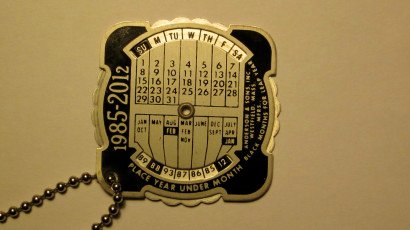
From the collection of Tom Lesser.  I would swear on a stack of waffles that I had one of these; Heaven only knows what happened to it. I was too young at the time to appreciate much astronomy, but nowadays there are some wonderful planetarium and space-exploration programs available online and offline both.

know I had one of these keychain perpetual calendars, and loved it:

165750_186608861356465_146155_n

Again, sadly, lost in the mists of time.

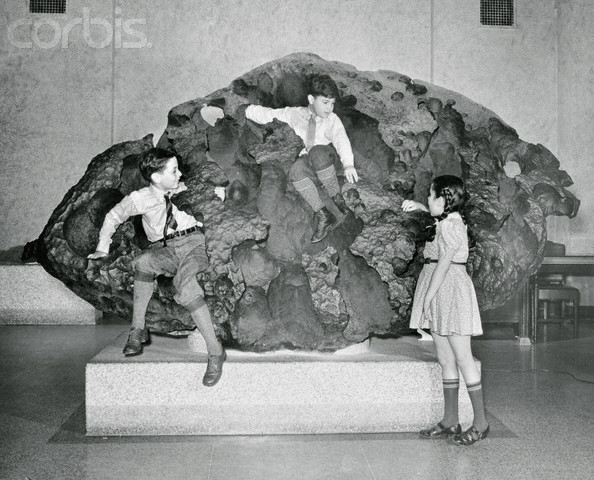
The Willamette Meteorite was on display as well:

Willamette Meteorite

That is one huge hunk of extraterrestrial iron.

Many, many more photos can be seen at the Original Hayden Planetarium’s Facebook page. The ones I have gathered here represent my clearest memories, but the original planetarium had much more to offer. It was a place of wonder and delight. On my next trip to New York, I must be sure to visit the modern incarnation and see what has happened in the last 60 years or so.

Edit: The visit was accomplished, and the report is here.

The Old Wolf has spoken.

I’m going to Mars!

Well, at least my name is.

pass

Today’s the last day to get your name on a chip that will be included on Orion’s test flight on December 4th; later submissions can still get on subsequent missions, including to the red planet itself.

You can sign up today, October 31, 2014 at NASA.

My old bones may be earthbound, but my spirit soars to the stars.

The Old Wolf has spoken.

Curiosity and Learning

A recent article in Science Daily outlines some research on how the brain changes in response to curiosity. Executive summary: “The more curious we are about a topic, the easier it is to learn information about that topic.” I’ve long known this about my own mind – if I get really curious to learn something, it absorbs more easily and sticks around longer.

The study revealed three major findings. First, as expected, when people were highly curious to find out the answer to a question, they were better at learning that information. […]

Second, the investigators found that when curiosity is stimulated, there is increased activity in the brain circuit related to reward. […]

Third, the team discovered that when curiosity motivated learning, there was increased activity in the hippocampus, a brain region that is important for forming new memories, as well as increased interactions between the hippocampus and the reward circuit.”

The full article is worth a read.

Bill Watterson illustrated this principle delightfully almost 20 years before this study was ever done. Calvin and Hobbes find a snake in the garden. They marvel at its fluidity, the flicking tongue, wonder how they sleep with their eyes open, what they eat, and realize they know nothing about snakes. Hobbes suggests that perhaps Calvin’s mom would get them a book. It’s a captivating idea, until Calvin realizes that it’s summer vacation, and he’s determined to learn nothing, whereupon Hobbes intones, “If nobody makes you do it, it counts as fun.” The last panel makes the whole strip:

Cool1

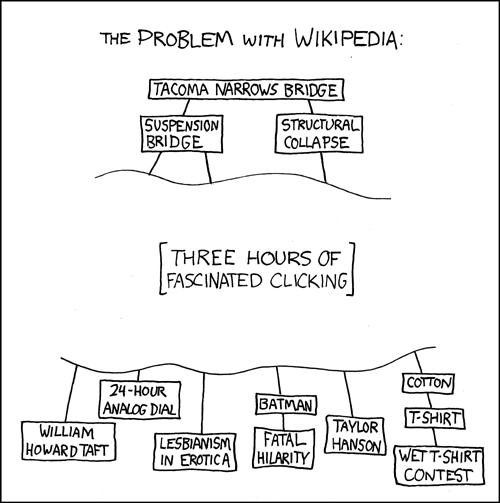
The problem with curiosity today is captured by Randall Munroe in his wonderful XKCD panel:

the_problem_with_wikipedia

This holds true not just for Wikipedia or TV Tropes (Stay away! Stay away!) but for the Internet in general. Falling down the rabbit hole makes time compress in a way that Isaac Asimov could never have imagined.

That said, I would have paid dearly for the internet when I was a child in the 50s. I wanted to know things. I wanted to understand things. But I didn’t have the patience to search the World Book, or the Brittanica, or the Americana, or the card catalogs, only to come up with results for a single topic.

On the other hand, given what’s out there, it’s probably a blessing that it wasn’t available.

Doonesbury - Truth of the Net

I struggle enough as it is.

one

The Old Wolf has spok… ooh squirrel!

To lose weight, take these drops (oh, and eat a 1200 calorie diet…)

homeopathy-debunked-because-its-just-water

It’s not good medicine for a representative of one nutritional product to bash those who rep for another. In my world of ethics, it’s just not done. As a result, I won’t mention any product names in this post, but I want to make a general comment about the way many weight-loss products are advertised and hyped.

Below you’ll find an example, using a homeopathic product as the teacher in the moment, which claims to flush fat and toxins out of your body.

The product concerned contains a panoply of things like Nux Vomica, Ignatia Amara, and about 8 others at 6x and 12x dilutions; the instructions call for placing 10-15 drops under the tongue three times a day.

Oh, yes… and also to eat a 125o-calorie diet while using the products (which cost $150.00 for a bottle of each).

The science behind homeopathic dilutions guarantees that at dilutions of 6X and 12X, there is virtually *no* active ingredient whatsoever in this product – no molecules are left. The physics of Avogadro’s number is incontrovertible.

If you consider the instructions for use of this product, and completely eliminate any reference to the product being referenced, any patient who faithfully complies with these guidelines will have success with weight loss.

Given the average caloric intake of 2,000 KCal for a female, a 1250 calorie diet will result in consistent weight loss, especially when combined with water intake and regular exercise. This weight loss will occur whether or not the patient

* takes homeopathic drops
* sings an aria from “Aida”
* stands on her head and spits nickels, or
* eats a spoonful of portland cement with each meal.

If you are a person of science and reason, you owe it to yourself to take a hard look at the scientific reality of what is going on with homeopathic or other similar weight-loss products, instead of being dazzled by all the marketing weasel words.

The Old Wolf has spoken.


There! Are! NINE! Planets!

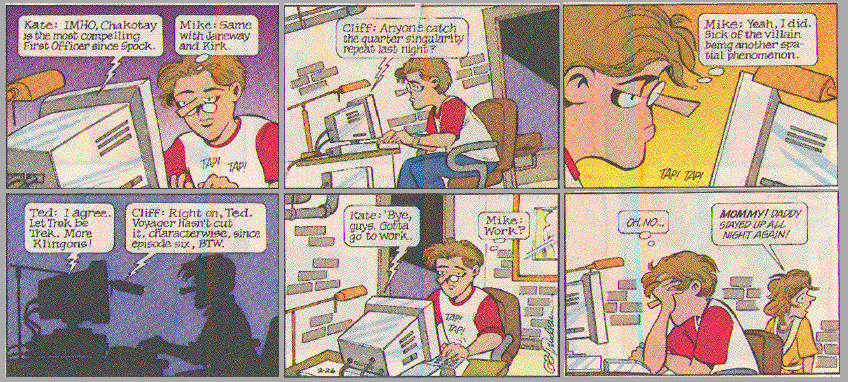
Nine Planets Thumb

Maybe.

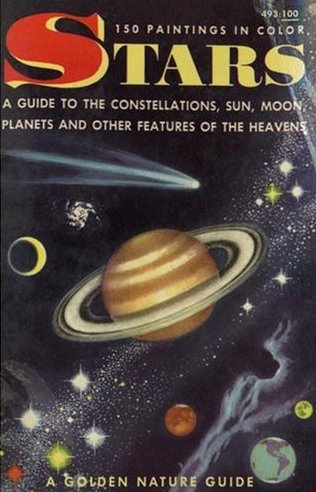
See, for the longest time, I’ve been fascinated by space, and the stars, and astronomy. When I was a kid in the 1950s I’d go from New York City where I lived to visit one of my uncles in the country, and he had an interesting and eclectic library, which things like CS Lewis’ Out of the Silent Planet or The World of Å by A.E. van Vogt. He also had this book:

zim stars

which I would spend hours and hours perusing, right around the same time Alfred Bester was publishing the exploits of Gully Foyle. In my own mind, the stars were my destination.

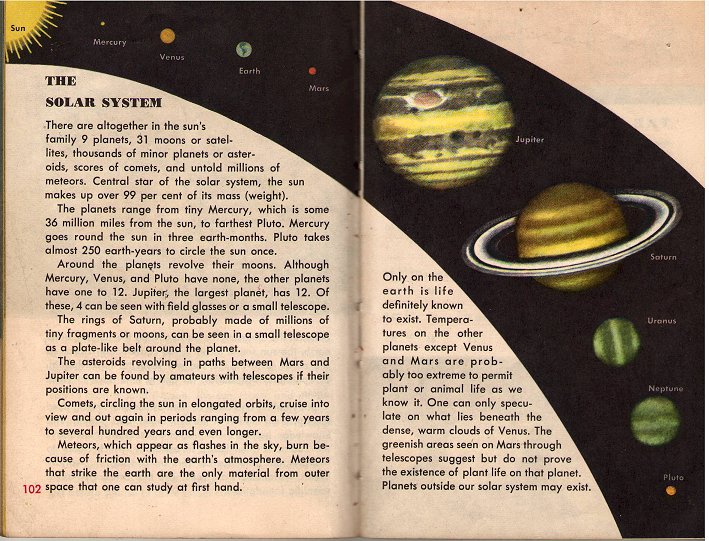
And of course, there were Nine Planets. Nine.

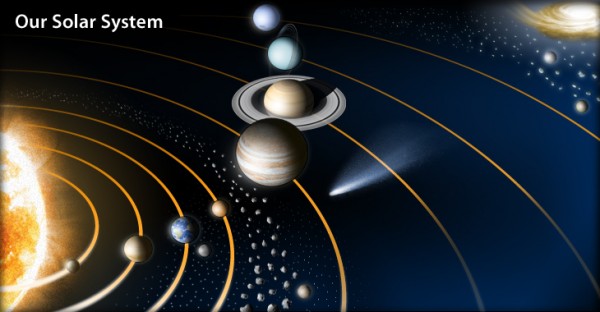
Solar System

This was cemented into my mind when, during the same epoch, I read Heinlein’s Have Space Suit, Will Travel. Beyond being a delightful space opera, it was full of hard science, too. Kip Russell was a genius who thought higher math was as addictive as peanuts, and had all sorts of astronomical data tucked away in his mind which helped him figure out where his evil worm-faced kidnappers were taking him and his little companion, Peewee.

“Mother very thoughtfully made a jelly sandwich under no protest.” Could you forget that after saying it a few times? Okay, lay it out so:

Mother Mercury $.39
Very Venus $.72
Thoughtfully Terra $1.00
Made Mars $1.50
A Asteroids Assorted prices,
unimportant
Jelly Jupiter $5.20
Sandwich Saturn $9.50
Under Uranus $19.00
No Neptune $30.00
Protest Pluto $39.50

The “prices” are distances from the sun in astronomical units. An A.U. is the mean distance of Earth from Sun, 93,000,000 miles. It is easier to remember one figure that everyone knows and a lot of little figures than it is to remember figures in millions or billions. I use dollar signs because a figure has more flavor if I think of it as money – which Dad considers deplorable. Some way you must remember them, or you don’t know your own neighborhood. (Heinlein, Robert A., Have Space Suit, Will Travel).

And no, I could never forget it either. There were nine planets. Nine. And the mnemonic was seared into my consciousness forever. When Pluto was demoted from planetary status to “dwarf planet,” I was devastated. I refused to give in. No. Still a planet, always a planet. Apparently, others felt the same way I did, and for similar reasons:

I really wasn’t too concerned about Pluto’s demotion from being a planet. It was a non scientific discussion about a silly serious definition.

Well, at least that was until they decided to TAKE AWAY PLUTO’S NAME. WTF? So, please Mr It’s-Not-A-Planet-Just-A-No-Name-Dwarf Astronomer, what am I supposed to use for my mnemonic now? Huh?

I learned “Mother very thoughtfully made a jelly sandwich under no protest” as a teenager reading Robert Heinlein. And now? “Mother very thoughtfully made a jelly sandwich under no 134340” just doesn’t have the same ring to it.

[Update: Thanks Dan]
Pluto may have lost it’s planetary status, but it GOT A NEW NUMBER! It went from merely 9 to a rocking 134340! Wow, what a raise. I am however bummed that my favorite memonic, “Mother very thoughtfully made a jelly sandwich under no protest” learned as a teenager reading Robert Heinlein, no longer works.

Perhaps “Mother very thoughtfully made a cherry jelly sandwich under no protest. Excellent!”  (Hmmm, still doesn’t ring well.) Anyway I still stand to-

Sure tell me Pluto it isn’t a planet, but stop MESSING AROUND WITH MY CHILDHOOD! (From Eclectics Anonymous)

And that’s the crux of my objection: don’t screw around with what I learned as a child. If nothing else, Pluto should have been grandfathered in, because despite its true status as a captured Kuiper Belt object (as clearly shown by its off-kilter orbit and the identification of countless other trans-Neptunian objects), it was treated as a planet since it was discovered by Clyde Tombaugh.

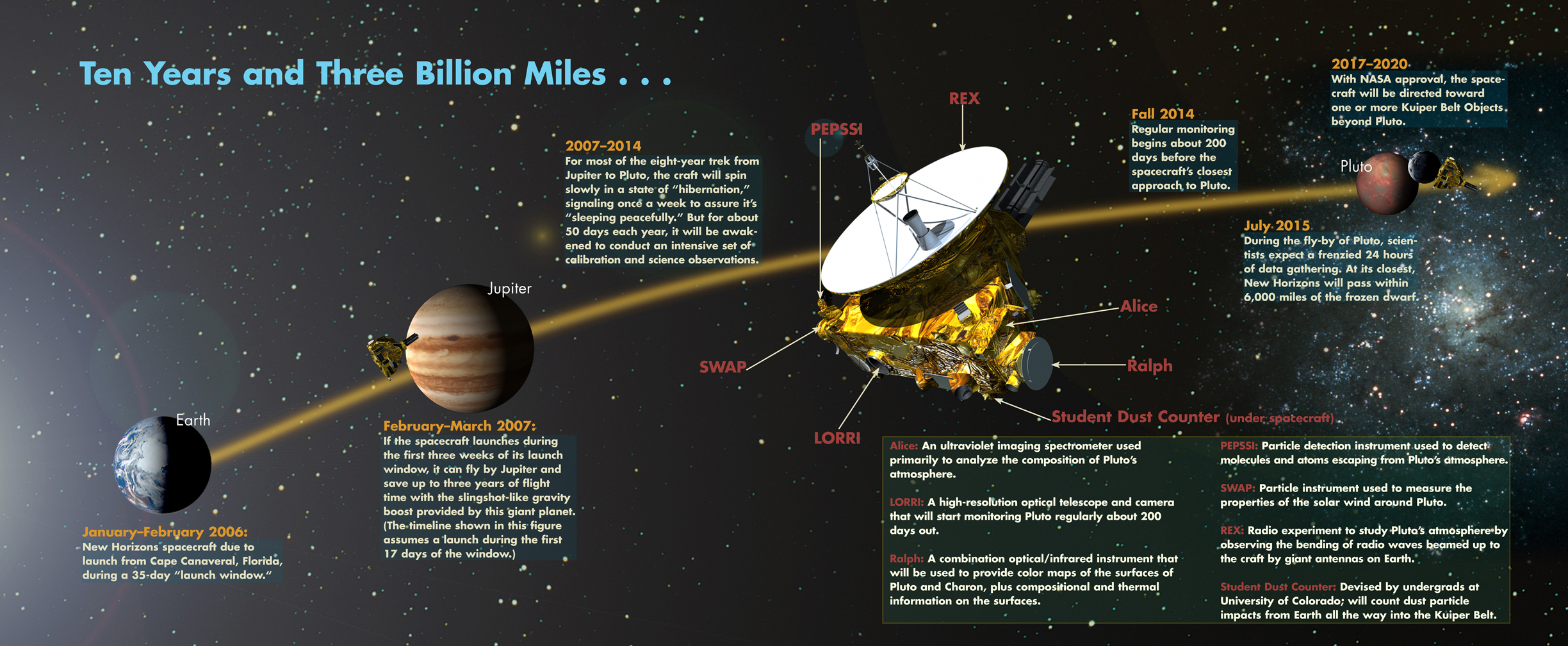
Sadly, science moves on. As Neil de Grasse Tyson has said, the universe is under no obligation to make sense to us – it’s just out there, waiting to be discovered. In much the same way as they took away my beloved Brontosaurus, we learn new things every day. Now, as New Horizons approaches Pluto for a scheduled 2015 rendezvous, my excitement to see our last little solar system outlier (at least, that’s the way it was in the 50s) knows no bounds.

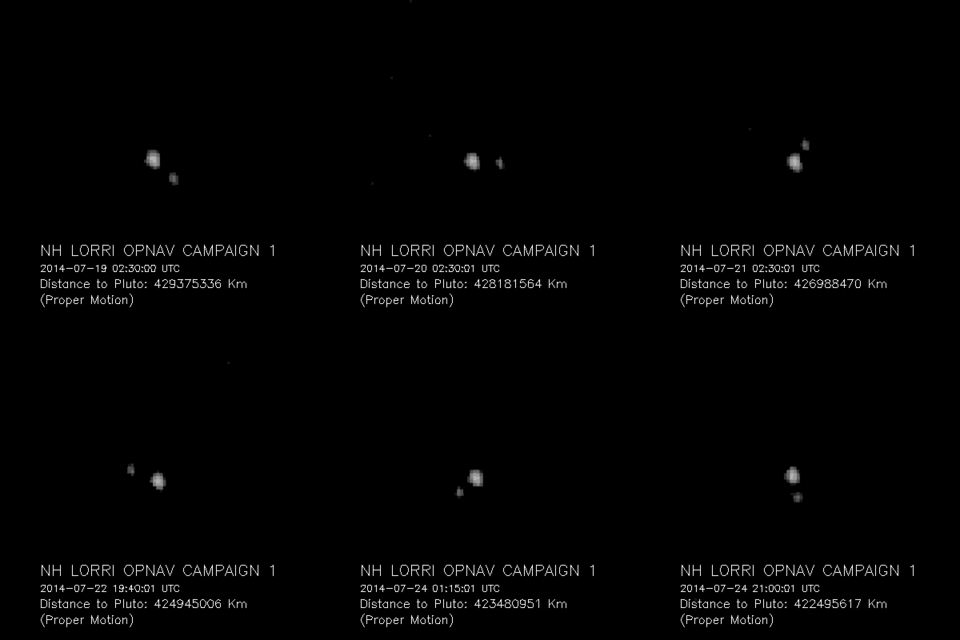
xaqbwrmxwyqtn68mqecd

“The [above] animation of Pluto and its largest moon, Charon, was created using a series of images captured by the New Horizons spacecraft as it continues its long journey to the distant planetoid. Taken from a distance of 422-429 million km, the images are not for scientific study, but for optical navigation between worlds. (From i09)

Those pictures are going to get a lot clearer and more wonderful as New Horizons approaches, if the results from Cassini and other planetary probes are any indiation. But based on what I’m seeing there, it may turn out that Pluto and Charon are not really planets at all, but nothing more than space junk, garbage that looks more like comet 67P/Churyumov-Gerasimenko. And if that ends up being the case, I’ll have to throw my visceral but irrational defense of Pluto’s planetary status onto the trash heap of disproven theories, as sad as it may be.

Our Solar System is a lot bigger now than it used to be. No one ever made mention of the Kuiper Belt or the Oort cloud. It was just us, although some scientists even back then were looking for the mysterious “Planet X” [1] which would help to explain certain orbital anomalies.

splash-planets-600x312

Image: NASA’s Solar System Exploration. Click through for the full interactive graphic, along with a lot of other wonderful information.

Some other really good stuff about space and stars and especially planets is found at Starts with a Bang!

In the end, better minds than mine have come to terms with advancing knowledge. A quote at Wikipedia’s article about Clyde Tombaugh is particularly comforting:

Tombaugh’s widow Patricia stated after the IAU’s decision that while Clyde may have been disappointed with the change since he had resisted attempts to remove Pluto’s planetary status in his lifetime, he would have accepted the decision now if he were alive. She noted that he “was a scientist. He would understand they had a real problem when they start finding several of these things flying around the place.”Hal Levison offered this perspective on Tombaugh’s place in history: “Clyde Tombaugh discovered the Kuiper Belt. That’s a helluva lot more interesting than the ninth planet.”

The Old Wolf has spoken.

Old_Wolf_Cry


[1] They’re still looking.

Rosetta: Captivated again.

I grew up in the space age.

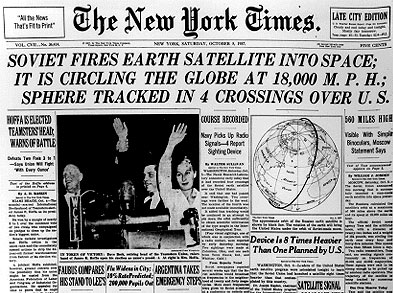
sputnik-ny-times


I worried along with my parents about what it meant now that the “russkies” had launched Sputnik.

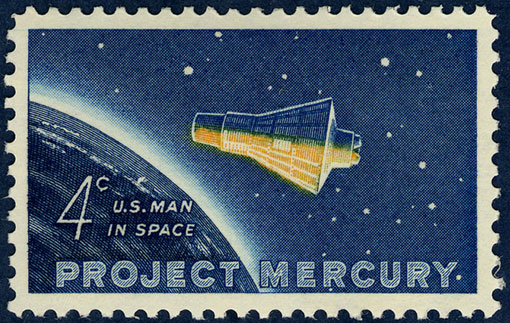
Mercury-Stamp

I sat glued to the television as the most momentous events in history took place, and as we equaled and surpassed the Russian space effort.

nasa-apollo8-dec24-earthrise

Apollo 8: Earthrise. ©Nasa

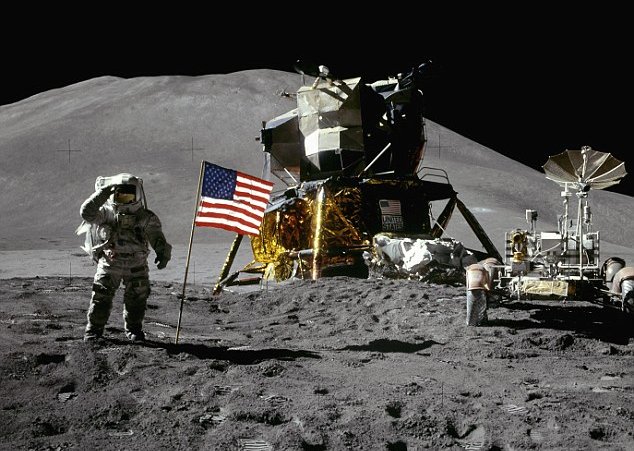
moon2

Apollos 15. ©Nasa

The space shuttle era brought triumph and tragedy and a sense of the mundane to space travel. NASA’s budget was cut, and cut, and cut again. America lost its fascination with space travel. There were no more Russians to beat, and people forgot about the amazing science and benefits that accrued to us as a result of the space effort.

Every now and then, however, there was a glimmer of excitement.

converted PNM file

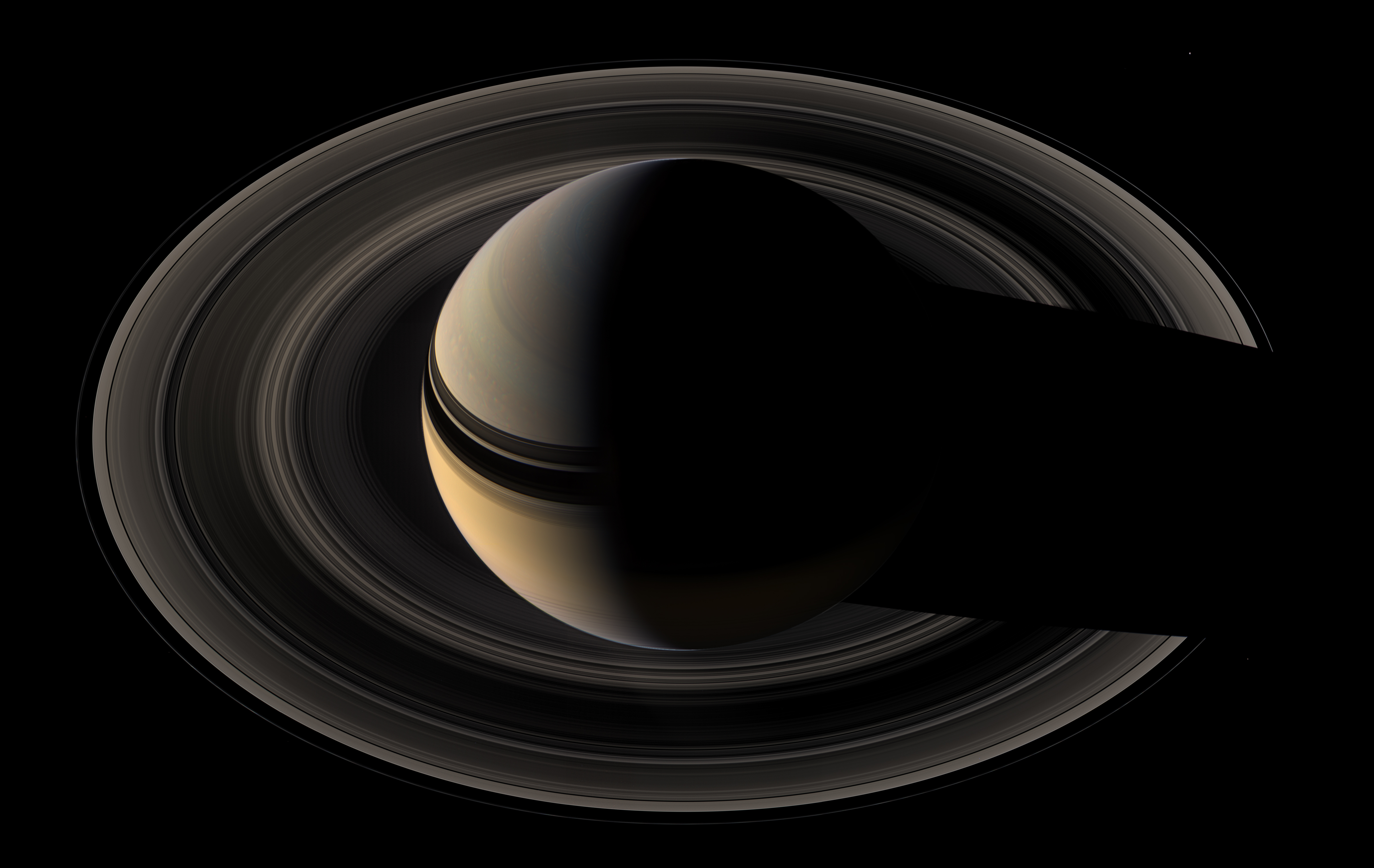
The Cassini probe and others sent back breathtaking images of our outer planets, adding immensely to our knowledge of the nature of our solar system. Saturn was not the only ringed system: Jupiter, Uranus and Neptune had them too.

PIA17048

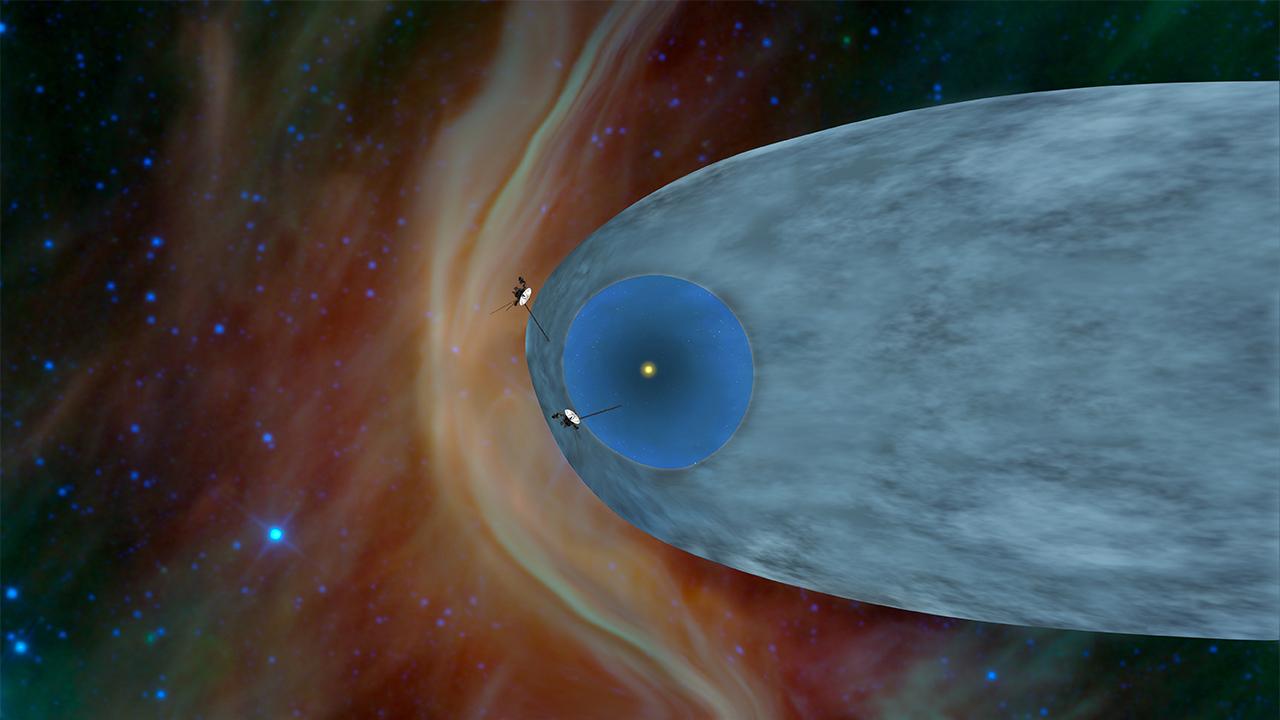
Voyager 1 crossed the heliopause and entered interstellar space on August 25, 2012. V’ger continues to provide the information.

On July 14 of next year, New Horizons will encounter Pluto[1], an event for which I wait with extreme anticipation.

New-Horizons-Poster

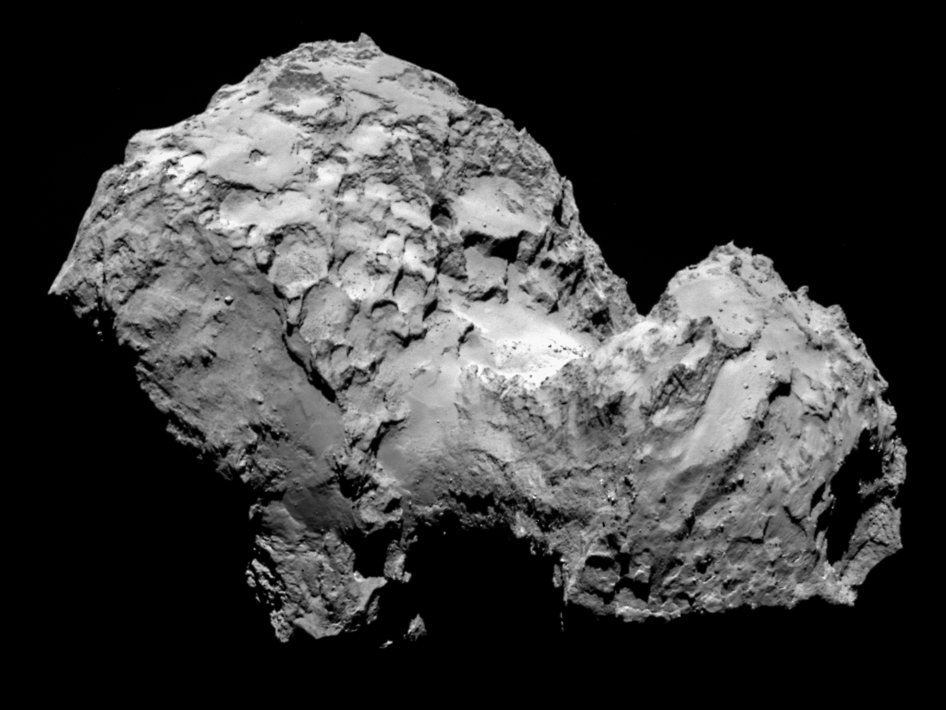
And yesterday, the Rosetta space probe made its approach and inserted itself into orbit around comet 67P/Churyumov-Gerasimenko. I had insomnia anyway, so I watched some of the live feeds.

comet_on_3_august_2014

The comet imaged from 177 miles away. ©Nasa

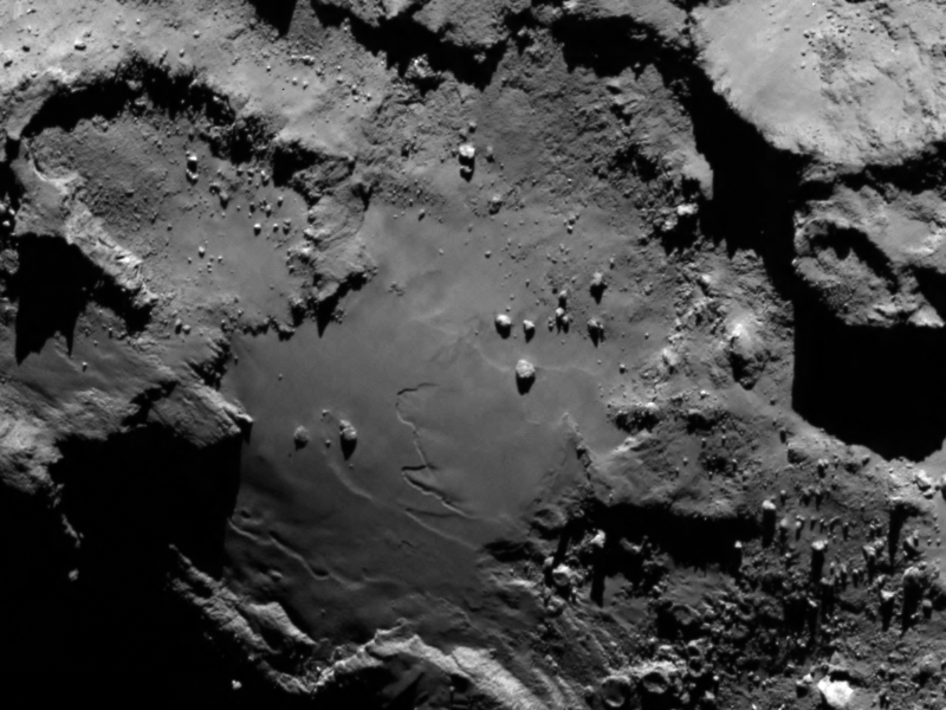
esa_rosetta_osirisnac_130806_a

A closeup of a smooth area on the main segment of the comet, taken from 80 miles away. Resolution: 8 feet per pixel. (The boulder in the middle is about 160 feet across). ©Nasa

What an astonishing accomplishment. The mathematics and engineering required to achieve this are exquisite and beyond my ken, but I admire and applaud all those who had a hand in bringing this miracle to pass (along with all the other milestones along the way.) I know someone personally who is intimately involved with the JPL, and she’s smart. So smart. My admiration for scientists knows no bounds.

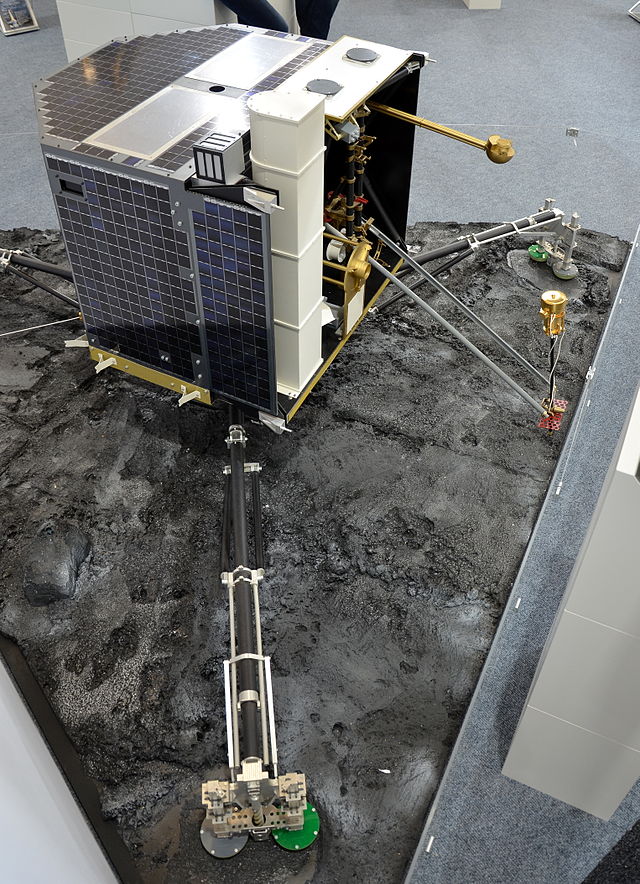
Next month, if all goes well, a lander will anchor itself to the surface of the comet, and do amazing science as it rounds the sun. If it doesn’t get blown off. I’m on tenterhooks.

Maquette_de_Philae_atterrisseur_de_la_sonde_spatiale_Rosetta_DSC_0156

Mockup of the Philæ lander.

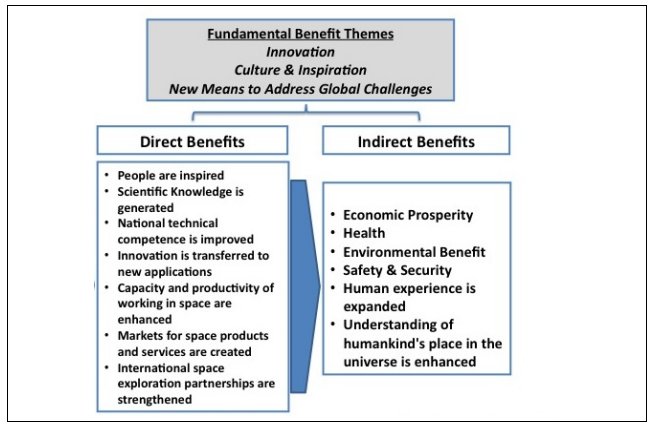
I go on record as saying that money expended on the science of space exploration is money well spent. The benefits are real and tangible as well as potential.

Benefits

©Nasa. Click through for a copy of the full report.

Just a few of the many, many things that have developed out of our space exploration effort over the years:

  • Cell Phone Camera
  • Clean Energy Technology
  • Scratch-Resistant Lenses
  • Water Filtration and Purification
  • CAT Scans

And of course, Velcro™.

I’m not sure if technology will ever get us as a species to a new home. Terraforming Mars is still a dream, and escaping the Solar System to find another habitable planet among the stars is still the stuff of science fiction. But I’m open to surprises, for the benefit of generations yet unseen. In the meantime, I will rejoice in each new step toward the unknown that science can grace us with.

The Old Wolf has spoken.


[1] Still a planet. Always a planet.

Nine Planets Thumb