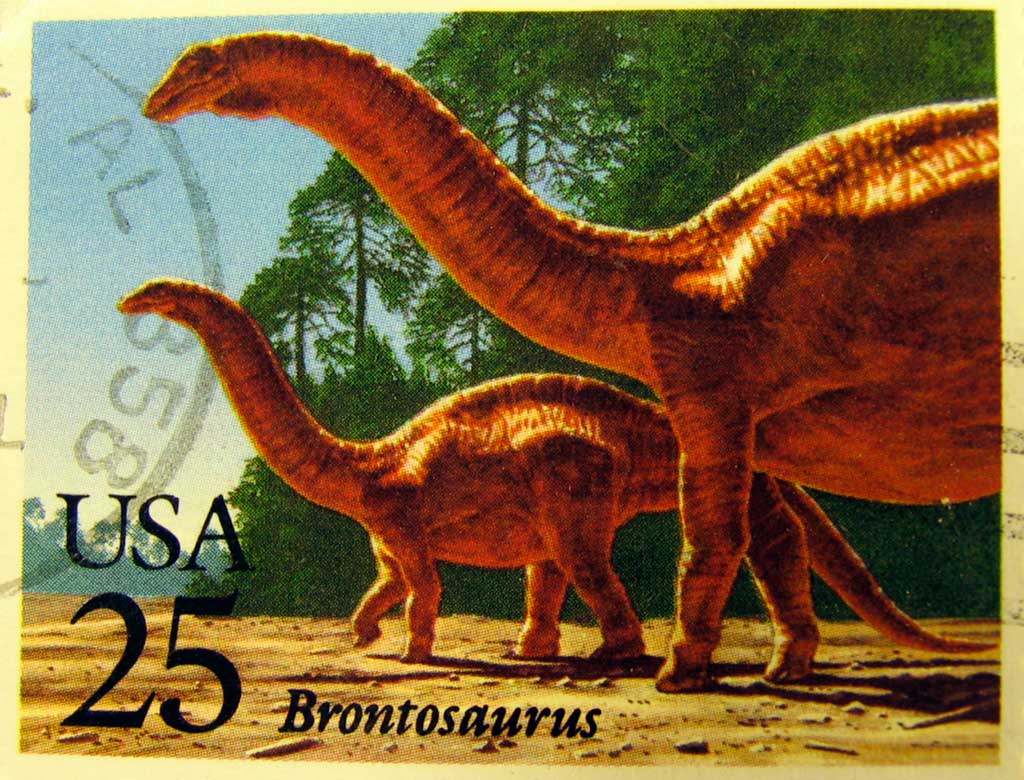
When I was a kid, the biggest dinosaur was the brontosaurus. Later scientists declared that there was no such beast, and renamed it apatosaurus, the post office notwithstanding.
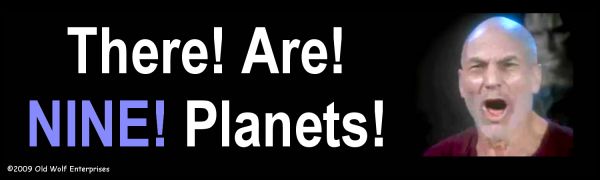
Well, you can argue until the cows come home, but the bottom line is that scientific knowledge is always advancing. Except that Pluto is still a planet, dammit.
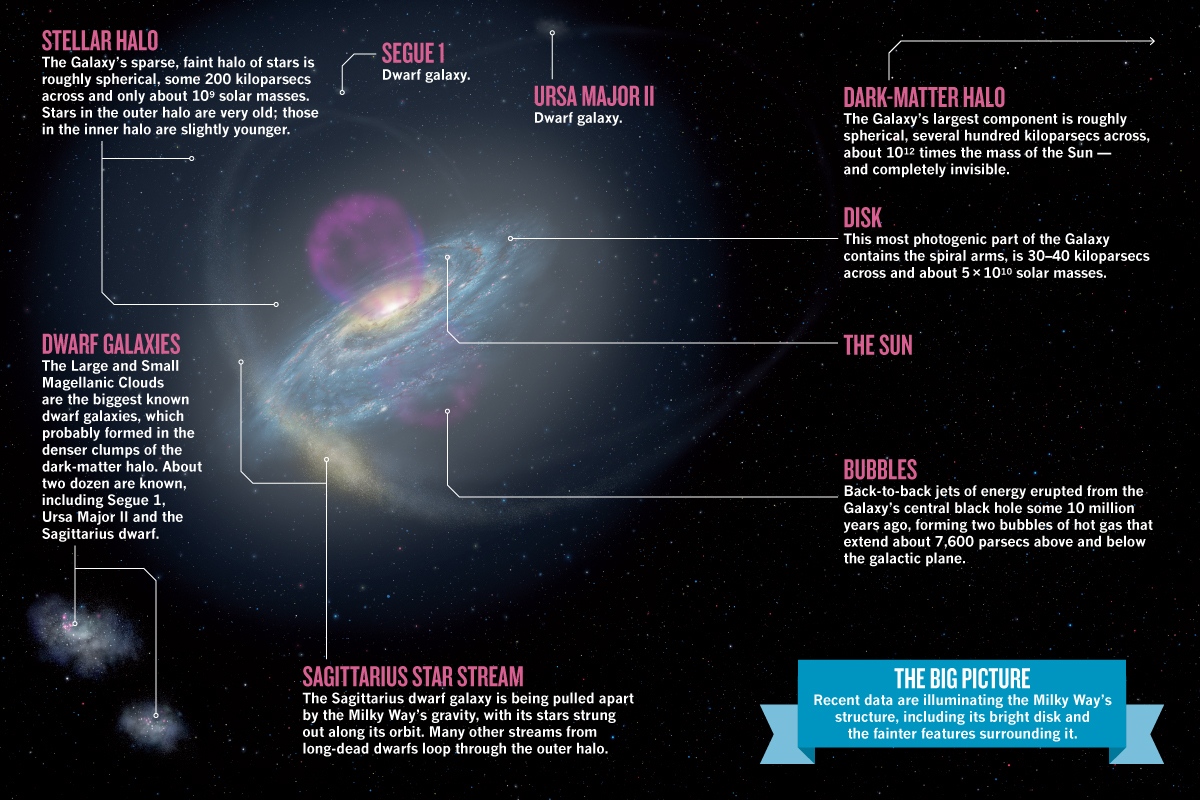
We’ve known for a long time that our galaxy was a spiral, similar to the great “nebula” in Andromeda, but over my lifetime, our knowledge of our home has increased exponentially, and it’s hard to keep abreast of all the changes.
First off, we now know our galaxy is a barred spiral, with an elongated central core. Moreover, instead of being a lone unit in space as was once thought, our galaxy is only part of a large dynamic neighborhood of at least 26 dwarf galaxies (some of which are being torn apart and consumed, like the Saggitarius star stream), 157 globular clusters, a massive halo of stars with almost the mass of the main disk itself which may extend as far as the Magellanic clouds, powerful x-ray and gamma-ray bubbles issuing from a central black hole, and a dark-matter halo with a radius of 100 kiloparsecs. And that’s just today; just imagine what we’ll know tomorrow.
I try to keep abreast of science news, but this one slipped totally under my radar.
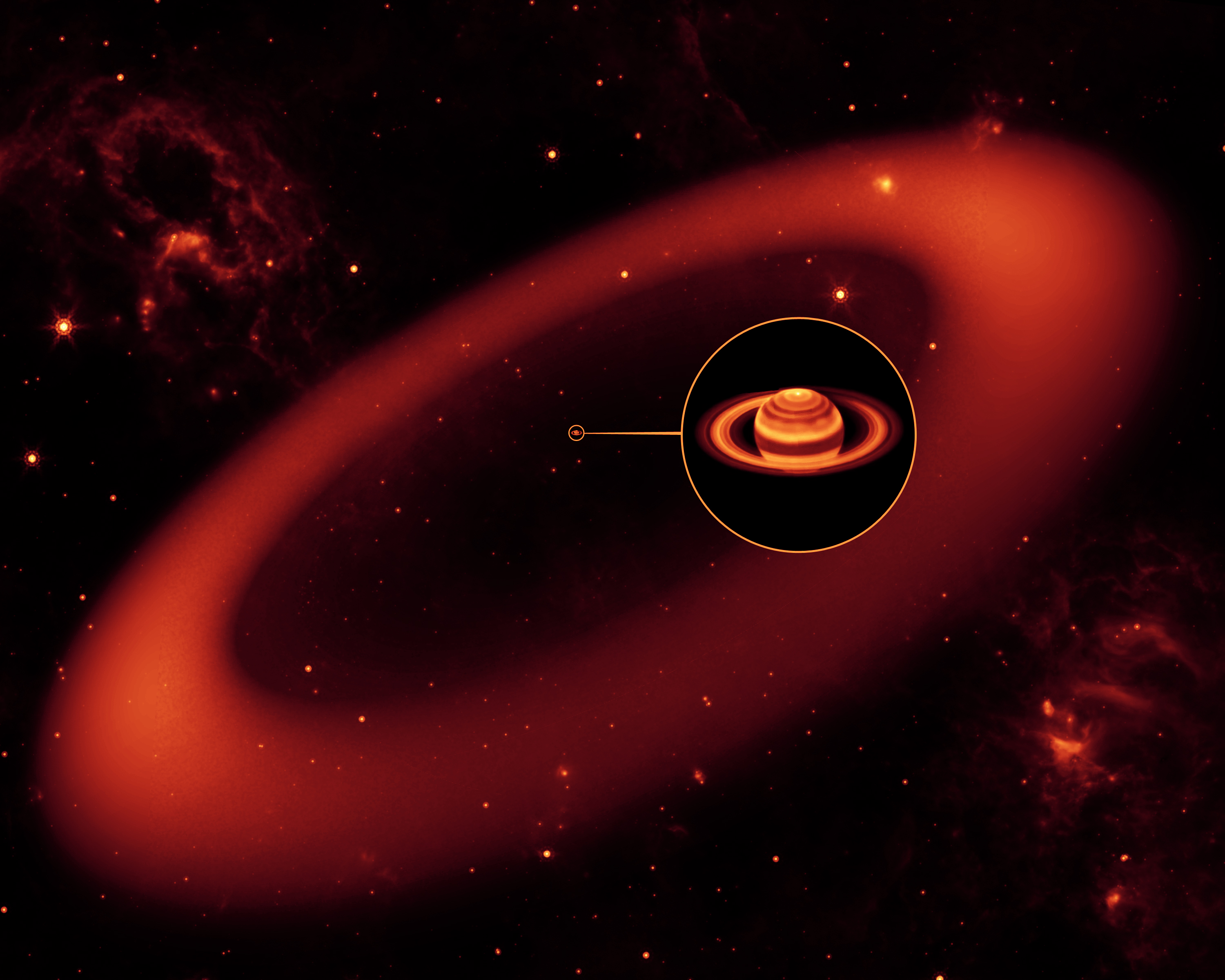
In October 7, 2009, NASA’s Spitzer Space Telescope discovered an enormous and previously unknown infrared ring around Saturn. Scientists think this ring may help solve the mystery of why Iapetus looks like the yin-yang symbol. Read more at NASA.
On July 20, 1963, a total solar eclipse cast its shadow over North America, and crossed over Bridgton, Maine, where I was attending Camp Wildwood. The dangers of looking directly at the sun were well-known, so they gathered us all into the lodge and had a television set up so we could watch the broadcast. I remember how uncanny it was (I was twelve at the time) to see the sky go so dark at mid-day, and through the windows of the lodge we were treated to that strange and unnatural crepuscular light which covers the area of the eclipse’s umbra. Ever since that day, I’ve been intrigued by the phenomenon, which is rare enough, but even rarer for any given geographical area.
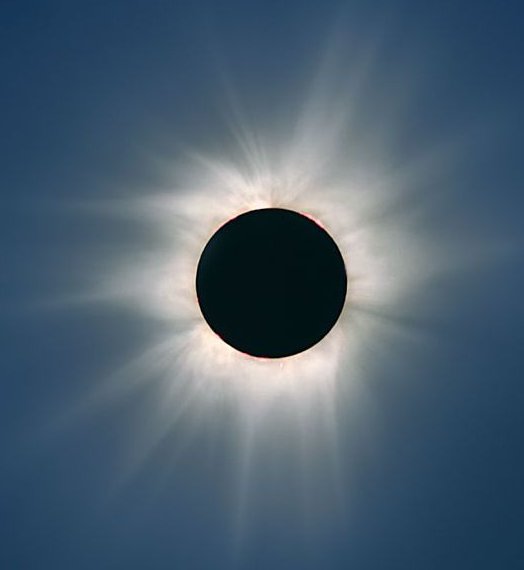
In 1999, I had a business trip scheduled to Eastern Europe, and by miraculous happenstance I found myself in Bucharest, Romania – the “sweet spot” of a beautiful eclipse.
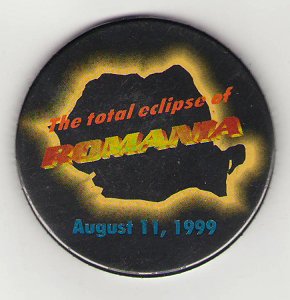
Eclipse Commemorative Button
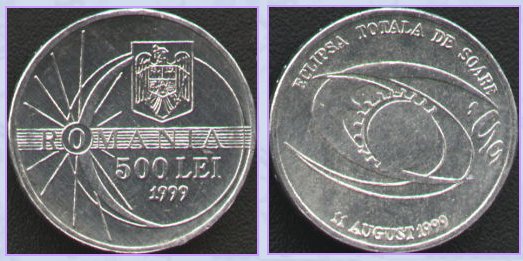
500 Lei commemorative coin, the first such issue since 1906.
It was breathtaking. The sky around the totality was a dark purple, and while not totally cloudless was obscured only by wisps of high clouds which only added to the impressive beauty of the event. Given the upcoming schedule of total eclipses, this is probably the last one I’ll get to see – and I’m so grateful to have been on hand. But my appetite was whetted, and when an annular eclipse passed over Utah in May of 2012, I knew I had to be there.
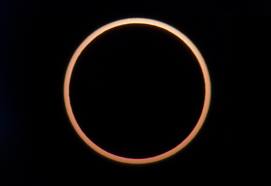
This was what they call a “ring of fire” eclipse – the sequence below was taken in my shadow box, so the quality is not spectacular, but they give a good idea of the progression of the event. Again – truly breathtaking. We don’t see this happen all too often, and it left me with a heightened sense of awe for the size and complexity of the universe we live in.
… but this is what it looked like through our eclipse glasses. Quite a sight.
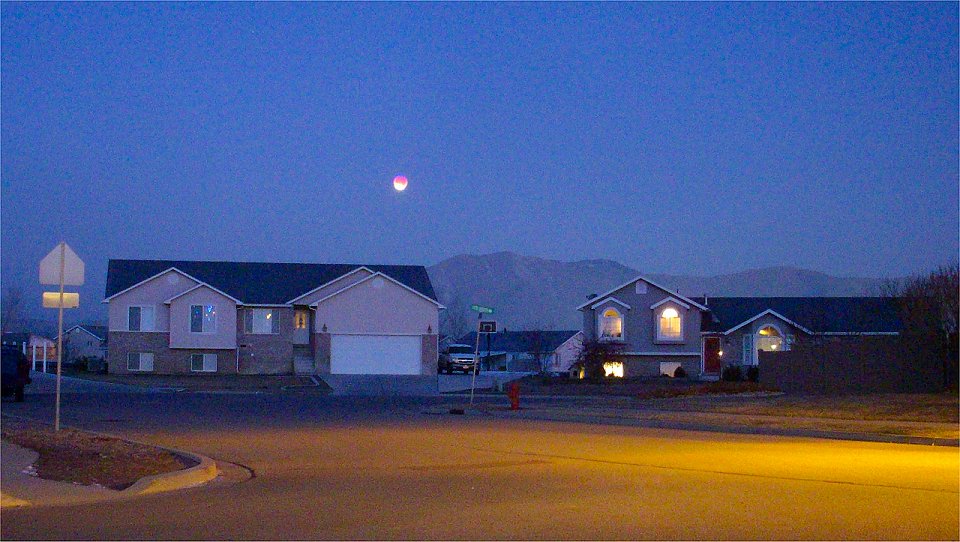
Lunar eclipses are more common, but I’ll always take the chance to watch one when it comes around. My little camera is not good at night shots, but I captured this picture of an eclipsing moon over the Oquirrh mountains on a bitter cold morning of December 10, 2011.
If I were richer than God I’d go chasing more of these celestial events, but since I’m not, the memories will have to suffice.
I previously posted about the worthless and deceptive nutritional products hyped to the elderly (and anyone who will cheerfully send in their money); today comes an article announcing
Inspector general: Some supplements for weight loss, immune system make illegal health claims.
Well, .
The article goes on to say that “20 percent of the 127 weight loss and immune-boosting supplements investigators purchased online and in retail stores across the country carried labels that made illegal claims to cure or treat disease.” The DHHS concern is not only with the deceptive marketing, but also that people taking supplements and other natural remedies to treat diseases instead of seeking medical assistance.
Personally, I think the 20 percent figure is a gross underestimate, based on everything I’ve seen in the industry, which remains largely unregulated.
Now getting into a discussion of this nature raises the question: Is the DHHS in the pockets of the pharmaceutical industry and the insurance companies, both of which have a vested interest in keeping people sick? Today’s answers are, “I don’t know,” and “It’s not that simple.” Let me state that I’m pretty convinced that Big Pharma is more interested in making money than in getting people well – otherwise they’d be driving themselves out of the market, which makes good moral sense but poor business sense, and in today’s world money always trumps morals. That said, there are countless drugs which people use on a daily basis which keep them healthy and hearty – if I cut my finger, you’d better believe that I’m going to wash it well with soap and water, and apply Neosporin™ or something like to ward off infection; I suffer from a mild form of Menière’s disease which causes violent vertigo (fortunately for me, only rarely) and if it weren’t for Meclizine™ I might spend a week with my head in the crapper. Not all drugs are bad – but the industry is motivated by the wrong reasons, and one of the greatest mistakes our government ever made was allowing pharmaceutical companies to advertise.
Homeopathy
Then there’s the “natural remedy” market. Let’s take homeopathy as the teacher in the moment. I personally put no stock in what from a scientific viewpoint seems like total mumbo-jumbo [1], but it’s multi-billion dollar mumbo-jumbo, and that kind of money will bring all sorts of gnurrs out of the voodvork. [2] Then there’s the fact that many people whom I love and respect do put stock in it, and claim to have experienced benefits from the use of homeopathic remedies, as well as herbs, oils, alternative health treatment, and so much more.
Science is both blessed and burdened by its reliance on empirical evidence. That means in the long run, if the evidence supports a theory, science is required to change its point of view no matter how vehemently one’s gut opposes the discovery. If, continuing in the same vein, a sufficient body of gold-standard trials (randomized, double-blind, placebo-based, with a statistically significant sample) were to show that homeopathic remedies were actually beneficial, the textbooks would have to be rewritten. Thus far that hasn’t happened, and in my book it’s not likely – but one thing I will never do is shut the door on possibility. I’m always open to surprises.
Focusing on prevention
Where I do put stock is in what science has said about degenerative diseases. In the 19th and early 20th centuries, infectious diseases such as diphtheria, pneumonia, tuberculosis, cholera, and influenza were the largest killers of populations. Modern vaccines, antibiotics and anti-virals have drastically reduced the toll; today, we see a different enemy – people by the millions are dying from diabetes, strokes, cardiovascular diseasese, cancer, respiratory diseases, and a host of other degenerative disorders.
The standard unit of nutritional need, the RDA (recommended daily allowance) was developed during World War II by the U.S. National Academy of Sciences to investigate issues of nutrition that might “affect national defense”. In short, these amounts were established as the minimum requirements needed to prevent deficiency diseases such as rickets and scurvy, among others. Even today, RDI (recommended daily intake) and DV (Daily Value) of vitamins, minerals and co-factors are far below what modern science has determined are required for maximum health. Most vitamins supplements on the market today will do just what they were designed to do during WWII – keep you from getting deficiency diseases – but they won’t provide the optimal nutrition the body needs to fight off the ravages of oxidative stress.
In 2002, the Journal of the AMA stated that “most people do not consume an optimal amount of all vitamins by diet alone. Pending strong evidence of effectiveness from randomized trials, it appears prudent for all adults to take vitamin supplements.” [3] Both before and since that time, thousands and thousands of randomized clinical trials have shown that free radical damage (or oxidative stress) is the cause of the vast majority of degenerative diseases, and that providing the body’s cells with the defenses needed can drastically reduce the incidence of these maladies, cutting off the need for curative drugs and treatments at the source.
Conclusion
It should be said in passing that despite all we can do, sometimes people just get sick; like they say in the Japanese massage parlor, “shiatsu happens;” but it’s up to each person who is concerned about their health to do their research and find the solution that works best for them. There are a handful of companies out there who produce nutritional supplements that will give your body the nutrition it needs (combined with and on the foundation of a healthy diet and exercise, of course) to fight off degenerative diseases and maximize your odds for a long and healthy life, and none of them are found on supermarket shelves. Find one of them that works for you and treat yourself well; your body will thank you for it.
Despite the fact that in the last 21 years, computing power has increased by orders of magnitude from what it was in 1990, this article still makes some intriguing and valid points, and is reproduced here for your edification.
STOP BIT • Ben Smith
THE FLIGHT OF THE BEE WOLF
Reprinted from BYTE, June 1990, Page 384
Compared to this humble insect, a cruise missile is downright stupid
Today, multiprocessor microcomputers handle hundreds of tasks at virtually the same time. Desktop workstations perform operations that are more complex than those performed by room-size mainframe computers five years ago-and they do it faster. We are using AI systems in real applications without expenditures of millions of dollars. It seems that we are entering the age of truly intelligent systems.
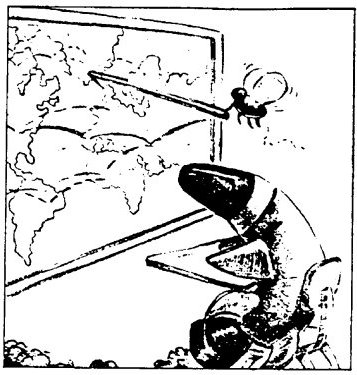
But consider the bee wolf. This seemingly insignificant creature is a beehunting fly that tunnels its single-occupancy home in beach sand. Even though hundreds of bee wolves have their tunnels in the same area of a beach, each bee wolf will return to its own home and no other.
A biologist covered the opening of one bee wolf’s tunnel with sand to see what the insect would do when it returned and found no tunnel. Without hesitation, the bee wolf went to the location of its entry and began digging.
The biologist noted that each time the bee wolf left for a hunt, it would fly a pattern above its home before departing. The creature appeared to be memorizing landmarks. The biologist tested his theory (not to mention the bee wolf’s patience with biologists) by sketching the layout of pinecones around the entrance while the unsuspecting subject was at home. Soon the bee wolf emerged from the tunnel and flew its pattern before heading out in search of prey. Once the bee wolf had departed, the researcher moved the array of pinecones over about a half-meter.
When the bee wolf returned, it attempted to find its private cave at the center of the relocated pinecones. It dug in the sand for a second or two but found no tunnel.
Unlike members of our species, the bee wolf did not call its lawyer, psychiatrist, or parish priest. Instead, it realized that something was amiss and flew a higher pattern over the territory. From this new perspective, it was able to discard the erroneous references to pine cones and promptly located the true entrance.
The first computer analogy to this recognition and guidance problem is in a military application. The self-navigating cruise missile uses a system called terrain-contour matching (TERCOM). Inside the cruise missile’s guidance computer is a set of computer-encoded maps of checkpoints along the programmed flight plan. At these checkpoints, the TERCOM computer compares readings of a radar altimeter with a contour map stored in its memory. If the computer finds no match between the expected data and the real data, it searches for a match with the map of the surrounding area. Once the match is found, the computer adjusts the course of the missile to account forthe error.
To fool the cruise missile, you just move the target, leaving behind a dummy target. Because the cruise missile destroys itself in the process of destroying its target, it never can discover that it has made a mistake.
Even though the flight-control computer in the missile weighs less than 100 pounds, it has the equivalent of millions of transistors. Producing each of these computers costs a good part of a million dollars. In contrast, the bee wolf s brain, which is no bigger than the head of a pin, must carry on far more complex operations than just finding its host’s way home. It must provide control to an aerodynamically instable machine, its body. The bee wolf also can walk, dig, locate and outmaneuver its prey, and find a mate (a task that would be disastrous for a cruise missile). Compared to the bee wolf, the cruise missile is downright stupid.
Many people falsely place computers in a scale of intelligence well beyond that of the human mind. But even a person with severe learning disabilities performs far more complex mental operations in a far shorter time than the largest and fastest computer. What size computer and program could control a walking robot that could rise from a chair, put on a coat, go outside, walk around the building on rolling terrain, establish the location of the entrance from visual information, and reenter the building-all this, while maintaining respiration, blood flow, and the input from millions of sensors for pressure, temperature, light, sound, and chemical analyses and production? Now consider the scope of the human brain. How much data is represented by all the memories in just one human being? What complex relationship exists between memories to create knowledge?
From this perspective of information processing, you must admit that computers are merely sophisticated adding machines. Even when this year’s highperformance machines outperform last year’s model by an order of magnitude, they are still not noticeably closer to the performance of the humble bee wolfs brain, let alone the performance of the human mind.•
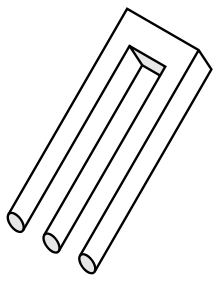
I have always loved optical illusions. One of my first introductions to a famous one was the 1965 “three-pronged poiuyt” from MAD magazine (otherwise called a “blivet”):
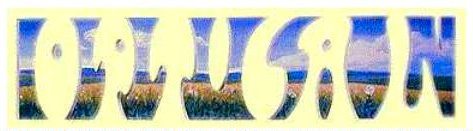
But there are many others. The one below is one of my all-time favorites – it contains both the words “optical” and “illusion”, depending on where you look.
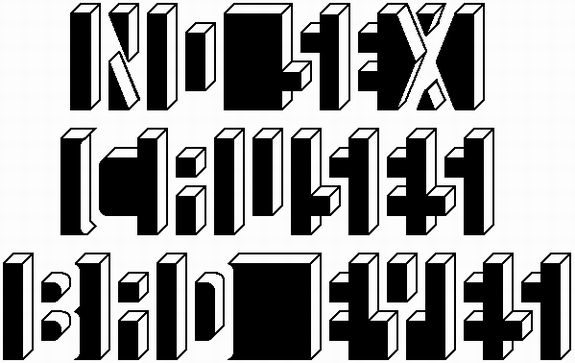
The spatial-perception phenomenon is exquisitely illustrated among the geometric shapes below – what you see depends on whether you are looking at the blocks, or at the spaces between them.
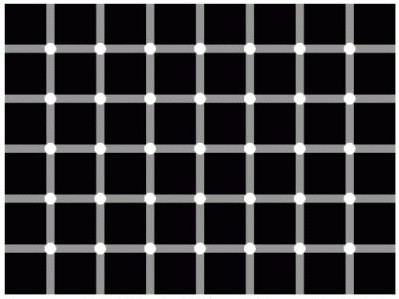
The next one makes my head hurt. Try counting the black dots:
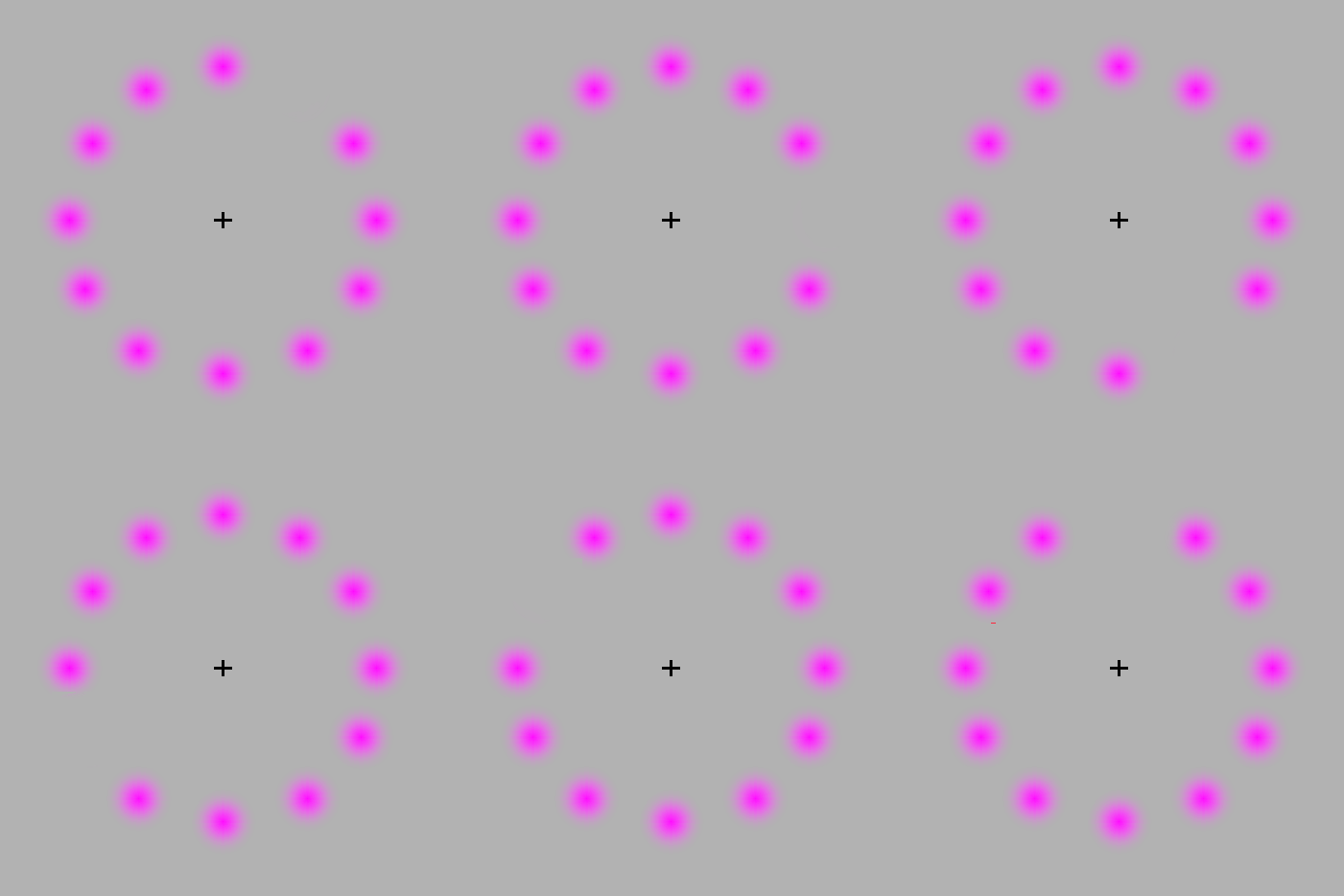
This one is uncanny. Stare at the “+” for a while, and watch the dots gradually vanish.
Similarly, if you stare at any point in the image below, the entire thing will gently fade away.
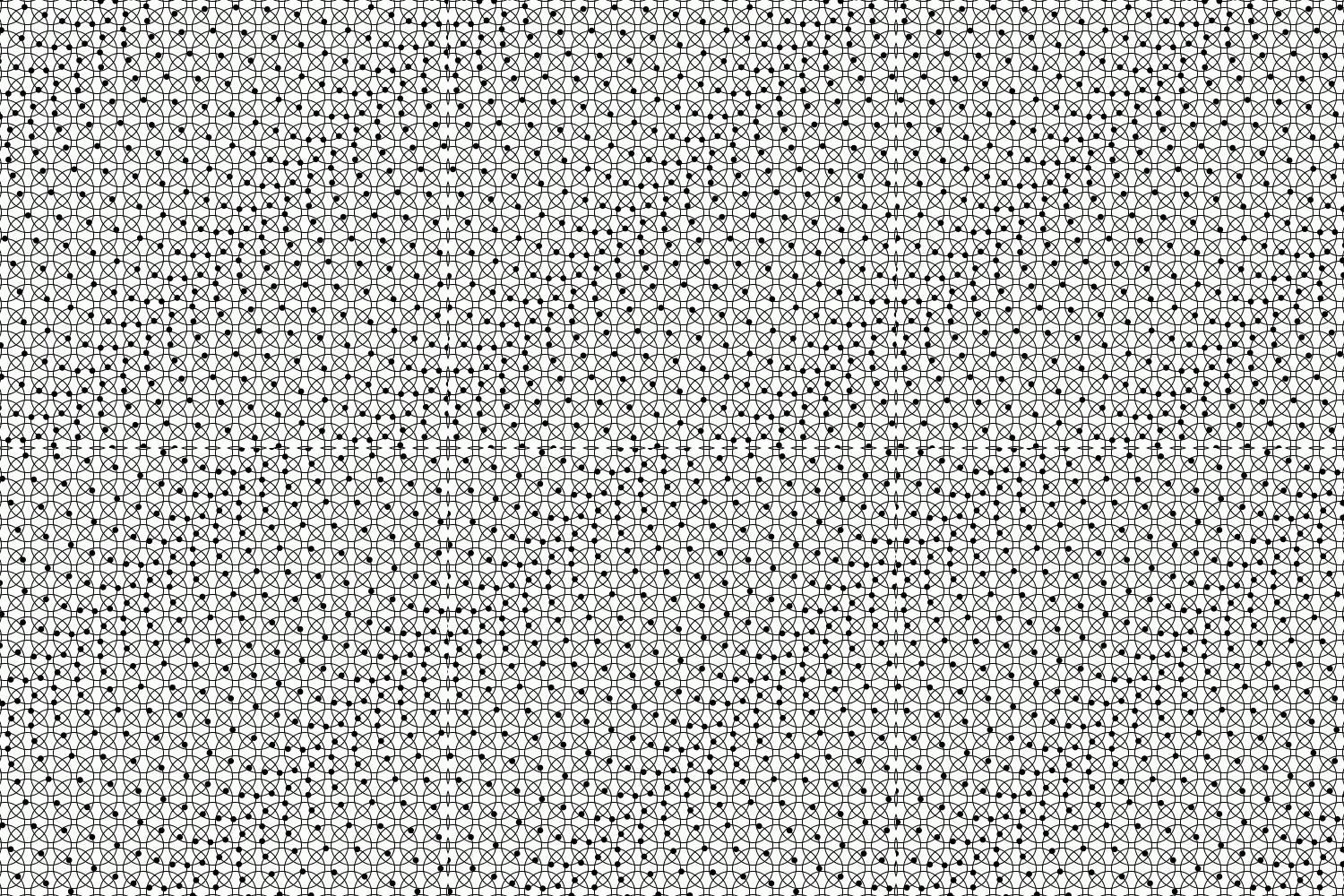
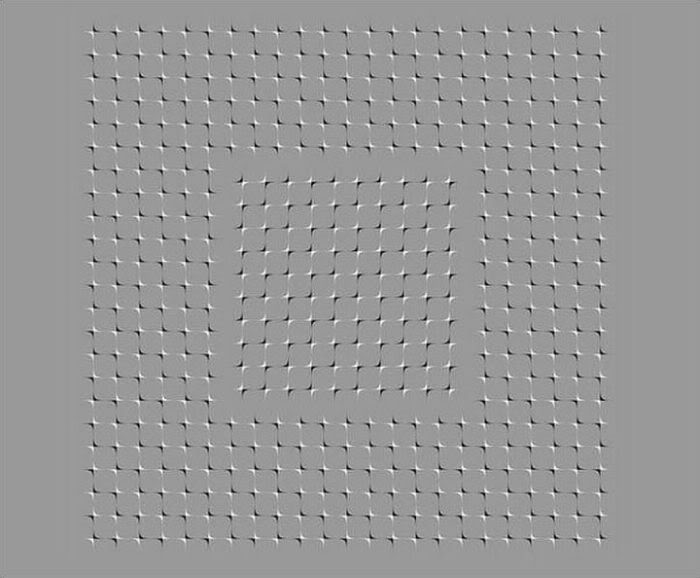
The wheels below are not moving. Really.
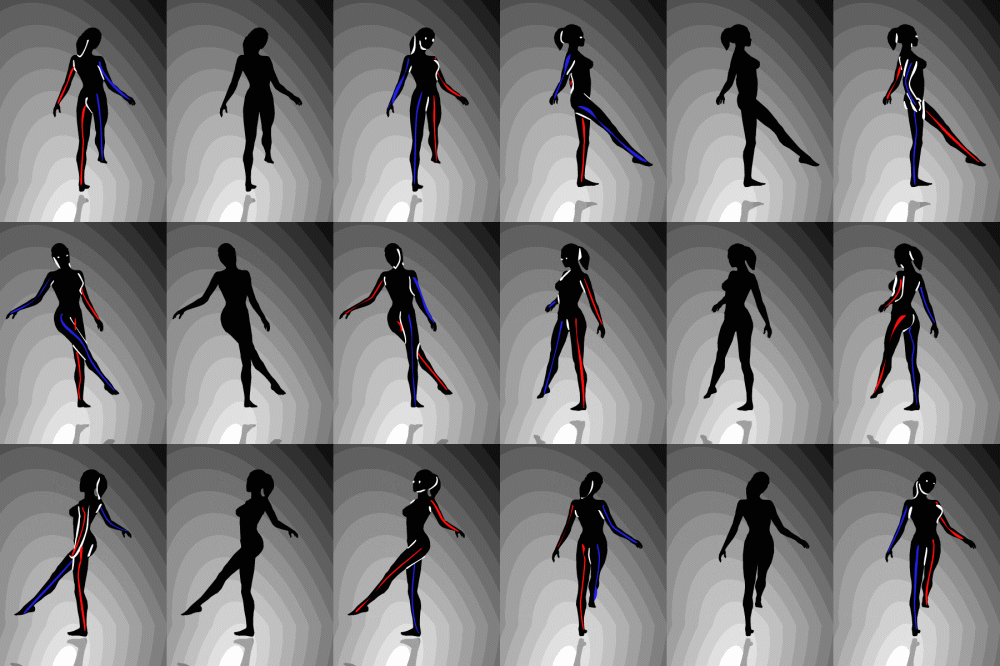
The following one is a mindbender. Stare at the spinning dancer for a while – she’ll switch from clockwise to counterclockwise at random. Some people can shift their perception of her at will, but I’ve never found the knack.
If you’re having trouble, the gif file below has been tweaked to let you switch back and forth with less difficulty. Look at the image on the left, and the silhouette will rotate clockwise. Look at the one on the right, and she’ll change directions for you.
Edit: Here’s one that’s similar, but a bit easier to manipulate. Kind of uncanny.
And on that note, here’s the “flashed face distortion,” which is pretty darn creepy – but it’s a real thing.
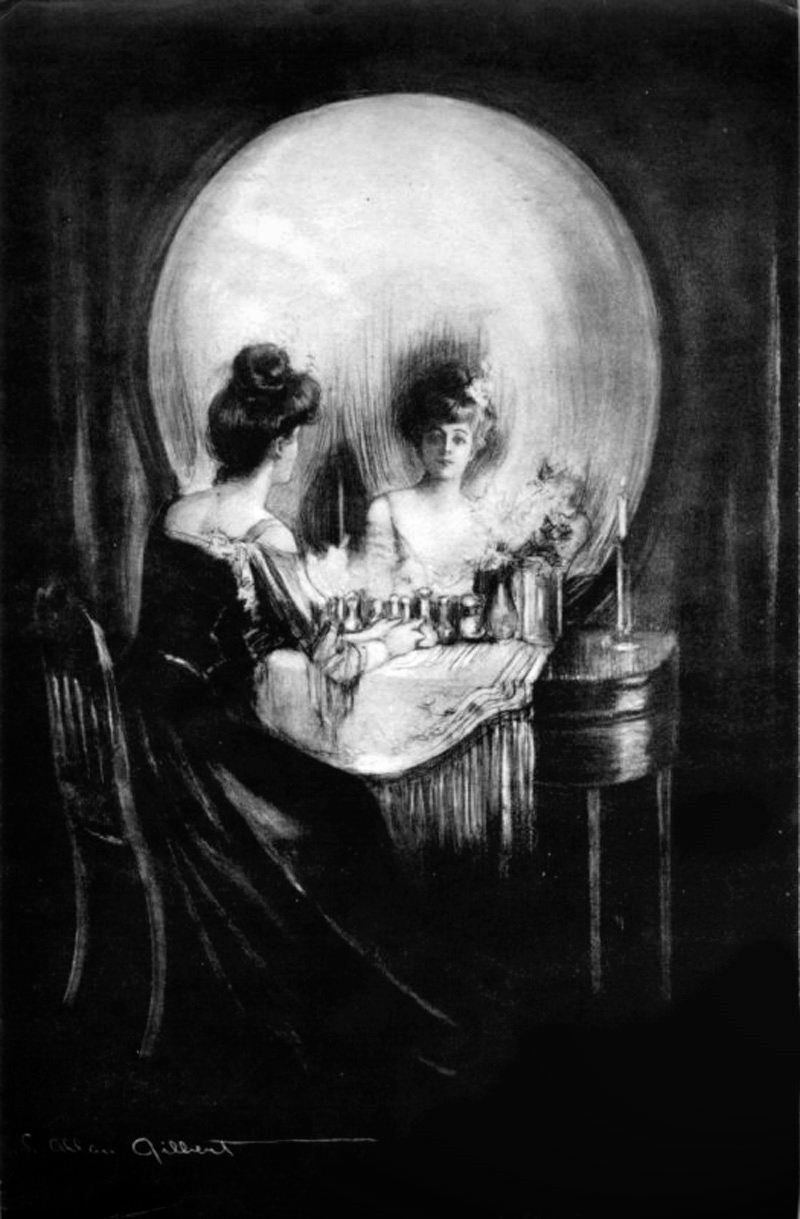
The famous drawing “All is Vanity” by Charles Allen Gilbert below has long been one of my favorites:
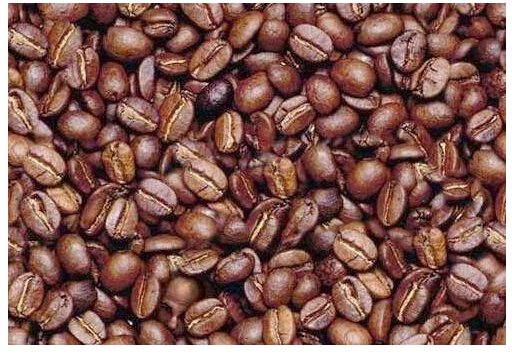
This modern one is less of an illusion than a perceptual challenge – how long did it take you to find the face among the coffee beans?
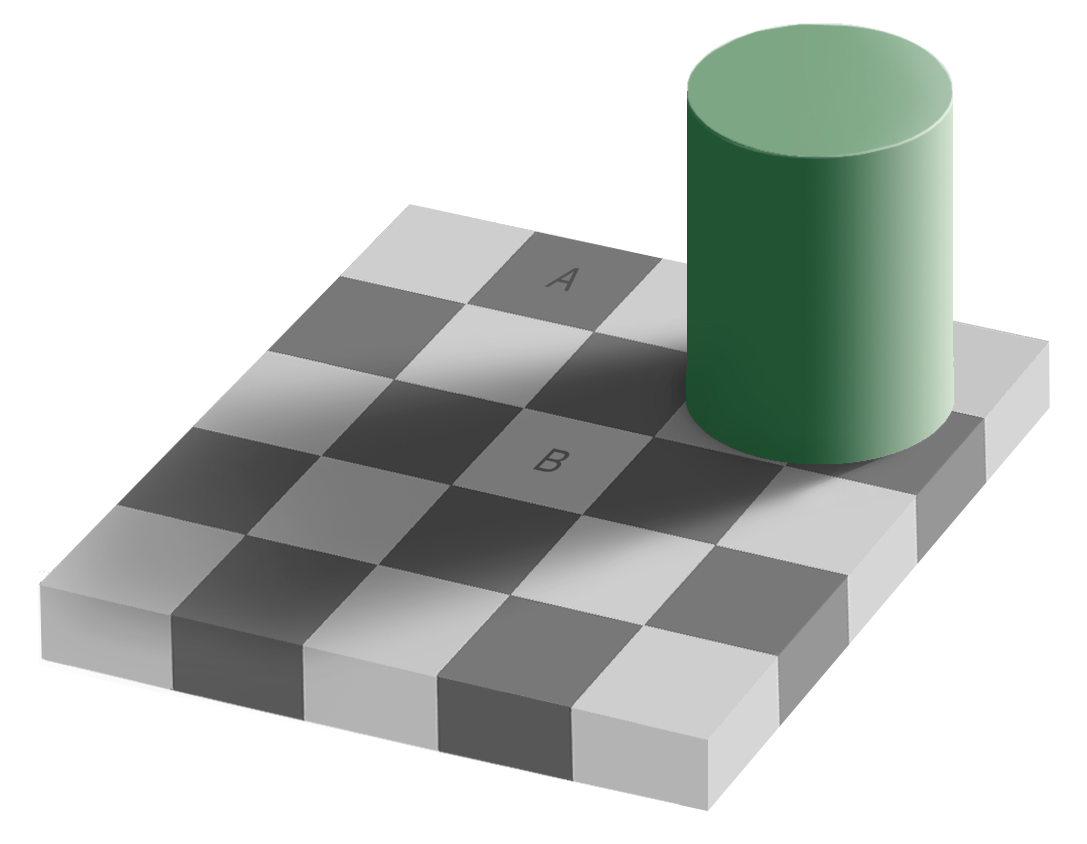
With technology come new challenges. Squares A and B are exactly the same color, RGB 120, 120, 120 or HTML #40B09C. Cross my heart.
This animated GIF file is less of an illusion than an interesting phenomenon, but I thought I’d add it here. Watching the waves move is captivating.
The image below is not a .gif file. Watching it makes me woozy.
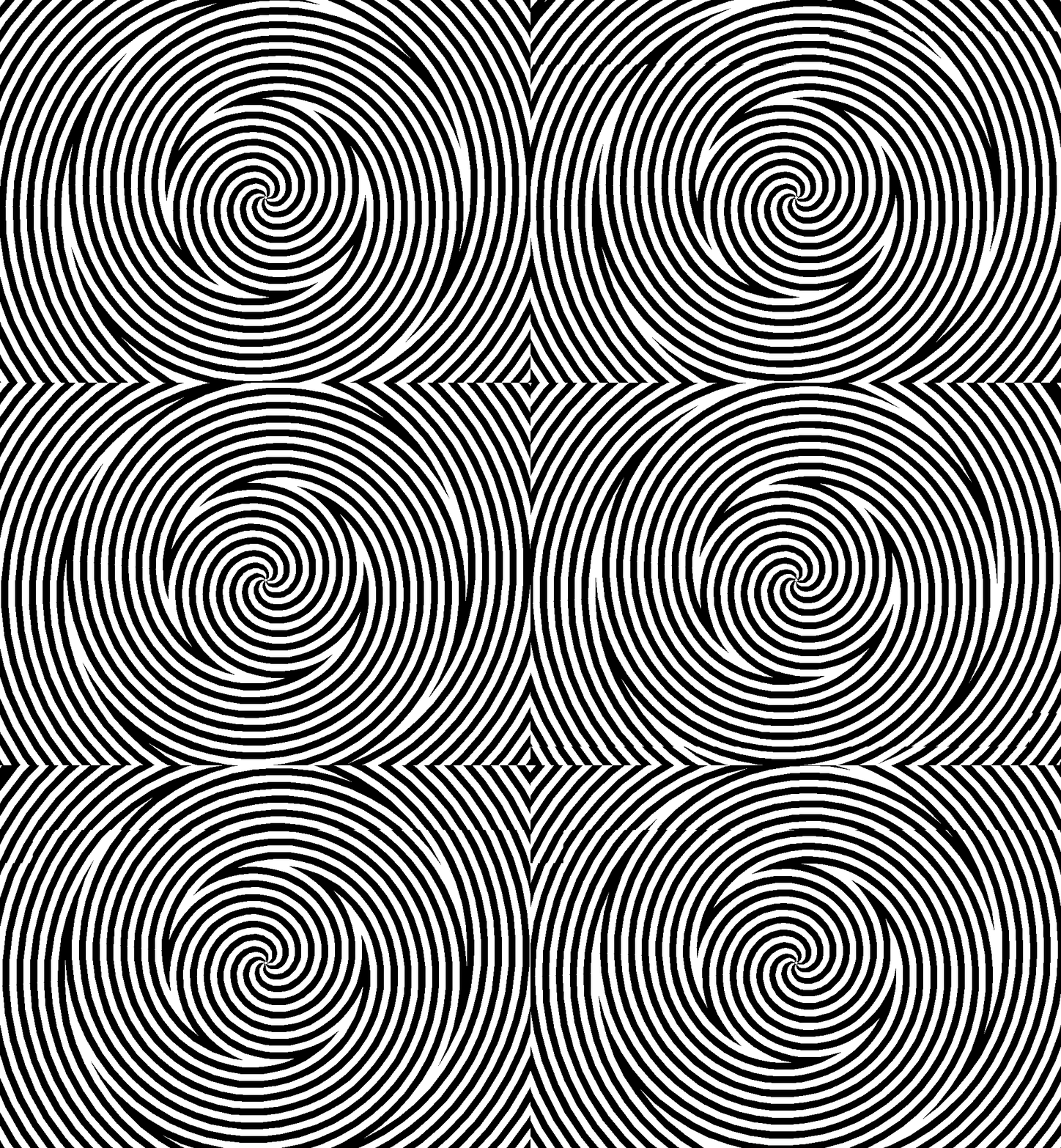
Last one. Click on the spinner below to get a full-size image. Watch the center for about 15 seconds, and then look at the palm of your hand. Try not to faint.
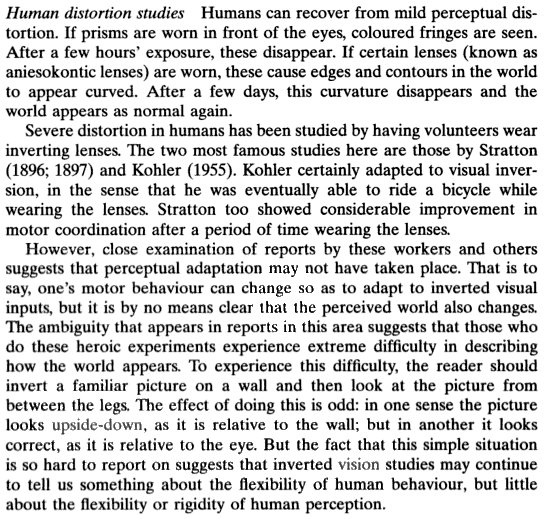
There is no end of illusions on the Internet, but these are some of the ones that I find the most intriguing. Our minds do very strange things – in the book Perceptual Development: Visual, Auditory and Speech Perception in Infancy
By Alan M. Slater, the famous prism-glasses experiment is mentioned – contrary to conventional wisdom, the subjects may not have “inverted” their world, but a form of adaptation was certainly noted.
Dan Piraro is a funny man, and an intelligent one. He falls squarely on the liberal side of the political spectrum, and while I don’t always agree with his philosophies, I love his daily Bizarro strips. Recently he published this one…
… which points out the dangers inherent in Genetically Modified Organisms, commonly labelled “Frankenfoods.”
I’ve always been nervous about eating things whose genes have been tweaked – for example, corn that produces its own pesticide – because the deleterious effects of such things might not show up for generations. But Mr. Piraro then took a public journey of self-education which I found most enlightening. After he published this cartoon, he received a veritable Niagara Falls (slowly I turn!) of information from his readership, and apparently it was sufficient to get him to do a thorough examination of the issue within the boundaries of the time he could carve out of his life.
His summary of the experience is recorded over at his blog – and it’s well worth the read. The executive summary:
Peer-reviewed science is generally reliable, although there are always some nuts among the berries.
Humans have been genetically modifying foods for a long time (through natural breeding and selection processes) without giving us all third eyes.
Everyone hates Monsanto – but not always for the right reasons.
Do your own research, because the issue is not at all clear-cut.
As a matter of fact, I’d recommend you work backward to the original post of the cartoon, and then read his following posts: Schooled!, More GMO, and his conclusions. And then go read some more.
I appreciate the effort that Mr. Piraro has gone to in presenting his findings to his readership – the links contained in his blog posts are a good place to start a serious study of the issue.
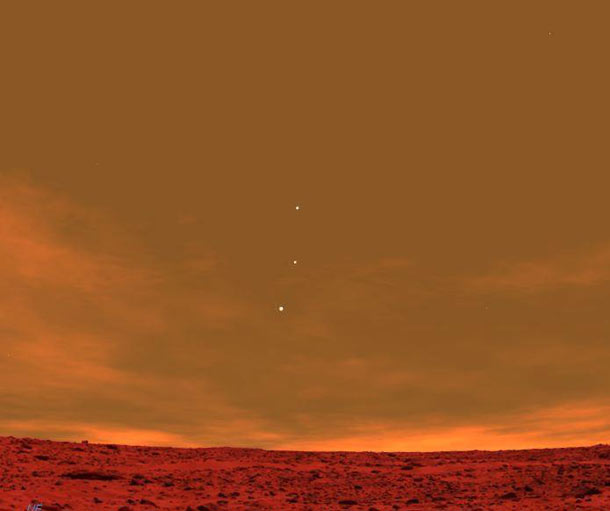
A post on George Takei’s Facebook feed displayed this photo of Earth and two other planets seen from the surface of Mars, purportedly taken from one of the rovers up there.
The one on Takei’s feed had an arrow pointing to the lower dot which said, “You are here.”
It’s a pretty picture, but my BS bells went off because there’s just something “off” about the photo, specifically those clouds and the fact that the three dots are the only things visible in the sky.
By the time I saw this, the post had gathered over 2,000 comments, and a brief perusal led me to this post over at Discover, which explains that the image is a computer-generated “planetarium” scene, as witnessed by the little “NE” in the lower left hand corner of the screen.
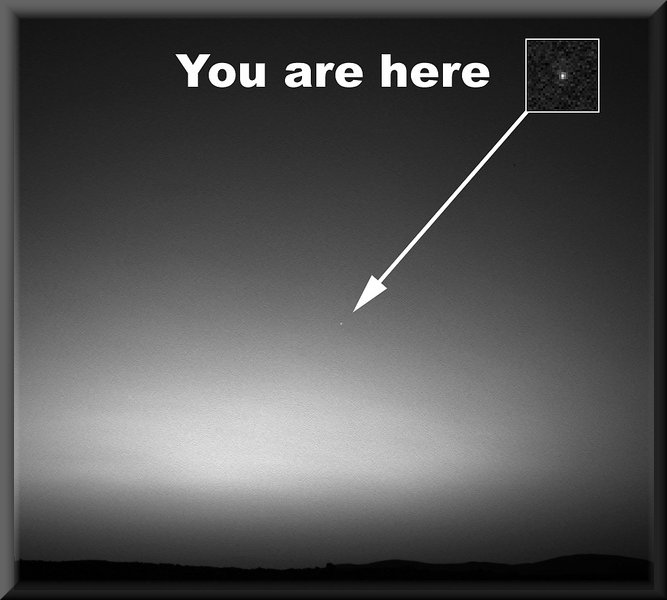
Sweetly enough, the article also posted this picture…
… which is a real picture, “the first image ever taken of Earth from the surface of a planet beyond the Moon. It was taken by the Mars Exploration Rover Spirit one hour before sunrise on the 63rd Martian day, or sol, of its mission. (March 8, 2004).” Found at NASA’s Flickr Feed, where you can read more information about the shot.
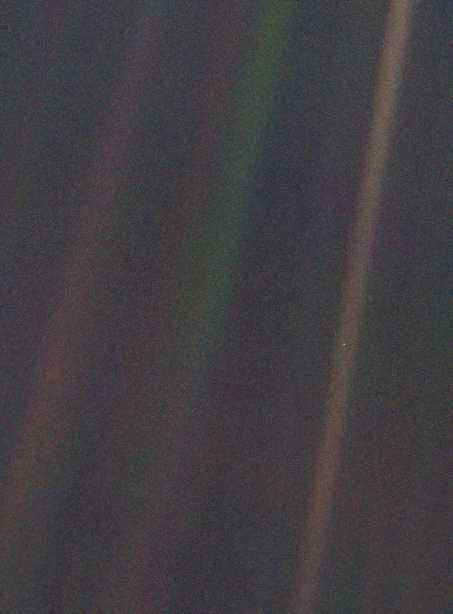
The tiny speck put me immediately in mind of the now-iconic photo of Earth taken by Voyager 1 as it was leaving the earth.
Astronomer Carl Sagan had requested NASA to point Voyager’s cameras back toward home, and this was the resulting image.
In his book Pale Blue Dot: A Vision of the Human Future in Space, astronomer Carl Sagan related his thoughts on a deeper meaning of the photograph:
From this distant vantage point, the Earth might not seem of any particular interest. But for us, it’s different. Consider again that dot. That’s here. That’s home. That’s us. On it everyone you love, everyone you know, everyone you ever heard of, every human being who ever was, lived out their lives. The aggregate of our joy and suffering, thousands of confident religions, ideologies, and economic doctrines, every hunter and forager, every hero and coward, every creator and destroyer of civilization, every king and peasant, every young couple in love, every mother and father, hopeful child, inventor and explorer, every teacher of morals, every corrupt politician, every “superstar,” every “supreme leader,” every saint and sinner in the history of our species lived there – on a mote of dust suspended in a sunbeam.
The Earth is a very small stage in a vast cosmic arena. Think of the rivers of blood spilled by all those generals and emperors so that in glory and triumph they could become the momentary masters of a fraction of a dot. Think of the endless cruelties visited by the inhabitants of one corner of this pixel on the scarcely distinguishable inhabitants of some other corner. How frequent their misunderstandings, how eager they are to kill one another, how fervent their hatreds. Our posturings, our imagined self-importance, the delusion that we have some privileged position in the universe, are challenged by this point of pale light. Our planet is a lonely speck in the great enveloping cosmic dark. In our obscurity – in all this vastness – there is no hint that help will come from elsewhere to save us from ourselves. The Earth is the only world known, so far, to harbor life. There is nowhere else, at least in the near future, to which our species could migrate. Visit, yes. Settle, not yet. Like it or not, for the moment, the Earth is where we make our stand. It has been said that astronomy is a humbling and character-building experience. There is perhaps no better demonstration of the folly of human conceits than this distant image of our tiny world. To me, it underscores our responsibility to deal more kindly with one another and to preserve and cherish the pale blue dot, the only home we’ve ever known.
—Carl Sagan, Pale Blue Dot: A Vision of the Human Future in Space, 1997 reprint, pp. xv–xvi
This quote, and much additional information about the photo and how it was taken, was found at Wikipedia. I had seen the picture and read the quote before, but it never ceases to move me.
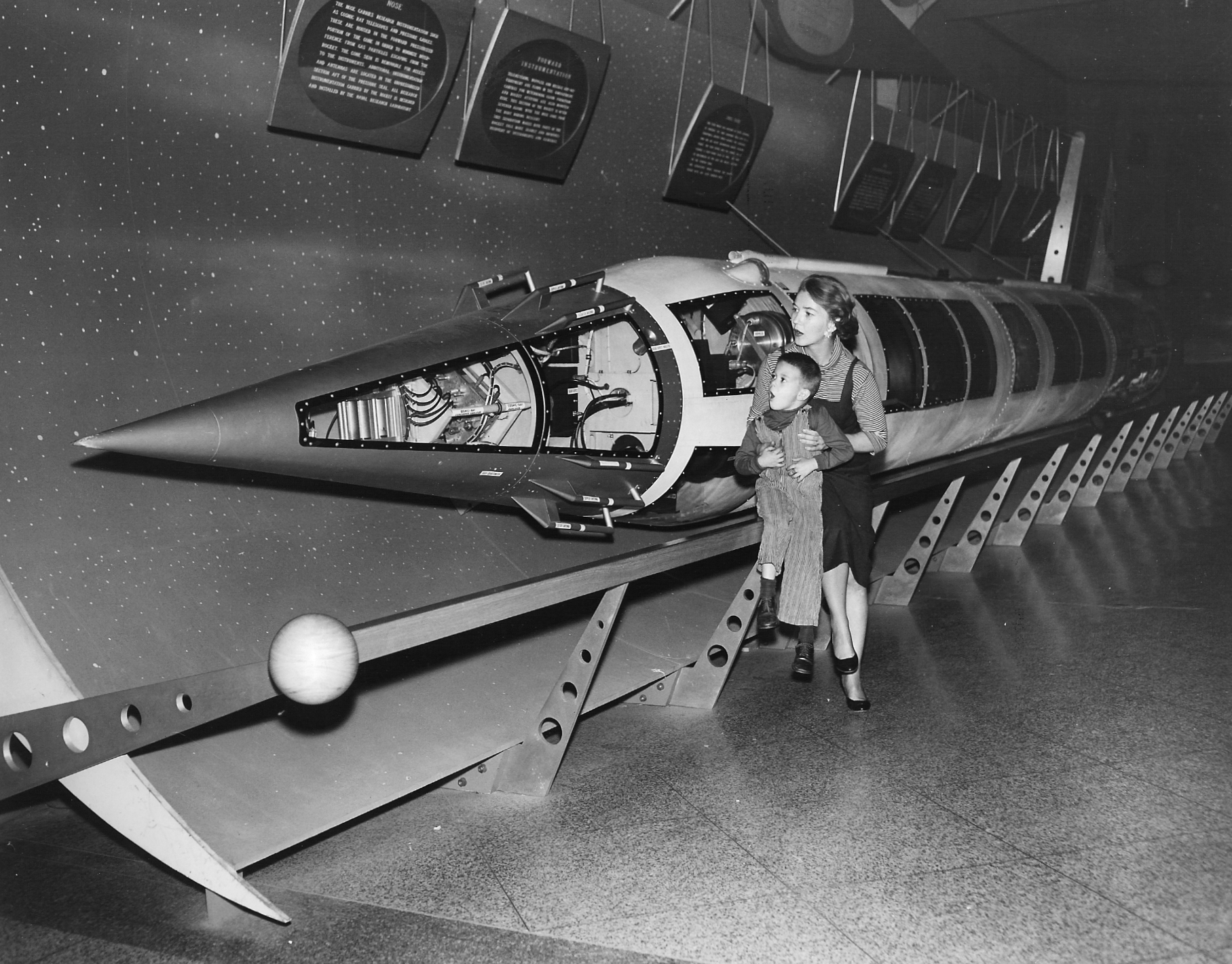
Confession: I can’t do higher math.[1] I always wanted to be a doctor, but calculus put a rapid end to that dream, because you need calculus for the pre-med Chemistry degree and screw whole bunches of that, with apologies and honor and homage to my freshman chem teacher, Dr. Alex T. Rowland of Gettysburg College, a good man and a fine professor. But I’ve always loved science, and have stood in awe of the glory and majesty and miracle of the universe from its largest expanses to its smallest bits and pieces. I think I owe that love of science to the hours and hours my mother spent allowing me to roam the halls of the Hayden[2] Planetarium and the Museum of Natural History.
Publicity shots for “Pepper Young’s Wife”, TV-Radio Mirror, March 1957
I loved that rocket – it was in a darkened room, and each section was illuminated by a different color. The fuel chamber had a deep, red glow and I could stare at it for hours. This was one of my favorite books. Alas, my inability to comprehend the fine points of differentiation meant that I had to spend my life as a linguist and not as a scientist, but the love of understanding our world, from the quantum to the cosmic scale, never left me. All I can do is peep through the keyhole to where the big boys and girls are playing, and hope to understand as much as I can from there.
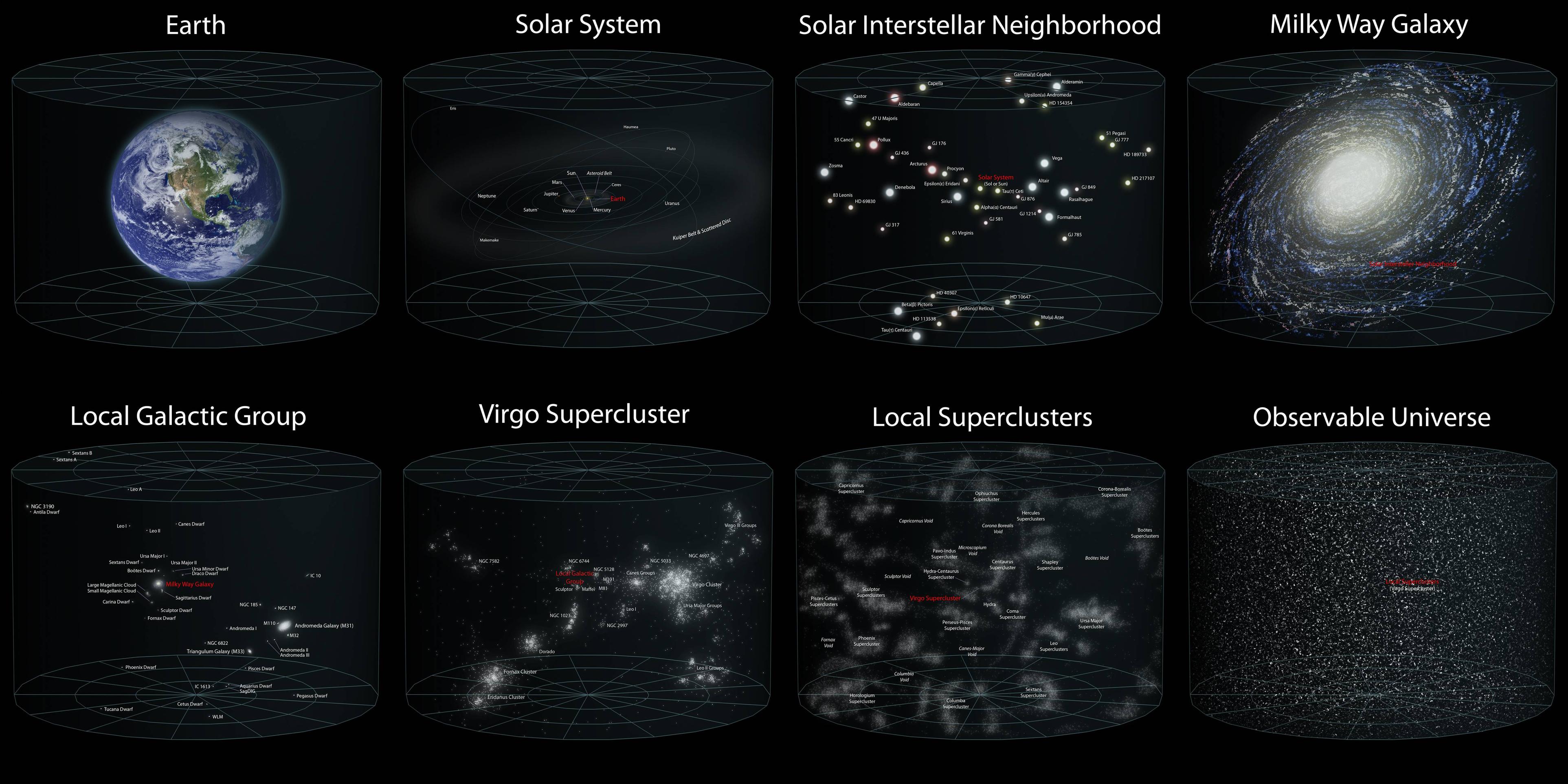
Years ago I happened across a copy of Powers of Ten, a companion volume to two films of the same name which were based on the book Cosmic View (1957) by Dutch educator Kees Boeke.
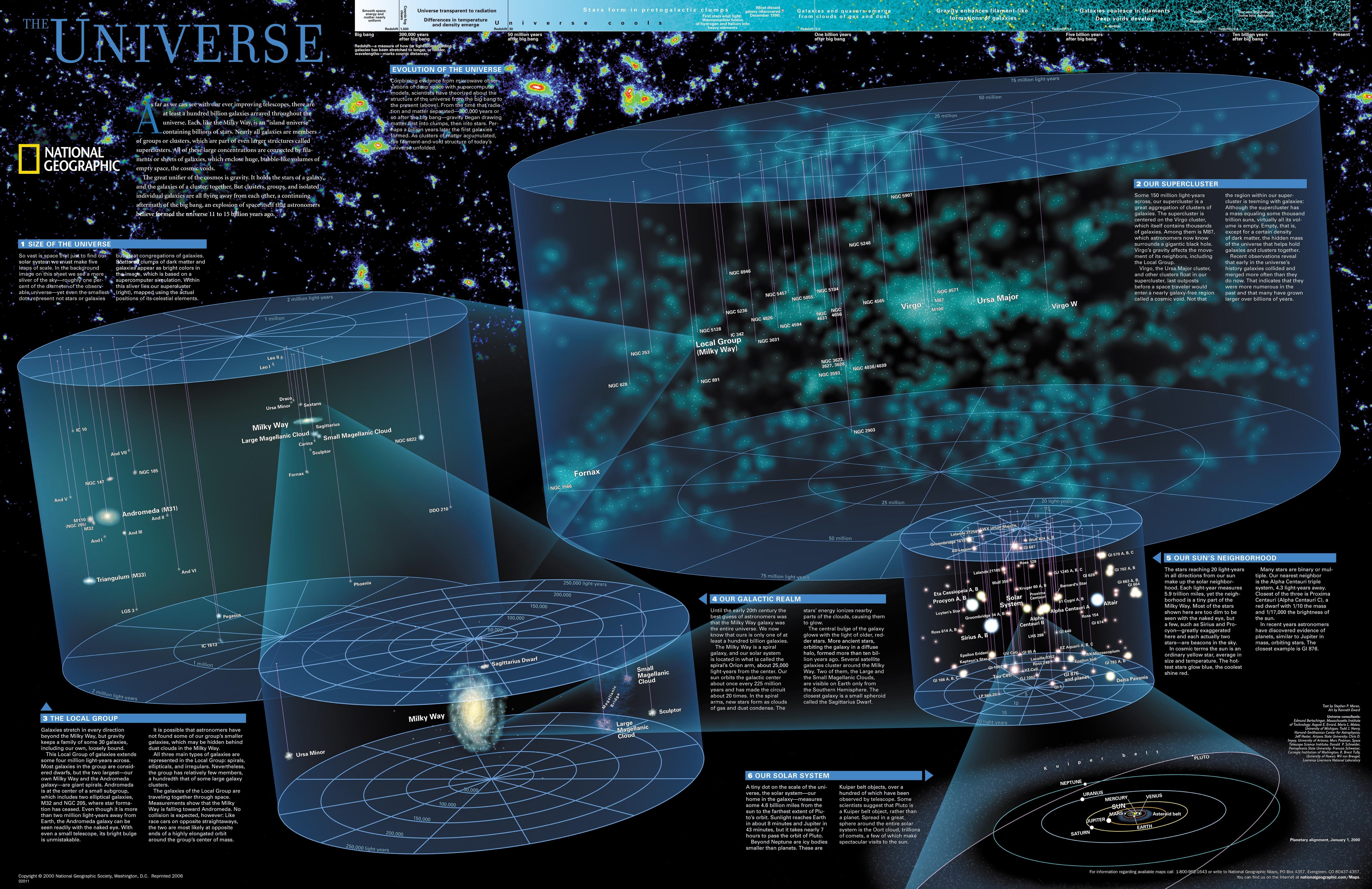
Later, this map of the known universe from National Geographic served to pretty much bork my mind out completely.
Trouble is, it doesn’t stop there.
I posted the above map earlier, along with a photo of Hubbles ultra-deep field image, and just recently came across this mind-bending video done by the folks at NASA/ESA:
The animations were based on the red-shift values of the various galaxies captured in the image. The thing is, that is by no means all of it – it’s only the part we were able to capture with our rather primitive (albeit wonderful) instruments.
So what is our place in the universe? Scientists will be grappling with that question for as long as man continues to be relevant. The president of my church, Thomas S. Monson, said in 2001, ” I acknowledge that I do not understand the processes of creation, but I accept the fact of it.” Taken in the context of the rest of his quotation, this has been interpreted by some to mean that we should reject science in favor of faith. I do not see it that way. The miracle of creation, in all its massive and miniscule glory, is before me, and I must accept the fact of it. But another fact remains: for all we know, we know virtually nothing. As tiny as the pale blue dot is in the immeasurably vast universe, so is all our scientific knowledge in the face of all there is to be known. I believe firmly that we do have a purpose and a place in all the vastness, and that purpose is to raise the human condition, to make life better in all possible ways for ourselves and for all whom we encounter. This is sufficient for me. In the words of Hillel, “the rest is commentary.”
And all this because of a single “fake” picture posted on George Takei’s Facebook feed. Thanks, George.
The Old Wolf has spoken.
1Just because I can’t do math doesn’t mean I can’t appreciate it.
A mathematical friend of mine assures me that this equation evaluates to ⅓. I couldn’t say for the two crore question, but I’ll never forget how to write it. See, it’s a limerick, and limericks I can remember. All of them. Darnit.
“Integral zee squared dee zee
From one to the cube root of three
Times the cosine
Of three π over nine
Equals log of the cube root of e.”
[2]With thanks for the correction to Haydn Rawlinson, who apparently knows not only how his own name is spelled but also the Planetarium’s.
Yesterday I posted about the rice on the chessboard problem, and after I finished, my mind got… squirrel!
Well, yeah, that’s about how it works. I started wondering how long that much rice would last if you were feeding the entire population on a daily diet of 2027 calories. All of this is hypothetical, because living on nothing but rice is not great nutrition, but it would keep you alive – sort of – and a good percentage of the world’s population would kiss your feet if you provided them with that much rice (19.7 ounces) daily on a regular basis.
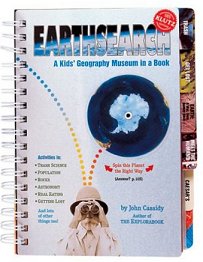
Since that squirrel just trotted through my mind, I’d like to pause here and put in a plug for an awesome book, Earthsearch by John Cassidy. This little wonder is a geography museum for kids that you can hold in your lap, full of games and facts and hands-on stuff. I was reminded of this by the fact that one section actually contains 4.8 ounces of rice, less than half of what the average kid (8-14 years old) needs per day. This is divided again into two bags, 2.8 ounces and 2.0 ounces respectively – and a spinner that shows your odds (1:20) of being born in the Western world. If your spin is lucky, you get to eat almost 500 calories. Spin poorly, and all you get is about 280 calories, enough to keep a kid hungry for a while and drive the point of world malnutrition home.
Back to our regularly scheduled programming: I’m also assuming that everyone is an adult male, 5’11” tall and about 150 lbs, which is where the 2027 calories come from. Of course that’s going to fluctuate wildly when you factor in the dietary needs of women, children, and people of different sizes and metabolisms. Still, it’s good enough for government work – all I’m doing here is coming up with a nice round number that my mind can wrap itself around.
Thanks to a handy dandy spreadsheet, I didn’t need to do much math.
461,168,602,000 metric tons of rice (bigger than Mount Everest, remember), at 35,273.962 ounces per ton is equivalent to 16,267,243,742,541,100 (16.2 quadrillion) ounces.
Today, the world’s population, according to Worldometers is estimated at 7,066,853,164.
If it takes 19.7 ounces of rice to feed our average citizen, then we’re going to require 139,266,082,699.99 (139.2 billion) ounces of rice to feed the world for a day.
Which means that with his reward from King Shihram, Sissa ibn Dahir could feed today’s world for 116,807 days, or the equivalent of 320 years. That is a lot of sushi.
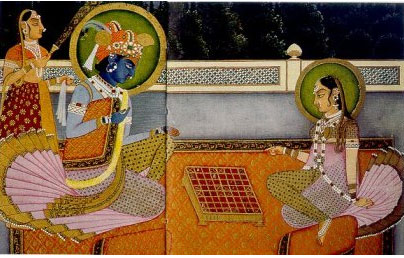
When I was young, I heard the story of the rice and the chessboard.
King Shihram of India was an oppressive tyrant. One of his subjects, Sissa ibn Dahir, invented the game of chess as a strategic (and social) training tool, and the king was so pleased that he asked Sissa what reward he wanted. Sissa’s answer was that the king should put one grain of rice (or wheat, in some versions) on the first square of a chessboard, two grains on the second square, four grains on the third square, eight grains on the fourth square, and so on, doubling the number of grains of rice with each square.
The King thought he had gotten off easy, but the simple math of exponential increase demonstrated that Sissa was no fool: the total weight of rice would exceed the weight of all living things on earth and make a heap larger than Mount Everest.
I always wondered just how much rice that was, but back then we didn’t have Wikipedia, and I don’t think such an “inconsequential” article would have made it into the Brittanica. Now, however, all is different.
An illustration of the operating principle is below:
The abbreviations refer to Mega (million), Giga (billion), Tera (trillion), Peta (quadrillion), and Exa (quintillion).
This principle was used by Ray Kurzweil who coined the term “The Second Half of the Chessboard,” referring to the point at which an exponentially growing factor begins to have a significant economic impact on an organization’s overall business strategy. The example above shows that the first square of the second half contains more rice than the entire first half combined.
Mathematically, the total number of grains of rice can be expressed as
(or so I’m told), which resolves to 264 – 1 (or so I’m told.) Dammit Jim, I’m a linguist, not a mathematician.
On the entire chessboard there would be 264 − 1 = 18,446,744,073,709,551,615 grains of rice (that’s 18.4 quintillion), weighing 461,168,602,000 metric tons, which would be a mountain of rice larger than Mount Everest. This is around 1,000 times the global production of rice in 2010 (464,000,000 metric tons).
Looking at the amazing Humphrys map comparing the heights of various mountains, look at how tiny St. Peter’s cathedral is in comparison (click the map for full size).
Even had King Shihram been able to pay, Sissa would have had difficulty finding a place to put his reward. And that’s a whole lot of sushi.

 .
.










 Playing in the World Game