“Next summer I’ll make the strike, and this time I’ll put it into something safe for the rest of my life, and stop this fool wandering around.” [1]
The above map shows the states (in blue) which have state-sponsored lotteries. When the jackpot rises to the hundreds of millions of dollars, people flock to the convenience stores and plunk down a few dollars for the chance at a big one. But the probability of winning is so vanishingly small that players are simply flushing their money down the toilet for a brief, titillating dream.
The infographic below is large, but rather enlightening, as it makes your chances rather visible in terms of scale.
In Arabic, the appropriate expression is “بكرة في المشمش” (bokra fil mishmish, or “tomorrow, when the apricots bloom.”) That’s the equivalent of “How about never. Is never good for you?”
Proponents of lotteries push the idea that it’s cheap entertainment, cheaper than going to a movie or bowling or to a dance or concert. But I’m put in mind of Isiah 29:8:
“It shall even be as when an hungry man dreameth, and, behold, he eateth; but he awaketh, and his soul is empty: or as when a thirsty man dreameth, and, behold, he drinketh; but he awaketh, and, behold, he is faint, and his soul hath appetite.”
It is cheap entertainment… cheap as in the sense of little worth. When I was a kid in the 50’s, “made in Japan” was the equivalent of cheap slum, garbage, worthless trash – nowadays “made in China” seems to have taken over that shame (although we consume millions of tons of it from Wal-Mart and other places.)
Oh, make no mistake… I’ve been tempted. I live in one of the six states which has no lottery, and a couple of times I’ve been sorely tried… a little drive would take me over the border where I could plunk down my quatloos like the rest of humanity. But thankfully, I’ve prevailed, simply by reminding myself of the odds, and realizing that most of my money would be going to subsidize expenses for a state other than my own.
Despite the odds, millions play – and many others drop cash for worthless “systems” like the one shown here:
Yes, I’d love to be a multi-millionaire… but like WOPR said at the end of “War Games”, it’s a strange game… the only winning move is not to play.
The Old Wolf has spoken.
[1] Van Tilburg Clark, Walter, “The Wind and the Snow of Winter”
Stress: n. The confusion caused when ones mind overrides the body’s natural desire to choke the living out of some that desperately needs it.
I’ve always tried to keep this blog at a level that all family members will find appropriate. That’s not going to stop, but sometimes the level of stress that arises when I really, really want to say what I think about government stupidity that has risen to the thermonuclear level overwhelms me.
An article at Forbes entitled “The Inexplicable War on Lemonade Stands” outlines a disturbing trend, driven most likely by the same lack of common sense and blind devotion to rules and procedures found in most school boards, districts and principals’ offices.
Fortunately, there are a few good spots among the bad and the ugly:
Red: Shutdowns or enforcement action Yellow: Restrictions in place Green: No restrictions or entrepreneurship encouraged
There’s a clear difference between a licensed food truck or vending operation, appropriately subject to local ordinances and health regulations, and kids’ lemonade stands. Some of the comments from the Forbes article are quite interesting:
Keir in Germany said,
It took a mass public outcry to finally get the authorities to back down. Thank God I live in Germany, a country that knows all too well the dangers inherit in a state where the police overstep their mandate to trample on the well-being and livelihood of the common man. The state looks after its people whilst allowing them to live as they see fit without undue interference. The US seems more and more to be following a fascist route; as its influence diminishes around the world, it seeks to enforce its dominance upon its own people. There doesn’t appear to be any hope given the general decline in its education system and completely ignorant, unqualified people who run for office and are given headlines due to notoriety rather than experience and ability. What a dystopia the US has become, and we in Europe, grateful for the US of three generations ago, can only shake our heads and bemoan the loss of a former model and friend.
Gabby responded,
I remember growing up in an America that looked on with great favor kids who setup lemonade and kool aid stands. I used to do this all the time. I also sold greeting cards door to door, and ran a babysitting service when I was in high school. The idea in our country that anyone could do great entrepreneurial things, starting from the poorest of circumstances, and succeed beyond one’s wildest dreams, is what set our country apart from the rest of the World. In fact, in my state where I live, we have success stories in spades. These success stories though wouldn’t happen today, most likely, because the people who started these businesses weren’t backed by big bank loans, venture capitalists, ect. and they weren’t hindered by draconian regulations, rules, and expensive licenses, permits, and the need for regulation commercial kitchens. One lady whose potato chips are known locally all over the state, started in her kitchen in the 1930′s. A successful furniture retailer here, started selling stuff from his garage, and a lady whose name is on some very well known cookies, started baking and selling her cookies, right from her kitchen. I am hopeful that our citizens are starting to see what is going on, and are becoming involved to stop fascist ideas from ruining our country.
lymanlapstrake also responded,
This is an excellent comment and I agree with you 100%. Upon reflection however, I have concluded that this is not necessarily a law enforcement problem, but rather a people problem. Yes, we the people of the U.S.A. are the worlds most litigious society (Google this phrase). There are about a million lawyers sitting around waiting to litigate. The enforcement takes place because someone complains. If nothing is done idiots will probably sue the parents for unsanitary practices or some such nonsense. We cannot help but meddle in each others business. So I think the enforcement is a defensive measure on the part of the authorities. Nobody wins and to my way of thinking it is the fault of our nation having become a society peopled with an excess of wingnuts.
These are excellent comments, although I would not go so far as to invoke the word fascism. The last comment to me seems to be the most relevant – there are just too many attorneys hungry for billable hours who are willing to sue anyone for anything, and driving the culture of litigation that permeates our society (don’t get me started on the demise of the school playground, I’ve already ranted about that here.)
To conclude, I refer you to the popular obituary of Common Sense, widely attributed to “unknown” or George Carlin, but actually written by Lori Borgman and published in the Indianapolis Star in 1998.
The Death of Common Sense
Lori Borgman | Sunday, March 15, 1998
Three yards of black fabric enshroud my computer terminal. I am mourning the passing of an old friend by the name of Common Sense. His obituary reads as follows: CommonSense, aka C.S., lived a long life, but died from heart failure at the brink of the millennium. No one really knows how old he was, his birth records were long ago entangled in miles and miles of bureaucratic red tape. Known affectionately to close friends as Horse Sense and Sound Thinking, he selflessly devoted himself to a life of service in homes, schools, hospitals and offices, helping folks get jobs done without a lot of fanfare, whooping and hollering.
Rules and regulations and petty, frivolous lawsuits held no power over C.S. A most reliable sage, he was credited with cultivating the ability to know when to come in out of the rain, the discovery that the early bird gets the worm and how to take the bitter with the sweet.
C.S. also developed sound financial policies (don’t spend more than you earn), reliable parenting strategies (the adult is in charge, not the kid) and prudent dietary plans (offset eggs and bacon with a little fiber and orange juice).
A veteran of the Industrial Revolution, the Great Depression, the Technological Revolution and the Smoking Crusades, C.S. survived sundry cultural and educational trends including disco, the men’s movement, body piercing, whole language and new math. C.S.’s health began declining in the late 1960s when he became infected with the If-It-Feels-Good, Do-It virus.
In the following decades, his waning strength proved no match for the ravages of overbearing federal and state rules and regulations and an oppressive tax code. C.S. was sapped of strength and the will to live as the Ten Commandments became contraband, criminals received better treatment than victims and judges stuck their noses in everything from Boy Scouts to professional baseball and golf.
His deterioration accelerated as schools implemented zero-tolerance policies. Reports of 6-year-old boys charged with sexual harassment for kissing classmates, a teen suspended for taking a swig of Scope mouthwash after lunch, girls suspended for possessing Midol and an honor student expelled for having a table knife in her school lunch were more than his heart could endure.
As the end neared, doctors say C.S. drifted in and out of logic but was kept informed of developments regarding regulations on low-flow toilets and mandatory air bags. Finally, upon hearing about a government plan to ban inhalers from 14 million asthmatics due to a trace of a pollutant that may be harmful to the environment, C.S. breathed his last.
Services will be at Whispering Pines Cemetery. C.S. was preceded in death by his wife, Discretion; one daughter, Responsibility; and one son, Reason. He is survived by two step-brothers, Half-Wit and Dim-Wit.
Memorial Contributions may be sent to the Institute for Rational Thought. Farewell, Common Sense. May you rest in peace.
The letter came in a box of Halloween decorations purchased at Kmart, but for a year Julie Keith never knew. It gathered dust in her storage, a haunting plea for help hidden among artificial skeletons, tombstones and spider webs.
Keith, a 42-year-old vehicle donation manager at a southeast Portland Goodwill, at one point considered donating the unopened $29.99 Kmart graveyard kit. It was one of those accumulated items you never need and easily forget. But on a Sunday afternoon in October, Keith pulled the orange and black box from storage. She intended to decorate her home in Damascus for her daughter’s fifth birthday, just days before Halloween.
She ripped open the box and threw aside the cellophane.
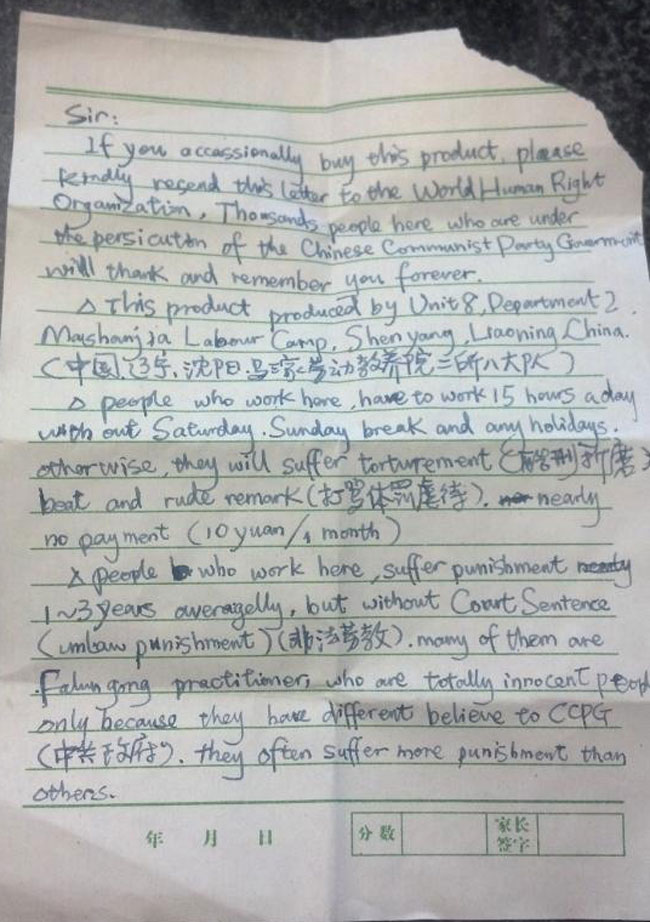
That’s when Keith found it. Scribbled onto paper and folded into eighths, the letter was tucked between two Styrofoam headstones.
“Sir:
“If you occasionally buy this product, please kindly resend this letter to the World Human Right Organization. Thousands people here who are under the persicution of the Chinese Communist Party Government will thank and remember you forever.”
“People who work here have to work 15 hours a day without Saturday, Sunday break and any holidays. Otherwise, they will suffer torturement, beat and rude remark. Nearly no payment (10 yuan/1 month, or $1.61).”
“People who work here, suffer punishment 1-3 years averagely, but without Court Sentence (unlaw punishment). Many of them are Falun Gong practitioners, who are totally innocent people only because they have different believe to CCPG. They often suffer more punishment than others.”
The letter was not signed.
The graveyard kit, the letter read, was made in unit 8, department 2 of the Masanjia Labor Camp in Shenyang, China. Chinese characters broke up choppy English sentences.
The administrative building of the Masanjia labor camp and other facilities in China.
Keith started doing homework and digging around, and the letter was widely published on the internet. Responses ranged from outraged to skeptical, including those who pointed out that her publication of this material put the writer at risk if he/she were real.
On June 11th, 2013, The New York Times published a follow-up article indicating that the writer had been found, and was no longer in the labor camp. It’s an interesting read and lends credence to the original story, although there has been no other independent confirmation from inside China.
It appears that many companies who import Chinese products have no policies that bar the use of forced labor.
Just something else to think about the next time you go shopping at a big box store and the label says “Made in China.”
The Totally Ghoul product – the letter from China was found in a package like this.
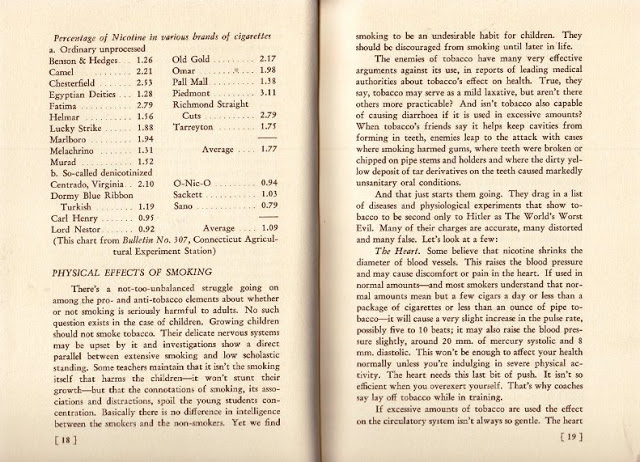
… and you’ll sell more tobacco products. (A couple of earlier posts about tobacco products are here and here.)
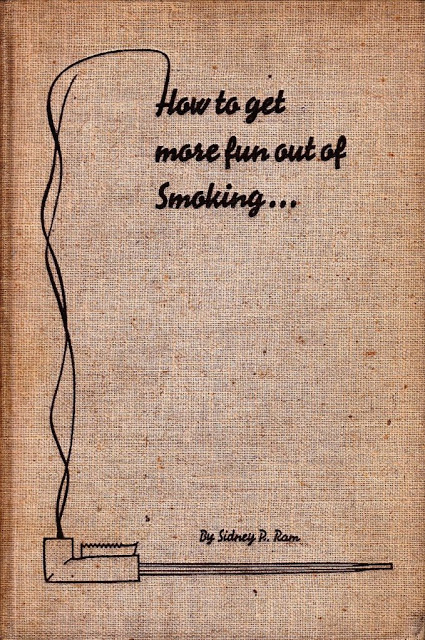
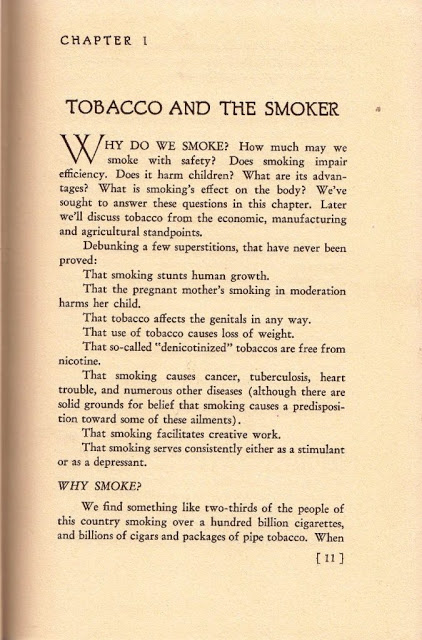
Sydney P. Ram was a Chicago pipe-maker who had a shop on the loop (he retired in 1942). Apparently his pipes are still sought after by afficionadoes. This book was published in 1941, when advertisements of this nature were still common:
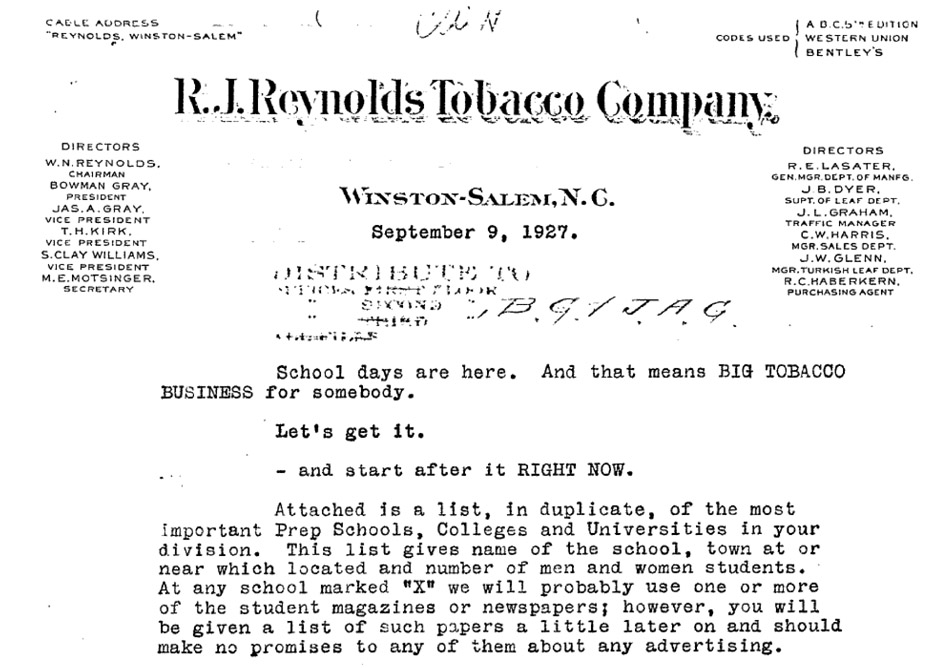
And memos like the following were (while not publicly disseminated) urging marketeers to go after the young:
In 1952, Reader’s Digest condensed an article from the Christian Herald entitled “Cancer by the Carton.” Prior to this, very little was being publicly said about the dangers of smoking, and as we can see from Ram’s book, it was easy to muddle the issue simply by denying the “superstitions.” Anti-smoking PSA’s became one of Readers Digest’s favorite soapboxes, along with anti-Communism.
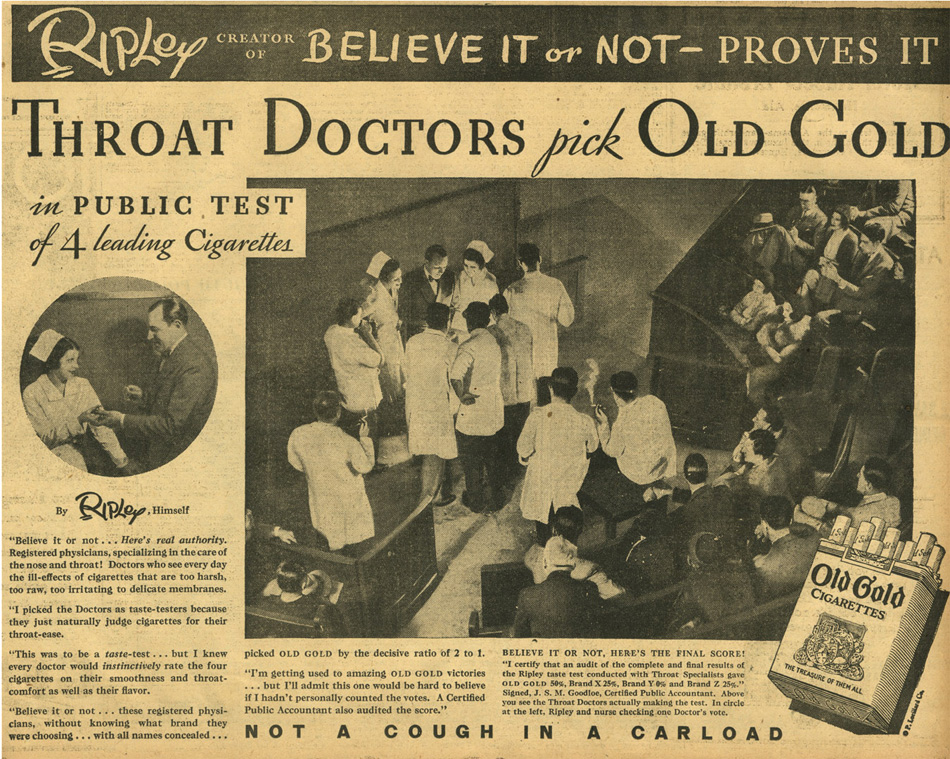
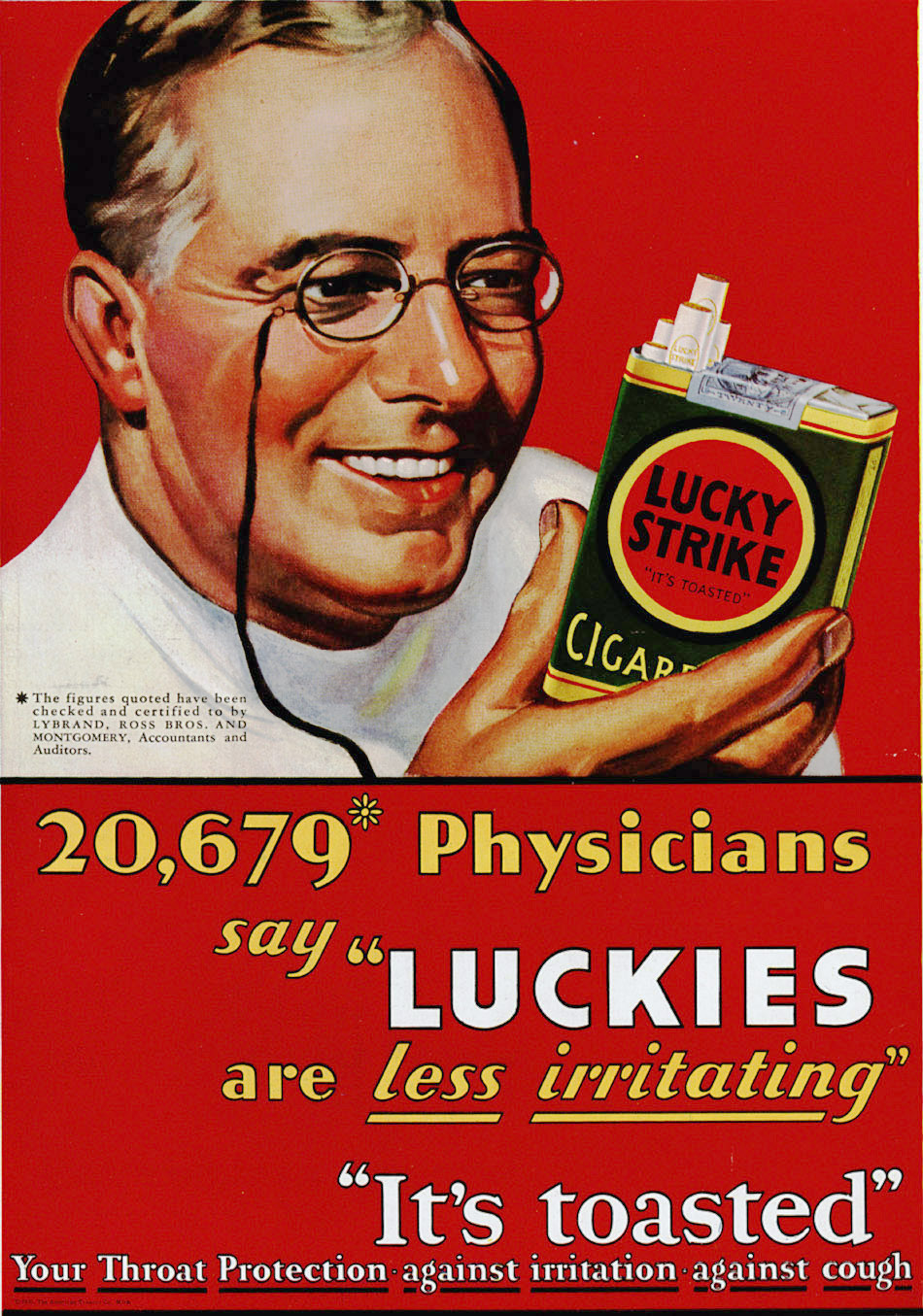
The worlds of advertising and cigarette smoking have been intertwined for as long as we can remember. In the first half of the 20th century, tobacco companies were major contributors to the advertising industry, and many radio and TV programs were sponsored by these companies.
As the 1960s dawned, things were beginning to change. During the 1950s, people became aware of the health hazards of cigarette smoking and began to file court cases against the tobacco companies. Private medical journals published studies linking smoking to lung cancer, and magazines like the Readers Digest ran anti-smoking articles.
The turning point came in 1964 when the Surgeon General released their first report linking smoking to lung cancer, heart disease, chronic bronchitis and emphysema. These results got everyone’s attention. The government, which had been at the mercy of the tobacco lobby, began to get involved and slowly some changes were made.
I was roped into smoking in high school in 1964. After I gave up tobacco five years later, for a while I became a dedicated crusader and I recall getting quite an assortmant of pamphlets, article reprints, buttons,
and other tools for use in my campaign.
Progress has been slow, but continues to be made in our country. The education campaign continues:
The faces of the onlookers are priceless.
Unfortunately and to our shame, tobacco manufacturers have shifted their focus from the US to overseas. As consumers here became more aware of the dangers of smoking, Big Tobacco looked for victims (I use that term deliberately) in other parts of the globe. In 2019, the global market was worth $614 billion; even Everett Dirksen would be impressed by a number like that.[1]
According to the American Lung Association,
Cigarette smoking is the number one cause of preventable disease and death worldwide. Smoking-related diseases claim over 393,000 American lives each year. Smoking cost the United States over $193 billion in 2004, including $97 billion in lost productivity and $96 billion in direct health care expenditures, or an average of $4,260 per adult smoker.[2]
We can’t give up the fight. It will be slow. Tobacco is a legal product, and many people in the USA still put bread on their family’s table as a result of the industry. Acceptable alternative crops for farmers need to be found, and those who work in the packaging and shipping aspects will need to be moved into other economic sectors. If headway can be made in the legalization of industrial hemp[3], this could prove a godsend for farmers looking for a way out of the tobacco market.
Given the costs to society and individuals incurred as the direct result of tobacco use, the fight is a worthwhile one.
The Old Wolf has smoken (and is glad that he was able to quit when he did!)
[1] Senat0r Everett Dirksen was once reputed to have said, “A billion here, a billion there, pretty soon it adds up to real money.” He may never have said it, but it continues to circulate; after all, nothing on the Internet ever really dies.
[2] “Smoking-Attributable Mortality, Years of Potential Life Lost, and Productivity Losses — United States, 2000–2004”, CDC. Click through for the article.
Children eating their Christmas dinner during the Great Depression.
As I looked at this picture, I was reminded of this passage from Richard Wright’s Black Boy:
“Christmas came and I had but one orange. I was hurt and would not go out to play with the neighborhood children who were blowinghorns and shooting firecrackers. I nursed my orange all of Christmas Day; at night, just before going to bed, I ate it, first taking a bite out of the top and sucking the juice from it as I squeezed it; finally I tore the peeling into bits and munched them slowly.” -Wright, Richard, Black Boy, Harper and Row, 1965
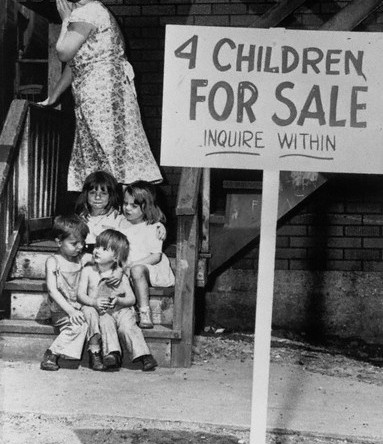
Poverty sucks. Previously I posted this picture of a desperate woman offering her children for sale in Chicago in 1948. Three years after World War II, when the military machine had largely mitigated the effects of the depression, and people were still struggling. And people continue to struggle today, in 2013, in America the Great and Terrible – which to far too many seems like nothing so much as smoke and mirrors, while the 1% who control over half our nation’s wealth shout, “Pay no attention to that CEO behind the curtain!”
They say the recession is over. For the wealthy and those whom our tax dollars bailed out, with no accountability or even gratitude, for the CEO’s and executives and board members who benefited with huge salaries and bonuses, perhaps it is. But not for the average working american. It’s two years on from that article, and economic terror is still snapping at the heels of far too many in our country. Economic giants like Wal-Mart crow about the “opportunities” and “dignity” they provide people:
“Unfortunately there are some people who base their opinions on misconceptions rather than the facts, and that is why we recently launched a campaign to show people the unlimited opportunities that exist at Walmart,” Buchanan said, noting that 75 percent of Walmart managers started as hourly employees. “Every month more than 60 percent of Americans shop at Walmart and we are proud to help them save money on what they want and need to build better lives for themselves and their families. We provide a range of jobs — from people starting out stocking shelves to Ph.D.’s in engineering and finance. We provide education assistance and skill training and, most of all, a chance to move up in the ranks.”
But as the source article indicates, a single Wal-Mart’s low wages can cost taxpayers around $900,000 per year in food stamps and other government programs because wages are so low, no benefits are paid, and hours are kept to unliveable minimums. Nobody said it better than Jib-Jab:
One would think that a skilled laborer with advanced degrees could at least get a job with Wal-Mart; one might think that they would appreciate wisdom, experience and reliability. Unfortunately, that’s the exact opposite of what is happening. The sad truth is that Wal-mart’s turnover rate is obscenely high; 60% would not be considered abnormal in some stores. Managers expect impossible performance, treat employees like refuse and pay as little as the law allows. Report after report from former Wal-Mart employees refer to constant threats of firing and reminders that they needed Wal-Mart to survive; they will fight unemployment claims to the teeth and make sure their employees are aware of this. As a result, HR is actively looking for people who can’t find anything better and who won’t complain, regardless of how poorly they are treated.
How can a business possibly survive on such a model? How can managers who buy into this mindset live with themselves or sleep at night? I truly have no answers to these questions, but the fact that the situation persists is deeply troubling.
To be fair, I know people who have been with their Wal-Mart stores for a long, long time, have risen through the ranks by dint of sheer perseverance and who are grateful for their employment. I know some people who work at the corporate level in IT, and who say they’ve had it a lot worse elsewhere. But the overwhelming preponderance of tales seem to support what is generally supposed about the big box working environment.
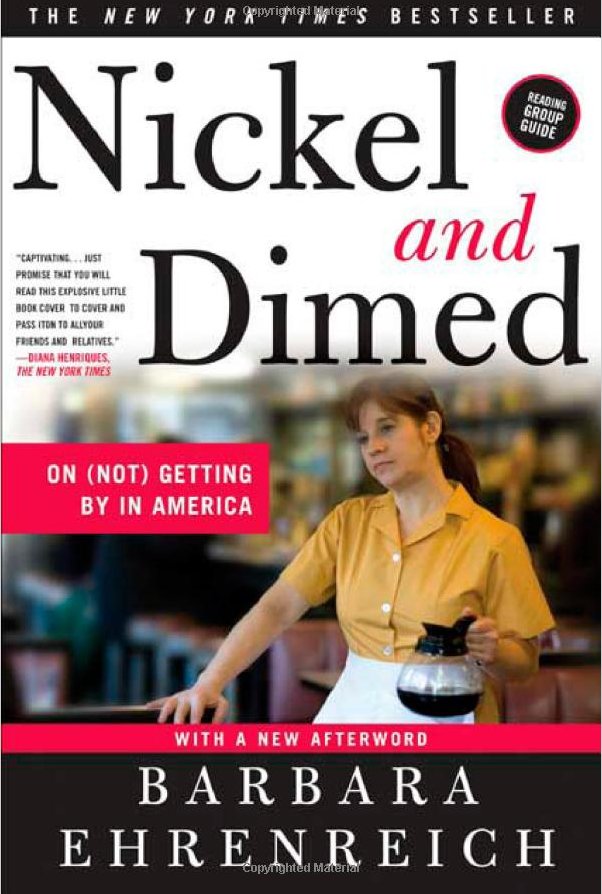
If you’d like a good (albeit depressing) read about what life is like for far too many of us in this country, read Nickel and Dimed: On (Not) Getting By in America, by Barbara Ehrenreich[1]; she describes what it’s like to try to live on minimum-wage jobs in our country.
Her tales of shelters, budget motels, cheap food, endless job interviews, and working in demeaning drudgery, only to find that it was seldom enough to live on, will open your eyes to the harsh realities of our economy. Her conclusion:
The “working poor,” as they are approvingly termed, are in fact the major philanthropists of our society. They neglect their own children so that the children of others will be cared for; they live in substandard housing so that other homes will be shiny and perfect; they endure privation so that inflation will be low and stock prices high. To be a member of the working poor is to be an anonymous donor, a nameless benefactor, to everyone else. As Gail, one of my restaurant coworkers put it, “you give and you give.”
Someday, of course – and I will make no predictions as to exactly when – they are bound to tire of getting so little in return and to demand to be paid what they’re worth. There’ll be a lot of anger when that day comes, and strikes and disruption. But the sky will not fall, and we will all be better off for it in the end.
Again in the interest of fairness, here’s another opinion from Charles Platt in 2009; no idea if he’s a shill or not, but add it to the mix. [2]
As a country, we must do better. We owe it to ourselves, and we owe it to our children. We need to start teaching kids how to think out of the box, how to value humanity, how to run an ethical business, and how to build a world that works for everyone. Richard Wright ended the original version of his autobiography with these words: “With ever watchful eyes and bearing scars, visible and invisible, I headed North, full of a hazy notion that life could be lived with dignity, that the personalities of others should not be violated, that men should be able to confront other mean without fear or shame, and that if men were lucky in their living on earth they might win some redeeming meaning for their having struggled and suffered here beneath the stars.” (Wright, Richard, Black Boy, Harper and Row, 1965)
We must do this. Otherwise, as John Howard Griffin said in his moving conclusion to Black Like Me, “we will all pay for not having cried for justice long ago.”
The Old Wolf has spoken.
[1] You can find it at Amazon or read a pdf of the book here.
[2] What’s it like for Wal-Mart executives at the stratospheric corporate level? Not all peaches and cream, as Julie Roehm discovered; her odyssey makes for an interesting read as well.
Thought patterns and philosophies have changed over time – many of us are familiar with sexist advertisements that ran in magazines in newspapers in decades and centuries past:
Yikes. And this isn’t even the worst of them.
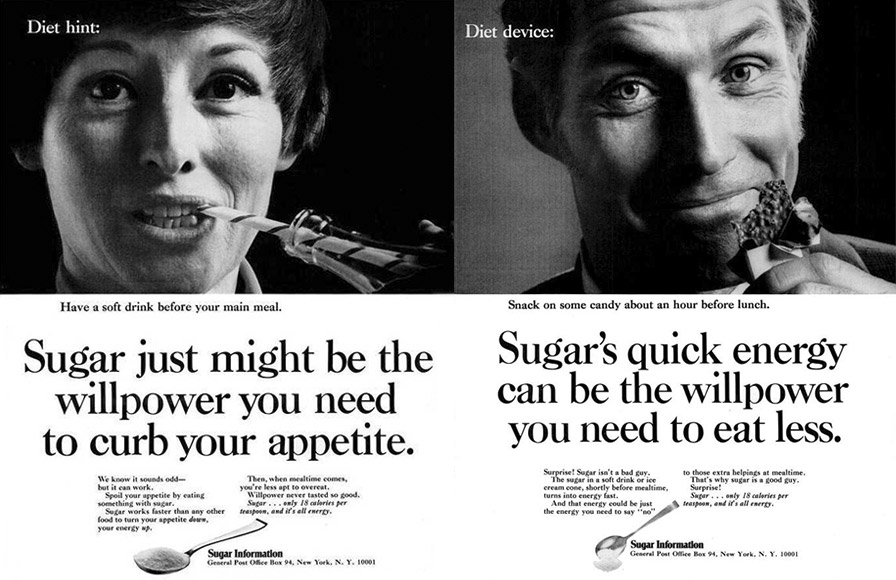
I was recently pointed to a collection of ads that were not only stupid but downright dangerous:
Some of these simply contravene common sense, like the “vitamin doughnuts” ad above, but some of them are downright toxic, for example the DDT advertisement. You can see a full exposition on each of these over at Collector’s Weekly.
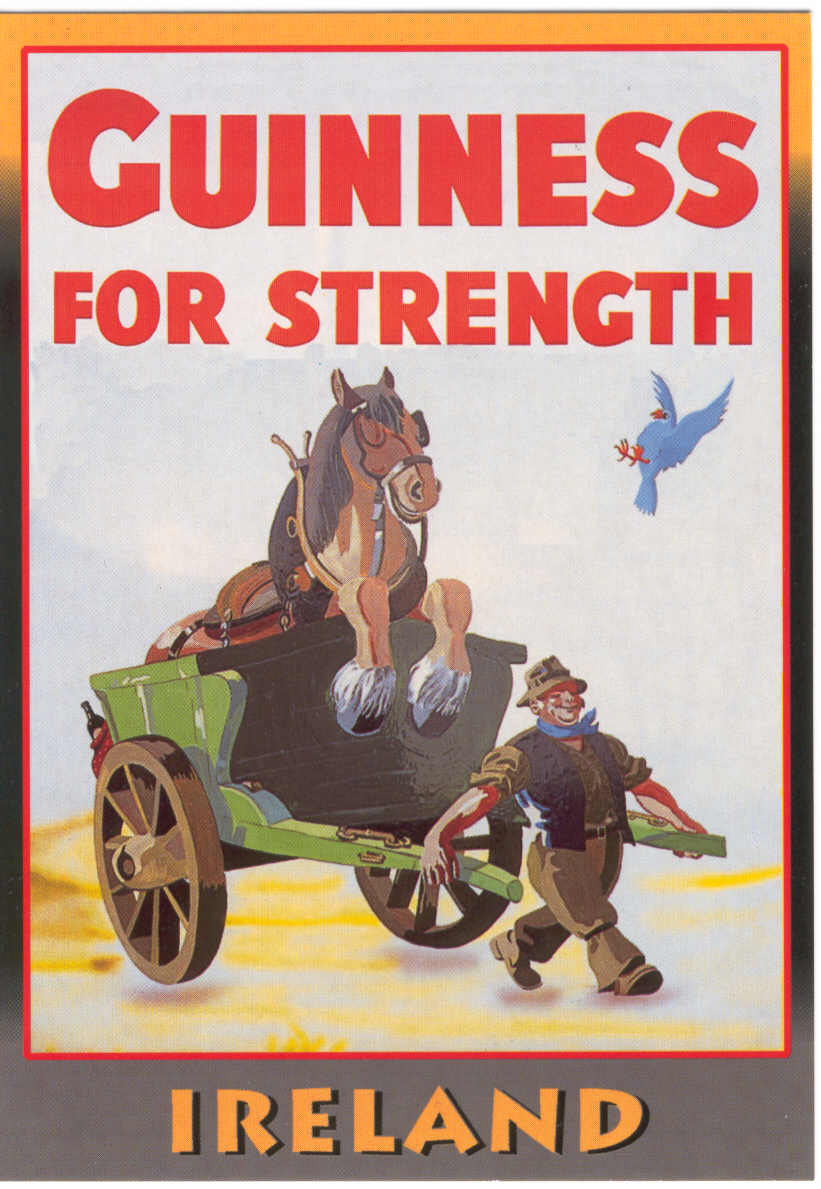
And of course, don’t forget the “Guinness is Good For You” campaign:
Have we changed all that much, though? I rant regularly about quack remedies and sleazy advertisements that seem so prevalent on the web (if you don’t want to see these, consider using AdBlocker Plus for Firefox or Chrome – you’ll see almost no ads.)
As I said at the post I referenced above, regarding the “Açaí Berry / Colon Cleanse” scam,
Colon cleansing is unnecessary and potentially harmful. Your colon is an amazing apparatus. With the exception of abnormal medical conditions such as fecal impaction due to longstanding constipation, or intestinal torsion, your colon cleanses itself efficiently and regularly. If you do a colon cleanse, you’re likely to lose a few pounds as the result of clearing out two days worth of food in your system, but as soon as you start eating again, it will come right back. Colon cleansing on a regular basis can disrupt the natural intestinal flora, and impair the colon’s natural ability to regenerate its lining. A diet rich in soluble and insoluble fibers is all your body needs to keep your colon happy, and doing what it does best – absorbing nutrients and expelling wastes.
As for the berry itself,
Antioxidants are good. Virtually thousands of randomized, double-blind, placebo-based studies published in JAMA, Lancet and other mainstream medical journals show that free-radical scavengers help improve overall health. Fruits are full of antioxidants. The açaí berry is a fruit. Just like strawberries, kiwis, oranges, grapefruits, pomegranates, mangosteens, ningxia wolfberries, and you name it. When consumed as part of a balanced diet, they’re all good for you. But there is nothing “miraculous” about this or any other fruit.
The sad bottom line is that most advertising is borderline unethical by nature. It’s either
Misleading
Outright deceptive
Practicing “bait and switch” tactics, or
Designed to create a burning, passionate desire for something that you don’t really need.
It’s a conundrum, because advertising is what drives commerce, and commerce is what drives society. If nobody bought anything, practically nobody would have a job and our economy would collapse.
I don’t have all the answers, but if the human race is ever going to crawl out of the mud, ethical business is a must. We need to teach our upcoming generations that the end does not justify the means.
… that gets shared around and around and around with nary an attribution. I looked, and was not able to find anything credible; two friends with greater Google-fu than I were able to identify a source, and thanks to them.
Parents Selling Children
Original caption: August 4, 1948 – Chicago, Illinois: They’re on the auction block. These small children of Mr. and Mrs. Ray Chalifoux of Chicago, Illinois.
For long months 40 year old Ray and his wife, Lucille, 24, waged a desperate but losing battle to keep food in the mouth and a roof over their heads. Now jobless and facing eviction from their near barren flat, the Chalifoux have surrendered to their heart breaking decision. Photo shows mother sobbing as the children pose wonderingly on the steps. Left to right: Lana,6. Rae, 5. Milton, 4. Sue Ellen, 2 years old.
One wonders at what happened after the photo was taken. Hard times are hard.
[Edit: Many thanks to reader Jen who found a recently-published followup:
Lana (top left) was likely adopted and died of cancer in 1998; RaeAnn (top right) was sold for $2 along with her brother Milton (bottom left) to an abusive family. Sue Ellen (bottom right) was adopted. David, inside mother Lucille Chalifoux’s womb in this picture, was adopted as well. Lucille would have four moure daughters; “She kept them; she didn’t keep us,” David says.




 out of some








![vintage-sexist-ads (13)[3][2]](https://playingintheworldgame.com/wp-content/uploads/2013/06/vintage-sexist-ads-1332.jpg)










 Playing in the World Game