New York Market, 1917

Interior retail stalls at Washington Market in New York City in 1917. New York Word-Telegram & Sun Newspaper Collection

12750u


While this is much larger and brighter, it still has the same feel of an indoor market I found in Toulouse, France in 1970:

Europe Trip - Jun 1971 - Toulouse Market


Of course, such places still exist: here Quincy Market in Boston:

quincy-market-4


I’ve always loved spaces like this, and I think we need more of them.

The Old Wolf has spoken.

Sushi Yasuda in NYC does away with tipping

I’ve blogged about tipping before. Now, a few bold restaurants are beginning to buck the trend.

(Reblogged from The Consumerist)

Note: Sushi Yasuda is the restaurant’s correct name – it appeared in the original article as “Yasada”.

 NYC Restaurant Tells Customers That Tipping Is Not Allowed
By  June 7, 2013

 (From ThePriceHike.com)

(From ThePriceHike.com)

As we’ve discussed here many, many times, restaurant wait staff often rely on tips because their base pay is generally far below the minimum wage level. Since tipping is an anomaly overseas, waiters in most other countries are paid a living wage. Thus, one sushi restaurant in Manhattan, which claims it has always paid its employees well, has recently started telling customers that tips will not be accepted.

On his Price Hike blog, Bloomberg food critic Ryan Sutton writes about the note that was recently added to the bottom of all receipts at Sushi Yasuda in NYC. It reads:

Following the custom in Japan, Sushi Yasuda’s service staff are fully compensated by their salary. Therefore gratuities are not accepted. Thank you.”

Sutton talked to the restaurant’s owner who says he decided to not go the route of some restaurants who simply add 18-20% service charges on to bills rather than have customer tip. That’s really just the same as the old system; it just saves the diner the hassle of doing basic math.

Instead, Yasuda’s owner raised the menu prices a bit and simply tells customers: Do Not Tip Your Waiter.

“We just take tipping out of the equation,” he explains to Sutton.

The reason more restaurants don’t follow this model is that they are afraid higher menu prices will drive away customers, but this owner maintains that “if you have faith in what you’re serving, and how you’re serving it, you know that when your customers have a good meal and look at their final tally it’s going to be around the same.”

He claims that paying your staff a solid wage that doesn’t fluctuate from day-to-day based on tips is a good way to build stability among your workers.

In spite of this being the standard for most of the world, there are only a very small number of restaurants in the U.S. that don’t accept tips and also don’t tack on service fees.


According to the poll at the bottom of the Consumerist’s page, the question “Should more restaurants do away with tipping?” provided (to me) unsurprising results:

results

Whereas in my previous posts I’ve stressed that tipping is not optional and that servers depend upon tips for their daily wage, I would be entirely in favor of eliminating tipping at restaurants and paying servers a dependable, living wage. Naturally, if restaurateurs try to take advantage of this trend to their own benefit and to the detriment of their employees, that doesn’t work… but I’d be willing to bet a lot of servers would line up for a regular job where busting their ass for a party of cheapskate douchebags never enters the equation.

Hats off to Sushi Yasuda! 

The Old Wolf has spoken.

Lies, Spies, and Videotape.

8501189

Edward Snowden. Hero? Traitor? Irrelevant?

It’s a big deal, and the calls for lionization, incarceration, exculpation, evaporation, and a lot of other “-ations” are beginning to ring from coast to coast and across the world.

I have no doubt the NSA, CIA, FBI, and Mogg knows what other hush-hush agencies would like to see this man suffer in the fiery heat of Satan’s hottest furnace for eternity. On the other hand, civil libertarians are calling for an immediate pardon for a man they see as a brave and fearless national hero.

It appears that Snowden certainly broke the law in releasing the information that he did, but in so doing it also appears that he brought to light an even greater violation of principles than he himself is guilty of. So where do we draw the line?

mission-impossible-season-5

“As usual, if you or any member of your IM force is caught or killed, the Secretary will disavow any knowledge of your actions.”

Sean Connery as James Bond

License to Kill

Spies are paid to lie. Governments who employ them lie on a regular basis. The popularity of the action/spy thrillers on TV and in movies proves that we expect, nay, demand it. In real life it may not be right, but it becomes a matter of national security in some cases; nations simply don’t operate along the same moral lines as we would like them to. Can you imagine what would happen if governments were  completely open, honest, and transparent with one another? [1] The “good guys” are pretty much obliged to resort to deception and subterfuge to combat the “bad guys,” and keep their nations safe. That’s what the NSA and the CIA are there to do. For what it’s worth, we even spy on our friends. Don’t ask me how I know… I’d have to lie to protect certain other people.

Unfortunately, the CIA and NSA and other alphabet-soup agencies have also been tasked with things that have much less to do with keeping our nation safe than with keeping it rich, at the expense of other governments and peoples. If you’d like a glimpse into that shadowy world, read “Confessions of an Economic Hit Man,” by John Perkins; it will most likely raise both your eyebrows and your conscience. An extract of Amazon’s review:

“John Perkins started and stopped writing Confessions of an Economic Hit Man four times over 20 years. He says he was threatened and bribed in an effort to kill the project, but after 9/11 he finally decided to go through with this expose of his former professional life. Perkins, a former chief economist at Boston strategic-consulting firm Chas. T. Main, says he was an “economic hit man” for 10 years, helping U.S. intelligence agencies and multinationals cajole and blackmail foreign leaders into serving U.S. foreign policy and awarding lucrative contracts to American business. “Economic hit men (EHMs) are highly paid professionals who cheat countries around the globe out of trillions of dollars,” Perkins writes. Confessions of an Economic Hit Man is an extraordinary and gripping tale of intrigue and dark machinations. Think John Le Carré, except it’s a true story.”

What has been revealed by Snowdon goes far, far beyond keeping our nation safe from external evils; it has much more to do with controlling a domestic population, and despite groans and sobs of denial from those in the know, I can’t believe – I refuse to believe – that this massive accumulation of data can and will not be used for financial and potentiary gain by those in a position to access and use it.

And the fact that this mind-boggling misuse power was authorized years ago by the “patriot act” does not make it any more right. I’m glad it came to light, and I’m glad there’s a dialog going on, and I hope that some people are going to get their feet held to the fire, and I hope that what comes out of it is more transparency, and better for the citizenry of our country than for the power brokers.

I don’t condone illegal behavior. But I do believe in the principle of the “greater good.” I think Mr. Snowdon has recognized that his actions would carry a heavy price, and it was a price he is willing to pay to act according to the dictates of his conscience. I have no idea how all this is going to play out, but for me, at this moment, I’m keeping him in the plus column.

The Old Wolf has spoken.


[1] Somewhere out there is a science fiction story (or perhaps creative fantasy) about a special blend of coffee that mutates somewhere, and has the stunning effect of making people reasonable. After drinking some of it, the French delegate to the UN stands up and shouts, “It’s all balls!” In the end, the entire world has partaken, and governments actually start acting with decency and common sense, for the good of all the people of the world. I have never been able to relocate this story. If it sounds similar to Mark Clifton’s 1952 story “The Conqueror,” that’s not surprising – instead of coffee it was a mutant pychotropic dahlia root that changed the world:

“So it came about that one by one the members of the Politbureau tasted of the dahlia, even to the leader himself.

All of this took much time, and meanwhile heads of other nations who were not so suspicious of every shadow, and not so inaccessible, were eating regularly of the dahlia.

When finally the sincere word of peace and goodwill came ringing from Moscow to all the world, it was echoed back with all sincerity.”

A lovely story. Read it, if you’d like a smile.

World’s Top Languages

The other day I posted about being able to talk to most of the world’s people by learning 20 languages out of the over 7,000 currently existing ones. I forgot to post this infographic, so I’ll just add it here as an addendum, because I found it interesting, and it’s actually the thing that got me thinking about the subject.

182727_617345131626380_582618989_n


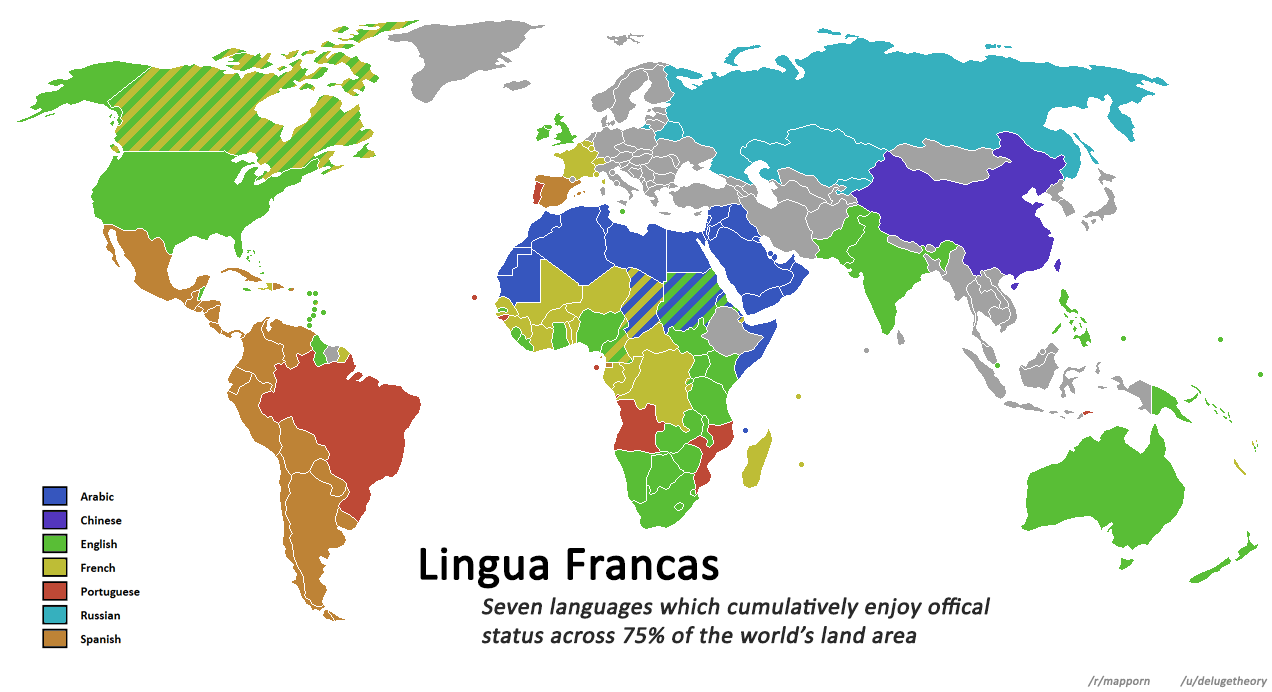
In addition, here’s a map showing how linguae francae, or “portmanteau languages”, are distributed across the globe; one can see the broad reach of the top seven.

tumblr_moodwegXI01rasnq9o1_1280

The Old Wolf had forgotten.

7 billion people, 20 languages (more or less)

In 1982, Charles Berlitz, one of the post popular linguists and language pedagogues of recent times (although perhaps not the most rigorously scholastic), made the following observation. The numbers and order of languages have shifted somewhat over the last 30 years, but the idea remains the same.

The_world_flag_2006

“Among the several thousand world languages, only 101 count over 1 million speakers. Of these, the fourteen most important in number of speakers are, in approximate order,

  • Chinese
  • English
  • Hindi/Urdu
  • Russian
  • Spanish
  • Japanese
  • German
  • Indonesian
  • Portuguese
  • French
  • Arabic
  • Bengali
  • Malay
  • Italian

All of these have over 50 million speakers, including dialects. [Chinese has the most native speakers, but English is more widely spoken worldwide.]

Since most of the world’s population speaks, or is familiar with one of the 14 languages listed above, with one of three other widely-spoken languages – Dutch, Greek, or Swahili – or with a language in either the Scandinavian or Turkic, or Slavic group, it is possible for an individual with the time and inclination to be able to communicate with a great majority of the inhabitants of this planet by learning to speak these 20 languages.”[1]

Wikipedia gives some alternate figures, but the general principle still holds: most of the world’s people speak one of the languages listed above as a first, second, or third language. When one considers that according to the Ethnologue, there are  7,105 known and documented languages on the earth, this makes the challenge of basic communication substantially simpler.

I have experienced this phenomenon myself as I’ve taken trips around the world. Before I had learned Spanish, I was able to hold bilingual conversations using Italian, and got about 65% comprehension. I’ve used German to get by in Bulgaria, and once again Italian in Albania. I have communicated with Russians in Croatian, and also (to my shame) with Slovenians, whose language eludes me despite rubbing shoulders with it for years. All of this, of course, ignoring English, which is used well and widely by so many people. I know Norwegians and Swedes and Finns and Danes and Dutchmen who speak better English than I do, whereas all I can do is look at the ground shamefully, scuff my feet, and mumble “lutefisk” and “Scheveningen.” Well, not quite that bad, but you get the idea.

With the advent of the Internet, the penetration of English is increasing as well, and many countries are beginning to encourage the study of Chinese instead of more traditional languages like French, given the growing presence of China in global trade. I’m up at odd hours of the night (like right now) teaching English to people in Japan, Korea, and China via Skype. For better or for worse, English is on the road to becoming the Esperanto Dr. Zamenhof hoped for, even though it’s devilishly complex and irregular. [2]

Sadly, the number of languages in the world is diminishing almost daily. The list of endangered tongues in Europe alone is astonishing; languages like Ume Saami in Sweden or Tsakonian in Greece could be gone within my lifetime. Given the massive growth of English and Chinese, as well as the predominance of the above-mentioned languages or language families, this might seem to be less than critical. However, Stephen R. Anderson of the Linguistic Society of America wrote, “When a language dies, a world dies with it, in the sense that a community’s connection with its past, its traditions and its base of specific knowledge are all typically lost as the vehicle linking people to that knowledge is abandoned.”[3]

You can’t really study a language without becoming involved with the cultures and histories of the peoples that speak it. I’ve been a linguist for a long time, and I never stop being curious about new languages, new words, and all the associated things that come with them. While my study of Irish Gaelic (or gaeilge) may not do much to save the endangered language over the long run, it’s taught me more about Ireland and its people than I could have ever hoped to learn otherwise.

If you’re reading this blog, you’re either blessed to speak English as a native tongue, or you’ve put in the hours and become fluent, and my hat’s off to you. But I encourage everyone to learn at least one additional language (for what it’s worth, the more you learn, the easier it gets) to broaden your horizons and increase your awareness of the world.

The Old Wolf has spoken.

[Edit: Click through for two additional charts which shine further light upon the subject.]


[1] Berlitz, Charles, Native Tongues, Grosset and Dunlap, 1982, p. 6

[2] If you’re not familiar with Gerard Nolst Trenité’s “The Chaos,” give it a read. Try saying it out loud. I dare you.

[3] “How Many Languages Are There In the World?”, Linguistic Society of America, 5/2004 PDF File

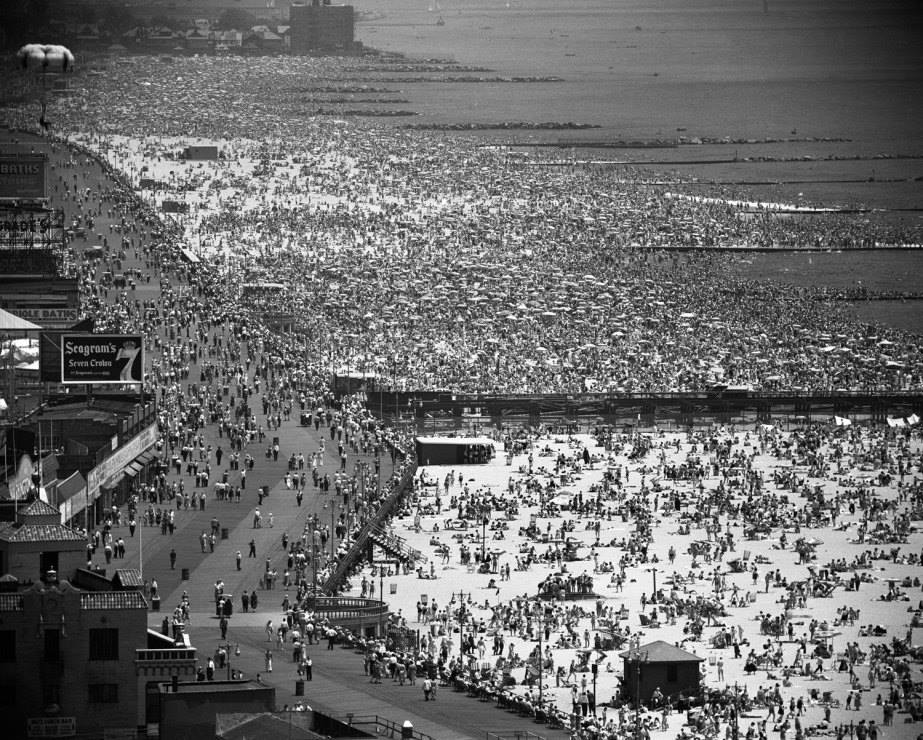
Coney Island, 1949

602366_612277405451774_1519350734_n

A view of the famous boardwalk and beaches shortly before I was born.

A few years later, I was able to ride this attraction:

stphorses

This was the Steeplechase, the main attraction of Steeplechase Park, which ceased operations in 1964. The entrance looked like this:

Steeplechase_Park_entry_LC-USZ62-80370

I remember it well. You sat on these metal horses, held on by only a bulky leather strap. Try building this today and you’d have 10,000 hungry lawyers looking for billable hours suing you for even thinking about it.

Steeplechase park was also the home of the famous Parachute Jump, originally built for the 1939 World’s Fair and later purchased and moved to the Coney Island area. I also remember riding this one. Despite some controversy over its actual decomission date, it appears that it closed in 1964 with the rest of Steeplechase Park.

NSAPBPL6_EXTR


The towers remains standing to this day.

Coney_Island_Parachute_Jump


Steeplechase Park was an amazing experience. It looked even more attractive in 1903:

4a11109a


Found at Shorpy

The Old Wolf has spoken.

The Brick Story

No, not the one about the lady on the airplane and the guy with a cigar. That’s from about 1960. This one is about 600 years older than that.

151515159c7d2231-6

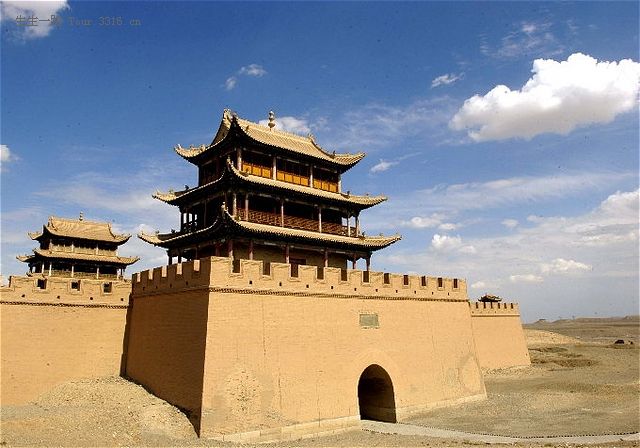
Jiayuguan or Jiayu Pass is the first pass at the west end of the Great Wall of China, near the city of Jiayuguan in Gansu province. It has also been called “Jiayuguan Pass”; however, this form is tautological since “guan” means “pass” in Chinese. Along with Juyongguan and Shanhaiguan, it is one of the main passes of the Great Wall. Construction began sometime around 1372.

Among the passes on the Great Wall, Jiayuguan is the most intact surviving ancient military building. The pass is also known by the name the “First and Greatest Pass Under Heaven” (天下第一雄关), which is not to be confused with the “First Pass under Heaven” (天下第一关), a name for Shanhaiguan at the east end of the Great Wall near Qinhuangdao, Hebei.

There is a famous legend regarding the building of this amazing monument. I have heard two versions, so I present them both here:

  1. A fabulous legend recounts the meticulous planning involved in the construction of the pass. According to legend, when Jiayuguan was being planned, the official in charge asked the designer to estimate the exact number of bricks required and the designer gave him a number (99999). The official questioned his judgment, asking him if that would be enough, so the designer added one brick. When Jiayuguan was finished, there was one brick left over, which was placed loose on one of the gates where it remains today.
  2. During the Ming dynasty, a talented architect named Yi Kaizhan was tasked to build this important outpost and finishing point for the Ming dynasty’s monumental construction effort. After finishing his plans, Yi announced that it would take exactly 99, 999 bricks to build the Jiayuguan structure, no more and no less. Yi’s supervisor thought that Yi was too arrogant and worried that any miscalculation on Yi’s part could reach the ears of the emporer with serious consequences, so he threatened that if Yi’s calculations were off, Yi and all of the workers would be punished. When construction was completed, there was one brick left over and the supervisor delightedly prepared to punish Yi for his arrogance. However, quick-witted Yi immediately told him that this extra brick had been placed by some supernatural being during the night to guard Jiayuguan and prevent its collapse, and that even the tiniest movement would cause the collapse of the entire outpost. The surpervisor, unwilling to take the risk, let the brick stay and was unable to punish Yi , and so the brick remains to this day.

Regardless of which legend has merit, the brick is there for all to see:

jiayuguan-pass-trip-34

“The world is so full of a number of things, I’m sure we should all be as happy as kings.”
-Robert Louis Stevenson

The Old Wolf has spoken.

Tell a lie often enough…

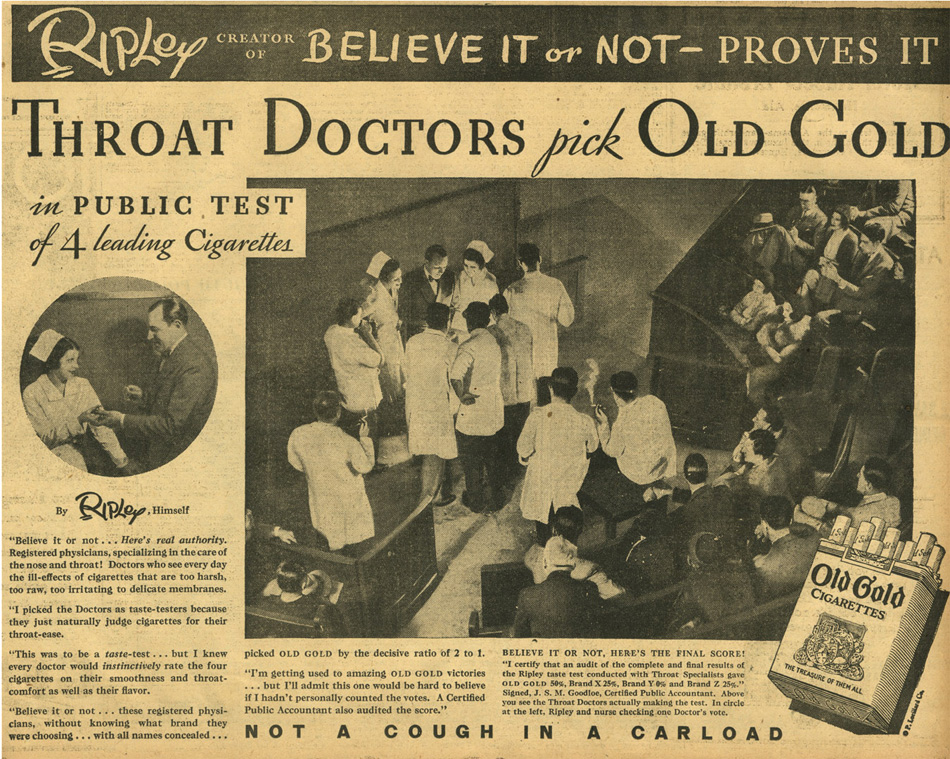
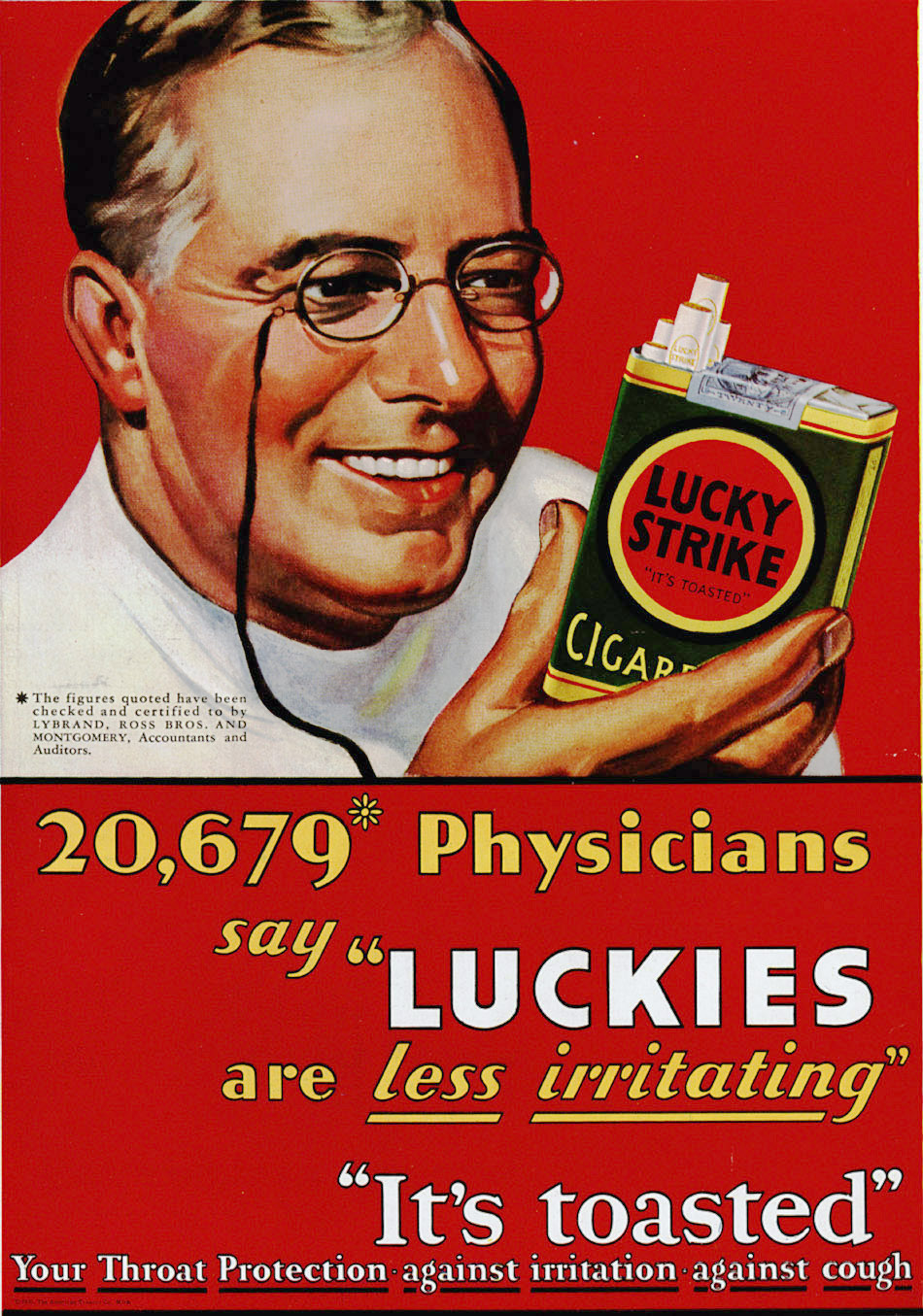
… and you’ll sell more tobacco products. (A couple of earlier posts about tobacco products are here and here.)

bemerkenswerte-bucher-1

bemerkenswerte-bucher-2

bemerkenswerte-bucher-3

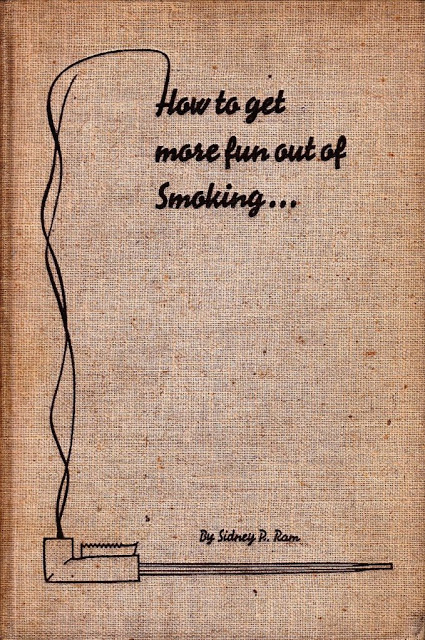
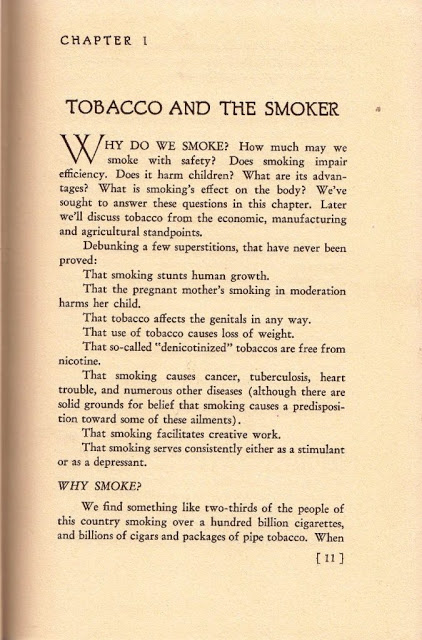
Sydney P. Ram was a Chicago pipe-maker who had a shop on the loop (he retired in 1942).  Apparently his pipes are still sought after by afficionadoes. This book was published in 1941, when advertisements of this nature were still common:

ripleysL

20679physiciansL

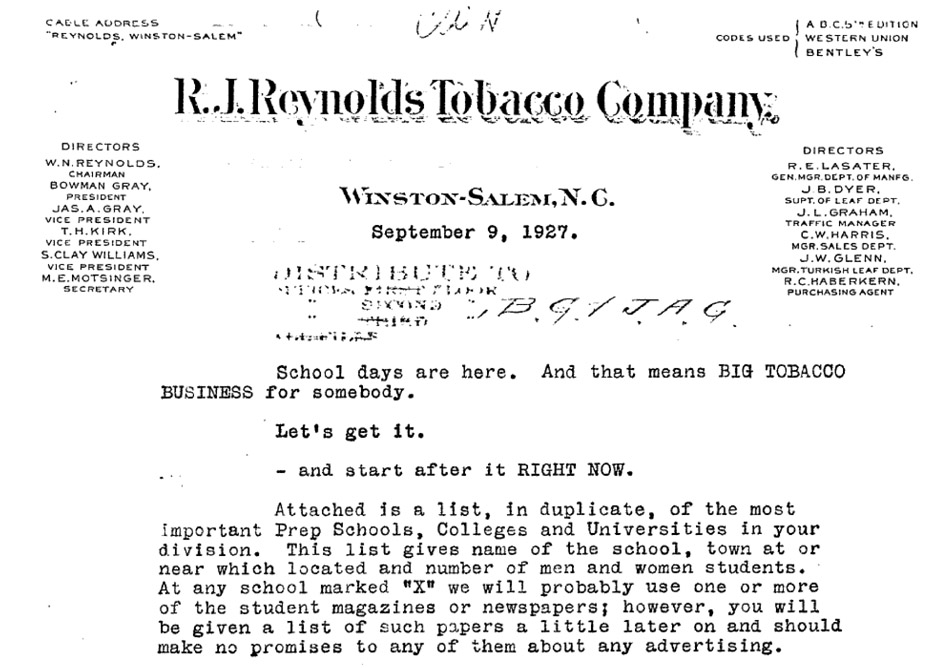
And memos like the following were (while not publicly disseminated) urging marketeers to go after the young:

rjreynoldsL

In 1952, Reader’s Digest condensed an article from the Christian Herald entitled “Cancer by the Carton.” Prior to this, very little was being publicly said about the dangers of smoking, and as we can see from Ram’s book, it was easy to muddle the issue simply by denying the “superstitions.” Anti-smoking PSA’s became one of Readers Digest’s favorite soapboxes, along with anti-Communism.

The situation was well described over at Lisa’s Nostalgia Cafe:

The worlds of advertising and cigarette smoking have been intertwined for as long as we can remember. In the first half of the 20th century, tobacco companies were major contributors to the advertising industry, and many radio and TV programs were sponsored by these companies.

As the 1960s dawned, things were beginning to change. During the 1950s, people became aware of the health hazards of cigarette smoking and began to file court cases against the tobacco companies. Private medical journals published studies linking smoking to lung cancer, and magazines like the Readers Digest ran anti-smoking articles.

The turning point came in 1964 when the Surgeon General released their first report linking smoking to lung cancer, heart disease, chronic bronchitis and emphysema. These results got everyone’s attention. The government, which had been at the mercy of the tobacco lobby, began to get involved and slowly some changes were made.

I was roped into smoking in high school in 1964. After I gave up tobacco five years later, for a while I became a dedicated crusader and I recall getting quite an assortmant of pamphlets, article reprints, buttons,

smokingsnuffyouout   smokingstinks

and other tools for use in my campaign.

Progress has been slow, but continues to be made in our country. The education campaign continues:

The faces of the onlookers are priceless.

Unfortunately and to our shame, tobacco manufacturers have shifted their focus from the US to overseas. As consumers here became more aware of the dangers of smoking, Big Tobacco looked for victims (I use that term deliberately)  in other parts of the globe. In 2019, the global market was worth $614 billion; even Everett Dirksen would be impressed by a number like that.[1]

According to the American Lung Association,

Cigarette smoking is the number one cause of preventable disease and death worldwide. Smoking-related diseases claim over 393,000 American lives each year. Smoking cost the United States over $193 billion in 2004, including $97 billion in lost productivity and $96 billion in direct health care expenditures, or an average of $4,260 per adult smoker.[2]

We can’t give up the fight. It will be slow. Tobacco is a legal product, and many people in the USA still put bread on their family’s table as a result of the industry. Acceptable alternative crops for farmers need to be found, and those who work in the packaging and shipping aspects will need to be moved into other economic sectors. If headway can be made in the legalization of industrial hemp[3], this could prove a godsend for farmers looking for a way out of the tobacco market.

Given the costs to society and individuals incurred as the direct result of tobacco use, the fight is a worthwhile one.

anti_smoking_ad_children

The Old Wolf has smoken (and is glad that he was able to quit when he did!)


[1] Senat0r Everett Dirksen was once reputed to have said, “A billion here, a billion there, pretty soon it adds up to real money.” He may never have said it, but it continues to circulate; after all, nothing on the Internet ever really dies.

[2] “Smoking-Attributable Mortality, Years of Potential Life Lost, and Productivity Losses — United States, 2000–2004”, CDC. Click through for the article.

[3] U.S. Department of Agriculture’s ‘White Paper’ on Hemp