
Roman Loranc
Edit: An update has been added down at the bottom
Back in another geological epoch (about 40 years ago or so), I worked for an outfit called “Dër Ratskeller Pizza Shoppe.” That’s right, “Dër.” When the time came to build a second shop, I helped in the process and ended up as the assistant manager there. During the course of construction, I mentioned to the owners that “ë” only exists in Albanian, Kashubian, and a few other esoteric places for phonetic disambiguation (like the archaic English form reëntry, or the French noël), and that “dër” is decidedly not German. My input was ignored.

First of all, you may rightly inquire why pizza is being served by a sprightly lad in Lederhosen. Well, the original shop served beer on tap (a rarity in Salt Lake City in the 70’s) and so the concept of a Ratskeller made sense… and they happened to serve pizza as well. Dang good pizza, too – but that’s another story.
I guess they thought that adding those two little dots would make the name look more German to the untutored public, and – looking back at it – that may have been the case, because now you see them everywhere. Madison Avenue, in a mad rush to give foreign panache to their products, appears to have gone crazy for European accents.
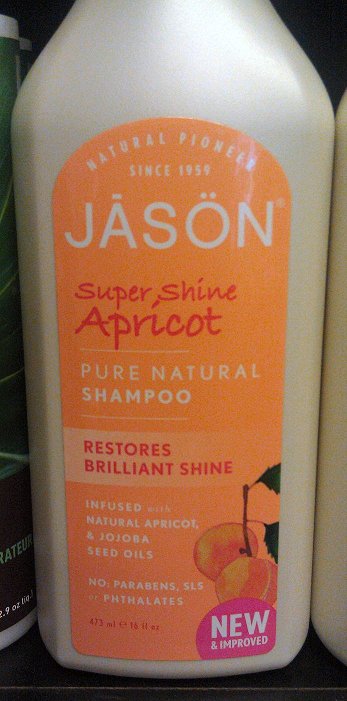
On a recent trip to Florida, I happened across these examples in the brief space of a week; I have no doubt that were I to scan the aisles of any reputable grocery store or supermarket, I would see many, many more.
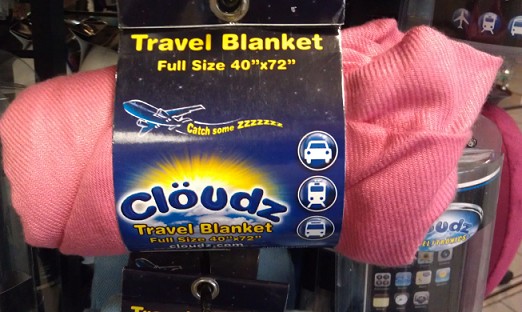

This stuff looks more like a can of Raid™

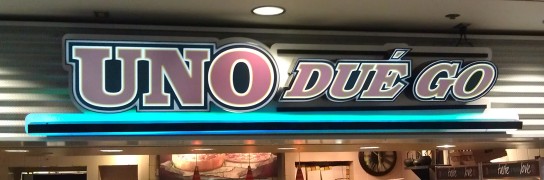
This one uses the “é”, which does not appear in the Italian word “due” (two).
The grand-daddy of them all. How is this supposed to be pronounced, really?
Americans tend to ignore the umlauts and other accents, pronounce the words as though they weren’t there, and toddle blithely along their monolingual way. But friends of mine from the Teutonic or Scandinavian countries, without the benefit of television commercials, would say these names in ways that might make them unrecognizable; good thing they don’t count. (Just kidding, folks, just kidding.)
It’s the fad of the moment. How long it will last, whether it has hit its peak, and what the next spate of nonsense will bring, no one knows. All I do know is that if I ever open a Pån-Ëurøpëan Яešţaüranŧ, I have just as much chance of succeeding as Joe’s Grill.
Edit: Only in the wee hours of February 2021 was I made aware of the concept of the “Metal Umlaut” or “röck döts” – heavy metal not being among my preferred music choices I had no idea this was such a common occurrence in the music world to have become worthy of a Wikipedia article.

The Old Wolf has spoken.
Eve’s Wireless, from the Pathe Vaults.

“So, as time went on, the Doctor got more and more animals; and the people who came to see him got less and less. Till at last he had no one left–except the Cat’s-meat-Man, who didn’t mind any kind of animals. But the Cat’s-meat Man wasn’t very rich and he only got sick once a year–at Christmas-time, when he used to give the Doctor sixpence for a bottle of medicine”
Hugh Lofting, The Story of Dr. Doolitle
A buddy of mine in the UK linked to this cartoon, which despite being humorous also points out a very real danger for the elderly:
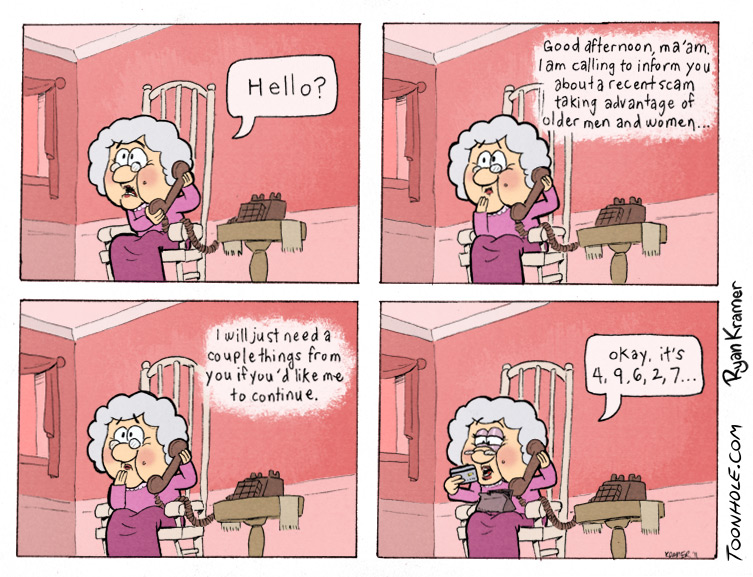
(Click the image to see the full-size cartoon)
My own mother, go ndéanai Día trocaire uirthi (Irish for “may God have mercy on her”), was victimized unmercifully by fraudsters, and lost substantial amounts of money to these miserable wastes of human cytoplasm. As a result, I was moved to put together the Sweepstakes Fraud Factsheet, as this was the kind of operation that caused her the biggest problems.

Be aware that these solicitations, while causing minimal financial loss themselves, are typically bait for larger operations. Once a victim has responded, they’ve not only lost $19.95, or however much they send for one of these worthless reports, but they are now on an ever-more-widely-circulated “pigeon list,” and can expect floods of additional solicitations and personal calls from advance-fee criminals.
This is only one of innumerable ways that the scum-suckers of the earth target the elderly; disreputable telemarketers will sell anything to anyone who is willing to give out a credit card number, and many of these spurious sales also result in recurring charges to bank accounts and credit cards.
Moral: Be careful yourselves, and if you have elderly loved ones, especially ones who are becoming senescent, do all you can to take charge of their finances or appoint guardians with power of attorney before the douchebags get their foot in the door. The FTC has a raft of additional information which lists the most common scams and how to protect yourself and your families.
The Old Wolf has spoken.
The astonishing work of Federico Pietrella.
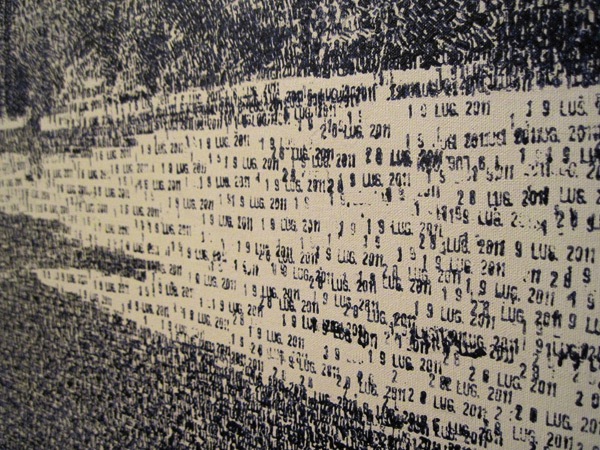
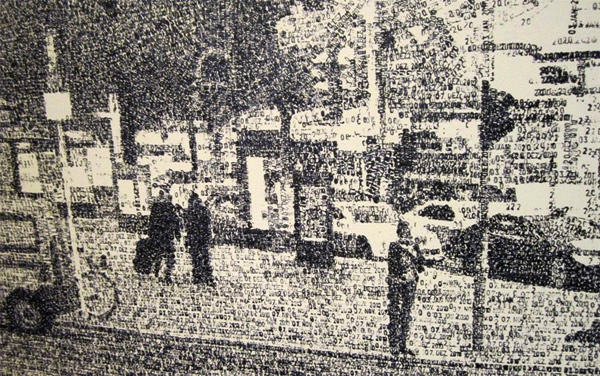

This dude understands pointillism. Or dateillism, whatever you want to call it.
One of my favorite poems as a child.
The Lamplighter
Stevenson, Robert Louis (1850–1894). A Child’s Garden of Verses and Underwoods. 1913.
MY tea is nearly ready and the sun has left the sky;
It’s time to take the window to see Leerie going by;
For every night at teatime and before you take your seat,
With lantern and with ladder he comes posting up the street.
Now Tom would be a driver and Maria go to sea,
And my papa’s a banker and as rich as he can be;
But I, when I am stronger and can choose what I’m to do,
O Leerie, I’ll go round at night and light the lamps with you!
For we are very lucky, with a lamp before the door,
And Leerie stops to light it as he lights so many more;
And O! before you hurry by with ladder and with light;
O Leerie, see a little child and nod to him to-night!

Rose Barton: Familiar London (1904)
The Old Wolf has spoken.
♬ Zinc Trisodium Aspartate, Sorbitol and Bisulfate; Oxide, Beta Carotine, Lactic Acid, Carob Bean ♬
So begins “Be Careful What You Eat,” a song by Warner Brothers’ Animaniacs, poking fun at the artificial nature of the food that we eat. While anyone who reads labels is aware that much of what we eat is highly processed and artificial, the depth to which our food has sunk was pushed into my face with some emphasis when we had lunch at KFC yesterday.

The perky little girl behind the counter asked if we wanted butter and honey with our biscuits, and while I was aware that what she was offering me was neither butter nor honey, I had never taken a good look at the ingredient lists. What we actually got, and what KFC has been serving for several years, was “Buttery Spread” and “Honey Sauce.” These words are red flags in themselves, just like “Juice Drink” or “Cold Pack Processed Cheese Food Product,” which are guaranteed to contain very little juice or cheese, respectively.
Interestingly enough, the ingredients for these little delights are not found on KFC’s ingredients listing; it’s a dirty little secret that Yum! brands would rather, it would seem, keep buried. On the internet, no one may know whether you really are a dog, but there is very little information which can be kept hidden; as a result, it wasn’t hard to find these:
Honey Sauce
High fructose corn syrup, Sugar, Honey, Corn syrup, Natural Flavors, Caramel Color
Buttery Spread
Liquid and Partially Hydrogenated Soybean Oil, Water, Salt, Hydrogenated Soybean Oil, Vegetable Mono and Diglycerides, Soy Lecithin, Sodium Benzoate (A Preservative), Natural and Artificial Flavor, Beta Carotene (Color), Vitamin B Palmitate Added. Contains Soy.
These listings sound just as bad, if not worse, than the Animaniacs song. While in and of themselves these things may not be toxic, they’re certainly not natural, and they are in no way they should be called “Butter” and “Honey.” While the issue is only sufficiently annoying for me to post a mini-rant here, I wouldn’t be surprised if some lowlife attorney hungry for billable hours were able to scare up a client willing to bring a case against Yum! for misrepresentation.
The lesson here is that the more processed the food, the less healthy it is.

One of these days, I may just start taking my own advice again.
The Old Wolf has spoken.
Back in the early days of VCR’s, Hitachi was a fairly common name in imported electronic consumer goods. Most RCA VCR’s were manufactured by Hitachi as well.
I came across this old ad for Hitachi Lamps (Strong! Bright!) and it unleashed a flood of memories.

The thing that grabbed my attention when I saw this ad was the logo.
Oh, that logo. To my eyes and to my mind, it’s one of the most beautifully-crafted company logos I’ve ever seen, because it morphs the company name into a distinctive, attractive, and easily-recognizable glyph. It’s a shame they’ve given it up in favor of an English version,

although in a global market it makes a certain amount of sense.
If you have not had the privilege (or torment, depending on your outlook) of studying Japanese, let me just point out that the language is written with four separate writing systems: kanji (characters like 電 – electric, or 雨 – rain); hiragana (ひらがな – usually used for grammatical endings, particles, and pronunciation for children, among others); katakana (カタカナ – used for representing sounds and foreign words); and “romaji” (the roman alphabet, used for writing English words which are used in Japanese or in advertising, among other things.)
This makes learning the language for a foreigner doubly challenging, but to the Japanese mind it makes perfect sense. The meanings of words are so closely bound up with the visual aspect of kanji that instead of spelling a word that sounds ambiguous, a Japanese will sketch the character on his or her palm.
The name “Hitachi” in Japanese is rendered as 日立 (日, “hi”, meaning “sun,” or “day,” and 立, “tachi/tatsu”, meaning “rise” or “stand” or a bunch of other things.) Characters, however, began as pictures, and gradually evolved over time into the stylized forms we see today.

The history of the character for “sun”.
So what the brilliant designers at Hitachi did was to take the company name, and using the old form of the first character, skilfully blended the two into an eye-catching logo:

To an American, a distinctive symbol – to a Japanese, not only a picture but the company name, beautifully rendered. I miss seeing it.
The Old Wolf has spoken.

 Playing in the World Game