Passwords are the bane of computer users and IT administrators, and – for the most part – an open, beckoning door to hackers, scammers, and Russian Viagra spammers.
But until someone comes up with something more practical and secure, we need them.
Sure, people are trying. Fingerprint scanning, retinal scanning, all sorts of biometric stuff is either on the market or in development, but thus far there seem to be either financial barriers or security questions around many of these.
So we continue to use passwords.
I’ve written about strong passwords and stronger passwords; for myself, I do my best to make my passwords as strong as possible, but I have dozens of them, and that makes them hard to remember.
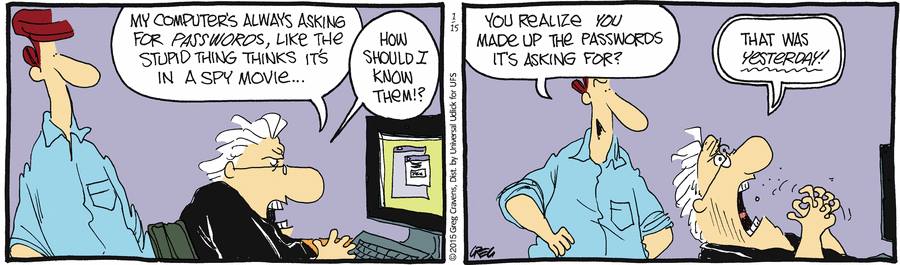
A cartoon posted by an IT colleague of mine just today points out the difficulty, especially as we grow older:
As Friedrich Althoff (not Konrad Adenauer) said, “Was gebe ich auf mein dummes Geschwätz von gestern?” (What do I care about the stupid hqiz I said yesterday?”)
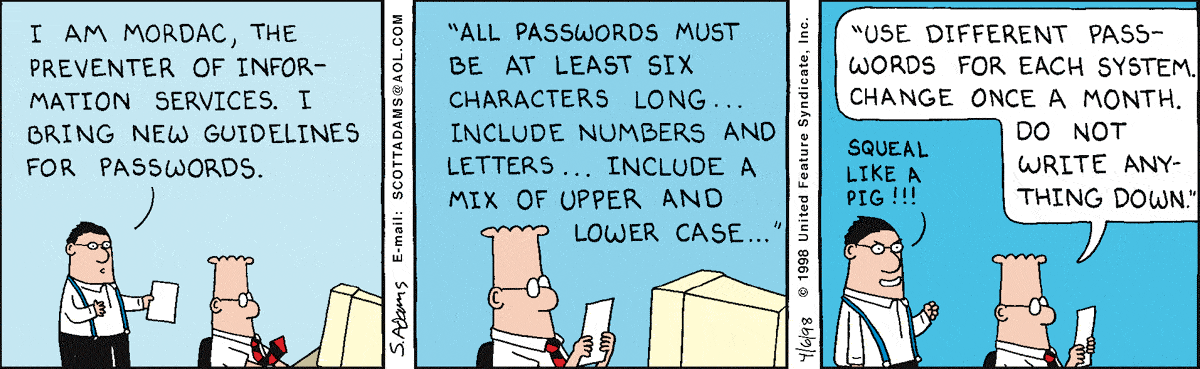
Now, some sysadmins take joy in making things as hard as possible for their user base:
Having spent years in IT, Mordac is hands-down my favorite Dilbert character. Parenthetically, Mordac’s appearance has changed over the years, but I like this iteration the best because he reminds me of one of my old IT colleagues, who was paradoxically one of the nicest guys I’ve ever met.
On the other hand, it drives me nuts when webmasters limit their passwords; given the nature of hacking attempts, to deliberately block users from including spaces or special characters in their passwords is inviting more incursions, and whenever I encounter a site like this it makes me want to reach through my modem and slap someone to Nouakchott and back.
So how does one remember a laundry list of passwords without putting sticky notes on your CPU? Well, there are certain encryption programs and lockers out there that allow you to keep these things written down, using one (very complex) master password to access the file, which is my preferred method. Another one is using mnemonics such as Tt*hiwwUR (sing “Twinkle, twinkle, little star”…) but it’s tough to come up with a whole grundle of these.
Whatever the case, you owe it to yourself to use strong passwords wherever your identity or your data is at risk. The recent massive hack at Sony is a perfect example of why (even though this may have been an inside job, which would render any company vulnerable.)
This will be a short post, with a good video to watch.
I’ve written before about why tipping is not optional. The video below addresses that, but provides a good overview of why the example provided by Bar Marco – banning tipping and paying their servers a living wage – is a good idea, and should be the wave of the future. Mind you, Bar Marco is not the first – Sushi Yasuda started the practice in 2013. It is my hope that the entire industry is ultimately going to follow suit.
I love eating out, and if prices go up a bit to make this happen, as far as I’m concerned, it’s well worth it.
The video is below. It’s from College Humor, so there’s a bit of language in it – but I recommend this short film to anyone who enjoys dining out.
I’ve written about making fun of the German language before, which included references to Fraulein Bo-peepen And More Tales Mein Grossfader Told, by Dave Morrah, and John Hulme’s Mörder Guss Reims – the Gustav Leberwurst Manuscript, but recently while scanning papers from my mother’s estate, and she has a lot of them, including things her own mother collected, I ran across a few previously unseen gems.
Before we go on, remember that a working knowledge of German was necessary for a serious study of organic chemistry in days gone by; Beilstein’s Handbuch der organischen Chemie was the seminal reference book, so famous that Isaac Asimov wrote a story using the book and the author’s name as its central conceit (“What’s in a Name”).
The following material was found in Newscripts, a column that ran in “Chemical and Engineering News”
Once upon a time, the requirements for a degree in chemistry included reasonable competence in a foreign language. A jocular essay in fractured German in those days could be counted on to convulse a chemical audience. Two such yarns that appeared during 1952 were” Der Franklin und sein Keit” (April 28) and “Der Volta und seine Peils” (June 2). Language skills were declining even then, however, and Newscripts noted only five years later that “To keep up with rapid advances in technology … scientists have had to develop new terms-and also ways of translating these terms into foreign languages. An up-to-date English-German glossary … includes:
Guidance system: Das Schteerenwerke.
“Preset guidance: Das senden offen mit ein pattenbacker und finger gekrossen Schteerenwerke.
“Warhead: Das Laudenboomer.
“Nuclear warhead: Das eargeschplitten Laudenboomer.
“Project engineer: Das Schwettenoudter.” (Sept. 9, 1957)
The following stories should be read aloud in a heavy Colonel Klink accent for best effect:
Der Franklin und sein Keit
(Originally printed, we are told, in the Journal of the Electrochemical Society, some 30 years ago)
Der Franklin der war ein rechter Tschinius, immer bissig mit Inwentschiuns, wie zum Beispiel sein Stohf, den wir bis heute noch bei seinen Namen kennen. “Bei Galli”-so meinte er eines Tages-“es ist doch e’ Skandel und e’ Schem, dass so viele Häuser von Leitning gestreikt werden. Wenn ich das prewenten könnte, es wäre schur eine kühle Million wert. Aber was ist denn eigentlich der Leitning? Ennihau, ich habe e’ Honntsch!”
Also baute er ein Keit, mit einer langen String mit e’ Kieh am Ende, und geht in die Beckjahrt, ihn zu fleihen. Und wenn es zu regnen anfängt, und der Leitning flescht, so steckte er e’ Knockel an den Kieh; un achherrjesses! der Spark rippt ihm zwei Fingernehls und e’ Viertelskwerrfuss Skinn von der Hand ab; und der Franklin weiss nun, von dem Schock, dass Leitning und Electrozität alleik sind.
Sodann steigt er auf die Ruf mit e’ Bumberschuht mit e’ stiehl Händel, und wartet für mehr Leitning; aber die Deborah – das war sein Frau – die hollert, das Sopper sei rettig, und er soll Hörriopp machen und aufwaschen und ins Haus kommen. Also machte er den Bumberschuht an den Daunspaut fest – und das war der erste Leitningrad.
Der Franklin war lockig und so lebte er noch vierzig Jahre, und hatte alle gestumpft-besonders die Lehdis; aber ein russicher Physiker, der den Keitexperiment repieten wollte, wure vom Leitning gekillt;-was alles pruhft, der wahre Scientist hat nicht senns genug, vom Rehn auszukiepen.
– Sol Nemen
Der Volta und seine Peils
Die Studenten in der Universitaet zu Pavia waren Holitaerrers,—die Strietlemps haben sie am Halloween gebostet und die Garbetschkenns gedommpt—und sieben Mal in einer Nacht haben sie dem Prof. Alessandro Volta den Dorrnacker geklappert. Da hat der gute Doktor doch endlich ein Fiuss gebloht. “Nun ist doch mein Limit gerietscht” fuhmt er, “elende Lohfers, euch will ich fixen!”
Und so denkt er nun, wenn andere mit blos zwei Metallstuecke Froschschenkel twitschen machen konnten, was wuerde er nicht selbst mit e’ Koppel hundert Metallpaare akkomplischen! Also nimmt er e’ silber Bock, un e’ Zinkwascher, und e’ Stueck Blattingpapier das er erst in Salzwasser gedunkt hat, un noch e’ Bock, und wieder e’ Zink, und so an, bis er ein Peil von eibettju ennihau 300 Volts hat. Dann hitscht er ein Ende des Peils mit e’ Weier an den Dorrnacker, un graundet das andere Ende, und ohboi! der naechste Bursche, der den Nacker retteln will, wird selbst fuer e’ Lup genackt.
Der Volta reported sein Socksess an dei Royal Society in London, und bald haben die Scientists in allen Laendern auch Peils, – noch viel groesser wie Voltas – und fangen an, Leute zu schocken, und zu elektroleisen, un sogar zu plehten, wie niemand sein Bissness. In Poland gab es zwei Professore, die hatten e’ Brehnsturm und haben die Weiers von der Batterie getehstet! Der erste insistet, es schmeckte sauer, der zweite meint nein, mehr wie Seife; der erste sagt, “Mein Meind is aufgemacht, es ist doch so”; der andere sagt “Balloni!”; und so kommt es, dass noch heute an jeder Batterie e’ positiver Pol und e’ negativer Pol ist.
Volta wurde fuer seine Arbeit von Napoleon geonnert, und seine Stadt hat ihn Praeseident fuer Lief von der Pavianerhalloweenneusundhellrehsungsverhinderungsgesellschafft gemacht. Zwar haben die Buben nie wieder mit seinem Dorrknacker gemonnkieht, doch schon am naechsten Halloween haben sie sien Beckhaus getippt und einen sehr toten Skonk durch sein Fenster gehieft. Und so haben ihm seine Peils am Ende doch viel Trubel gemacht.
Around December 20th, I entered a drawing for a $2,500 mall shopping spree. Of course, I didn’t win – but what I got was a call from representatives at “Rewards Fulfillment,” letting me know “we had been selected” to receive a “luxury vacation.”
Well, I’ve written about this kind of scam before. This time, it was Global Travel Network. They called me, told me “I had been selected based on my demographic profile,” and all I had to do was go up to Salt Lake for a presentation and to collect my prize.
The musicians have changed, but the music remains the same.
I told them I was not interested, and why. Thank you for calling. Goodbye.
Were we done? Not by a long shot. These people or their contractors called me back five times more, each one giving the same spiel, and each one being given the same information from me: 1) I’m not interested. 2) This is the [n]th time I’ve been called. 3) please remove me from your database.
Today I got a call from a lady who acknowledged that I had told previous agents that I wasn’t interested. She launched into a sales pitch, saying she was from quality control and her job was to make sure that her agents were doing their job right. I explained to her Rule No. 1 of sales: “Never try to sell to someone who isn’t going to buy.” Yet she rattled on for 15 minutes, trying to get me to come in for a presentation that I wasn’t interested in (I was just waiting for a car to be repaired and had nothing else to do at the moment.) They must get paid based on how many people they sign up.
Talk about relentless and disrespectful. This outtfit is worse than a rogue debt collector, and there seems to be no way to get them to stop calling. Each call, for what it’s worth, has come from a different phone number.
Here are a couple of horror stories about Global Travel Network: This one and this one.
An investigative report from 9News in Denver give you a good look at how the scam works – apparently Global Travel Network is behind this as well, but in Denver they were representing themselves as Global Connections, and hijacking that company’s BBB rating. Nice and honest, huh? Global Travel Network is not accredited with the BBB; have a look at what the Better Business Bureau has to say about them as of 1/12/2015:
This company has a pattern of complaints alleging misrepresentation during initial contact with the representative as consumers allege being offered several different incentives for attending a presentation such as gas cards, cruises, round-trip airfare, free vacations, etc. with promise that nothing will be required out of pocket and there are no black-out dates or restrictions. Once consumers receive said incentives or attempt to book their vacation they find that what was initially promised to them is not what has been received. There are additional fees required or difficulty booking the vacation.
While the business has responded to the BBB’s concerns and stated all terms and conditions of the offers are disclosed and that additional training has been set in place to ensure that this no longer occurs, BBB has continued to receive complaints with the same underlying issue.
/* When I wrote this, only God and I understood what I was doing. Now, God only knows */.
/* I dedicate all this code, all my work, to my wife, Darlene, who will have to support me and our three children and the dog once it gets released into the public. */
/* Drunk, fix later */
/* Magic. Do not touch. */ [1]
/* This code sucks, you know it and I know it. Move on and call me an idiot later */
*/ I am not responsible of this code.They made me write it, against my will.*/
/* I can’t divide with zero, so I have to divide with something very similar result = number / 0.00000000000001. */
/* If you’re reading this, that means you have been put in charge of my previous project. I am so, so sorry for you. God speed. */
/* If this code works, it was written by Paul DiLascia. If not, I don’t know who wrote it.*/
[1] This must have been the code that produced miraculous results… for a brief time. I’ve referred to this before, but it seems appropriate here.
CALL MAGIC
One day while cleaning off my desk there came
Into my hands a scrap, upon it writ
Five lines of code – a subroutine whose name
Was “Magic” which required no arguments.
My curiosity began to itch.
I wrote a simple driver with but one
“Call Magic” statement – and submitted it
And walked outside to bask beneath the sun.
Four hours later I awoke in pain.
A sunburn had decided it should
Take out a lease and dwell upon my skin.
So I returned inside in no sweet mood.
I claimed my job – my reason was enraged.
Queer looks were given me when I exclaimed,
“Great Caesar’s Ghost,” for on its final page
Was “For your sunburn try some Solarcaine™”.
Three times I ran that job – three times amazed.
For once it solved a problem that had been
My tormentor for months, and, sans arrays,
It gave a winning strategy for Gin.
The second run output a proof which showed
That every map with four colors may be
Completely marked and all adjacent nodes
Have different hues for their identity.
The third described a model of the skies
Which made the Einstein formulation seem
As trivial as one plus four is five,
And yet could be explained to a Marine.
Just one more time I ran that job and while
It executed I sat deep in thought.
I concentrated all my earthly guile
On making “Magic” show the key to Luck.
The world is full of greed and avarice.
It spins on axes hewn from Mankind’s lust.
Small children learn – avoid the precipice
Of grabbing for that final piece of crust.
No trace of “Magic” could be found by this
Sad author after I turned in that job
Which disappeared with all the prevous
Results collected – dust to worthless dust.
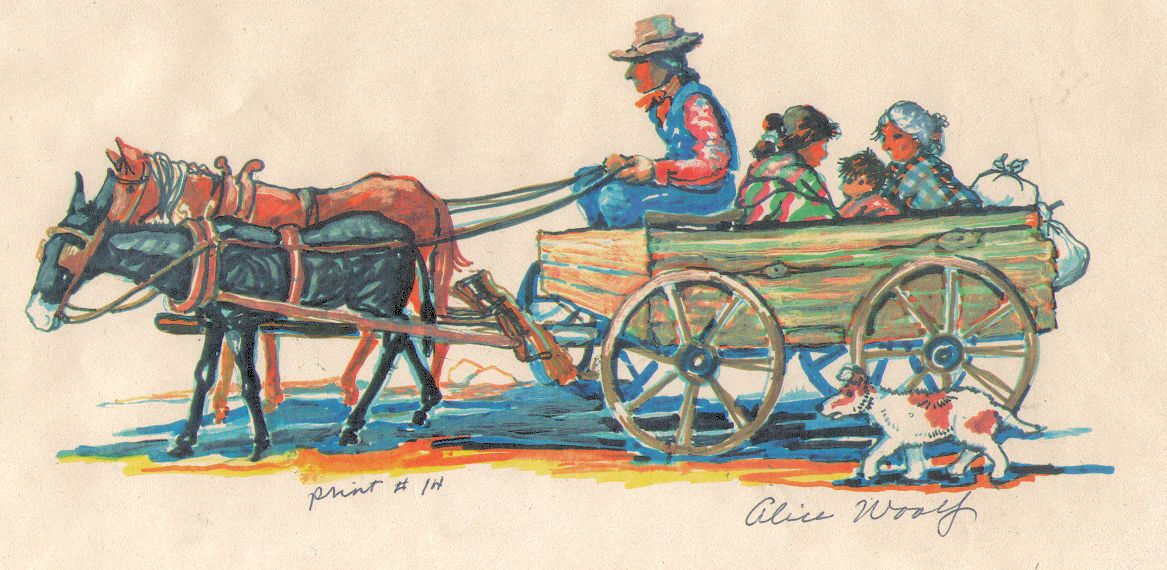
Alice Bartlett Woolf, a painter, writer, master teacher, horse breaker, and story teller, was also a dear friend of my mother. While working on scanning my mother’s papers, I came across an article that Alice had submitted to the Utah Humanities Review for their first edition in October of 1947. I found it delightful, and thought it worth sharing here. I have provided a PDF version of the article for anyone who wants to download it. The essay gives a homey, affectionate and impartial look at Mormon communities in the first half of the 20th century; there is much to be envied in the lifestyle of these simple and sincere people.
SKETCHES OF LIFE IN THE UINTAH BASIN
Woolf, Alice B.
Utah Humanities Review
1 (October1947): 313–319.
Expecting the mode of life and the people to be much changed, I was going “home” for a vacation in the red sand hills of northeastern Utah. As I turned my car north from U.S. highway 40, I was delighted to see again the small farms on either side of a very muddy and rutted road. Of course, I reasoned, the very structure of the farms, with outbuildings, Jackson-fork hay derricks, stackyards, and straw-covered. sheds couldn’t have all disappeared in the space of fifteen years. But what of the people? Had the innovation of electric lights, radios and refrigerators changed their way of life? Did they still refer to a journey to Salt Lake, or some place other than the Uintah Basin as “outside”? Had the oil boom in the nearby town of Vernal urbanized them?
SUNDAY MORNING – Alice Woolf
After several weeks in Uintah and Duchesne counties I concluded that life in general was much the same as it had been when I was a child of the sagebrush, happily riding my pony between prairie dog holes.
Of course, one may wonder why anyone should hope that small communities of people would not change; and after some thought, I decided that the people in the farm area to the south of the Uintah Mountains are, by and large, the happiest group I have ever known. I had been worried lest the “finer things” of civilization had made them unhappy with their lot, for to the casual observer the small farmer in the Uintah Basin has so many natural odds against him that it seems incredible that the country has ever been populated. He has a constant battle with wind, sand, drouth, and grasshoppers. Getting water to the land has been a major problem since the land was homesteaded, and even today everyone donates time to the building of canals and ditches, in an effort to fight the desert dryness.
MAIN STREET – Alice Woolf
The main factor in this happiness the people enjoy, it seems to me, is the complete social integration of all members of the community. From birth, children go through the same experiences as their elders. They work or: the farms, go to church, visit the stores, listen to conversations, attend dances and all public social functions. Most of their parents did the same. Thus the group becomes tightly knit. Everyone in our own particular community (the nucleus of each community being the church, school, store, and post office) knows whether you were quiet or fiendish in church, how well you did your lessons in school, when you had your first date, how much a dozen you are getting for your eggs now that you are grown and farming for yourself.
One finds the people themselves tolerant and understanding with members of their own community, or of communities they would consider neighboring. They discuss the faults and failings of friends, as well as their good qualities, with joyous abandon. However, this ready acceptance extends only to the group. A stranger entering their midst – let’s say someone from “outside, ” perhaps Colorado or Wyoming – would receive a very reserved welcome from everyone, and it would take considerable good-will on the stranger’s part to draw any attention but the rather austere courtesy that is far from impolite, but leaves the atmosphere a little frigid.
Farm methods have improved somewhat in the last few years. There are more tractors and less broken-down teams. Nearly everyone has a car, and there are actually people in the farming district who are getting running water.
In dress the people are utilitarian rather than stylish. The men wear overalls and work shirts, and the women effect the typical “Utah” house dress and apron.
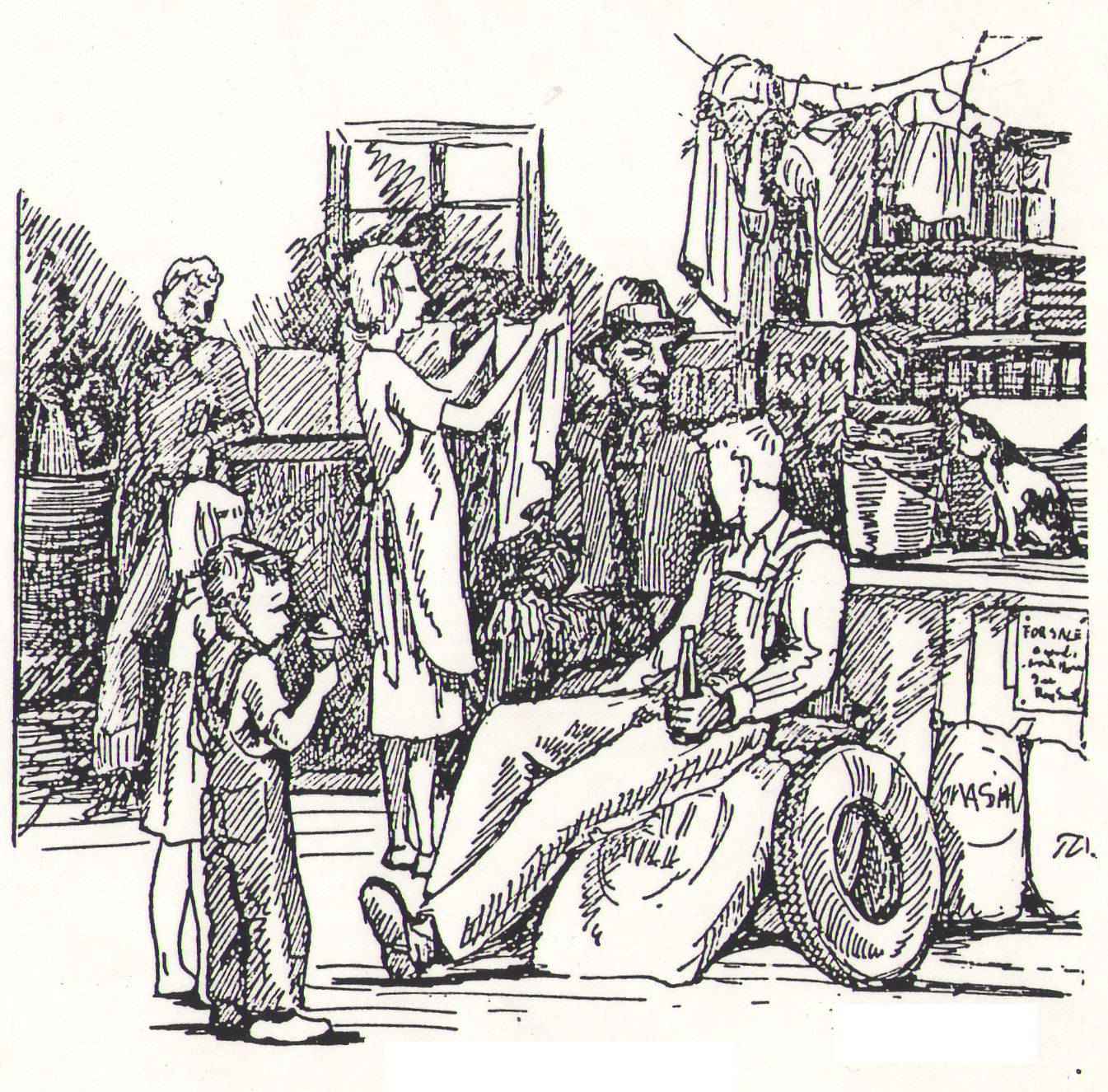
COUNTRY STORE – Alice Woolf
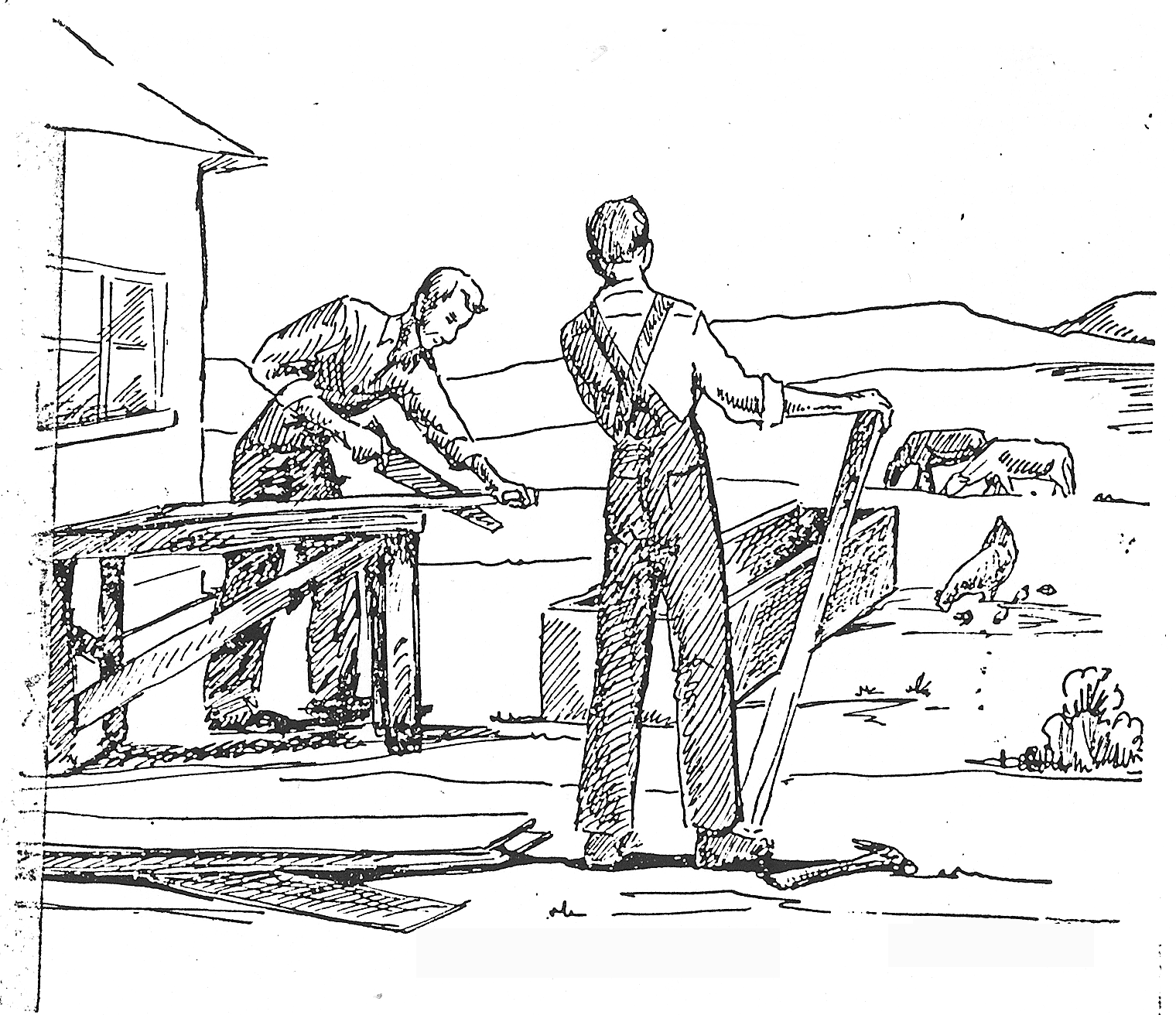
In the series of sketches, I chose several pictures which depict the life of the people. The one entitled “Main Street” is actually a typical thoroughfare in rural life. The barbed wire fence in the background encloses a pasture that lies between the store and the school house. l would like to call attention again to the children, who, even though small, are becoming used to grown-up talk, and the exigencies of grownup life.
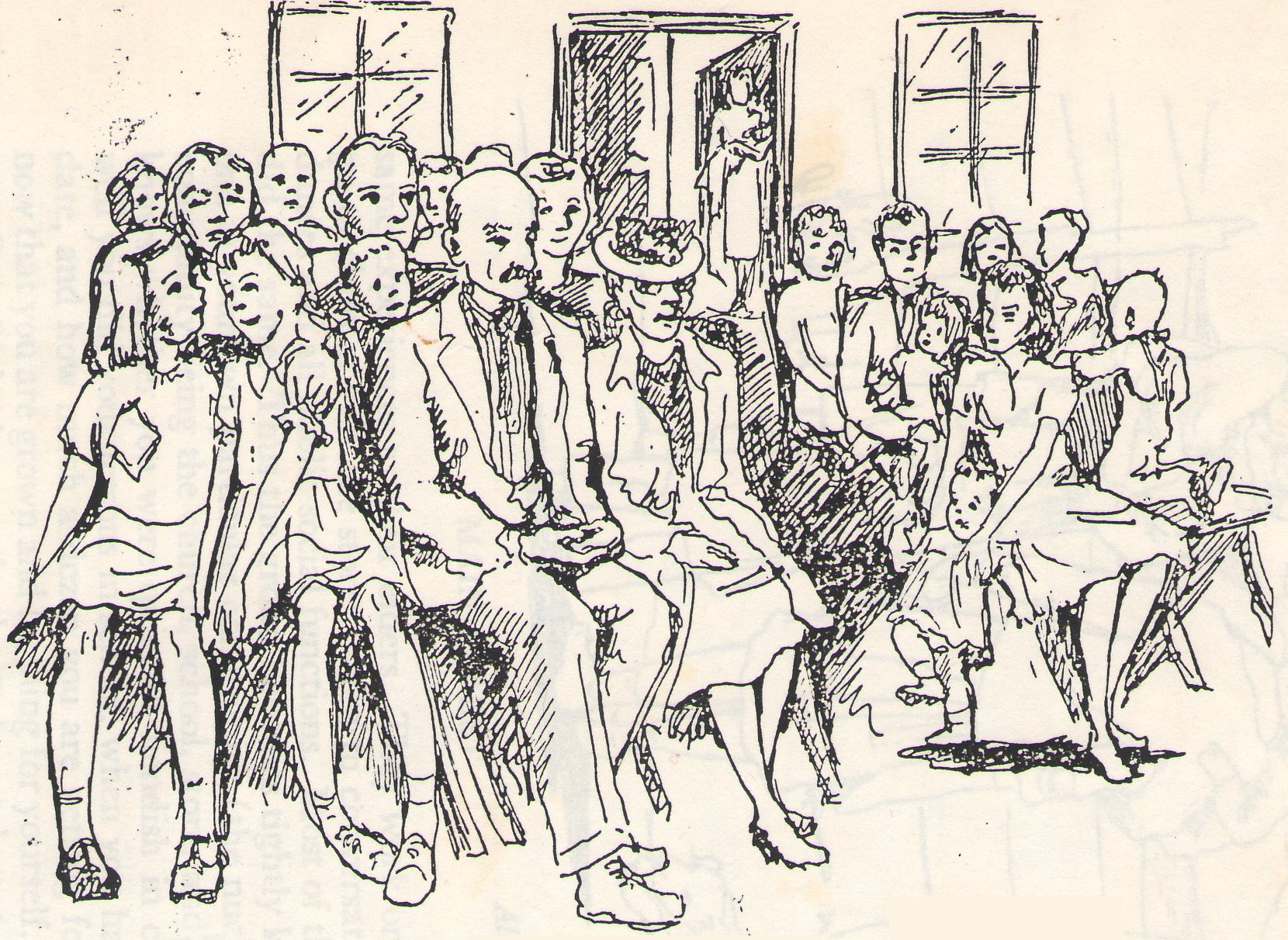
I have chosen two other sketches dealing with social pleasure. One is the interior of a typical rural store, where the people come partly to buy and partly to visit. There is nearly always a family or two in the store, the men, of course, discussing weather and crops, and the women doing exactly what visiting women have always done talking a mile a minute. The second sketch concerns a dance. This one happens to be at a Gold-and-Green Ball, but is a scene that might be sketched at any country’ dance. Unlike dances in the city, this one is not selective; everyone comes. Many come as “lookers-on.” They simply choose a scat and tend children and visit. The young women, both married and unmarried, come in delightful confections of pink and blue tulle, as “formal” as can be. Older children slick up in their Sunday best and dance or not as they feel inclined. The charm of the whole occasion is that everyone has a good time, the dancers dancing, the onlookers speculating about any new romances, and the children just being children. At midnight the three or four-piece orchestra plays “Home Sweet Home, ” and the hall is vacated, except for a few older boys who stay to put the chairs up for church next morning.
GOLD AND GREEN BALL – Alice Woolf
When someone in the community dies, friends of the family build the coffin. This is looked on not so much as a distasteful task as a last kindly gesture toward the deceased, and even though neighboring towns have undertaking parlors, it is rare indeed that the dead are not cared for by their own friends.
MAKING COFFINS – Alice Woolf
Sunday morning finds nearly everyone at church. If chores or housework keep people until past the starting time, they come late, expecting everyone to understand. Here again we see ail ages amalgamated together in the large general assembly. No one minds the general hubbub caused by the small children, least of all the people conducting the church service, who are very likely tending children of their own. Somehow everyone comes away from the church uplifted spiritually, although an outsider might find the whole atmosphere confusing.
Last but not least is the sketch called “Saturday Night.” Never, in my return visit, did I fail to feel nostalgic as I walked into a warm kitchen and saw the tub on the floor and warm towels on the down-turned open door. If there is one thing above others that seems to cement family solidarity, it is the Saturday night bath. By the time everyone has participated in chopping wood and carrying water in preparation, and has emerged clean and shining from a tin tub, all seems right with the world.
SATURDAY NIGHT – Alice Woolf
After spending several months in such an area, it is a little difficult to return even to the modestly urban life of Salt Lake City, as it is always hard to leave a peaceful life among happy people for a life that is more hectic and far less happy. Struggling with wood-chopping, water-carrying, and a cow-to-you milk supply is incidental when one has a joyful life. If one makes the slightest attempt to live within the group mores and customs his life can be an open book – read and accepted by all, good and bad alike; and he can of course help in accepting his acquaintances, good and bad alike. With such community solidarity, as long as one stays in the community, security and contentment are forever present.
Two prints of artwork by Alice WoolfAlice and my mother were born in the same year; Alice passed five years before mother did, but they were lifelong friends, and I recall hearing many stories about her as I was growing up. I’m pleased to share this bit of Utah history which, thanks to Alice’s insights, has been preserved.
Every time I see an article posted about bad police behavior, someone chimes in about the officer being given “paid vacation” for his or her transgression.
It is not “paid vacation.”
Below a comment from redditor /u/thatsnotminesir, a police officer who gave a comprehensive explanation of what “administrative leave” really means, at least in his department – and it sounds like this is how it should work.
The myth I see the most of reddit is that when officers get in trouble, they just get “paid vacation.”
When an accusation of misconduct comes up, especially criminal misconduct, the officer is placed on Administrative Leave with pay. This is NOT the punishment. This is to get them off the streets while the investigation is being conducted, while at the same time, not punishing them (financially at least) until the accusations are investigated and proven.
When an accusation of Police Misconduct is investigated, there are TWO separate investigations. One is an Administrative Investigation, the other is a Criminal Investigation. They have to be separate because of Garrity.
Garrity is like the evil twin of Miranda for government employees, mostly police. After the Garrity admonitions are read to us, we MUST answer all questions, and MUST answer them truthfully. If we refuse to answer, or lie, we can be fired just for lying or refusing to answer.
That completely violates our 5th Amendment Right against self incrimination. Because of that, nothing said after Garrity can be used against us in criminal court. It can only be used in administrative actions against our employment.
Therefore, two separate investigations are conducted. An Administrative Investigation where they read us Garrity, and a Criminal Investigation where they read us Miranda. Nothing found in the administrative investigation can be used against us in the criminal, but things found in the criminal CAN be used against us in the administrative. So the criminal is usually done first, then the administrative afterwards.
Because the administrative is usually done after the criminal, that’s why it often takes time for the firing to happen, because the firing won’t happen until after the Administrative. While that seem strange to the laymen, if the Administrative was done first, and officer could say “Yeah I stole the money” under Garrity and it couldn’t be used against him in court. But if the criminal is done first, and he says “Yeah I stole the money” after Miranda, it can be used to prosecute him AND to fire him.
Once the two investigations are complete, THEN the punishment is handed down if the charges are sustained. Media articles don’t always follow up on the case, so all people read in papers is “officer got in trouble, is on paid leave.” Administrative Leave is just the beginning, not the end of the story.
Even then, the Administrative Leave isn’t fun. The take your badge and gun and you are basically on house arrest between the hours of 8am and 5pm on weekdays. You cannot leave your home without permission of your superiors, even it its just to go down the street to the bank or grocery store. You must be available to come into the office immediately at any time for questioning, polygraphs, or anything else involved in the investigation. Drink a beer? That’s consuming alcohol on duty, you’re fired. So even when officers are cleared of the charges and put back on the street, Admin. Leave still isn’t “paid vacation.”
EDIT: I did not realize the wiki explained garrity, but gave such a poor example of the admonitions, leading to some confusion. Here is a much better example.[3]
Here’s the original wiki[5] for those who wonder what I changed.
This was an eye-opener for me. Anyone who has watched cop shows knows about Miranda rights, but I had never heard of Garrity. The post was a good education – forever after, I will never wince the same way I used to when a news article mentions administrative leave.
There are a lot of stories in the media this year about police misconduct. That may be a good thing, but a lot of it seems like clickbait, low-hanging fruit for getting eyeballs on ads. It would be critical for our nation for every police department in the country to weed out its rotten apples and bad actors, but even if this were to happen, the number actually purged would be very small in comparison to the majority of men and women who entered law enforcement for better motives.
Let’s not forget what Jon Stewart recently said:
“You can truly grieve for every officer who’s been lost in the line of duty in this country and still be troubled by cases of police overreach. Those two ideas are not mutually exclusive.”
More information about Garrity
The Garrity rights, Garrity rule or Garrity warning is a protection that is utilized by many law enforcement officers each year. Simply, Garrity is an invocation that may be made by an officer being questioned regarding actions that may result in criminal prosecution.
The Garrity Warning
This article is geared toward law enforcement, but the Garrity Warning is also available for other employees of state and local government organizations.
The Garrity Warning is often misunderstood as it is inconsistently applied throughout the country. In some states it may be read to the employee before questioning begins. In other states, the employee must invoke his or her Garrity Rights.
Simply, our Constitution protects everyone from having to criminally incriminate themselves. We cannot be forced to testify against ourselves.
By invoking the Garrity, the officer is invoking his or her right against self incrimination. Any statements made after invoking Garrity, may only be used for department investigation purposes and not for criminal prosecution purposes.
The Garrity Rule stems from the court case Garrity v. New Jersey, 385 U.S. 493 (1967), which was decided in 1966 by the United States Supreme Court. It was a traffic ticket fixing case of all things.
Officers were advised that they had to answer questions subjecting them to criminal prosecution or lose their jobs. The Court held that this was Unconstitutional.
Technically, there are two prongs once Garrity has been triggered.
First, if an officer is compelled to answer questions as a condition of employment, the officer’s answers and the fruits of those answers may not be used against the officer in a subsequent criminal prosecution. Second, the department becomes limited as to what they may ask. Such questions must be specifically, narrowly, and directly tailored to the officer’s job.
Thus, the basic thrust of the Garrity Rights is that a department member may be compelled to give statements under threat of discipline or discharge but those statements may not be used in the criminal prosecution of the individual officer. This means that the Garrity Rule only protects a department member from criminal prosecution based upon statements he or she might make under threat of discipline or discharge.
Also, the Garrity Rule is not automatically triggered simply because questioning is taking place. The officer must announce that he or she wants the protections under Garrity. The above statement should be prepared in writing, and the officer should obtain a copy of it. If a written statement is being taken from an officer, the officer should insist that the Garrity Warning actually be typed in the statement. Consult your attorney and union delegate for the laws regarding Garrity in your state before providing any statement.
In New Jersey, the Garrity Warning is actually covered in the New Jersey Attorney General Guideline on Internal Affairs. Simply, if an officer being questioned invokes his Garrity Rights, the agency can contact the county prosecutor. The county prosecutor can elect to grant use immunity which will prohibit any part of the officer’s statement from being used against him or her in a criminal proceeding. But, if use immunity is granted, the officer is required to answer the questions.
Below is an excerpt from the Guideline:
If the subject officer states that he refuses to answer any questions on the grounds that he may incriminate himself in a criminal matter, even though the investigators do not perceive a criminal violation, the department should discontinue the interview and contact the county prosecutor.
If the department wants to continue its administrative interview, and the county prosecutor agrees to grant use immunity, the department shall advise the subject officer, in writing, that he or she has been granted use immunity in the event his or her answers implicate him or her in a criminal offense. The officer must then answer the questions specifically related to the performance of his or her official duties, but no answer given by him or her, nor evidence derived from the answer, may be used against the officer in a criminal proceeding. At this point, if the officer refuses to answer, he or she is subject to disciplinary charges for that refusal which can result in dismissal from the agency.
It is, of course, always recommended to seek advice from an attorney qualified in the field before answering any formal questions.
Below is the actual Garrity Warning:
1. I am being questioned as part of an investigation by this agency into potential violations of department rules and regulations, or for my fitness for duty. This investigation concerns
2. I have invoked my Miranda rights on the grounds that I might incriminate myself in a criminal matter.
3. I have been granted use immunity. No answer given by me, nor evidence derived from the answer, may be used against me in any criminal proceeding, except for perjury or false swearing.
4. I understand that I must now answer questions specifically, directly and narrowly related to the performance of my official duties or my fitness for office.
5. If I refuse to answer, I may be subject to discipline for that refusal which can result in my dismissal from this agency.
6. Anything I say may be used against me in any subsequent department charges.
7. I have the right to consult with a representative of my collective bargaining unit, or another representative of my choice, and have him or her present during the interview.
Assistant Prosecutor/Deputy Attorney General Authorizing: __________________________
Signature:________________________________
Date:_______________ Time:_____________
Location:_________________________________
Witnessed by: ______________________________
______________________________
These are sometimes referred to as the Garrity rights.
In light of the recent tragedy in Paris at the offices of Charlie Hebdo, a discussion sprung up on Facebook when a friend of mine, in reference to this article at the Daily Beast, asked the question, “where does humour cross the line into something rather ugly, threatening and repellent?”
I commented as below:
In some ways, Charlie Hebdo is the Westboro Baptist Church of the literary world. It’s a partially flawed analogy because WBC produces nothing positive whatsoever except hatred and misery, while Charlie Hebdo satirizes many things that deserve satire. Are they offensive? Absolutely… but then so is South Park, which show is afraid to pillory nothing. Mad and Cracked back in the 60s and 70s were very similar [1]; the French outfit simply doesn’t have the same restraints on them as American television or magazines, so they’re free to add all the crude sexual [and religious and political and social] humor they want. It may be this “crossing of the line” that some people find so offensive rather than the actual satire itself.
Nonetheless, the same principles of free speech apply here:
1) You’re free to say and publish what you want, and the government can’t come after you for it.
2) You are *not* free from the consequences of your speech.
In this sense, I agree with the thesis of the article. Charlie can be pretty nasty; just look at the comments of Dutch cartoonist Bernard Holtrop (Willem):
“We have a lot of new friends, like the pope, Queen Elizabeth and (Russian President Vladimir) Putin. It really makes me laugh,” Bernard Holtrop, whose pen name is Willem, told the Dutch centre-left daily Volkskrant.
“Marine Le Pen is delighted when the Islamists start shooting all over the place,” said Willem, 73, a longtime Paris resident who also draws for the French leftist daily Liberation.
He added: “We vomit on all these people who suddenly say they are our friends.”
The authors and cartoonists who work at Charlie Hebdo are not necessarily nice people, but they know who they are and they know the risks they are taking by being deliberately offensive. Unfortunately, this week some of them paid the price for taking those risks. This is sad, and unconscionable, and they didn’t deserve to die… but in the grand scheme of things this was not totally surprising.
I remember buying some of the first editions of Charlie when I was living in Italy in 1970. There was a parallel publication in Italian called, interestingly, “Linus.” I now wish I still had them – they’d be worth quite a bit.
As part of the discussion, another member of our community indicated she could identify with Willem’s disgust, citing the world leaders who are marching in Paris while pursuing national policies of destruction and/or oppression. And that’s a valid debate. I replied,
It is another debate entirely, and one that needs to continue. There are many who see the outpouring of support for Charlie as a good thing, others see it as superficial lip-service. And certainly, In that crowd of thousands marching in Paris, you would find thousands of reasons for being there.
In this particular case, I see Willem’s reaction (and those of many, many others in the blogosphere) as a confirmation of the axiom that reality is perception. We see things not as they are, but as we are.
Charlie Hebdo in many ways crosses the boundaries of responsible journalism into the realm of “we’re going to be assholes just because we can.” And while that aspect of satirical organs is repugnant to many, even those not the targets of their caustic commentary, it is and must remain protected – because if you shut them down, where does the censorship stop?
What happened in Paris is a tragedy of immense significance, and it has ignited a vigorous debate on the nature and aims of the Islamic extremist movement. In these attacks some have seen more than just revenge for offensive cartoons; journalists and analysts all over the world have chimed in suggesting that the true motive was to actually inflame hatred for Islam, making it easier for the terrorist groups to recruit the uneducated and the ideologically susceptible.
In the end, Charlie Hebdo is a pretty lowbrow publication, but I will defend to the death their right to be that way (as Voltaire’s biographer stated, although not Voltaire himself) – because if I don’t, it clears the pathway to the censorship of all writing, including my own, just because it happens to offend somebody, somewhere. And by the same token, I’m free to read it or not read it, and free to choose whether or not I will be offended.
So, yes. As Albert Uderzo so elegantly said by coming out of retirement:
“I’m Charlie too.”
The Old Wolf has spoken.
[1] Check out this tasteful ad for a revival of Disney’s Snow White from Mad’s December, 1970 issue:
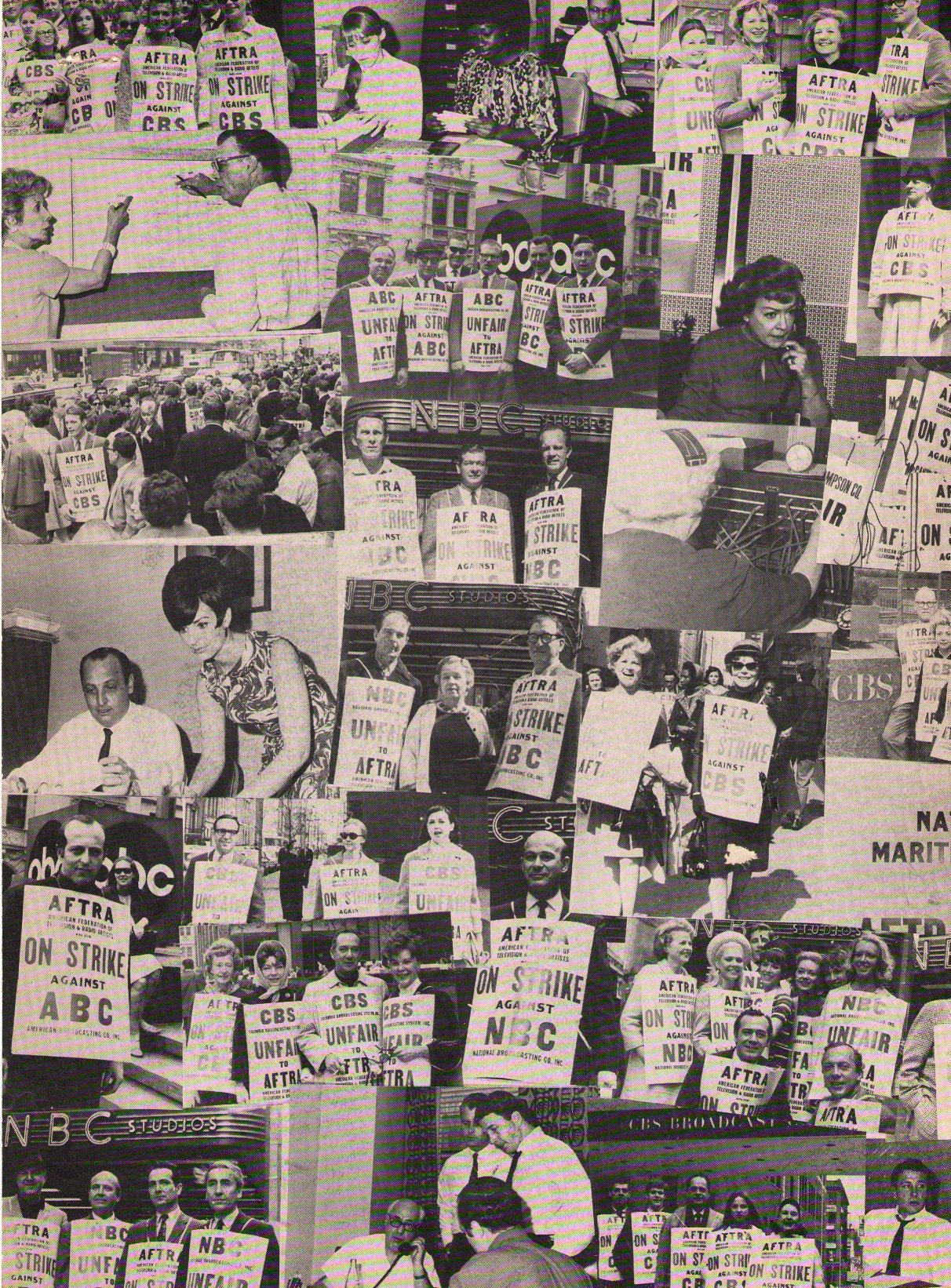
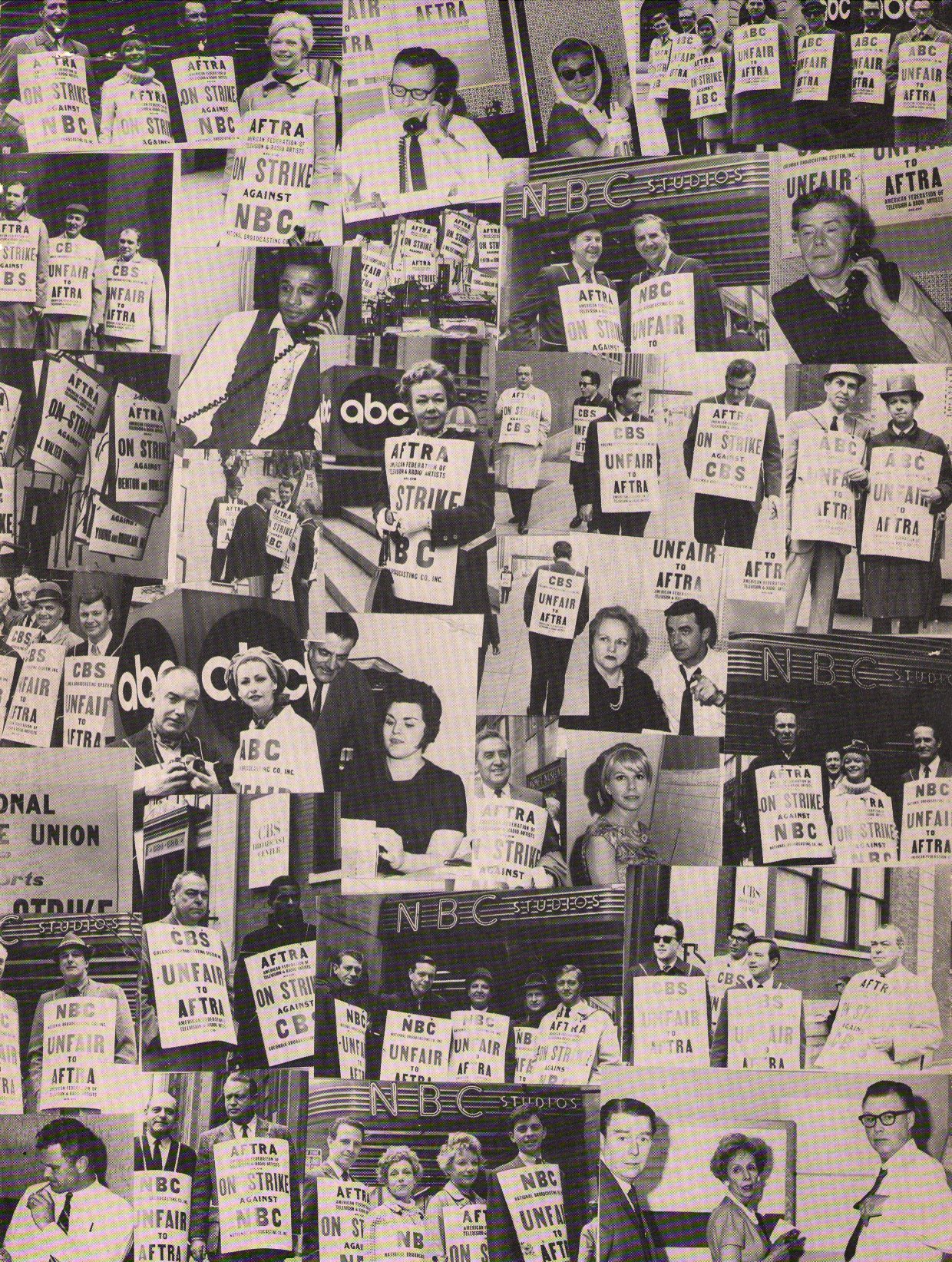
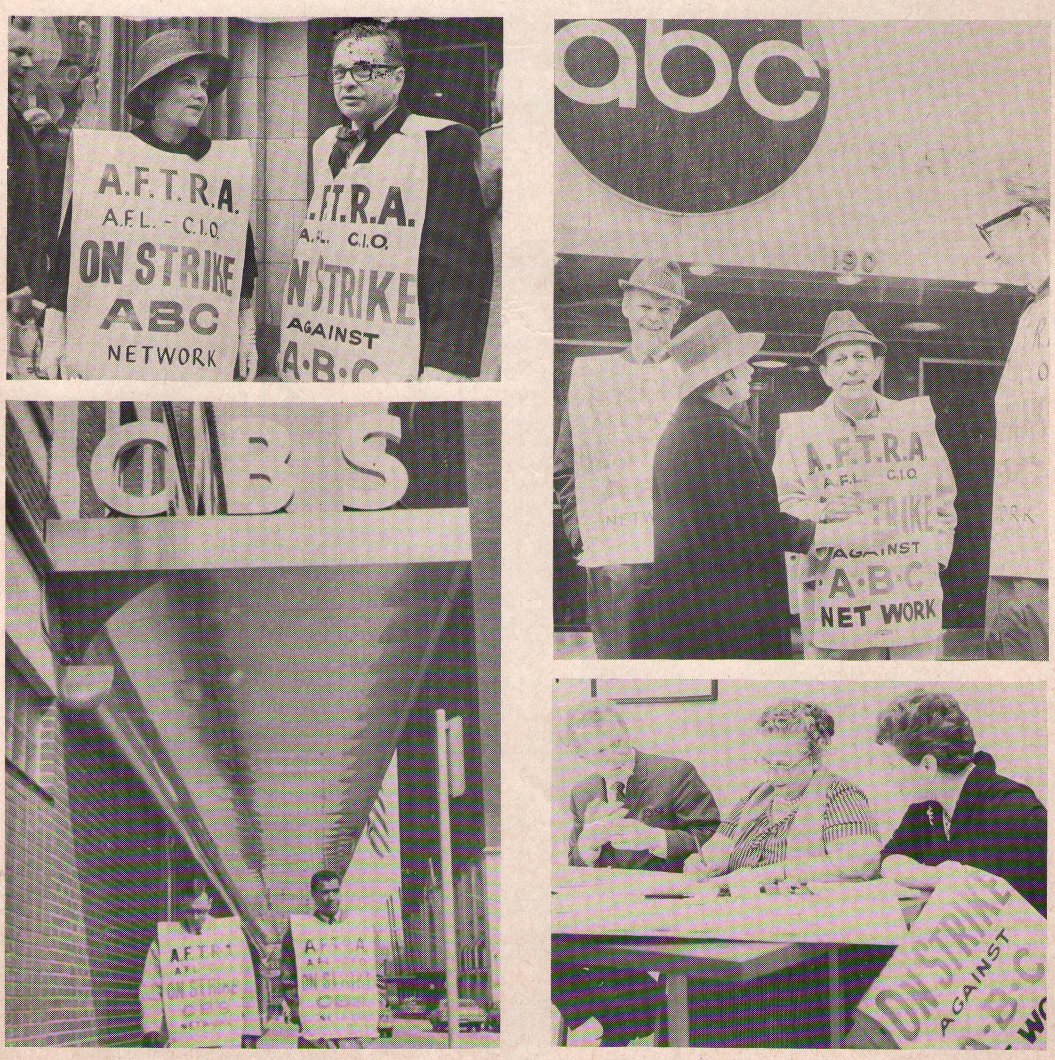
Images below found in Stand By! – February/March 1967. My mother can be seen in the first picture at top right, second from right.
Anchors Away: Huntley, Brinkley, and Cronkite and the 1967 AFTRA Strike
Socolow, Michael J., Journalism History, Summer 2003 Extract of an article found at Questia
In March 1967, the American Federation of Television and Radio Actors (AFTRA) called its firstnationwide strike. Although almost all programming on the national television networks ceasedproduction, the evening newscasts continued to be broadcast. NBC’s Chet Huntley crossed thepicket line, calling AFTRA a union “dominated by announcers, entertainers, and singers.” Hispartner, David Brinkley, refused to work, and CBS’ Walter Cronkite also supported the union.The strike represents a pivotal yet often overlooked moment in broadcast journalism history. Itcreated the perception of tension between Huntley and Brinkley that would play a role in the“CBS Evening News” surpassing the “Huntley-Brinkley Report” as the nation’s most highly-ratedevening news broadcast in 1967-68.
On the evening of March 29, 1967, most of the approximately 10 million regular viewers of the“CBS Evening News” probably were surprised at seeing the unfamiliar face of a twenty-nine yearold CBS corporate executive peering out from the screen. Ernest Leiser, the executive producer ofthe “CBS Evening News,” had spent that afternoon auditioning several members of the CBS Newsmanagement team to fill the anchor’s chair. Each took a turn reading a four-minute script in thebrightly lit studio. None matched the delivery or screen presence of Arnold Zenker, the programmanager for CBS News, who earlier that same morning had delivered the morning news over theCBS-TV network. Leiser called Zenker at home and told him to report back to the studio, and afew hours later he began reading the day’s top stories to the national television audience.Nowhere in that evening’s script did he mention the fact that the program’s regular anchorman-Walter Cronkite-was out on strike. When the American Federation of Television and RadioArtists (AFTRA) called a strike against the networks that morning, he immediately supported theunion and walked out.1
The idea of a celebrity television news anchor participating in a labor action seems absurd today.Even in 1967, the notion of broadcasters earning more than $100,000 a year striking againsttheir management was considered strange at best, laughable at worst. As U.S. News and WorldReport noted, “never had the country seen anything quite like it.”2 Although the era of thecelebrity journalist had yet to fully bloom, viewers and critics alike shared skepticism that a TVanchorman could be considered a member of the working class. In reporting on this unique laboraction, the press often stressed its more humorous aspects. Newsweek joked that “Eugene Debswould never have believed it,” and on the strike’s second day, the New York Times reported that“Today” show host Hugh Downs was chauffeured to the picket line “in a Cadillac limousinesupplied by the network.”3
The 1967 strike was an important moment in the history of television news. It raised definitionalissues about the social and political status of celebrity anchormen, and it offered the notoriouslyhabitual evening news audience an excuse to change the channel and alter the ratings dynamicbetween the most popular programs. Yet while the significance is clear, the strike has beengenerally ignored in the scholarship of television journalism. In Edward Bliss’ comprehensiveNow the News, the strike received two sentences in 470 pages of text.4 Historians have generallyfollowed the lead of the journalists involved, who downplayed the strike’s impact. Rememberingthe strike in a 1995 interview, NBC’s David Brinkley called it “pointless and quite silly.”5
However, in his 1995 memoir, Brinkley admitted that somehow, in a difficult to define manner,the strike led to the end of NBC’s leadership in the evening news ratings competition. His boss atthe time, Reuven Frank, had concurred in his 1991 memoir, Out of Thin Air.6 Because the strikeaffected the ratings dynamic between the two most-watched evening news programs, it was apivotal moment in broadcast history. (Full article continues with paid subscription at Questia).
This was a bit of history that I remember. The strike was ultimately settled with a new contract, but I recall my mother telling me about her days on the picket line.
Not if they’re going to make shipping a package online so flaming impossible.
I used to have a UPS account years ago, but apparently they purge them after a year of inactivity. So I went to their website to try to ship a package this morning.
So they give you the option to ship as a guest, but then the website throws an error and tells me I must login.
In the meantime, I get an email from PayPal stating that there’s a pending charge.So there’s obviously no problem with UPS getting access to my PayPal account. Take note of that, there’s going to be a test.
I wasn’t really all that excited about registering, so I end up calling their customer support people, who promptly shunted me off to a technical support department.
Tech support has me try submitting the shipment again. Same error message. And another pending charge in my PayPal account. The rep told me I needed to create an account.
Fine. I’ll create an account.
Oh, this is getting fun. Try again with a different email account, a different user name, the whole works. Same result.
Call tech support back. The lady manages to create a profile for me, although every bit of information I gave her was horribly mis-spelled, including the UserID.
OK, I can live with a UserID that’s not one of my choice. Go into my profile and change all the information. She directs me to the area where I can add my PayPal account as a default payment method. Go through all the steps. The PayPal side seems to work fine.
Another error. The lady tells me helpfully that there’s something wrong with my PayPal account. Oh wait, remember? You can actually submit requests successfully so oh, gee, I guess there’s not. Not to mention the fact that I’ve been using this account successfully for years. She tells me it’s because I have tried to access the account unsuccessfully three times, so I have to wait a full 60 minutes before trying again.
No, sorry. UPS threw the error the first time I tried shipping a package this morning. I ask her for someone in her department who is able to really dig in and find out why UPS is throwing all these errors. She says there is no one, and that I’d have to try contacting the programmers at corporate.
Good luck with that.
OK, fine. I guess I’ll make a credit card my default payment method.
This is my standard business card which works like a charm everywhere else in the world.
Call Tech Support back. They helpfully direct me to the number provided with the error message, saying that I have to call that number to get any help.
So i call. And get a recording. Naturally, this is Saturday and no one can take my call until Monday.
By now, I’ve spent over two hours just trying to ship a single package.
I have come to one inescapable conclusion:
It’s clear UPS doesn’t want my business. Their clunky and inoperable website, and the inability of their representatives to help me overcome these myriad problems, has guaranteed that they won’t get it.
The Old Wolf needs a drink and it’s a bloody shame he’s teetotal. He’ll just have a good cry instead.

















 Playing in the World Game