UPDATE: The Dutch police are aware of these scammers. See this post for a letter from the Dutch police secretariat, a way to report correspondence, and their advice (send no money, do nothing).
Edit: Received today [6/24/2017] email from
contact@worldcontactmedia.com
at the “World Business List.” Same scam, same scammers. Be careful out there. Send no money to these scammers for a worthless “listing” in their register. Do not respond at all. Read the fine print.
To: redacted
From: EU Business Register <register@eubusinessreg.com>
Subject: Business Register 2016/2017
Dear Madam/Sir,
In order to have your company inserted in the EU Business Register for 2016/2017, please print, complete and submit the attached form (PDF file) to the following address:
EU BUSINESS REGISTER
P.O. BOX 34
3700 AA ZEIST
THE NETHERLANDS
Fax: +31 205 248 107
You can also scan the completed form and attach it in a reply to this email.
Updating is free of charge.
The scam continues, which I referred to here and here. Making another quick reference to it for additional exposure in case people are searching the web to see if this outfit is legitimate.
It is not. It is a total scam.
Very little has changed. Their spam emails, blasted all over the world, always say “updating is free of charge.” But the small print, ah, the small print:
THE SIGNING OF THIS DOCUMENT REPRESENTS THE ACCEPTANCE OF THE FOLLOWING CONDITIONS AND THE CONDITIONS STATED IN “THE TERMS AND CONDITIONS FOR INSERTION” ON THE WEB PAGE: WWW.EUBUSINESSREGISTER.EU. THE SIGNING IS LEGALLY BINDING AND GIVES YOU THE RIGHT OF AN INSERTION IN THE ONLINE DATABASE OF THE EU BUSINESS REGISTER, WHICH CAN BE ACCESSED VIA THE INTERNET, ALL IN ACCORDANCE WITH THE CONTRACT CONDITIONS STATED ON “THE TERMS AND CONDITIONS FOR INSERTION” ON WEB PAGE: WWW.EUBUSINESSREGISTER.EU.THE VALIDATION TIME OF THE CONTRACT IS THREE YEARS AND STARTS ON THE EIGHTH DAY AFTER SIGNING THE CONTRACT. THE INSERTION IS GRANTED AFTER SIGNING AND RECEIVING THIS DOCUMENT BY THE SERVICE PROVIDER I HEREBY ORDER A SUBSCRIPTION WITH THE SERVICE PROVIDER EU BUSINESS SERVICES LTD. “EU BUSINESS REGISTER”. I WILL HAVE AN INSERTION INTO ITS DATABASE FOR THREE YEARS. THE PRICE PER YEAR IS EURO 995. THE SUBSCRIPTION WILL BE AUTOMATICALLY EXTENDED EVERY YEAR FOR ANOTHER YEAR, UNLESS SPECIFIC WRITTEN NOTICE IS RECEIVED BY THE SERVICE PROVIDER OR THE SUBSCRIBER TWO MONTHS BEFORE THE EXPIRATION OF THE SUBSCRIPTION. YOUR DATA WILL BE RECORDED. THE PLACE OF JURISDICTION IN ANY DISPUTE ARISING IS THE SERVICE PROVIDER’S ADDRESS. THE AGREEMENT BETWEEN THE SERVICE PROVIDER, EU BUSINESS SERVICES LTD AND THE SUBSCRIBER IS GOVERNED BY THE CONDITIONS STATED IN “THE TERMS AND CONDITIONS FOR INSERTION” ON THE WEB PAGE: WWW.EUBUSINESSREGISTER.EU
So if you enter your data and send it in for what you think is a “free listing,” you’re agreeing (at least on paper) to shell out €2985 for a three-year listing, and agreeing to be billed every year forever unless you cancel in writing.
Fear not. If you get stung, just write and tell them that you’re not paying. Quoted from my previous post:
If you happen to fall for this, these things will happen:
The company will ignore any attempts to contact them
If you simply refuse to pay, you will begin to get aggressive and threatening communications from a “global debt collection company,” Waldberg & Hirsch. That firm does not exist – it’s just the same drones trying to frighten you into paying. They will demand payment in full for the agreed-to three years, but will settle for one year’s payment if you’re foolish enough to send it.
The solution:
Just ignore them. They can’t sue you, because they are running a scam, they know it, and they don’t want to attract legal attention to themselves. Never pay these gong-farmers a cent; ultimately they’ll go away.
Again, why the Dutch authorities have not managed or taken the trouble to shut this scummy operation down is incomprehensible.
In my previous post, I ranted a bit about Microsoft’s efforts to alienate their customers by making competing or foreign programs (like Chrome – horrors!) incompatible or forcing them to ask permission to run, every time. We’re talking Windows 10 here, the latest and greatest.
Here’s an old joke, but one which remains totally valid in the 21st century:
A helicopter was flying around above Seattle when an electrical malfunction disabled all of the aircraft’s electronic navigation and communications equipment. Due to the clouds and haze, the pilot could not determine the helicopter’s position and course to fly to the airport. The pilot saw a tall building, flew toward it, circled, drew a handwritten sign, and held it in the helicopter’s window. The pilot’s sign said “WHERE AM I?” in large letters. People in the tall building quickly responded to the aircraft, drew a large sign and held it in a building window. Their sign read: “YOU ARE IN A HELICOPTER.” The pilot smiled, waved, looked at her map, determined the course to steer to SEATAC airport, and landed safely. After they were on the ground, the co-pilot asked the pilot how the “YOU ARE IN A HELICOPTER” sign helped determine their position. The pilot responded “I knew that had to be the Microsoft building because, like their technical support, online help and product documentation, the response they gave me was technically correct, but completely useless.”
One would think that after all these years as the 900-lb gorilla in the software space, someone at Microsoft would wake up and realize that this is a critical failing that generates massive ill will toward the company.
No, I’m not blowing smoke. Here’s an example, related to my last post.
I went to the Microsoft support site today, and asked a simple question: “Why does Windows Firewall in Win10 block Google Chrome?”
Here’s the page that comes up – one relevant to Windows Vista, dated 2011.
Someone named “Samuthra G,” tagged as a Microsoft agent, replied:
And this was designated as the “most helpful” response. Thank you so much, Microsoft and Samuthra G; nothing like blowing an unhappy customer’s problem off by blaming someone else.
Two months later, a user named “Karmana” followed up with the perfect response:
Why is it, over the years, that I have noticed the vast majority of supposed Windows or Microsoft higher-certified helpers cannot seem to actually read the questions asked by the original poster? Samhrutha, your answer to QW_895 is not only unhelpful, but if you were/are a Microsoft employee, then it is also highly irresponsible to blow off the OP by saying, “It’s not our problem.” Taking responsibility for one’s own products is a strong first step in positive Public Relations!
To this day, this is my boilerplate experience with Microsoft forums. First of all, the people who answer never give a relevant answer – it probably has to do with the fact that their first language is not English, and that they’re paid pennies per hour to respond to these questions. Second, if they do give a response that’s even on-topic, it’s almost always so technical as to be incomprehensible or un-implementable by the average user.
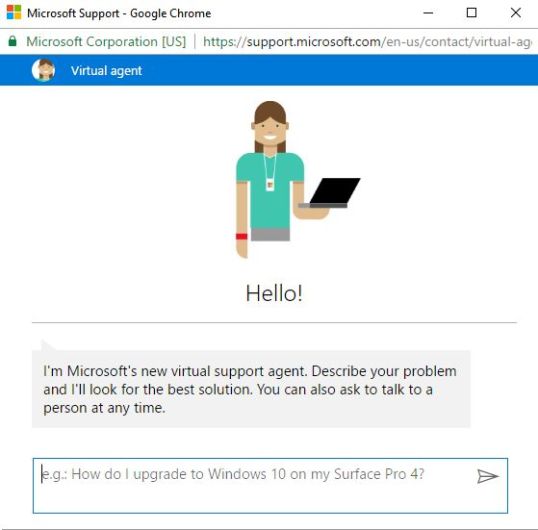
Today I tried contacting the Microsoft support site, just to see what happens:
Having already tried a search without success, I figured I’d take advantage of their offer:
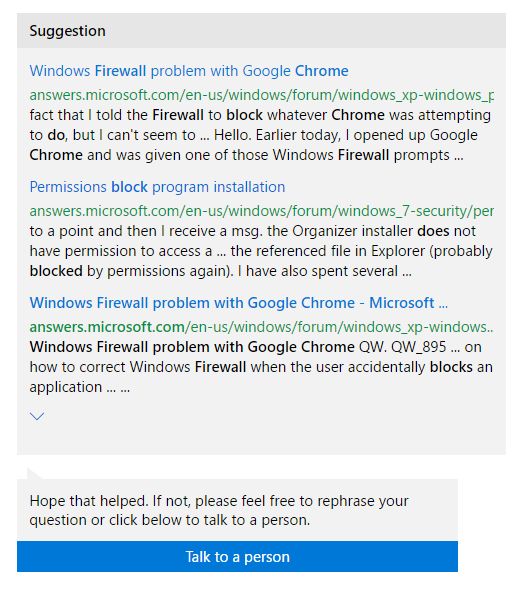
So I entered my question again: “Why does Win10 firewall block Chrome?” What I got was a list of articles – and once again, the most relevant hit is the worthless exchange I referred to above.
So I clicked the “Talk to a person” link, and was connected via Chat to a friendly Microsoft agent somewhere on the other side of the world.
“Clarisse” asked me some questions about which version of Windows I was using, provided a case number, and ended up suggesting that I uninstall and reinstall Chrome. So just for the hell of it, I gave that a try – predictably, without success. These agents in India or wherever are minimally trained, minimally paid, and working from scripts without much understanding of what’s happening under the hood.
If I wanted, I could pay $149.00 per year for premium Microsoft support, which would allow me to ask questions at any time and also enable remote desktop support, but I somehow feel that paying for support to solve problems that Microsoft generates is probably not the best allocation of my resources.
The challenge is that Microsoft is so widely accepted as the de-facto standard in the business world that people need it to conduct their daily affairs, and most people would rather muddle along with the best they can do rather than delve down into the guts of an operating system to try to find a fix or a workaround. Microsoft knows this, and based on results, they don’t care to spend any time, effort, or money to improve their byzantine and useless support system.
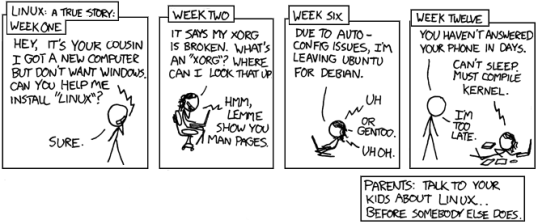
It’s sad. For myself, I don’t really feel like facing the Linux learning curve, and I’m seriously afraid of something like this:
As for Apple, I love the idea of the Macintosh platform, but unless the company brings their prices in line with PC hardware, I won’t be able to justify the expense. From a functionality standpoint, the lines between PC and Mac world have blurred considerably since 1984 when the Mac was introduced as the sexy computer for the rest of us, so the draw has diminished substantially.
From a recent Facebook post. Having worked as a freelance translator, these responses spoke to my soul. Yes, a few of them are more than four words, but they’re all good – and they’re all real. I have seen many of these myself.
For what it’s worth, I no longer do this sort of work. The reasons will become obvious. I’ve included a bit of commentary here and there.
Cheap bastards
Agencies make money by charging high rates to clients and paying low rates to translators, reviewers, and proofreaders. They’re always jockeying for a better deal. That’s the nature of business, but when you’re an independent contractor, and your standard rate (calculated to earn you a living) is always being undercut, it’s frightfully annoying. The global access of the Internet means that professional, trained, educated translators must now compete with millions of people in India, China, and elsewhere who “speak a little English” and who are willing to work for 1¢ per word or less.
Best lowest rate required.
What’s your best rate?
Make your best rate.
Make me (a) good price.
Send your best rate.
We pay in visibility. (Visibility and $7.95 will get you a coffee at Starbucks.)
Our budget is limited. (So I’m supposed to subsidize your profit, right?)
Special rates apply to this client. (He’s paying us less, so we’re going to pay you less.)
A discount for volume. (We’re paying less because there’s a lot of work).
It’s the market rate. (Take it or leave it.)
5¢ is not bad. (5¢ per word is shit.)
The others charge less. (Good, feel free to use them.)
Someone charges way less.
Our budget is only …
National Agreement Rate Please.
Could you proofread instead? (Read: Your rate is too high).
Cheaper bastards
Machine translation used to be cumbersome, expensive, and not very effective. Now it’s quick, easy, free, and only a bit more effective. While statistical translation models have made some exciting progress, people who don’t understand the intricacies of language assume that online translation is both free and reliable. Similarly, your neighbor may speak a bit of German, but don’t expect your translation to do well in the commercial arena. In the translation world, you still get what you pay for, and if you go cheap, you’re likely to get crap.
Google Translate is cheaper.
We will Google translate.
I’ll do it myself.
I can do it myself.
Neighbour can do it.
Will it cost anything?
Is it for free?
That much? No way!
The font was wrong. (Followed by “Will you accept 50%?”)
I could do it, but…
Could do it myself, but…
You’re overpaid.
Cheapest bastards
It’s not uncommon for an unethical agency to get a job, break it up into 20 segments, offer the job to 20 translators and have them each do part of the work as a “test,” then award the bid to nobody.
Please do this test.
Please complete test assignment.
We require (a) free test.
Test translation without charge.
Download the test translation.
It’s for a tender. (We need your free translation to make the bid.)
Scheduling headaches
Contractors spend a lot of time juggling their resources against customer needs. Agencies don’t care.
We’d like it for tomorrow.
Have you begun yet?
Great, don’t proceed yet.
Client brought deadlines forward.
The client sent changes.
The client made changes.
6000 words for tomorrow.
20,000 words of light postediting.
We need it yesterday.
Can you deliver early?
Sorry, client cancelled assignment.
End client just cancelled.
Please send your invoice (then we’re going to have minor changes).
File should arrive midnight. (Deadline in 8:00 AM, of course.)
We have a glossary (10 minutes before deadline).
That didn’t need translating… (After you’ve spent a day and a half on “that.”)
Please use US English. (Halfway through a huge project meant to be in UK English!).
Please deliver tomorrow morning.
Translate in real time! (What does this even mean?)
Client isn’t in a hurry (Followed, 2 months later, by “Client needs it ASAP”).
The project is cancelled (in the morning of due date!).
Your skills are worthless!
Anyone can translate. It’s just typing in another language.
(It doesn’t need to be translated,) just type this in Portuguese
Everyone can do it!
So you teach English?
You’re a translator? Then why don’t you give English courses?
What is your work?
Please do the shopping.
Go get the kids.
Don’t think, just translate!
What’s your real job?
Do you also teach?
You have done nothing.
Technical Headaches
“You need to use our tools, yours are garbage.”
Trados is a must.
TRANSIT is a must.
Across is a must.
[Insert CAT tool name of choice] is a must.
Use our online TM-tool.
We only use Excel. (Translating in Excel is a nightmare, if you were wondering.)
Please translate into Excel.
Your file doesn’t open.
Not only that, in the world of translation, these CAT (Computer-assisted translation tools) are de rigeur. They can be useful in speeding up translation and improving terminological consistency, but agencies routinely take advantage of this and pay less than the full rate for things that the software has translated for you. This ignores the fact that the translator is responsible for the coherence of the entire job and must read and evaluate every bit and piece of the work for accuracy. This alone is the major reason I stepped out of the freelance translation world. My rate per target word is X¢, period. Pay it or go somewhere else. Translators who survive in the industry pretty much have to suck it up, but I wasn’t willing.
We don’t pay repetitions.
Pro-rated for fuzzy match.
100% matches for free.
Discount for fuzzies applied.
Fractional Payment for Repetitions.
Payment Headaches
In the US, standard terms are 30 days net. Around the world, it’s not uncommon for translation agencies to expect translators to wait 60, 90, or even up to 180 days for payment of invoices (they usually claim that they’re waiting for their clients to pay them.) This is unethical in the extreme, but not an uncommon strategy in the business world.
We forgot your payment.
Did you send your invoice? (Yes, I did, 60 days ago.)
Net forty-five days.
The payment will delay.
Thanks for your patience. (After payment was delayed for a month).
Check’s in the mail. (Yes, people still use this one.)
Our accountant on vacation.
We know better than you.
Never mind your skills, the next person is always smarter.
Reviewer says you failed.
Is “the” necessary here?
Let me correct that.
I speak two languages.
(S)he knows better.
(S)he is a [language] teacher.
Proofreader does not agree. (Proofreaders know bupkis about translation.)
Changes made by proofreader.
My secretary edited it.
This translation is bad.
But Google translate says…
Creepy Clients
There is always one.
What are you wearing?
General Lies
“I have read and agree to the terms of service”
It’s a straightforward text.
It’s a piece of cake.
It’s short and easy.
It is not technical.
It’s not very technical.
Help me, it’s quick.
It only needs editing.
Just a quick question.
Translation Requirements, and Stupid Questions
Things that don’t fall into easily-defined categories.
Do you translate books?
Is Brexit affecting business?
Source text is JPG. (This means you can’t use your CAT tools for the job.)
Added to our database. (Don’t call us, we’ll call you.)
Read 50 pages of instructions (for a 100-word job)
Keep the original format.
You have to cook.
It’s a doctor’s prescription.
Don’t go into details.
Thanks for sharing.
Are you still translating?
Complete our six forms.
There’s no source text. (When proofreading a translation, you need to see the original text. If it’s not there, you’re just basically making wild guesses in the dark.)
About 30 years ago, an ad appeared on the bulletin board of the translation software company I was working at. It probably came from one of the trade publications, and showed a boss ripping an employee a new one. The text read, “Because you had your brother-in-law do the translation, our ad says that our new camera exposes itself automatically!”
I’ve dealt with the risks of translation on the cheap before, and in this one thing has not changed: If you want good translations for your business, use a professional and pay them well – otherwise your product may just bite the wax tadpole.
In a recent article, I mentioned a set of coins offered by PCS Stamps and Coins, and showed how much of a markup these people were getting.
Since their ads keep popping up on my mobile phone, I thought I’d add just one more example of how putting lipstick on a pig can bamboozle the ill-informed.
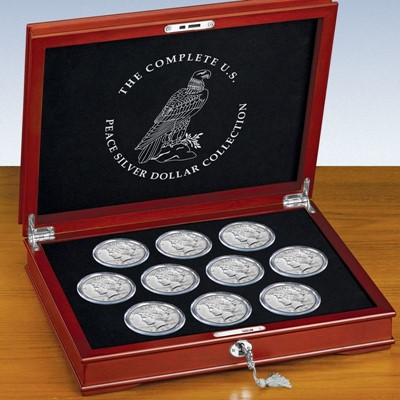
Today’s offering: A complete date set of the Peace Dollar, in protective plastic capsules and a handsome cabinet. Price: $848.00
Complete 10-coin set, with cabinet
United States Peace Dollar
No question, the set is very pretty. But:
Per the advertisement, these coins are offered in “gently circulated condition.” This is essentially a meaningless statement for collectors; let’s look at the average dealer asking price for a similar set as presented by the Professional Coin Grading Service:
Note that these are average dealer asking prices for PCGS-graded coins; buyers of this set have no guarantee that these coins have been graded by anyone.
The price for a set of coins in 40-grade (Extra Fine) is $442, and the odds that you’ll get a set of coins in this condition are vanishingly small. So you’re paying at least twice the price of these items for the bonus of a cheap cabinet from China and a few plastic capsules.
If you’re thinking this is a good investment, it’s not. You could assemble the same set for much, much less by visiting different coin stores online or in person, armed with the PCGS grading and pricing information.
Be careful out there, and don’t be taken in by the bells and whistles of slick advertising promotions.
Edit: As a followup to this post, here’s a good article from Consumer Reports about auto warranty scams. Still getting scammy letters as of 8/2017.
“We don’t actually send out any paperwork without receiving a down payment.”
This from an article by ConsumerMan, written in 2008, addressing the onslaught of fraudulent extended auto warranty offers by mail and by phone.
And here it is, 2016, and the tide has not turned. In the last couple of months, I have received virtually dozens of these solicitations to purchase an extended auto warranty (the companies not realizing that my Prius is already at 165,000 miles in 9 years, and hence ineligible by anyone’s standards.) Here are just 3 examples:
An article at Edmunds.com also addresses this ongoing plague. Granted, there’s no way of telling just from a solicitation that any given company is fraudulent or reputable, but the fact that there are so many of these things hitting my mailbox and email and even my phone is a pretty good indication to me that there is a huge and lucrative market for these things, and wherever there’s money to be made the roaches will scurry out of the woodwork.
By the time your manufacturer’s warranty has expired – many of them run up to 7 years or 110,000 miles or even more – your car’s pretty much past its day and you should think very hard about whether purchasing an insurance policy (that’s what these are) is really worth it.
Beware of high-pressure sales tactics and “limited time” offers. Research any company and/or policy carefully before sending any money to anyone. And for heaven’s sake, if a salesman tells you, “We don’t actually send out any paperwork without receiving a down payment,” run away fast.
Let’s look at this ad that appeared on my Facebook feed (Android). The first one seems to indicate that US comsumers are urged to stop using WiFi after some sort of revelation by Donald Trump.
But click on the ad (which I never do, unless I’m following some sort of jiggery-pokery down the rabbit hole) and you end up with an advertorial (read: advertising thinly disguised to look like a news article) for YesBackup, a cloud backup service.
If you’re confident in your product’s abilities, Mr. or Ms. CEO, you shouldn’t resort to outright lies, trickery, and deception to get customers. Even the use of Advertorials (sometimes called “farticles” or “fake articles”) alone is enough to make your integrity suspect. Now this may be the the work of an affiliate marketer, that doesn’t really excuse the company – they are, after all, responsible for all of their advertising whether in-house or contracted out.
The takeaway: Be very careful clicking “sponsored ads” – the vast majority of them are going to be deceptive at best and outright scams at worst.
I wish I had known this long ago. I would never have put in forwarding requests. It’s mean, it’s ignorant, and from a moral standpoint it’s downright reprehensible – but it’s legal, and they do it gleefully to get gain.
After our recent move to the wilds of Utah to the east coast, I put in three forwarding requests – one for our personal mail, and two for businesses. Little did I know that this would cause me no end of trouble, as that information was instantly transmitted to marketing agencies and basically anyone who has two coppers to rub together, and immediately began receiving junk mail and having my new information appear on automatically scraped websites.
Here’s the Forbes article I found – a bit dated, but still valid – that opened my eyes to this dirty little secret.
Whenever you fill out a change of address form with the United States Postal Service, the USPS adds your new details into a database of 160 million previous address changes over the past four years. The USPS has deals with data brokers to sell this data to anyone who pays, provided they have your old address. That means data firms cannot buy the address of Leroy Jones in Cincinnati, but can obtain his new address if they know where he used to live, which they usually do anyway.
This is, in a word, filthy. The PO’s responsibility is to get my mail from here to there, and that’s where their responsibility ends. To take people’s personal info and sell it to data brokers is nothing short of criminal, and it shouldn’t be permitted.
So this time, when we move from our temporary apartment to the home that we will – it is to be hoped – shortly be purchasing, I will not be relying on the PO to forward my mail. In plenty of time, I hope to inform our critical correspondents of our new address individually, and let the junk mail get returned to sender.
There is supposedly a loophole, although I don’t know if I trust the Post Office as far as I could throw a grand piano:
There is, however, a loophole that keeps data brokers from accessing your updated address. When you fill out the online form to change an address, you can indicate a temporary change that provides six months of forwarding that can then be extended for another six months. That information, unlike the changes marked as permanent, is not included in the master list sold to data brokers.
Edit: as of this morning, February 9th, whatever glitch they were experiencing has been repaired. So props to the local establishment, but still scratching my head that the national helpline considers this place outside of their purview.
Driving back from a visit to New York City and parts south this last week, I was overtaken by a blizzard which caused all sorts of havoc throughout New England. I stopped at a Motel 6 in Milford, CT, just a little bit down the road from where there was a horrific bus crash about an hour later. It’s been blizzarding all day, and I’m glad I made the choice to hole up rather than to proceed.
My experiences at Motel 6 around the country have been almost uniformly good, except for one nightmare in Toledo, Ohio which I won’t go into here. This particular property is very nice, more upscale than most I have stayed at. But for some reason, I was unable to connect to their Wi-Fi.
My cell phone detected Wi-Fi signal and connected all right, but when I went to the login page to enter my code, what I got is this:
This webpage is not available
ERR_SSL_VERSION_OR_CIPHER_MISMATCH
Details
A secure connection cannot be established because this site uses an unsupported protocol or cipher suite. This is likely to be caused when the server needs RC4, which is no longer considered secure.
I explained the situation to the desk clerk, and he told me that he was aware of the problem, and that the location had recently installed new equipment. He was, however, unable to help me solve the problem.
I thought I would give the national feedback line a try, and sent them an email via their website. They responded promptly and suggested that I call their Wi-Fi hotline; unfortunately, the phone number they gave me was for Resorts World Bimini. After another exchange, in which I got the correct number (a single digit was transposed), I called said helpline only to be informed that I was staying at an “unsupported property.”
That makes no sense to me, but it appears that not all Motel 6s are created equal. Apparently if you want tech support, you can’t be staying at a franchise location. At least that’s what the lady on the other end of the line told me.
So no Netflix for me tonight. With luck, the weather will permit me to get back to Maine tomorrow.
Now that the birthday has passed, the story can be told.
I went to F.Y.E. to buy a CD for my wife. I take my purchase to the register.
First Up:
Salesgirl: “Do you want to sign up for the F.Y.E. Backstage Pass? It’s free for the first month!”
Me: “How much is it after the first month?”
Salesgirl: “Only $11.95 per month thereafter.”
Me: “No, thank you.”
Apparently FYE has not had good press regarding their “Backstage Pass.”
Next:
Salesgirl: “Would you be interested in the CD replacement warranty today?”
Me: “No thanks.” (I didn’t even bother to ask how much extra profit they wanted on this one.)
Next:
Salesgirl: Pointing to a display of potential magazine subscriptions taped to the counter, the kind you’d find lying around in a substandard doctor’s office – People, Vogue, Cosmo, etc. “Would you like to buy a subscription to any of these magazines?”
Me: “No thanks.”
Next: (Will this ever end?)
Salesgirl: Pointing to a discount bin by the register: “Would you be interested in any of these fine movies for only $5.00?
Me: “No thanks.”
What I really wanted to say was, “Holy hqiz, girl, I only came in to buy one album. At least at McDonald’s they only ask you “Do you want fries with that?”
And the sad part is that these sales associates get graded on how many upsells they make, and probably have a regular quota to meet. I can’t imagine how many people they drive away with this relentless drive for nickels and dimes. Frankly I’m surprised they stay in business.
Note: This article was originally published at FT.com (Financial Times). It is copyright. They have indicated that these articles can be shared with their “sharing tools,” and added, “Please don’t cut articles from FT.com and redistribute by email or post to the web.”
That would be fine, if they didn’t use that accursed “complete a survey to read this full article” ploy. Or make you register (i.e. give them your information) to read “3 free articles per month.” Both of these are scummy tactics which serve no purpose other than to drive people away from a website; to Pluto with that. So, FT, get rid of the surveys and the paywall and I’ll be happy to link people directly to your site. Until then, hard lines.
Wil Griffiths set up an organisation that aims to save the bees and his native tongue
Wil Griffith: ‘When we started, other beekeepers thought we were racist’
Welsh has always lent itself to prose and poetry, to music and singing. But it has never been associated with scientific matters, and beekeeping is a science. If the language is to survive, it needs to expand into all aspects of everyday life.
I run the only Welsh-language beekeeping association in Wales. I set up Cymdeithas Gwenynwyr Cymraeg Ceredigion (the Ceredigion Welsh Beekeeping Association) at the end of the 1960s with two aims: survival of the bee and survival of the language.
Our Welsh beekeeping terms are not a pure translation of English terms because word-for-word translation is meaningless. For example, in a beehive, honey is stored in the very top of the hive, in the top box. The term in English is “super” — as in “superintendent”. It means “above”. But “above” would not be used that way in Welsh. The more usual Welsh word is “lloft” — meaning “upstairs”. So, in determining new terminology, we use everyday words that make sense to a Welsh ear. I wrote a book, Dyn Y Mel (The Honeyman) in which our Welsh terms are listed. In English, the term is “beekeeper” but, again, in Welsh, “dyn y mel” is more common.
I’m well over 80 now but I started beekeeping 60 years ago. At about that time modern hives were introduced. Before then, beekeepers had used closed straw skeps — but suddenly, for the first time, they were able to see what was taking place within the hive.
Modern terms were coined to reflect these changes, which flustered the older beekeepers. Very experienced beekeepers, who were first-language Welsh, were at a loss. The terminology involved was beyond them, particularly if it was in English.
Today our association has about 30 members and we even put on an annual show in a pub for our honey and mead. Finding enough bilingual judges is always a problem. As they are tasting, the judges must comment out loud in Welsh.
Beekeeping can be hazardous. A friend went to shift a hive late one evening and didn’t bother with protective clothing; a bee crawled into his ear. We tried to get it out but couldn’t. The only way was to drown it, and the only liquid we had to hand was a bottle of brown ale. So that was poured in and the bee floated out. But there’s no special term — in Welsh or English — for these beekeeping mishaps.
Our members do not have to speak Welsh — but we are true to our founding principles. At meetings, English speakers sit next to someone bilingual — most of us are — who will quietly translate for them. After a season or so, they have a good smattering of the language.
When we started other beekeepers thought we were racist. But what is wrong with studying in our native tongue? People would not be surprised if beekeeping associations in France or Germany discussed beekeeping in French or German. Why be surprised about Welsh?
The best way to keep a language alive is to place it at the centre of everyday life. In my county, Ceredigion, Welsh is a minority language. There has been a big fall in the number of native speakers in the past 30 years, and people are realising that we are in danger of losing one of the oldest languages in Europe.







 Playing in the World Game