25 Years of Dilbert

Edit: Ten years after I wrote this, the landscape has changed considerably. For some reason Adams has made a hard shift to the right, and outed himself as an unrepentant racist, which resulted in his strip being dropped by newspapers all over the country and even his online outlet gave him the boot. This is sad, but there it is. But I still find humor and painful reality in his past strips, although in the ten years since I wrote this, his comics seemed to lack the wit and cleverness of the earlier decades.

If you’ve worked in an office, you probably know Dilbert like you know your significant other. If, by the vagaries of chance, you do not… what are you waiting for?

On April 16, 1989, Scott Adams published the first Dilbert cartoon. Four days ago, the 25th anniversary of Adams’ amazing strip passed, with nary a hiatus or a break. Each episode resonates with someone in the business world, and amazingly, the well shows no sign of running dry, as the corporate world continues to be full of pointy-haired bosses, egomaniacal CEO’s, and maddening co-workers.

2419.strip.zoom

Don’t you just want to slap this guy? Haven’t we all know someone equally self-absorbed, clueless and abusive during our careers? How people like this ever get hired, and then manage to keep their jobs, is a total mystery to me – except the model has not gotten stale at all:

Boss

Adam Scott as Ted Hendricks in “The Secret Life of Walter Mitty.”

Adams 25-year journey is full of wonders: good advice for dealing with abusive bosses and clueless co-workers, but also, if you read between the lines, a scathing commentary about the state of affairs in corporate America as well as pointers for those who want to be good bosses and good employees.  Adams follows up and expands on his philosophies over at the Dilbert Blog.

One of the most succinct analyses of what’s wrong with business today, and what could be right, is found in Adams’ book The Dilbert Principle; he calles it OA5 (Out at Five). I quote it here without permission and hope I don’t get sued by one of his army of lawyers:

New Company model: OA5

The key to good management is knowing what’s fundamental to success and what’s not.

Companies with effective employees and good products usually do well.

That might seem like a blinding flash of the obvious, but look around your company and see how many activities are at least one level removed from something that improves either the effectiveness of the people or the quality of the product. When I refer to product, I mean the entire product experience from the customer’s perspective including the delivery, image and channel.

Any activity that is one level removed from your people or your product will ultimately fail or have little benefit. It won’t seem like that when you’re doing it, but it is a consistent pattern.

It’s hard to define what I mean by being “one level removed” but you know it when you see it. Examples help:

  • If you are writing code for a new software release, that’s fundamental, because you’re improving the product. But if you’re creating a policy about writing then you’re one level removed.
  • If you’re testing a better way to assemble a product, that’s fundamental. But if you’re working on a task force to develop a suggestion system then you’re one level removed.
  • If you’re talking to a customer, that’s fundamental. If you’re talking about customers you’re probably one level removed.
  • If you’re involved in anything in the list below, you’re one level removed from the fundamentals of your company and you will not be missed if you are abducted by aliens.

Not fundamental

  • Quality Faire
  • Process Improvement Team
  • Recognition committee
  • Employee satisfaction survey
  • Suggestion system
  • ISO 9000
  • Standards
  • Policy improvement
  • Reorganization
  • Budget process
  • Writing vision statements
  • Writing mission statements
  • Writing an “approved equipment list”

These “one off” activities are irresistible. You can make a convincing argument for all of them. You couldn’t run a company, for example, without a budget process. I’m not suggesting you try. But I think you can focus more of your energy on the fundamentals (people and product) by following a simple rule for all the “one off” activities.

Rule for “one off” activities: consistency. Resist the urge to tinker. It’s always tempting to “improve ” the organization structure, or to rewrite the company policy to address a new situation, or to create committees to improve company morale. Individually, all those things seem to make sense. But experience shows that you generally end up with something that is no more effective than what you started with.

For example, companies tinker endlessly with the formula for employee compensation. Rarely does this result in happiness and more productive employees. The employees redirect their energies toward griping and preparing resumes, the managers redirect their energies toward explaining and justifying the new system.

The rule of consistency would direct you toward keeping your current compensation plan- warts and all- unless it is a true abomination. The company that focuses on fundamentals will generate enough income to make any compensation plan seem adequate.

The best example of a fruitless, “one off” activity that seems like a good idea is the reorganization. Have you seen an internal company reorganization that dramatically improved either the effectiveness of the employees or the quality of the product?

Sometimes there are indirect benefits because reorganization is a good excuse for weeding out the ninnies, but that hardly justifies the disruption. The rule of consistency would say it’s best to keep the organization as it is, unless there’s a fundamental shift in the business. Add or subtract people as needed, but leave the framework alone. Let the employees spend time on something besides reordering business cards.

Many of the ” one off” activities start taking care of themselves if you’re doing a good job with your people and your products. A Company with a good product rarely needs a Mission Statement. Effective employees will suggest improvements without being on a quality team. Nobody will miss the Employee recognition Committee if the managers are effective and routinely recognize good performance. The budget process will suddenly look very simple if you’re making money (by focussing on your products).

As far as consistency goes, I would make an exception for changes that are radical enough for “reengineering” a process. It is the fiddling I object to, not elimination or major streamlining.

Out at Five

I developed a conceptual model for a perfect company. The primary objective of this company is to make employees as effective as possible. The best products usually come from the most effective employees, so employee effectiveness is the most fundamental of the fundamentals.

The goal of the hypothetical company is to get the best work out of the employees and make sure they leave work by five o’ clock. Finishing by five o’clock is so central to everything that follows that I named the company OA5 (Out at five) to reinforce the point. If you let his part of the concept slip, the rest of it falls apart.

The goal of OA5 is to guarantee that the employee who leaves at 5 PM has done a full share of work and everybody realizes it. For that to happen an OA5 company has to do things differently than an ordinary company.

Companies use a lot of energy trying to increase the employee satisfaction. That’s nice of them, but let’s face it-work sucks. If people liked work they’d do it for free. The reason we have to pay people to work is that work is inherently unpleasant compared to the alternatives. At OA5 we recognize that the best way to make employees satisfied about their work is to help them get away from it as much as possible.

An OA5 company isn’t willing to settle for less productivity from the employees, just less time. The underlying assumptions for OA5 are:

  • Happy employees are more productive and creative than unhappy ones.
  • There’s a limit to how much happiness you can get while you’re at work. Big gains in happiness can only be made by spending more time away from work.
  • The average person is only mentally productive a few hors a day no matter how many hours are “worked”.
  • People know how to compress their activities to fit a reduced time. Doing so increases both their energy and their interests. The payoff is direct and personal –they go home early.
  • A Company can’t do much to stimulate happiness and creativity, but it can do a lot to kill them. The trick for the company is to stay out of the way. When companies try to encourage creativity it’s like a bear dancing with an ant. Sooner or later the ant will realize it’s a bad idea, although the bear might not.

Staying out of the way

Most people are creative by nature and happy by default. It doesn’t seem that way because modern management is designed to squash those impulses. An OA5 is designed to stay out of the way and let the good things happen. Here’s how:

  1. Let the employees dress any way they want, decorate their work places any way they want, format memos any way they want. Nobody has demonstrated that these areas have any impact on productivity. But when you “manage” those things you send a clear signal that conformity is valued above either efficiency or creativity. It’s better to get out of the way and reinforce the message that you expect people to focus on what’s important.
  2. Eliminate any artificial “creativity” processes in the company, such as the Employee Suggestion Plan or Quality Teams. Creativity comes naturally when you’ve done everything else right. If you have a good e-mail system, a stable organization chart, and an unstressed workplace the good ideas w2ill get to the right people without any help. The main thing is to let people know that creativity is okay and get out of the way.

What does an OA5 manager do?

“Staying out of the way” isn’t much of a job description for a manger. So if you want to be a manager in an OA5 company you’ll need to do actual work too. Here are the most useful activities I can think of for the manager:

  1. Eliminate the assholes. Nothing can drain the life force out of your employees as much as a few sadistic assholes who seem to exist for the sole purpose of making life hard for others.
  2. Make sure your employees are learning something every day. Ideally they should lean things that directly help on the job, but learning anything at all should be encouraged. The more you know, the more connections form in your brain and the easier every task becomes. Learning creates job satisfaction and supports a person’s ego and energy level. As an OA5 manager you need to make sure every person is learning something every day. Here are some ways :
  • Support requests for training even when not directly job related.
  • Share your own knowledge freely and ask others to do the same, ideally in small digestible chunks.
  • Make trade magazines and newspapers available
  • If the budget allows, try to keep employees in current computers and software. Make Internet connections available.
  • Support experimentation sometimes even when you know it’s doomed (if the cost is low).
  • Make teaching a part of everybody’s job description. Reward employees who do a good job of communicating useful information to co-workers.

Collectively all these little things create an environment that supports curiosity and learning. Imagine a job when after you’ve screwed up your boss says, “What did you learn?” instead of “What the hell were you thinking?”

  1. Teach employees how to be efficient. Lead by example, but also continuously reinforce the following behavior in others:
  • Do creative work in the morning and do routine, brainless work in the afternoon. For example, staff meetings should be held in the afternoon (if at all). This can have a huge impact on people’s actual and perceived effectiveness.
  • Keep meetings short. Get to the point and get on. Make it clear that brevity and clarity is prized. The reward for brevity is the ability to leave at 5 o’clock with a clear conscience. Every company says that brevity is good but only an OA5 company rewards it directly.
  • Blow off low priority activities and make it clear why. Don’t be sucked into an activity because it’s the polite thing to do. If it’s a “one off” activity, say no. Say why you’re saying no. Be direct.
  • Respectfully interrupt people who talk too long without getting to the point. At first it will seem rude. Eventually it gives everybody permission to do the same, and that’s a tradeoff that can be appreciated. Remember, there’s a reward-you get out at five.
  • Be efficient in little things. For example, rather than some Byzantine process for doling out office supplies, add $25 a month to each employee’s paycheck as a “supply stipend” and let employees buy whatever they need from their local store. If they spend less, they keep the difference.
  • If you create an internal memo with a typo, just line it out and send it. Never reprint it. Better yet, stick with e-mail.

A culture of efficiency starts with the everyday things that you can directly control: clothes, meeting lengths, conversations with co-workers and the like. The way you approach these everyday activities establishes the culture that will drive your fundamental activities.

What message does a company send when it huddles its managers together for several days to produce a Mission statement that sounds something like this:

“We design integrated world-class solutions on a worldwide basis”

Answer: it sends a message that the manager’s can’t write can’t think and can’t identify priorities.

Managers are obsessed with the big picture. They look for the big picture in Vision Statements and Mission statements and Quality programs. I think the big picture is hidden in the details. It is in the clothes, the office supplies, the causal comments and the coffee. I’m all for working for the big picture, if you know where to find it.

Finally- and this is the last time I’m going to say it- we’re all idiots and we’re going to make mistakes. That’s not necessarily bad. I have a saying ” Creativity is allowing yourself to make mistakes. Art is knowing which ones to keep.”

Keep your people fresh, happy and efficient. Set a target and get out of their way. Let art happen. Some times idiots can accomplish wonderful things.

Along with all the smiles and groans and winces and good entertainment, I’ve learned a lot from Adams and Dilbert along the way. Congratulations to Scott for a tremendous run, and I’m looking forward to the next 25 years, or as long as Adams feels motivated to keep Dilbert coming.

The Old Wolf has spoken.

There’s bad translation, and then there’s this.

Battery

Found this abomination at the “Selling It” section of the May 2014 Consumer Reports. Engrish.com is full of such things, but this example is so egregious I felt as though it deserved its own shout-out.

The accompanying text said,

“Bang Indeed. The buyer who inserted this battery in his new “pay as you go” phone needn’t have worried about the warnings. “Sure enough,” he writes, “the phone did not work.”

I’ve talked about products made in China before, but it’s also worth remembering that the appetite for cheap Chinese goods is not driven by the Chinese exporters and manufacturers, but rather by American importers who buy their junk, exerting such downward price pressure on their suppliers that the quality goes from the toilet into the septic tank. It’s difficult to walk through Wal-Mart or Dollar Tree, to name two examples, without finding “Made in China” stamped on the goods. While getting American families up to living wage standards would help, it would take a miracle to break people of the habit of buying cheap trash just to save a dime. Frankly, I don’t have an answer, but I know that the current situation is doing nobody any good, except for those who manufacture and sell this type of garbage, balancing their bankbook on the backs of low-wage workers and low-wage consumers.

The Old Wolf has spoken.

Change Nothing, Sell More

Marketing

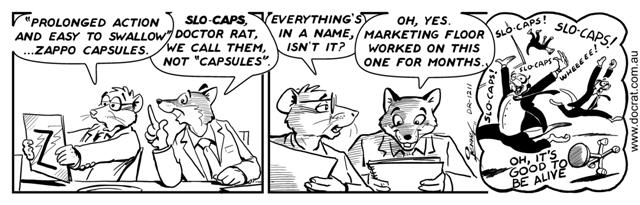
The webcomic “Doc Rat,” by Jenner (a practicing physician somewhere in the wilds of Australia) has long taken potshots at the marketing department of drug companies. It’s no coincidence that the marketing floor is represented by weasels.

I’ve written about the nature of persuasion before, but sometimes an example of the extreme folly of advertising and marketing rises to the surface, and I feel moved to share – a recent marketing campaign for Shreddies, a Wheat-Chex-like cereal sold in the UK, Canada, and New Zealand.

post_shreddies

It was a good seller, and popular, and as well known as Wheaties or Cheerios in the USA, but the manufacturers wanted to breathe new life into the product, and so Kraft Foods came to advertising firm Ogilvy & Mather with a unique request – to re-brand Shreddies as a leader, without having any news about the product to work with, and while keeping in mind that focus groups showed that Shreddies’ customers liked it just the way it was. The resulting campaign was devious, brilliant, humorous, and successful, all at once.

shreddies-ooh-02


All they did was rotate the image of the cereal by 45°, altering the visual perception of the product.


diamond-shreddies-pack


And despite the fact that the product was identical, taste-testers actually reported a difference in flavor – and a positive one to boot. They liked it better. Not content to rest on their laurels, the company milked the campaign for all it was worth:

combo-pack-3d-big

The campaign was percieved by many as being tongue-in-cheek, but there were many who did not… and as a result, the sales of shreddies increased by 18% in the first month, and remained higher for many months thereafter. You can read the details of the campaign and see some video clips at Visual Targeting.

There are two main parts to marketing: 1) convincing your target audience that they absolutely need what you have to sell, whether or not they do, and 2) tailoring your product to what your target market actually wants and values. This bit of marketing jiggery-pokery addressed the second in a brilliant way, without the manufacturers having to do anything whatsoever to the actual product.

That’s funny, but it’s also scary. We are being bombarded on a daily basis by upwards of 5,000 ads a day, up from around 500 in the 1970’s [1]. That is an incredible amount of clutter to either tune out or sift through, depending on what your needs are. And almost every one of those ads is using targeted persuasion techniques to get your attention and influence your purchasing behavior. President of the Marketing Firm Yankelovich, Jay Walker-Smith, has said, “Consumers don’t hate advertising. What they hate is bad advertising.”  There is some truth in that; I’ve mentioned some of my favorite advertising spots before, and if all advertising were as clever as these, I’d be persuaded to watch more of them. At the same time, it’s important to remember that this advertising has only one purpose – pushing every single one of your buttons in the hopes that you will open your wallet.

A couple of good tips:

  • Nothing is free. You’re paying for it somewhere else. A “gimme” is only a good thing if you’re willing to pay the price elsewhere, and if that price has value for you.
  • A sale is not a sale. It’s simply a retailer cutting an inflated price back to the profit level he wants in the first place. (Liquidation sales can be the exception to this rule.)
  • Saving 20% on an item is not a good deal if you can’t afford the other 80% in the first place. Don’t buy things you don’t need.

The Old Wolf has spoken.

——————–

[1] CBS News.


Fraud by Deception – Labor Regulatory Compliance Office

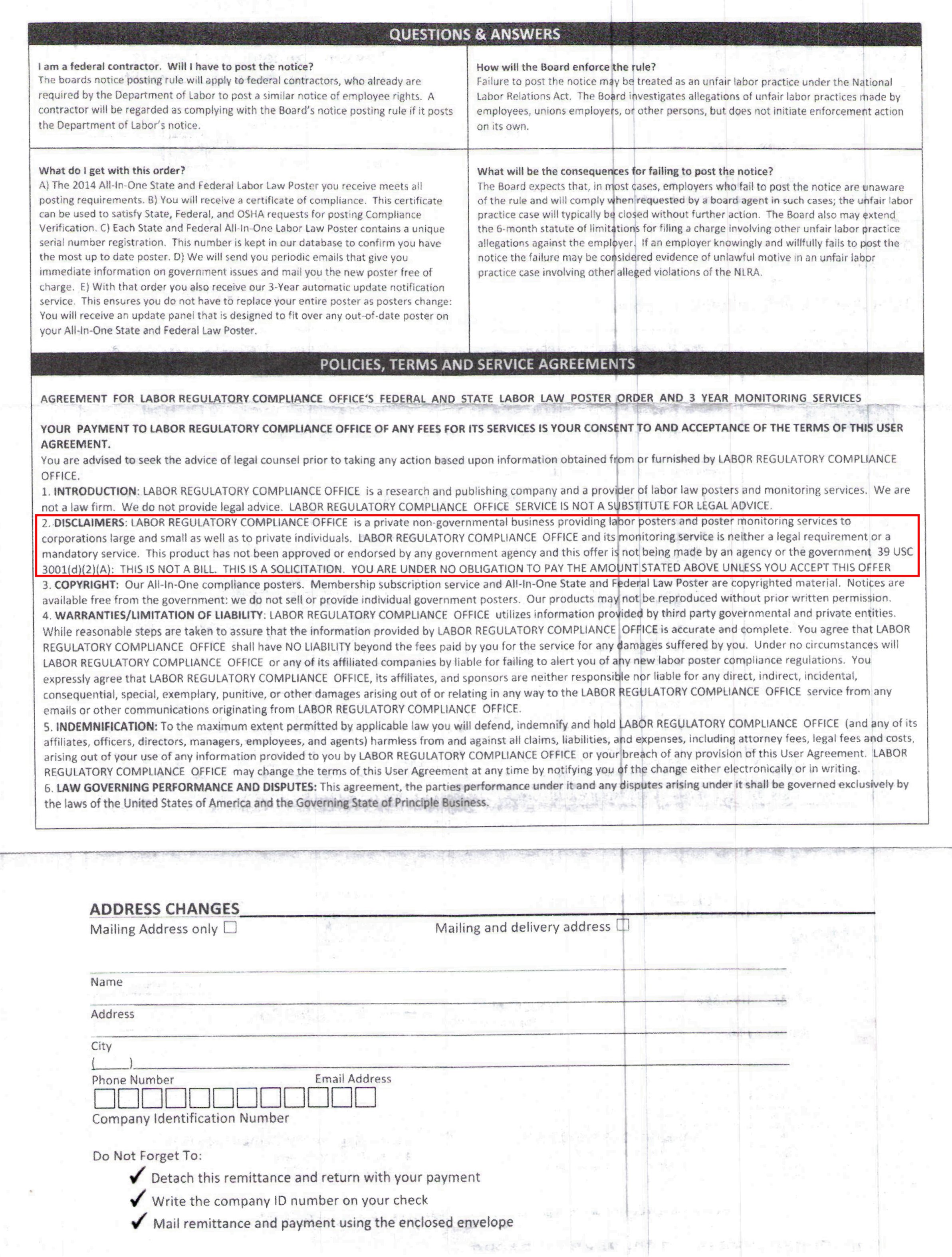
Executive Summary: Do not pay this company a dime. They are charging an outrageous fee for something any business can get for nothing, and using scare tactics to imply that you are at risk of fines up to $17,000 for being out of compliance.

Fraud1  Fraud2

You can click the thumbnails above for larger images. Note that the “invoice” is designed to intimidate and frighten; the disclaimers and additional information on the back side are printed in very light gray type, difficult to read (I’ve enhanced the contrast and gamma for readability.) Note that they admit you are under no obligation to pay for their services, and what are you getting? A poster. A very, very, very expensive poster, plus three years of their “monitoring service,” which is worth precisely zip. Zilch. Nada. Cypher. Nothing.

Federal Labor posters are available for free. Utah provides a complete list of posters and where to obtain them. Unless you’re a company that’s rolling in so much money that you feel like it’s worth three hundred Benjamins to save the hassle of gathering these individually, save your cash.

And, in the rare case that your business is audited and you fail to meet the standards, most inspectors will simply let you know what’s missing and give you a chance to post whatever is needed. They are not draconian inquisitors, and fines are usually levied only in case of willful non-compliance.

The Old Wolf has spoken.

The Net is a Myth

statue_ring_the_lord_of_rings_tolkien_argonath_lotr_isildur_anarion_fellowship_desktop_2011x1135_hd-wallpaper-25254

In a recent blog post about the feud between Peter Jackson and the Tolkien estate, it was stated,

Like many quarrels in Hollywood, the Tolkien/Warner Bros. spat can be narrowed down to an argument about money. Part of the author’s estate’s contract with the film studio said that a percentage of the profits from any adaptation of Tolkien’s work would go back to them, and it became a bit of a controversy following the release of The Lord of The Rings trilogy. The three movies made a reported $2.9 billion at the global box office, but when those box office totals were combined with project’s expenses, the studio claimed that the movie didn’t make a profit – thus reportedly shortchanging the Tolkien estate. In an interview with Le Monde back in 2012, Tolkien Estate lawyer Cathleen Blackburn recounted, “These hugely popular films apparently did not make any profit! We were receiving statements saying that the producers did not owe the Tolkien Estate a dime.”

This isn’t an entirely rare thing in Hollywood. In 2010, a net profit statement for Harry Potter and the Order of the Phoenix (another Warner Bros. film) was leaked and reported that despite the movie’s $934 million box office take, the studio actually lost $167 million when the final calculations were made.

A very revelatory post by The Furious D Show elaborates on the kind of jiggery-pokery that Hollywood studios engage in to avoid having to pay actors and other involved parties, and offers a few well-considered suggestions.

“A major summer blockbuster can, through the magic of ‘colourful accounting’ lose a fortune because the studio’s corporate parent lost money on cattle futures in Argentina. What survives this whittling, or to be more exact, hacking, is called the ‘net profit.’ Except there is never a net profit. The net is a myth. It’s a fantasy. It’s the corporate equivalent of bigfoot. Traces have been reported, but no one has ever actually caught one.”

—–

Stop playing games with the money. Make a plan so that if the film really does make a profit on its own merits, that those profits are divided equitably among all involved. Trust me, playing with the books costs more money than it saves, ask Enron.

Pay actors what they’re worth. I’m not saying that you pay them scraps, but pay them a salary based on their real box-office appeal, not just the number of times Mary Hart drops their name or how many magazine covers they get. It has to be based on bums on seats, and if they are box-office gold, they’re profit more from a intelligently run profit sharing system and won’t demand the immense up front money.

Simplify the business plan. You see when studios offer a mission statement, they always talk about ‘paradigms’ and ‘maximizations’ and other pointless buzzwords that have nothing to do with making movies. The real business plan of a studio is to tell stories and sell stories. Remember that and you can’t go wrong.

For any rational human to believe that the Lord of the Rings, or any Harry Potter movie, actually lost money is to ask one to believe in the tooth fairy. Hollywood and their legions of accountants and attorneys would do well to go back to school for some remedial work in corporate ethics. But I’m not holding my breath.

The Old Wolf has spoken.


Not Always Right… Right?

Over at Not Always Right, retail workers share their best horror stories of bad, abusive, or stupid customers. (Don’t worry, there’s a companion site for lazy, stupid and ill-mannered workers as well.)

But here’s a story that had a short life on Facebook, and even though it’s now gone from the company’s website it deserves to be shared. Widely.

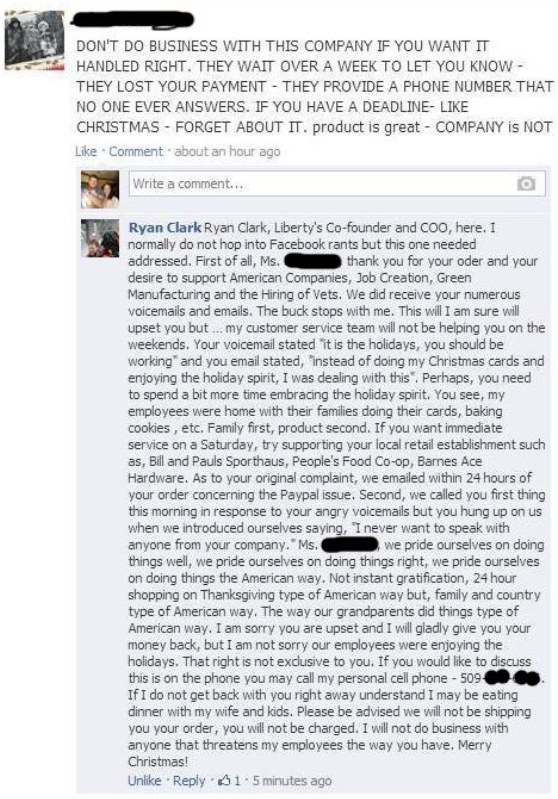
Liberty Bottleworks is an American company that manufactures metal bottles and tries to do so in an ethical and responsible manner. Have a look at a rant from a disgruntled customer and the response she got from the company co-founder and COO:

liberty+post


I would have hit “Like” a hundred times for this post if it were possible; the response from the company officer was firm, steadfast, measured, and well-deserved. I run a business or two myself, and I’ve always tried to give top-notch customer service, but this kind of douchebaggery is beyond the pale. The customer deserved to be reamed out but good.


Now, if you’re in business for yourself you probably understand why this exchange was deleted from Facebook. Right or not, deserved or not, it’s probably not the kind of thing the firm cares to dwell on or have appearing on their website on a permanent basis. But I’m sharing it here because there are far too many customers in the world who seem to think that the retail universe revolves around them, and that they have the right to be as mean, snarky, snotty, and abusive as they please without fear of retribution.

Well guess what… it just ain’t so.

Retail workers appreciate beyond measure a management that will stand up for them when customers become rude, abusive, or unreasonable. It happens, sadly, in far too few concerns. But as for me and my house, I give Liberty Bottleworks a 10/10 on the awesomeness scale, and will patronize them any time I need something they can provide, just because of this (not to mention all the other good reasons that they deserve my business.)

The Old Wolf has spoken.


Why “Black Friday” is a truckload of camel ejecta

I’ve always known it. With the exception of a few scarce loss-leaders on the front table at Staples, or the one or two flat-screen TV’s listed at a ridiculously low price at WalMart, the things people are disembowelling each other for could be had for the same price at other, much more peaceful, seasons.

An article in the Wall Street Journal talks about the dirty secret of “Black Friday” discounts:

The common assumption is that retailers stock up on goods and then mark down the ones that don’t sell, taking a hit to their profits. But that isn’t typically how it plays out. Instead, big retailers work backward with their suppliers to set starting prices that, after all the markdowns, will yield the profit margins they want. The red cardigan sweater with the ruffled neck on sale for more than 40% off at $39.99 was never meant to sell at its $68 starting price. It was designed with the discount built in.

Why this is not common knowledge by now is beyond me, other than the fact that most people get their educations from slanted news media and the National Enquirer.

The Week gives some more information in an article entitled Black Friday ads: 4 sneaky pricing tricks — and how to spot them  The summary:

  • They mislead us on original prices (“Original Prices” are grossly inflated.)
  • They push derivative products (The wares they’re selling often aren’t the cream of the crop. These models are, unsurprisingly, unreliable and shoddy. Derivative products often have fewer features than comparable sets as well.)
  • They repeat deals from last year (90 percent of Black Friday ads from 2012 contained at least one of the exact same items selling at the exact same price as in 2011.)
  • They use rebates (Shoppers often forget to submit rebates — which is exactly why retailers love them.)

Each of these points comes with advice on how to beat the retailer at his own game, or at least make sure you’re not falling for the scams.

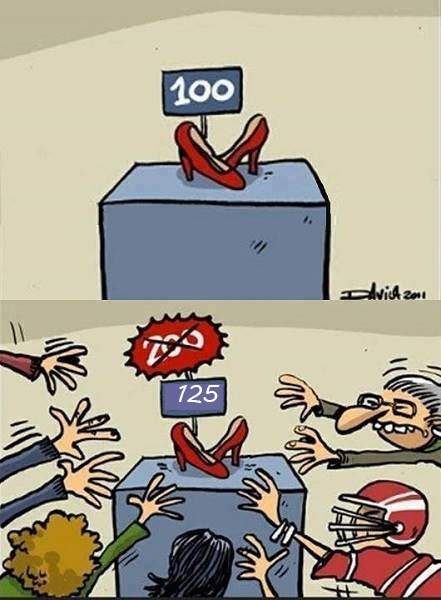
If you need a visual summary, I found this one over at reddit, courtesy of /u/guyinnova

CLUyh7x


Do yourselves a favor. Stay home on Black Thursday and Black Friday, shop on December 4th (or at other less-stressful times), and do your homework. You’ll save both money, stress, and possibly life and limb.

The Old Wolf has spoken.

To dream the impossible dream

Growing up – or even being grown up – and dealing with body image issues is difficult enough in the absence of an impossible standard. Unfortunately for everyone, the advertising industry is responsible for holding up a zenith of beauty which is impossible for anyone to attain – even the beautiful models themselves.

The two shots below were captured from a video that shows model Sally Gifford Piper being photographed and then photoshopped.

Impossible1

This is the photo of Sally before the photoshop work was done. Yes, she’s had hair work and makeup and lighting for this shot, but she’s a beautiful woman just the same.

Impossible2

This is the “after” version – she’s been given body work and cosmetic surgery to give her Barbie proportions, something no human could ever hope to approximate.

Watch the process in the video below:

And as a followup, an interview with Piper herself, courtesy of CNN.

This reminds me of the Dove makeover video, that is worth watching at any time.

The advertisers should be ashamed of themselves for promoting such unattainable standards, but of course they won’t be, because the result is far too lucrative, at the expense of the self esteem of people everywhere – largely women and girls. The more exposure this kind of douchebaggery can get, the better off humanity will be.

The Old Wolf has spoken.

A Love Letter to Canada Post

not-my-job

Not my job / Pas mon boulot

A couple of weeks ago I sent a package to a colleague in Québec. I addressed it exactly as he indicated I should; a couple of days ago it came back to me marked “Address Incomplete.”

Canada Post suggested a message to them at their Facebook page, so I obliged:

Since you asked for private messages about difficulties, I thought I’d share this here instead of pillorying you publicly. I’m sure folks are doing their best, but when I send a package from the USA to the address given me by my correspondent, to wit:

Jean X. Untel
11 rue Quelquepart
Montréal, QC H3J 2V9

and it comes back to me stamped “Incomplete Address,” I’m pretty frosted that I wasted the money on international postage – my friend’s comments are more indicative than my own would be – “Probably needed the apartment number, mais le christ de facteur pouvait bien compléter, hostie!”[1]

I agree – this is the pinnacle of “not my job” mentality. I just thought someone might be interested in this… at least, it is to be hoped. Thank you for listening.

Well, I gave them a chance, but unfortunately their answer (they get one point for taking the time to answer) was less than satisfactory:

Thanks for your message! If the recipient confirms that an apartment number was missing; that could be the reason why your package was returned to you. If there wasn’t any error with your address, please contact the USPS to open a claim. They’ll contact us to investigate.

Kind Regards,

Canada Post

Once upon a time, the attitude of businesses (the Post Office is one, regardless of which country you happen to live in) was “service above all.”

From the Scottish Daily Record & Sunday in 2002:

THE Royal Mail revealed yesterday Britain’s undeliverable post costs about pounds 10million a year. 
The National Return Letter Centre handled 72million “undeliverable” items of mail and the figure is on the increase with an 18 per cent annual rise. 
But, despite this, postmen and women still manage to deliver letters with the strangest addresses. 
Rothesay’s postal service had to deliver a letter with the address: “Moira, Recently holidayed in Russia, Get off ferry, Turn left for 2 miles, Isle of Bute, Scotland.” 
The local postie had been delivering mail to Moira for 15 years and had remembered her mentioning she was going to Russia on holiday. 
A postie in Inverness successfully delivered a letter addressed to: “Mr W MacKenzie, Over Pedestrian Crossing, Turn Left Up Mid Street, Tank in Garden, Before Fraser Street, Inverness.” 
Ray Kennedy, of the Belfast-based NRLC, said: “When customers say their letter is ‘lost in the post’ often what they don’t realise is it is actually ‘undeliverable’ because they got the address wrong or forgot to write one at all.”

Although some claim it’s an urban legend, the article in the December, 1952 Popular Science, “Riding America’s Biggest Mail Train” tells the story of a clerk on the Massachusetts car who handled the

Wood

letter, and successfully delivered it to “John Underwood, Andover, Massachussetts.” An earlier example was listed in the May-October, 1898, issue of “The Ludgate Illustrated Magazine” and claimed that a similar letter was delivered to John Underwood, Andover, Hampshire even though it was addressed to

Wood
John
Hants,

as well as a letter that found its recepient at “The Old Oak Orchard, Tenbury” despite being addressed as

Too Dad Thomas
hat the old oke
atchut
10 Bary

It should be noted that such things might have been much more likely when the population of the country was substantially smaller. I don’t expect every postal worker to have every address of every recipient memorized, but it would have taken Monsieur le Facteur (ou bien Madame la Factrice) less than 30 seconds to look up my friend’s apartment number; you can’t tell me they don’t keep such lists. But it seems that for the individual involved, that was too much trouble.

There’s no question about it: this is one of those “first world problems.” As I indicated, I’m sure most of the people at the post office are doing their best – in fact, an interesting article over at Improbable Research indicates that things are not as dismal at the USPS as we like to gripe about, and I’m sure the same thing could be said of Canada Post. It’s just that this one bugged me as a particularly egregious example of “Not Always Working,” and the official response seemed to reflect the attitude that “we won’t go out of our way for anyone.”

Having vented a bit, I now feel better.

The Old Wolf has spoken.


[1] This is Québecois for “The damn postman could have completed it, for Hell’s sake,” or something similar. The French is considerably more blasphemous.

Dear web developers: Don’t do this

I often grab bits of text from news websites and other places of interest to quote at this blog. I always give credit to the source if it’s known, so this fairly recent development gets under my skin. Many websites now append a bit of text to anything that’s copied, like this:


“Frozen in time: The occupants of this abandoned farm house are long gone, but their belongings remain; from the paintings hanging on the walls to the neatly made bed”

Read more: [Some URL here]
Follow us: @MailOnline on Twitter | DailyMail on Facebook


See that blue stuff up there? I didn’t request it. I’m just going to delete it. It’s annoying, something along the lines of blinking text, forced social logins, popup ads, and back-button disable.

Weeaboos

The Old Wolf has spoken.