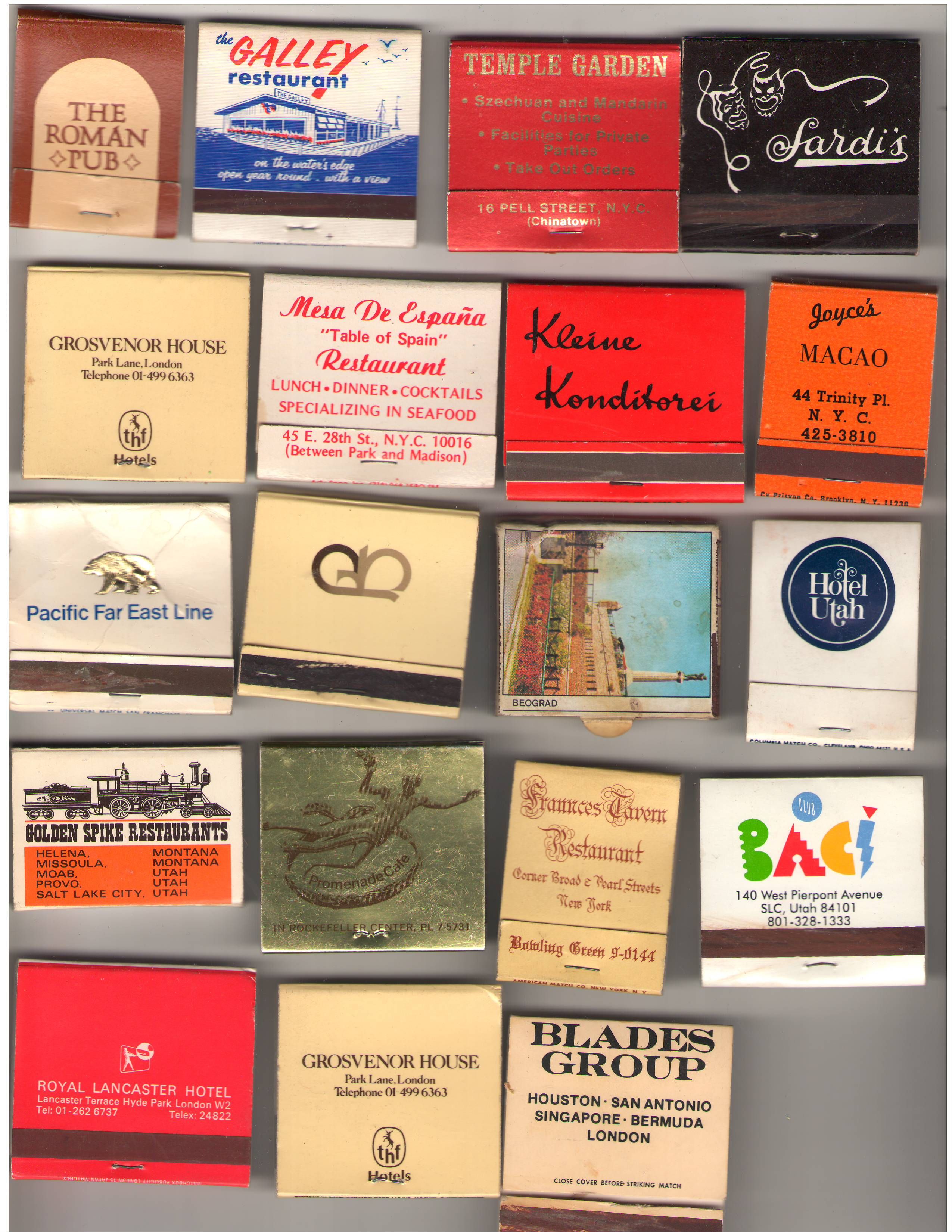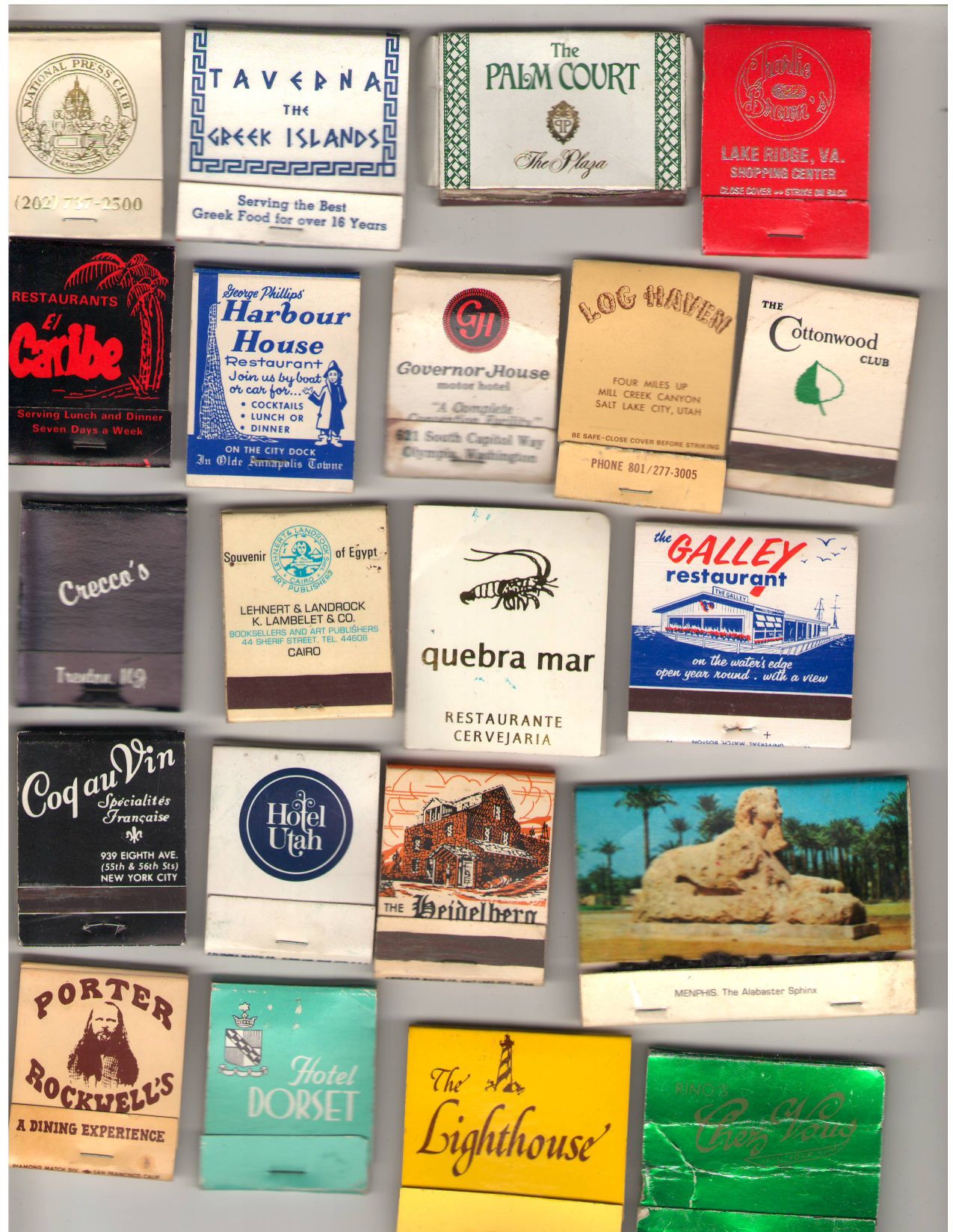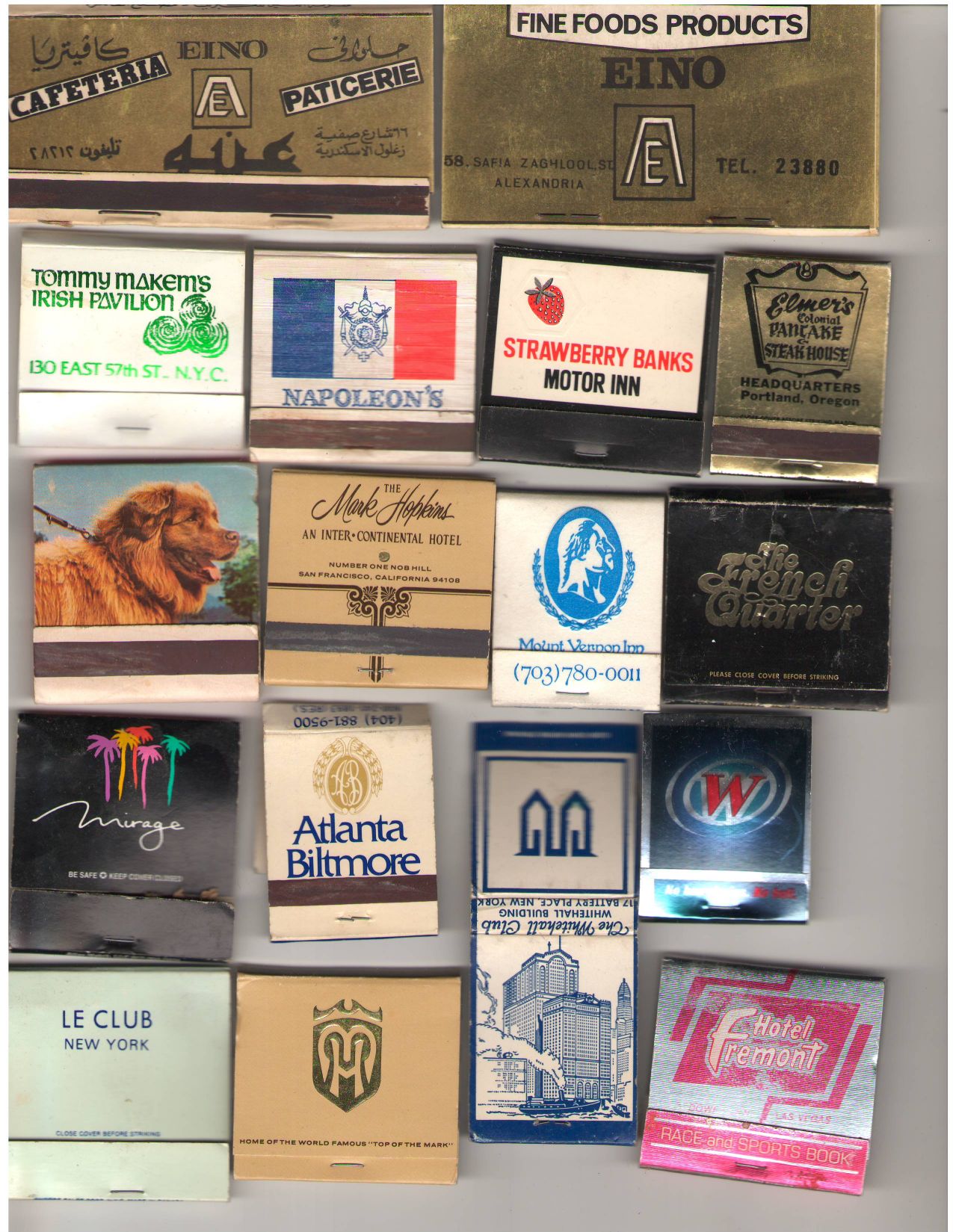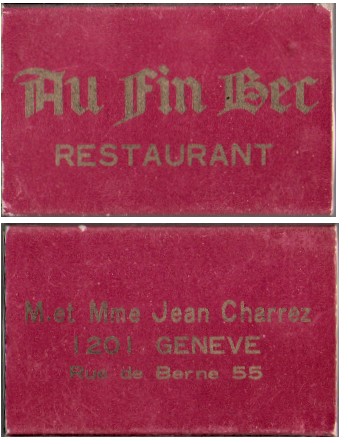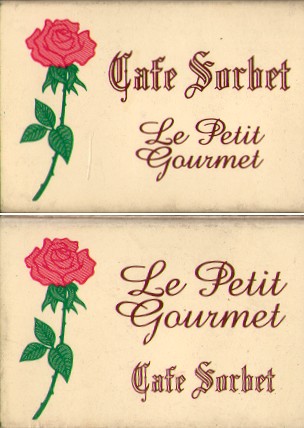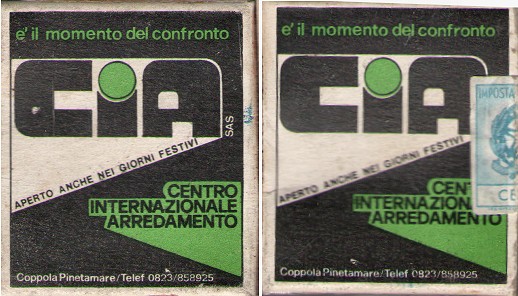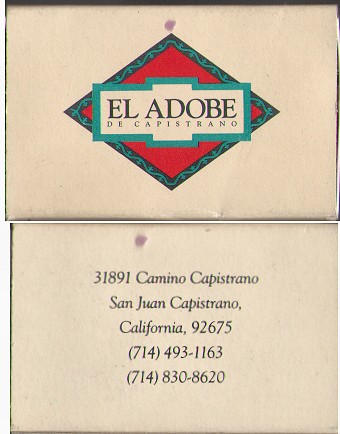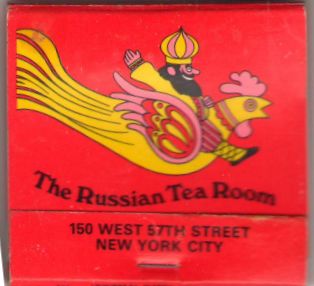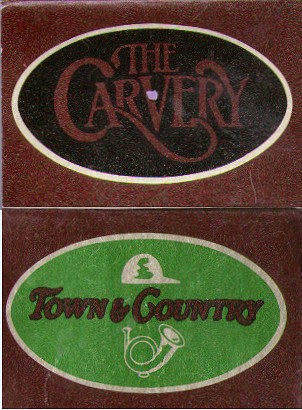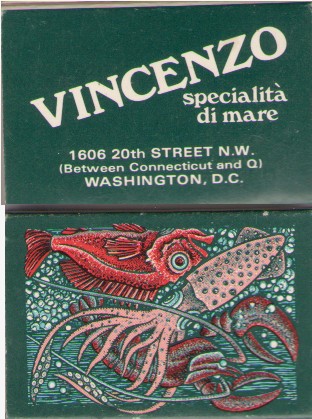
The Matchbook Collection of Margaret Draper

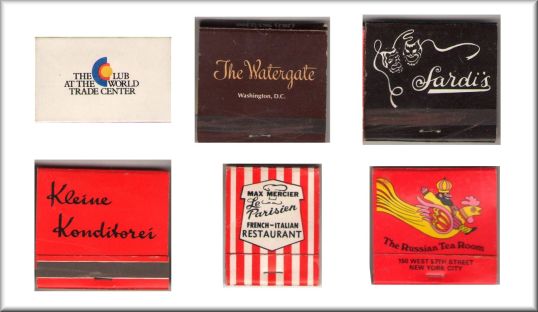
Maggie was a world traveler, and a lover of fine dining. These images are from her collection of matchbooks from numerous places around the world. If she favored New York City, she is to be forgiven, for that is where her heart resided. These are not generally collector-quality, as most matchcover specialists look for unstruck books, but many of them are quite interesting. Perhaps they can find a home with someone who values such things.

Matches 9

Some of the more interesting covers I found while scanning. Le Parisien was a beloved French restaurant in Salt Lake City.

Matches 1 Matches 2 Matches 3 Matches 4 Matches 5 Matches 6 Matches 7 Matches 8

13th Floor Golden Spike Amalfi Ceramic

Ambassador Grill 44th & 1st Ave NYC

Au Fin Bec

Bar at Capitol Hilton DC

Blackstreet Landing Damariscotta ME

Brandywine Downs Atlanta

Brasserie Bretonne DC

Cafe Sorbet DC

Carlton Wine Bar DC

Centro Internazionale Arredamento

Club at the World Trade Center

El Adobe San Juan Capistrano

El Nido Tesuque NM

Fujiya Hotel

Georgetown Hamlet DC

Horikawa Santa Ana

Hotel Utah 2

Hotel Utah

Italy Ceramic

Kleine Konditorei

La Bonne Soupe

Laurent NYC

Le Garage Wiscasset ME

Max Mercier

Morton's The Steakhouse Chicago

New York Marriott

Nino's University Club SLC

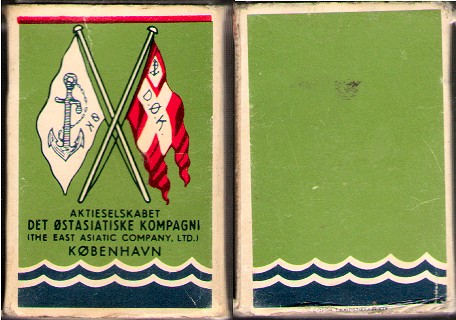
Oestasiatiske Kompagni

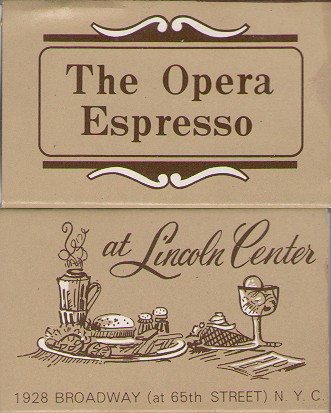
Opera Espresso Lincoln Center

Paris Milano NYC

Pepe's Cupertino

Petroglyph Santa Fe

Randolph's

Roof Terrace Restaurant at JFK Center, DC

Russian Tea Room 2

Russian Tea Room NYC

Santa Fe NYC

Sardis

The Carvery Mayflower DC

Trattoria Lombardi Dallas

Vincenzo DC 2

Vincenzo DC

Watergate 2

Watergate

Zephyr Grill NYC

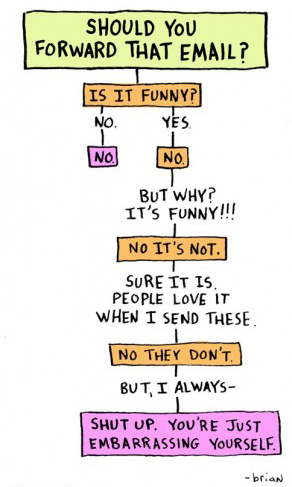
A “forward from Grandma”: Our generation is awesome.

should-you-forward-that-email

I used to get all kinds of effluence in my inbox, mostly from people forwarding things to me that they could have debunked with a 5-second visit to Snopes.com, or telling me that Microsoft would pay 20¢ to some cancer fund for each forward (they won’t.) In the course of telling people that these kinds of viral messages were essentially destructive time-wasters, the deluge has dwindled to a trickle.

But every now and then I get something that I like, and which I feel is worth sharing. This is one of them.

I had to do some massive re-formatting of the text, removing countless exclamation points!!!! fixing grammar and punctuaton, and making it look less like some clickbait thing from BuzzFeed, but when you get down to the core ideas, they resonate with me. Without further ado (I’ve added some notes):


To those of us born 1925 – 1979, and to all the kids who survived the 1930s, 40s, 50s, 60s and 70s:

First, we survived being born to mothers who may have smoked and/or drank while they were pregnant. They took aspirin, ate blue cheese dressing, tuna from a can, and didn’t get tested for diabetes. 1

Then, after that trauma, we were put to sleep on our tummies in baby cribs covered with bright colored lead-based paints.

We had no childproof lids on medicine bottles, locks on doors or cabinets, and, when we rode our bikes, we had baseball caps, not helmets, on our heads.

As infants and children, we would ride in cars with no car seats, no booster seats, no seat belts, no air bags, bald tires and sometimes no brakes.

Riding in the back of a pick- up truck on a warm day was always a special treat.

We drank water from the garden hose and not from a bottle.

We shared one soft drink with four friends, from one bottle, and no one actually died from this.

We ate cupcakes, white bread, real butter, and bacon. We drank kool-aid made with real white sugar. And we weren’t overweight. Why? Because we were always outside playing. 2

We would leave home in the morning and play all day, as long as we were back when the streetlights came on. No one was able to reach us all day, and we were okay.

We would spend hours building our go-carts out of scraps and then ride them down the hill, only to find out we forgot the brakes. After running into the bushes a few times, we learned to solve the problem.

We did not have play stations, Nintendos and Xboxes. There were no video games, no 150 channels on cable, no video movies or DVDs, no surround-sound or CDs, no cell phones, no personal computers, no internet and no chat rooms. We had friends and we went outside and found them!

☛ We fell out of trees, got cut, broke bones and teeth, and there were no lawsuits from those accidents. 3

We played outside, in parks and on the streets, alone, and nobody accused our parents of neglect. 4

We would get spankings with wooden spoons, switches, ping-pong paddles, or just a bare hand, and no one would call child services to report abuse.

We ate worms, and mud pies made from dirt, and the worms did not live in us forever.

We were given B-B guns for our 10th birthdays, 22 rifles for our 12th, rode horses, made up games with sticks and tennis balls, and although we were told it would happen, we did not put out very many eyes.

We rode bikes or walked to a friend’s house and knocked on the door or rang the bell, or just walked in and talked to them.

Little league had tryouts and not everyone made the team. Those who didn’t had to learn to deal with disappointment. Imagine that.
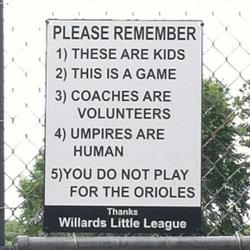
130715_SNUT_BaseballDadSign.jpg.CROP.article250-medium

Signs like this were not needed.

The idea of a parent bailing us out if we broke the law was unheard of. They actually sided with the law.

When we got bad grades, we were punished – not the teacher.

teachersnow_590_332

These generations have produced some of the best risk-takers, problem solvers, and inventors ever.

The past 50 to 85 years have seen an explosion of innovation and new ideas.

We had freedom, failure, success and responsibility, and we learned how to deal with it all.

If you are one of those born between 1925-1970, congratulations!


Naturally, these are not absolutes, but rather thoughts about how our society has changed. Sadly, despite all the amazing advances, not always for the better.

The Old Wolf has spoken.

Notes:

1) Yes, this and some of the other things mentioned above did cause accidents, health issues, and injuries. They still do. But strip away the lawyers and the nanny state, and most people would still survive.

2) There were some overweight kids. But they were the exception, rather than an ever-growing statistic.

3) This is my favorite one. I execrate the litigious nature of today’s society.

4) They even have a term for this nowadays: free-range parenting. This is abomination. Back then, it was just the way life was.
Keeping Welsh (and Bees) Alive.

Note: This article was originally published at FT.com (Financial Times). It is copyright. They have indicated that these articles can be shared with their “sharing tools,” and added, “Please don’t cut articles from FT.com and redistribute by email or post to the web.”

That would be fine, if they didn’t use that accursed “complete a survey to read this full article” ploy. Or make you register (i.e. give them your information) to read “3 free articles per month.” Both of these are scummy tactics which serve no purpose other than to drive people away from a website; to Pluto with that. So, FT, get rid of the surveys and the paywall and I’ll be happy to link people directly to your site. Until then, hard lines.


Wil Griffiths set up an organisation that aims to save the bees and his native tongue

Welsh beekeeper Wil Griffith

©Gareth Phillips

Wil Griffith: ‘When we started, other beekeepers thought we were racist’

Welsh has always lent itself to prose and poetry, to music and singing. But it has never been associated with scientific matters, and beekeeping is a science. If the language is to survive, it needs to expand into all aspects of everyday life.

I run the only Welsh-language beekeeping association in Wales. I set up Cymdeithas Gwenynwyr Cymraeg Ceredigion (the Ceredigion Welsh Beekeeping Association) at the end of the 1960s with two aims: survival of the bee and survival of the language.

Our Welsh beekeeping terms are not a pure translation of English terms because word-for-word translation is meaningless. For example, in a beehive, honey is stored in the very top of the hive, in the top box. The term in English is “super” — as in “superintendent”. It means “above”. But “above” would not be used that way in Welsh. The more usual Welsh word is “lloft” — meaning “upstairs”. So, in determining new terminology, we use everyday words that make sense to a Welsh ear. I wrote a book, Dyn Y Mel (The Honeyman) in which our Welsh terms are listed. In English, the term is “beekeeper” but, again, in Welsh, “dyn y mel” is more common.

I’m well over 80 now but I started beekeeping 60 years ago. At about that time modern hives were introduced. Before then, beekeepers had used closed straw skeps — but suddenly, for the first time, they were able to see what was taking place within the hive.

Modern terms were coined to reflect these changes, which flustered the older beekeepers. Very experienced beekeepers, who were first-language Welsh, were at a loss. The terminology involved was beyond them, particularly if it was in English.

Today our association has about 30 members and we even put on an annual show in a pub for our honey and mead. Finding enough bilingual judges is always a problem. As they are tasting, the judges must comment out loud in Welsh.

Beekeeping can be hazardous. A friend went to shift a hive late one evening and didn’t bother with protective clothing; a bee crawled into his ear. We tried to get it out but couldn’t. The only way was to drown it, and the only liquid we had to hand was a bottle of brown ale. So that was poured in and the bee floated out. But there’s no special term — in Welsh or English — for these beekeeping mishaps.

Our members do not have to speak Welsh — but we are true to our founding principles. At meetings, English speakers sit next to someone bilingual — most of us are — who will quietly translate for them. After a season or so, they have a good smattering of the language.

When we started other beekeepers thought we were racist. But what is wrong with studying in our native tongue? People would not be surprised if beekeeping associations in France or Germany discussed beekeeping in French or German. Why be surprised about Welsh?

The best way to keep a language alive is to place it at the centre of everyday life. In my county, Ceredigion, Welsh is a minority language. There has been a big fall in the number of native speakers in the past 30 years, and people are realising that we are in danger of losing one of the oldest languages in Europe.

Copyright The Financial Times Limited 2015

DIY Part II – Things worked out better this time.

So the CD player in my 2007 Prius went South; wouldn’t eject disks any longer. Time to get a new one.

Called up two dealerships requesting information.

  • Dealer 1: $365.00 for a re-manufactured unit plus about 2 hours of labor at $108.00 per hour.
  • Dealer 2: $1200.00 for a new unit plus similar installation charges. No mention of the possibility of gettting a refurbished unit. Holy hqiz.

Thinking I would have to do without a CD player, because those prices were definitely beyond my means at this moment.

Then I found this outfit that had refurbished units for $199.00, and the video below that details how to replace the part myself.

The guy who made the video missed a couple of screws and got one bit out of order (you have to remove the far-left vent cover before being able to access the second screw on the bottom panel), but it worked out; I was able to swap the unit out with very little difficulty, and I was astonished at how easily and with what precision everything fit together again when I was done.

ick

My car did look pretty much like this by the time I was down to the stereo. It looked really scary, but now you can’t tell that anything had ever been done.

This little escapade saved me between $400 and $1000, depending on which dealership I might have gone with.

Takeaway: Always compare dealerships, don’t take any of them at their word, and if you can possibly find a way to do the work yourself, do it.

The Old Wolf has spoken.

Utah Speak

Utah has its own language and its own dialect, especially when you get out of the cosmopolitan areas. This list of Utah words was assembled by the Radio from Hell show.

Liar
Skiddin
Sway
Mart
Al
Scout
Strew
Sarah
Zrenny
Meetin
Smelp
Bulimia
Cheatin
Skit
Sain
Skweet
Jeat
Snot
Stew
Zis
Smee
Frude
Frignernt
Melk
Mungry
Lechin
Galna
(lawyer)
(just kidding)
(this way)
(my heart)
(owl)
(lets go out)
(it’s true)
(is there a)
(is there any)
(I am eating)
(some help)
(believe me, I …)
(what are you eating)
(let’s get)
(saying)
(let’s go eat)
(did you eat)
(is not)
(is too)
(who is this)
(it’s me)
(for rude)
(for ignorant)
(milk)
(I’m hungry)
(let you in)
(gallon of)

Other phenomena have been observed, such as the tendency of vowels to go from tense to lax before /l/, resulting in things like “Bell the Hay, George, there’s a hellstorm coming.” The phenomenon is not limited to production, but also perception; my ex-wife always referred to my cousin Del as “Dale” – i.e. she couldn’t hear the difference between the two phonemes in that position.

Southern Utahns have a heavy tendency to pronounce words like “born” and “Mormon” as “barn” and “Marmon.” This has been stigmatized as “hick speech,” and some people, aware of this, can overcompensate when trying to avoid the appearance of being a jay, coming up with things like “horpsichard.”

Here in Utah, we call that little gray bug that rolls up when you touch it a “potato bug,” rather than whatever you probably call it, and the thing that goes down the middle of two freeway lanes is called a “bar pit.” “Caught” and “cot” are identical here, as are “Mary,” “merry,” and “marry.” Coming from New York, I distinguish between these words, and have never given up the distinction although I’ve lived in Utah for 46 years.
Lastly, Utah is famous for its double modals, such as “might could,” “might would,” etc, as well as the odd names with interstitial majuscules like “LaVar,” “DuWayne,” and such things. If you want some real technical stuff, a preliminary survey of Northern Utah speech can be found here.
Strew.

The Old Wolf has spoken. Er maybe spoke, dunno.

Do it yourself: Nothing ventured, nothing gained.

About 15 years ago I bought this Braun shaver, and it served me well for at least 15 years. The rechargeable batteries finally wore out, and I wondered if it would be worth trying to replace them myself rather than pay an appliance repairman ten prices for the privilege.

How to open it? I found a totally useless article on eHow (typical of all these crowdsourced answer sites like WikiHow, FixYa, Yahoo! Answers, and so many others – the blind leading the rutting blind) and then figured out how to get the thing open myself. Once you do, getting to the guts is pretty easy – and the little electronic board with the batteries pops right out. Nice German engineering.

I bought a couple of new NiMH rechargeables, and set about replacing them. The beggar was that those batteries were not soldered to the board, the were spot-welded at the contact points… but with some careful work I was able to get them out.

Popped the new batteries in, and the whole board started to smoke and melt.

Crap. I must have put the new batteries in backwards or something. I thought I was doing it right.

20150415_164000

RIP Braun – It’s the component in the front that really lit up – what looks like burning under the left battery is just residue from the original adhesive.

So this particular attempt at DIY didn’t work out so well… but that’s how I learn. Over the last half-century, I’ve assembled enough handyman skills to install a bathroom into a totally unfinished space, and all of that experience came from just jumping in and doing it. I made mistakes along the way, but these days most things go pretty smoothly.

So I had to run out and get a new Braun (I feel very loyal to that brand, I’ve been using good Braun shavers since 1974, the first one bought in Austria) and hopefully this one will last me at least 15 years, by which time I’ll get my grandkids to buy me a new one for Christmas, so I won’t have to try this particular experiment again.

I’m sure there will be others.

The Old Wolf has spoken.


PS: Ah, the luscious smell of burning silicon…

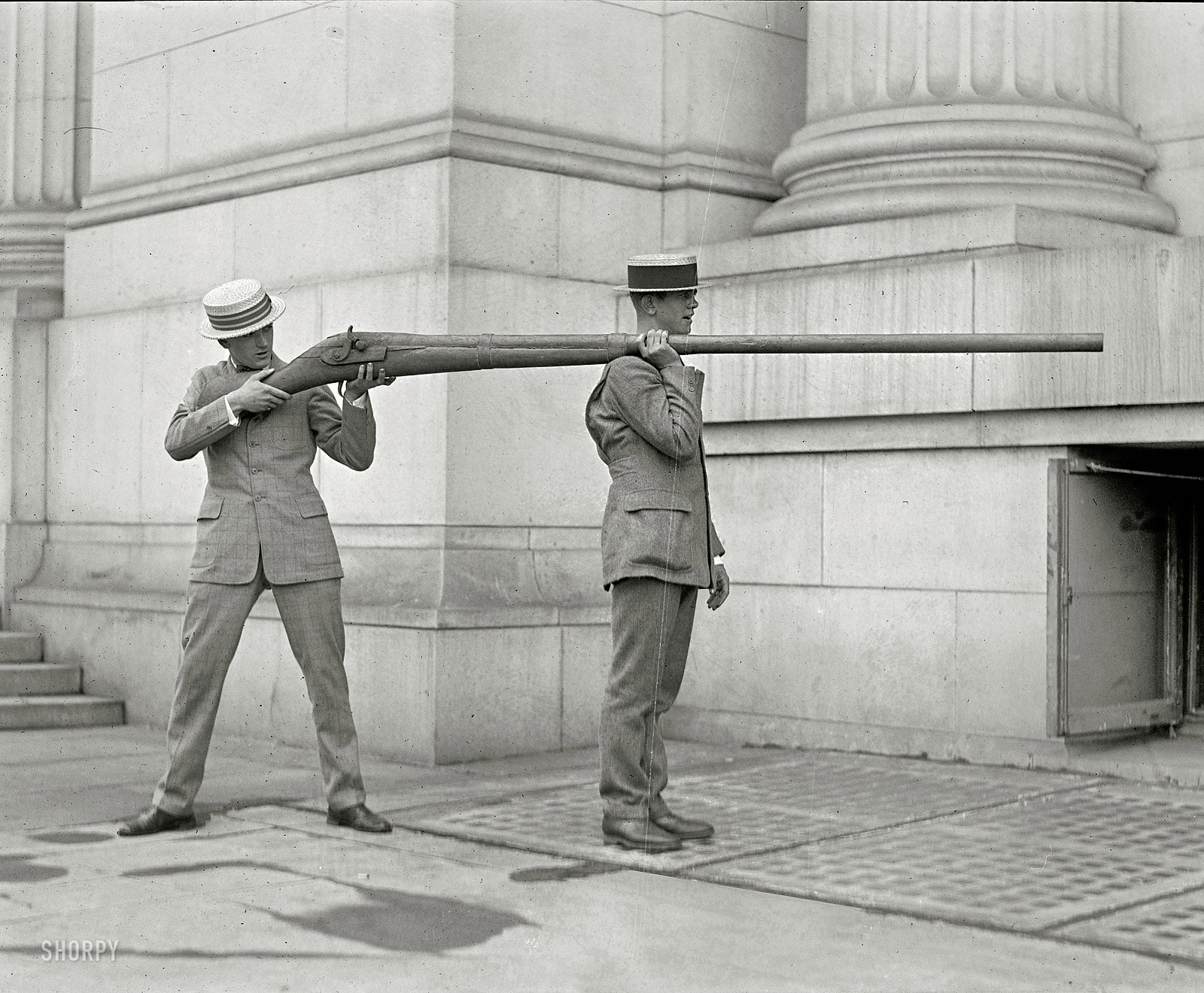
The Punt Gun – otherwise known as “dynamite fishing for waterfowl”

6j1r2kh

Matthew Quigley would probably have messed his pants had he been able to see this. Such a contraption seems to put his Sharp’s Buffalo Gun to shame, although it was designed for an entirely different purpose.

These guns were so large and their recoil so powerful that they were generally affixed to small hunting watercraft (punts); the force of the discharge would often drive the punt backwards a considerable distance.

gunboat

Use of a gun of this nature makes the small craft look like a duck-hunting battleship. While the idea is to be able to kill large numbers of waterfowl at once for commercial hunting enterprises, one wonders if a weapon of this nature would not be more likely to atomize its target!

The Wikipedia article indicates that the use of punt guns in large fleets led to depletion of wild game, and that in the early 20th century market hunting was outlawed, making the use of these weapons either illegal or impractical.

The title of this post refers to blast fishing, almost always illegal because it’s unsportsmanlike, dangerous to the environment, and dangerous for those who attempt it.

The above idiots were lucky that they didn’t lose hands, arms, or heads.

The Old Wolf has spoken.

RTFM, and never trust the dealer.

2007-toyota-prius-5dr-hb-natl-angular-front-exterior-view_100271619_s
Eight years.

Eight years of frustration could have been avoided had I simply taken the trouble to read my 2007 Prius’ Owner’s Manual when I bought the thing.

Now, I love my Prius. I hope it lasts forever because she’s been really good to me. But it has a few annoying quirks, and one of my biggest complaints was that with the smart key system, you touch the driver’s side door and the driver’s side door unlocks – but only that one. (Touching the other doors would unlock all of them, but I wouldn’t generally do that when using the car alone.)

I’d get in, go to work, and then try to get in the back door or the hatchback to get a briefcase or something, and the door was still locked. A first world problem to be sure, but when it’s raining out, it was a major pain to have to get back in the front door, press the “unlock button,” and then be able to open the other doors. Finally my patience had worn thin enough that I decided to see if it could be fixed.

I called the dealership where I bought the car (now 60 miles away), and asked them if this feature could be programmed. The first lady I spoke to said, “Sure, just bring it in.” Wonderful! Then my cynicism meter redlined, and I called a Toyota dealership closer to me. “No,” they said, “no, that function cannot be changed.”

BS Meter

Dang. Whom to trust? I called the first dealership back again, and explained what the other had said. I didn’t want to drive all the way up there only to be told, “Oh, we were wrong.” I got a plate of waffles this time: “Well, we need to have you come up and have the technician hook up his computer and see if your vehicle allows for that function before we’ll know for sure. The diagnostic charge will be $ABunchOfMoney, and if he can change the function, it will be $ALotMore.” Thank you, I appreciate your time. Click.

Good thing I didn’t drive all the way up based on the first “Sure, we can do that.” Now what to do? Once again I put it on the back burner.

About a month later, I decided to do some more searching on the internet, and  I finally discovered this video. Fully half of it is advertising, and the remainder is almost unwatchable, but props to whomever made it because it led me to a solution. The first thing I noticed was that the kid in the video had pulled out the Owner’s Manual. At that point I stopped watching the Cloverfield-style camera work, and went to drag out my own.

Really? You mean, the answer might just be in the Owner’s Manual?

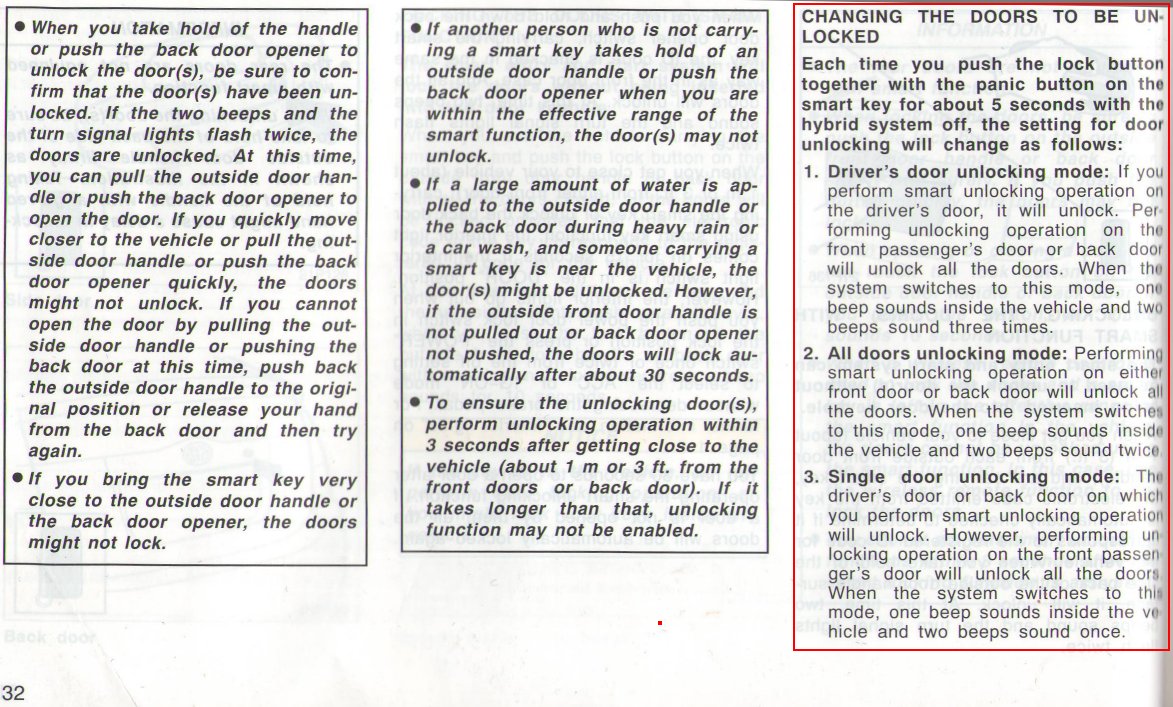
The 2007 Prius has a slightly different manual than the 2008 shown in the video, but sure enough, after a bit of searching I found something in the “Smart Entry and Start System” section; I had to hunt around because the index in the manual was probably written by a drunken lemur pay attention Toyota.

manual

So it turns out that if I held down the “lock” and “panic” button together for about 5 seconds, the car makes a bunch of beeps and the unlocking pattern rotates to the next option in the cycle. Done. Free. Heaven knows how much Dealer A would have charged me, or if they would have even been able to figure it out themselves.

I’ve learned a couple of lessons here.

Lesson 1: If I ever buy a new car, I’ll be sure to Read The Freaking Manual cover-to-cover and take notes. Yesterday as I was happily telling my wife about my triumph, she noted with her usual dry wit that I might even discover other wonderful things if I were to do so with this one. Make it so.

rtfm

Lesson 2: Never trust a car dealership to tell you the absolute truth. Some will outright lie to you, and others just won’t know. Dealer 1 told me that they could fix my problem just to get me in the shop, without even really knowing if the issue was fixable or not. Dealer 2 was ignorant. In the interest of fairness, folks who work in such places are just people; car models change every year, each car has a myriad of different features, and it would be hard for even a top service technician to keep abreast of all of them. Moreover, after 8 years there’s a high probability that the folks working there have only been on the job for a few years and don’t know as much about “older models.” That said, there is a certain expectation of competence when one reaches out to a dealership, so I was left with some residual disappointment that nobody bothered to give me accurate information.

But I’m pleased. A small burr has been removed from under my saddle, and the relief is palpable.

The Old Wolf has spoken.

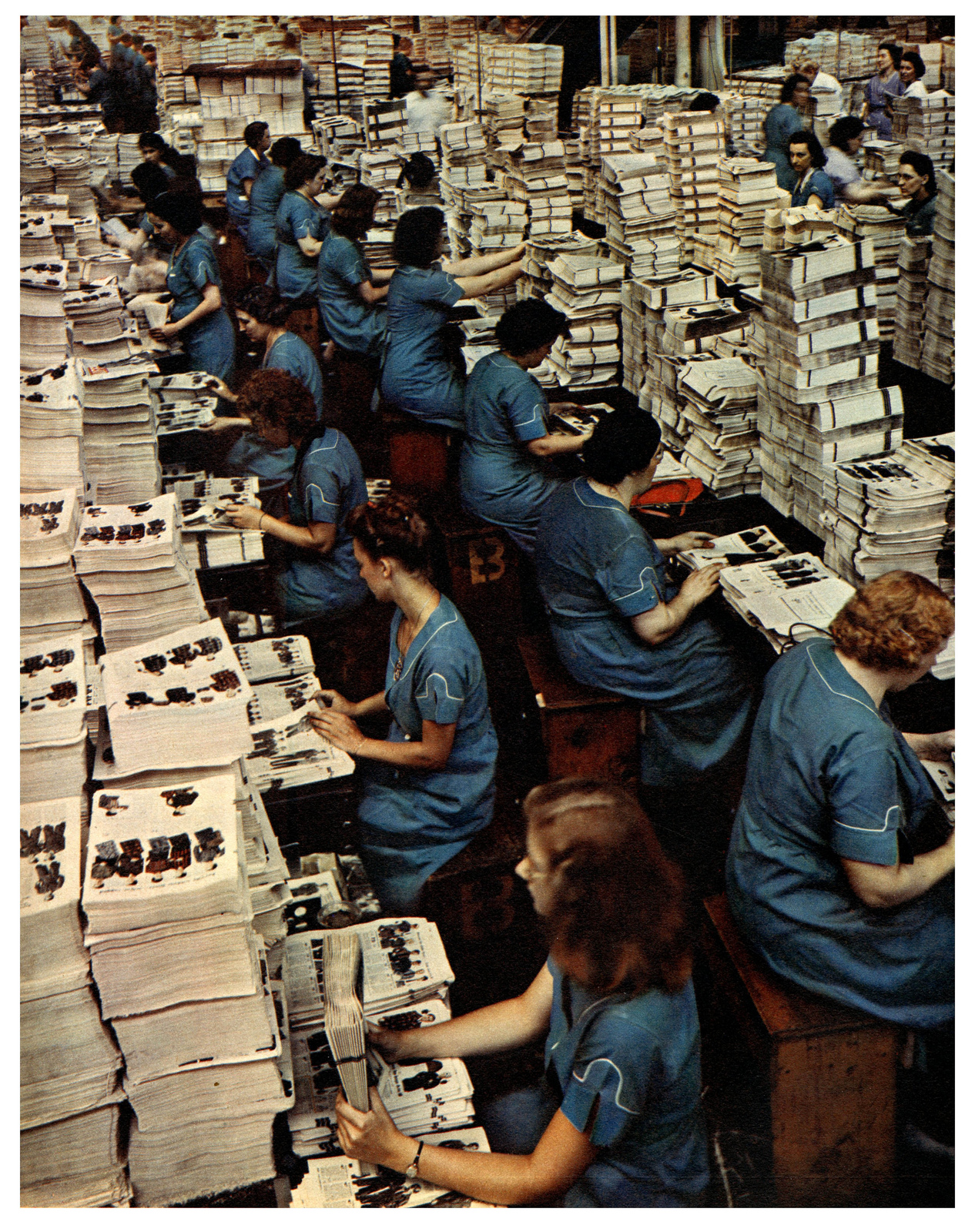
1942 – Assembling the Sears Catalog

… by hand.

DJJKNnt

Those catalogs offered just about anything under the sun. They were, in effect, the Amazon.com of the early days.

724986438d58ae70a4f0ae5264c2f135

sears-fall-1942-boys-coats

1942SearsChristmasBookPage0049_thumb

6c6335d71f34f8fc8de075b57df79785

CIMG0477

And those prices. Of course, the average annual salary in 1942 was $2,400, but still.

Not only were the catalogs useful, but they were entertaining as well. And they had the added advantage of being sent to the outhouse as reading material and… uh… other things.

The Old Wolf has spoken.

Dialect variations in nomenclature – the US vs. Germany

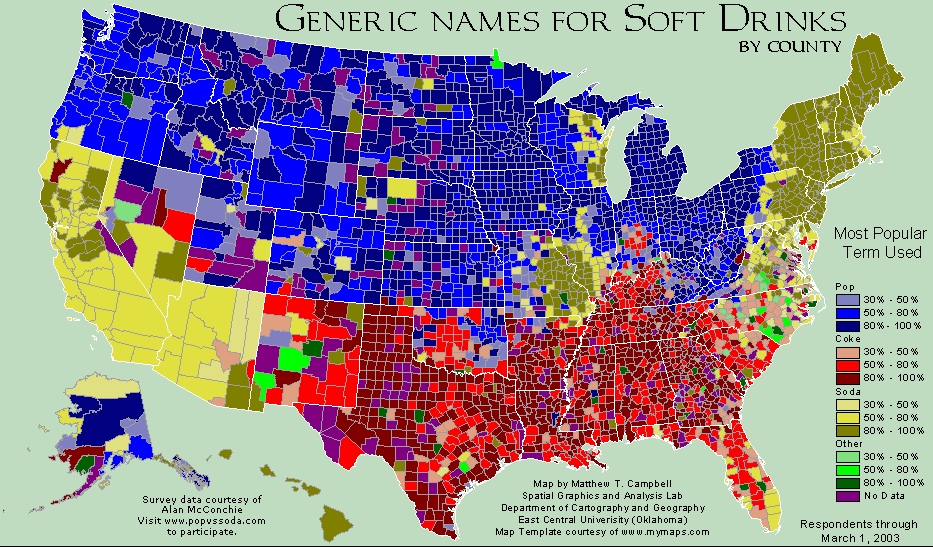
One of the more interesting terminology diversions in the US has to do with what you fill up your jug with at the convenience store. No, not that “good ol’ Mountain Dew,” although that can certainly be one of your choices, but anything sweet and fizzy. What do you call it? Soda? Pop? Coke? Fizz? Something else?

2012-11-09-Screenshot20121109at3.05.00PM

People registered their opinions over at popvssoda.com, and the results were tabulated. I knew one guy who called it “soda water,” even though to me that means just unflavored club soda.

Today as the result of a little discussion among my translation colleagues, I was presented with this website that shows the distribution of various terms for “potato” in German:

????????????????????????????????????????????????????????????????????????????

While most people would find things like this less exciting that watching paint dry (and even I myself, graduated linguist with advanced degrees absolutely detested my 7th-grade linguistics class, even though that’s a different story), I find comparative and social linguistics intriguing.

Think about what you call things; Crawdad, crayfish, crawfish; potato bug, pill bug; hoagie, sub, grinder, or po’ boy; water fountain or bubbler; so many, many others, and some of these are distinctly regional. Take the quiz and see how well it does in your case. Naturally it’s not going to be 100% perfect all the time, but I was impressed not only by the results but by the nature of the questions.

The New York Times dialect survey has shown to be amazingly accurate in my own case:

download

maps

I was born and raised in New York, but have spent the last 46 years in Utah; you couldn’t get more spot-on with my diagnosis.

The study of linguistic diversity across boundaries and how language evolves is an entire subset of the larger field, but I could think of much less interesting ways to spend a career than researching these matters.

The Old Wolf has done spoke.