How would you feel about a beautiful picture of your significant other being used as part of an ad campaign for Trojan condoms? For free, and without your permission? Which Facebook would have collected money for?
CNET.com is reporting today (along with Wired.com and other sources, that as of January 16th, they will now have the right to sell your photos without payment or notification. Oh, and there’s no way to opt out.
My first response was,
After thinking about it for 0.62 seconds, I was more like this:
From the CNET article:
“Instagram said today that it has the perpetual right to sell users’ photographs without payment or notification, a dramatic policy shift that quickly sparked a public outcry. The new intellectual property policy, which takes effect on January 16, comes three months after Facebook completed its acquisition of the popular photo-sharing site. Unless Instagram users delete their accounts before the January deadline, they cannot opt out.”
Fortunately, Wired gives instructions on how you can download your photos and delete your account. That massive sucking sound you hear? No, it’s not NAFTA – it’s the mad rush of users to clear out their pictures before every shot they ever took becomes free fodder for the largest stock photo database in the world.
Seriously. What ragskull in the corporate chain thought this up, what morons approved it, and who in their right mind thinks they can get away with it? I have never seen anything so egregiously arrogant in my life.
Edit: Here’s a photo of one of the potential ragskulls:
Kevin Systrom, Instagram’s CEO
Dear Kevin:
I have never used Instagram, but I wonder how long it will be before the people at Facebook decide to change their photo policies over on the main FB site? If they do, all my photos are coming down faster than a fly settles on a rotting mango.
There are insufficient words to express the depth of my sorrow for the loss of 27 innocent lives in our very own Dunblane. Although it seems impossible, my hope and prayer is that peace will somehow find the loved ones of those whose time came far too soon.
The media and the blogosphere is aflame with back-and-forth about the two Australian DJ’s who impersonated Queen Elizabeth to get information about the Duchess of Cambridge’s pregnancy. The tragedy surrounding it is that the nurse who took the call, and actually transferred it to the relevant ward, has now passed away – the victim of a possible suicide, although that has not yet been determined.
The two DJ’s, who have voluntarily gone off the air for an indeterminate period, are as distraught as you might imagine; the prank was never intended to succeed in the first place, and things of this ilk are not uncommon in the radio world. While they are being pilloried (and even threatened with mayhem) by the world at large, it’s pretty plain that they never planned to hurt anyone. Still, it raises the question once again of what constitutes a good joke, and what crosses the line. Far too many bullies (to bring up another very hot current topic) excuse their actions by saying, “we were just kidding around – it was just a joke.”
The following has been around for a long time, but I’ve saved it – because it’s the best guideline I’ve ever seen. Despite some human lapses in judgment, I’ve done my best to follow it.
When someone blushes with embarrassment…
When someone carries away an ache…
When something sacred is made to appear common…
When someone’s weakness provides the laughter…
When profanity is required to make it funny…
When a child is brought to tears…
Or when everyone can’t join in the laughter… It’s a poor joke.
I saw this posted over on Facebook today, on a fan page called “Being Liberal.”
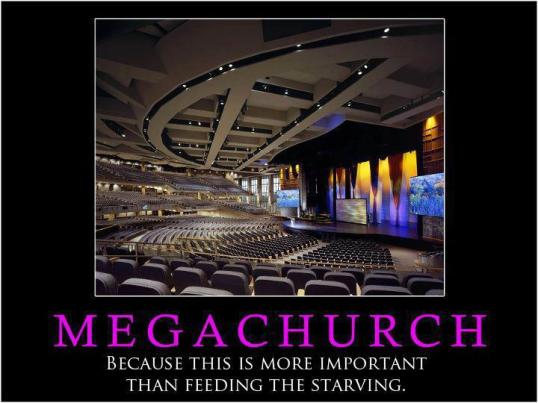
What caught my attention was the prominent picture of the Salt Lake temple of the Church of Jesus Christ of Latter-day Saints, of which I happen to be a member. There were 3,191 comments when last I checked and the debate was in large part your typical flame war between believers and anti-religionsists.
My response at the Facebook page was as follows:
“A picture of this nature is disingenuous and divisive by nature because it cannot convey even a fraction of the big picture. If, for example, you were to put the dollar value of such structures in a chart next to the dollar value of aid rendered by the organization to the disadvantaged or suffering throughout the world, and then in a third column, the dollar value of personal contributions and charitable service to society made by those who belong to your group, that might actually have some statistical value. Since such comparisons are impossible to quantify, the picture has relatively little empirical value other than to engender bitter polemics. If we were to reduce the massive expenditure down to the least common denominator, one could argue that it’s immoral to have a banana for breakfast when millions in Africa have none. One could create a similar montage of vast expenditures by secular organizations and make exactly the same point, so for me the net impact of the picture is an ill-advised and baseless attack on religion for no other reason than a personal bias.”
At the same page, I found this image:
Once again, the LDS Church is targeted. Granted, the conference center (pictured) may have cost more than $350 million to build. At the same time, The Church of Jesus Christ of Latter-day Saints as an organization has donated more than $1 billion in cash and material assistance to 167 different countries in need of humanitarian aid since it started keeping track in 1985, and this is over and above the charitable efforts of its individual members. And from the pulpit pictured above is broadcast to the world on a regular basis messages of hope, of faith, of goodness, of charity, and of service, messages which inspire Church members to live lives in harmony with the teachings of the historical Jesus.
For the sake of comparison, the Palace of the Parliament in Bucharest, Romania, built by the avowed atheist and communist Nicolae Ceauşescu, is estimated to have cost over €3 billion.
There’s a better way to spend one’s energy than tearing down organizations that do a lot of good, simply because one doesn’t happen to ascribe to the philosophy or theology upon which they are based. From a social standpoint, there is nothing intrinsically wrong with either faith or atheism – both systems are capable of tremendous human good and tremendous douchebaggery. Quiet service and the creation of positive energy trumps the public mockery of the beliefs of others any day – at least in my book.
According to the info on the page where I found it, the ad is in the public domain, so I put it up in good faith.
Someone else thinks it’s not, so I have a strike on my account. I hate legalese, I hate attorneys, I hate the whole copyright madness. Someone might simply have sent me a polite note requesting the movie be removed, but no – I get all this garbage:
I’ve sent an email requesting clarification to the claimant whose email address was provided – I hope they have the decency to respond.
Gah. Dealing with corporate legal hqiz is so unpleasant.
Clara Luper, an Oklahoma history teacher, ordered thirteen Cokes at Katz Drugstore in Oklahoma City on August 19, 1958 for herself and twelve children, ages 6 to 17. Lunch counters in Oklahoma, like much of the South, were segregated. This wasn’t just a request for drinks, but a request for civil rights.
Waitresses ignored them. Other patrons did not: leaving the restaurant, pouring drinks on them, cursing at them. The group left after a few hours without their drinks. They returned the next day and were served their Cokes, and burgers, too.
“Within that hamburger was the whole essence of democracy.” – Clara Luper
Note: This took place a year and a half before the much more famous sit-in at the Greensboro (NC) Woolworth’s on February 1, 1960. Luper would continue her fight to desegregate public spaces in Oklahoma City. She was arrested 26 times between 1958 and the passage of Oklahoma law to desegregate. (Passed two days after the Civil Rights Act.)
A friend of mine posted this essay on Facebook, and in light of the Black Friday madness taking place last night and today, I thought it well worth sharing.
As I was reading over the Gospel text for today (Luke 19:45-48, where Jesus cleanses the Temple), I was struck by a certain irony.
Just before this event, Jesus comes in sight of Jerusalem and weeps over it, since “If this day you only knew what makes for peace—but now it is hidden from your eyes. . . . [Your enemies] will smash you to the ground and your children within you . . . because you did not recognize the time of your visitation.” He then proceeds to enter the temple, where he finds the court of Gentiles has become a marketplace, not a place of prayer for the nations.
The temple authorities must have had a natural impulse. The court was nearly empty because, although this open expanse of over 20 acres had been reserved for the nations to come and pray to God, most of the peoples of the world neither knew or cared that it was for them. It was a vacuum, begging to be filled. There was a need to provide those who did come to the temple with pure animals for sacrifice, and the proper coins (without engraved images of humans or deities) for use in the temple. A vacuum, and the need that could fill it—the temple authorities put the two together very neatly. With only one problem. There was no room left for the original purpose, and so Jesus came along to restore this part of the world to its intended purpose.
In filling the court, the authorities had shown that they did not know “what makes for peace,” which is leaving room, being empty for God. They soon would show they did not “recognize the time of their visitation,” by killing God’s messenger, his own Son. Even though God had “pitched his tent” in their midst for a thousand years, from the time of David and Solomon, they still had not learned enough to know God or God’s peace.
However, lest we jeer at such foolishness, let us note this irony. Christmas commemorates our own hour of God’s visitation, not one thousand years ago now, but nearly two thousand. Decades ago it was taken over by the marketplace. Now it seems as if Thanksgiving is likewise vanishing under our worship of buying and selling to serve the almighty Dollar. Thanksgiving was begun as a day of peace and prayer to give thanks to God, an empty expanse that the merchants could not resist filling, with turkey for the feast, with football to entertain us, and with deals to entice us into the stores and malls. The temple authorities filled one court with their marketplace. It seems to me that we are very near to filling two holidays with our marketplace.
If the temple authorities were fools, does this mean that we are at least twice the fools?
I’ve mentioned chocolate before. It’s one of my favorite things in all the world, and when I die, I’m probably going to the Cholesterol Kingdom.
There’s Sachertorte from Vienna:
If you’re in Brazil, you can get death-star chocolates more deadly than the plasma bolts of a Sith lord:
(pause for culinary orgasm)
L’Italia in Harrisonburg, VA used to serve the most incredible chocolate marquese, sadly now discontinued:
and Piccolo Angolo in New York City, my favorite restaurant in all the whole wide world, offers up an amaretto tiramisu that stops your heart just to look at it.
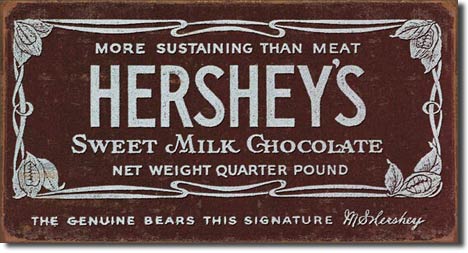
Now that my heart rate has returned to normal, it’s time to point out that there is some disturbing news bubbling up to the surface about chocolate, one which I need to consider seriously. Most everyone knows about blood diamonds, but few people know about child-labor chocolate.
The Wikipedia article gives a general background, and this petition outlines some of the ongoing questions. Neither of these sources cover the entire issue, and I don’t advocate signing the petition just because it’s out there – but I have been prompted to do more research and see what the current situation really is. If I had to cut back my chocolate consumption to make sure I’m not being part of the problem, my body would probably thank me for it. But I’d sit in the middle of the floor and cry.
The sad news has arrived that Buckyballs and Buckycubes will be no more.
Thanks to the douchebag wise attorneys at the Consumer Products Safety Commission and their relentless thirst for billable hours, the makers have thrown in the towel, and will not be making any more of these amazing and entertaining devices. Glad I got me a set when the getting was good. If you want some, head over to their website and order now before this little bit of history is gone.
Yes, these are not for children. Yes, the warnings on their website and packaging and instructions are loud and brash. And yes, there have been some injuries requiring surgery as adults have ignored the warnings. Yet, somehow, the following things continue to be sold:
Axes
Fireworks
Guns
Nitric Acid
Replica katanas
Chain saws
Skil saws
Ginsu knives
Plastic shopping bags
and a whole host of other things that, given to a child, could be wildly dangerous or fatal.
What’s going on here?
I remember another toy that vanished early on – click-clack balls.
Sort of a 20th-century version of the old paddleball toy, these could be both entertaining (because it was devilishly hard to get them going) and maddening (because of the noise.) Unfortunately, if you didn’t do it right, those hard little glass balls could whip around and give you a good solid whack on your wrist, or pinch your fingers. Worse, if you got them going hard enough and long enough, they could shatter with the surprising effect of a fragmentation grenade. The video below shows them in action:
Later versions were made of rubber or plastic, but as far as I know they are still banned here.
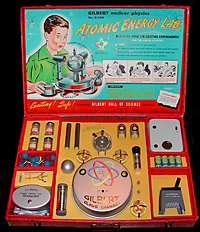
Other banned toys included a Gilbert atomic energy laboratory (1951)
which allowed young people to operate their very own cloud chamber, or lawn darts
which allowed people of all ages to put each other’s eyes out and perforate various body parts.
So the question is raised, where do you draw the line?
Common sense would dictate that when something is marketed as a toy and targeted at children, if it causes bodily injury from normal use (lawn darts racked up over 7,000 incidents), it’s probably not a good idea. But if something is marketed as destined for adults, and children are hurt because of rampant stupidity, does that mean that a product should be persecuted into oblivion? Nowadays, a single case of harm means that the personal injury attorneys come from the voodvork out, but it was not always so. Something had to be pretty egregious to get government action going.
Here are some other things that are difficult to find nowadays:
Jungle Gym
See-saw (or teeter-totter, depending on where you grew up)
Basic playground slide (a low one – there were higher ones as well)
Swingset
Merry-go-round
I played on each of these regularly, and somehow survived without the tender attentions of an attorney. I fell off of them, was flung off of them, swung around on them, got my cojones smashed on them, bonked my head on them, scraped knees on them, and never once told my mother that I was entitled to compensation. When my oldest son fell off a jungle gym and broke his arm in the early 80’s, it was an “oh well, huh” type of event – he got a blue cast, was cool for a few weeks, and survived to be an awesome young man. Today, you’re lucky if you can find a playground worthy of a child’s attention – all of them dumbed down to the level of a McDonald’s playland.
I blame the growing litigiousness and entitlement mentality of our society: people willing to sue at the drop of a hat, and attorneys encouraging them to do so. The CPSC still has a valid function, because people will also try to market anything that turns a buck and providing our kidlets with lead-painted toys and chokables is still rather not done. But that doesn’t mean every item that could cause harm to a child, especially when it’s prominently and forcefully advertised as being for adults only, should be hounded out of existence.