Terror From the Year 5000: Not so terrifying after all

In 1959, when my cousins were visiting New York from their country home in Connecticut, something possessed them to go take in a double-feature horror show (either at Loew’s or the RKO theatre, I can’t recall which one.) Double-billed was The Spider and Terror from the Year 5,000.

Bad idea.

My 8-year-old brain was scarred for decades. The Spider was bad enough, but The Terror had me pissing my pants any time I saw a closet door left ajar.

And not having TV or cable in later life, I missed the opportunity to poke fun at it on MST 3,000.

Until last year.

I found a copy of it at a vintage movie outlet online, and got my dear wife a copy of Don’t be Afraid of the Dark, the one that scared her to Nouakchott when she was young. They’ve been sitting on our shelves unopened, until the other night when the Goodwoman of the House was taking a nap, and I was working on a knitting project.

So I bit the bullet, and in it went.

Good idea.

Surprise! It’s not a bad film at all, as B-movies go. It had a plot, it had a message, and the effects were nowhere near as corny as some other things I’ve seen. And, over half a century later, not terribly scary.

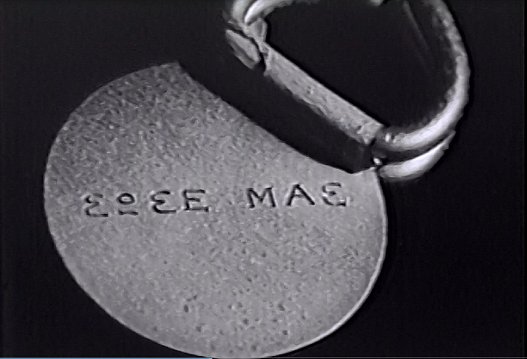
The basic plot: A scientist develops a time machine that has been sending small objects into the future, and bringing back “trade” items – which happen to be highly radioactive. He’s got a fiery young assistant who’s got the hots for his daughter, and a bad case of paranoia as well. The professor’s daughter arranges for a former colleague of her father to come down to the island where the experiments are taking place, and during a demonstration of the machine, a Phi Beta Kappa key is exchanged for a medallion which has “Save us” engraved on it – in Greek.
The professor decides the machine is too dangerous to use until more information can be gathered, but lover-boy (Victor) – who thinks he’s being sidelined – runs the machine at ever higher power until he brings back a lady from the 51st Century (seen above). She’s badly disfigured from the effects of radiation and seems to have hypnotic powers accentuated by shiny fingernails and the thousands of reflective bangles on her outfit, but other than that she’s largely unremarkable.

Victor’s about to get a surprise.

Earth of that year is dying of radiation poisoning, and this lady’s mission is to bring back someone with undamaged genes to inject new life into their dying society. Unfortunately, she’s not beneath killing anyone who gets in the way of her mission, including a caretaker and a nurse, whose face she steals (perhaps they had vintage movies in her day, and she had watched Silence of the Lambs).

The “Future Woman” wearing a stolen face (actually her own, that of the lovely and talented Salome Jens in her debut rôle.) [1]

At any rate, after much drama, Victor is killed in the lab trying to send the woman back to her time, and the unfortunate visitor is shot. In the end, the professor explains that they don’t need new genetic material, because the future is yet unwritten, and mankind has a chance to avoid atomic holocaust by acting more sensibly now.

Having seen it again, about the only major complaint I had about the film was the soundtrack, which incorporated a lot of musical interludes that sounded like they were lifted from Disney’s Pinocchio. The atmosphere of the movie was serious enough that the tinkle-tinkle passages seemed out of place. Other than that, I give it a thumbs up.

And, it’s nice to know that my horrific memories from the 50’s were nothing more than a child’s untutored perception.


[1]Salome Jens

Salome Jens has had a vigorous acting career, and in later years has played some very-recognizable characters (at least, recognizable by their makeup).

Star Trek TNG – “The Chase” – Humanoid Progenitor

Star Trek DS9 – The female shapeshifter and “ambassador” of the Founders.

Salome Jens and Gil Rogers in I Knock at the Door and Pictures in the Hallway, 2007.

The Old Wolf has spoken.

My wish for the world on this beautiful day

It’s sunny out, on the 22nd of November – almost 50F (10C, for you metrical folks), and my home smells like heaven. Economic times are tough, but at the moment I have a warm home, a loving wife, work to do, family coming to visit, and more food to put on the table today than billions of people may ever see in one place in their lifetime. I am blessed beyond my deserts.

May this season bring you an abundance and an increase of all in your life for which you are grateful.

The Old Wolf has spoken.


Zen Pencils:Make the most of this life

I was recently introduced to a most wonderful blog, Zen Pencils: Beautifully illustrated quotes from great minds. The author/artist is Gavin Aung Than, a freelance artist living in Melbourne, Australia. A huge shout-out to Gavin for creating something of such lasting positive energy. In many ways, Gavin’s artwork and world view reminds me of the work of Winston Rowntree (a pseudonym! I wish I knew who he really is) who does Subnormality! Rowntree’s work is decidedly more offbeat, but also encourages readers to examine and explore and question the world we live in, and make the most of themselves in spite of the challenges life can offer.

I can’t honestly say how I found Zen Pencils – it could have been a Stumble, or a recommendation from a friend on Facebook, or via email. However it happened, I’m grateful. The post I found first is “Books are Awesome,” a quote by Carl Sagan. Reading the notes led me to another Sagan quote, reflected in the title of this post.

Click the thumbnail to be taken to the original page, which contains the full quote.

Now, I happen to really, really, really love Carl Sagan, in much the same way as I really, really, really love Isaac Asimov. Both were staunch and lifelong humanists, each striving for and encouraging others to grow, to develop, to improve, and to raise the human condition. (For what it’s worth, I have long suspected that the good Dr. Asimov was a closet believer in something greater than man – or at the very least, in the hope that Man could evolve into something far greater than he now is; all you have to do is read his short story, “The Last Question” for a glimpse of that longing.) Whether I’m right or wrong about that, he remained dedicated to humanist principles all his life.

Here’s another bit of Sagan-lore that I love to revisit on occasion, because it just makes me feel so good (along with all the other Symphony of Science videos):

Sagan is undeniably one of the greatest ambassadors of pure science that humanity has ever seen.

Which puts me in a quandary.

Because I’m “a believer.”

Humanists and the religious have been heaving word bombs and vitriol at each other for as far back as human written records go, and I’m here to say publicly, in words that will end up in the cloud forever until the heat death of the universe, that it’s a crying shame, and unworthy of the principles that both espouse. There is room in this great big, vast, endless, amazing, astonishing, wondrous, and (dare I say it) miraculous universe, for science and belief – and have very little left over (the Germans say “nichts übrig”) for people whose sole purpose in life seems to be depriving others of their basic human dignity.

Whether it’s a Nobel prize-winning scientist, ensconced in his well-papered office in the genetics department of a major Ivy League university who bitterly mocks and de-humanizes people of faith, or a Bible-thumping head of a $300-billion-dollar megachurch who foams from the pulpit to televisions worldwide that the Second Coming is nigh because of the wicked unbelievers of the world, or just you and me, neighbors, being dicks to one another, there’s no room in my world for this kind of negative energy.

I’m not about to attempt apologetics for all religion everywhere; the history books and modern news reports are full of horrors perpetrated by one group of  humans on another because of a difference of belief, be it big or small –  a syndrome superbly enough mocked by Jonathan Swift in his analogy of the “big-endians” vs. “little endians” that a simple reference to Gulliver’s Travels will suffice. It is enough for me to say that any person of faith who seeks to make another human being less, for any reason, both misunderstands and defiles the tenets and commandments of whatever god they claim to worship.

Sagan once wrote, “How is it that hardly any major religion has looked at science and concluded, ‘This is better than we thought! The Universe is much bigger than our prophets said, grander, more subtle, more elegant?’ Instead they say, ‘No, no, no! My god is a little god, and I want him to stay that way.’ A religion, old or new, that stressed the magnificence of the Universe as revealed by modern science might be able to draw forth reserves of reverence and awe hardly tapped by the conventional faiths.” Sagan was so close to his own epiphany when he said that, but it seems that he lacked whatever spark was required to take that last step and posit the existence of a God great enough to create the wondrous universe that he described, simply because there was no empirical, measurable evidence of such a creator. What he was left with was wonder and admiration for the unfathomable complexity of the space we live in, and admirable philosophies such as the one found in the Zen Pencils episode that entitles this post.

For me, there is evidence enough. To paraphrase a scripture that I value, all things denote there is a God; the earth, and everything on it, its motion, and also all the planets which move in their regular form, demonstrate that there is a Supreme Creator. Even positing, for the sake of argument, hydrogen atoms evolved to consciousness, there is no compelling evidence to explain the awesome regularity and mathematical perfection we see in nature or in music; no scientific reason to explain why I can remember the amazing Yorkshire puddings my wife made for me last week, or that the slope of a line is defined by the relationship y = mx + b, or that I have a class to teach this morning at 1:40 AM. In my mind, if creation were an accident, our world would be as random and unpredictable as one of Bill Watterson’s offbeat Sunday Calvin and Hobbes strips.

But see, that’s just me. I resonate with the idea that I’m more than a collection of vibrating strings that came together to be me for 80 years or so; I take comfort in looking at the wonders of the universe that we’re just beginning to understand, and having someone to thank for it; and I especially take joy in knowing that I should hang on to my fork, because there’s something better yet to come.

If belief and humanism are to coexist, each must observe certain boundaries. I support the free exercise of religious faith, but not the imposition of one group’s beliefs on others; I support a secular government and public education system which teaches only empirical truths, but one which does not go out of its way to teach that people who do believe in something more than pure science are gibbering idiots. Private schools can teach what they want – that’s their privilege, and that’s why they are private – but I would encourage them to adhere to the same principles of universal human dignity.

Years and years ago, scientists began dreaming of a mind-boggling system that would deliver Curiosity to the surface of Mars. If they had not had the dream, that amazing little beast would not now be puttering around the surface of our solar neighbor, zapping rocks with its lasers and finding evidence of surface water.

It is our dreams that drive our reality. I dream of a world that works for everyone, no exceptions, and that’s what I am working for. The thoughts of Sagan and others like him go into the pot and become part of the energy that is driving me forward.

The Old Wolf has spoken.

Twinkies Forever

No, this does not refer to the fact that Twinkies, the iconic snack from Hostess, never go bad because they’re made of petroleum, portland cement and sodium stearoyl forhellsakedonteatthatalate; while that may be true to a certain extent, this post refers to the fact that you can make your own, and enjoy flogging your adrenals and punching holes in your arteries whether or not Hostess sells its recipe to another company [1].

First, let us pause for a moment of silence.

You see, I know as well as anyone that stuff like this is death distilled, but hey, yolo [2], right? And there’s something about a hyperinsulinemia-inducing Twinkie buzz that Little Debbie could never match. So let’s hope that some of the brands survive, if nothing else for the sake of the Texas State Fair.

In the sad event that this is not the case, Chef Todd Wilbur has come up with what seems to be a pretty respectable Twinkie clone which he shared here.

First, the recipe:

TWINKIE CLONES

Cake:
Non-stick spray
4 egg whites
One 16-ounce box golden pound cake mix
2/3 cup water

Filling:
2 teaspoons very hot water
1/4 teaspoon salt
2 cups marshmallow creme (one 7-ounce jar)
1/2 cup shortening 1/3 cup powdered sugar 1/2 teaspoon vanilla

Preparation:

  • You will need a spice bottle, approximately the size of a Twinkie, ten 12-inch by 14-inch pieces of aluminum foil, a cake decorator or pastry bag and a chopstick. (Unless you want to drop $26.00 for a twinkie-shaped pan at some “Oh Mater, no more buttered scones for me I’m off to play the grand piano” high-end cookware outfit.)
  • Preheat oven to 325 degrees.
  • Fold each piece of aluminum foil in half twice. Wrap the folded foil around the spice bottle to create a mold. Leave the top of the mold open for pouring in the batter. Make 10 molds and arrange them on a cookie sheet or shallow pan. Grease the inside of each mold with non-stick spray.
  • Disregard the directions on the box of cake mix.
  • Instead, beat the egg whites until stiff. In a separate bowl combine cake mix with water and beat until thoroughly blended (about 2 minutes). Fold egg whites into the cake batter and slowly combine until completely mixed.
  • Pour the batter into the molds, filling each one about 3/4 of an inch. Bake 30 minutes, or until the cake is golden brown and a toothpick stuck in the center comes out clean.

Filling:

  • Combine salt with hot water in a small bowl and stir until dissolved. Let cool.
  • Combine the marshmallow creme, shortening, powdered sugar and vanilla in a medium bowl, then mix with electric mixer on high until fluffy.
  • Add the salt solution to the filling mixture and combine.
  • When the cakes are cooled, use a skewer or chopstick to make three holes in the bottom of each one. Move the stick around inside of each cake to create space for the filling.
  • Using a cake decorator or pastry bag, inject each cake with filling into all three holes.

Serves 10.

From “Top Secret Recipes” by Todd Wilbur.

Here’s an amusing video by Wilbur illustrating the process. Skip to 1:11 for the good stuff.

Yes, I’m going to try this.

The Old Wolf has spoken.


1 Hostess is claiming that they were forced out of business by unreasonable labor demands; that they had reached agreement with several unions, including Teamsters, the largest, but that it was the baker’s union who drove them into closure because they had no more to give. However, Frank Hurt, president of BCTGM, stated “Our members were aware that while the company was descending into bankruptcy and demanding deep concessions, the top ten executives of the company were rewarding themselves with lavish compensation increases, with the then CEO receiving a 300 percent increase.” Some specific figures reported by Gawker were:

  • Brian J. Driscoll, former CEO: approximately $750,000 to $2,550,000)
  • Unnamed executive: $500,000 to $900,000
  • Unnamed executive  $375,000 to $656,256

Driscoll was forced out by the Teamsters after that obscenity; raises like that when a company is proceeding with Chapter 11 fly in the face of common sense, unless you consider piracy to be subsumed under that head. Obscene executive pay has long been a subject for discussion in boardrooms and shareholder meetings – one example is an article from the Economist, reproduced on page 34 of this student manual entitled “The Rewards of Failure.”

There’s a lot of stuff out there on the Hostess closure. Do your own research, and draw your own conclusions.

2 You Only Live Once (things labeled with this acronym usually end up on YouTube with a title like “World’s Stupidest…” or “Massive Fail.”

World’s First McDonald’s

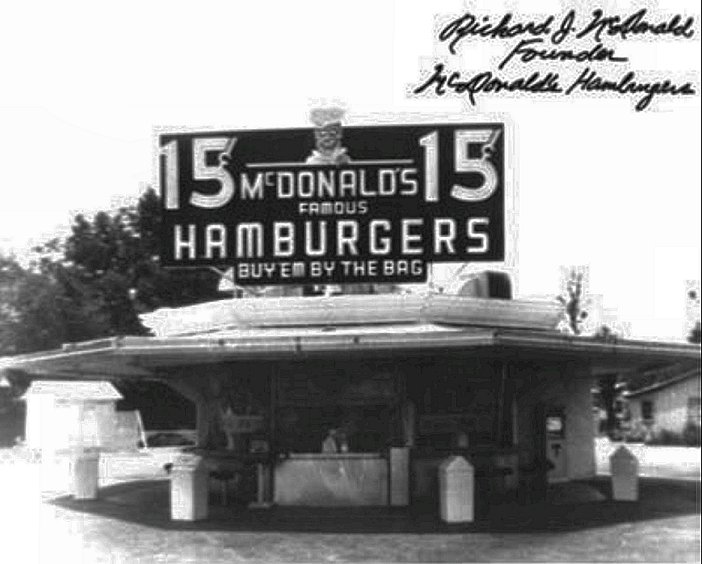
Richard and Maurice McDonald’s restaurant around 1948. First opened in 1940, the McDonald brothers focus on a simple menu with only nine items. Ray Kroc became the official franchising agent around 1954, and the rest is history. I remember those 15-cent hamburgers from the early 60’s, and they were pretty basic. To a kid, they were just great. Nowadays if I’m in the mood for something similar, I’d search out a White Castle or a Krystal – I love their little sliders.

The Old Wolf has spoken.

God Jesus, the Electronic Fortune Teller

Only in Japan, right?

Wine-spa at the Yunessun Spa Resort

Even tailpipes are kawaii.

And these are only two examples of the myriad head-scratchers to come out of Japan. The only fair thing to say about Japanese culture is that it’s really, really different from ours, and given the nature of cultural differences, it’s not our place to judge.

This little gem makes me laugh hard; I wish I had one on my shelf, just because it’s so wonderfully offbeat. Say hello to God Jesus, the fortunetelling robot created by Bandai in the 1980’s.

God Jesus is a plastic robot brandishing a crucifix, a bizarre cross (no pun intended) between The Clapper and a Magic 8 Ball. Think of a question and clap your hands, and God Jesus will either shake his head from side-to-side to indicate “No,” or nod his head to indicate “Yes.”

Want to find out if you’ll be lucky in love? Let God Jesus tell you the answer!

The boy is asking, 彼女はぼくのことを好きなのでしょうか。 どうぞお答えください。(Would she like to be my girlfriend? Please answer me.)

Poor kid… So heartbroken his glasses fell off. This model looks eerily like I did when I was that age. People even told me I looked like Ernie from “My Three Sons.”

The girl is saying 彼はわたしのことを好きなのでしょか。 どうぞお答えください。(I think he would like to be my boyfriend. Please answer me.) God Jesus tells her “Yes,” and she’s happy.

God Jesus needs to get his act together.

The instructions tell you how he operates – the video below shows God Jesus in action.

Now, a lot of people I know would be mightily offended by this and consider it blasphemy, but they don’t understand… It’s Japan. The Japanese live in a society where religion – even their own – plays very little part in their daily lives in terms of driving moral choices; an interesting blend of Shinto, which stresses veneration of ancestors, and the “middle way” of Buddhism.  Religion for the Japanese has more to do with tradition and a link to the past than it does with spiritual guidance, except at a very meta-level. Add to this the fact that the average Japanese man or woman knows less about Christianity than the average Evangelical Christian knows about Kimbanguism. It’s just not on their radar, other than to know a large percentage of the world worships a big guy in the sky who can do everything. It is entirely possible that the clapping function may tie in to the Shinto tradition of omairi.

So in that framework, this toy makes perfect sense. It becomes a curiosity, much like our own Charley Weaver bartender toy, or the singing bass.

This example is the best one  I have found out there – it shows Charley’s face turning red and smoke coming out of his ears.

Apparently God Jesus is extremely rare, and few working examples are know to exist. A bit of digging turned up an interesting bit of trivia:

What few people know, though, is that this was a tie-in to God-Jesus and the Cyberama Seven, in which the second coming was a robot, and the cybertronic savior did battle with various flying killer tortoises and huge insects and resurrected dinosaurs, all of whom were trying to plant fossils in the ground to muck with the heads of scientists and make them think the Earth was older than six thousand years. An animated show, it ran only three episodes and aired only once.” (Found at NeedCoffee)

The Old Wolf has spoken.

Coonabarabran: The world’s largest solar system drive

A post over on Facebook by a friend of mine in New South Wales reminded me that I wanted to spotlight this experience. I mentioned it in a Livejournal entry a few years back, but it deserves some exposure of its own. All photos are mine and ©2010-2012 Old Wolf Enterprises unless otherwise noted.

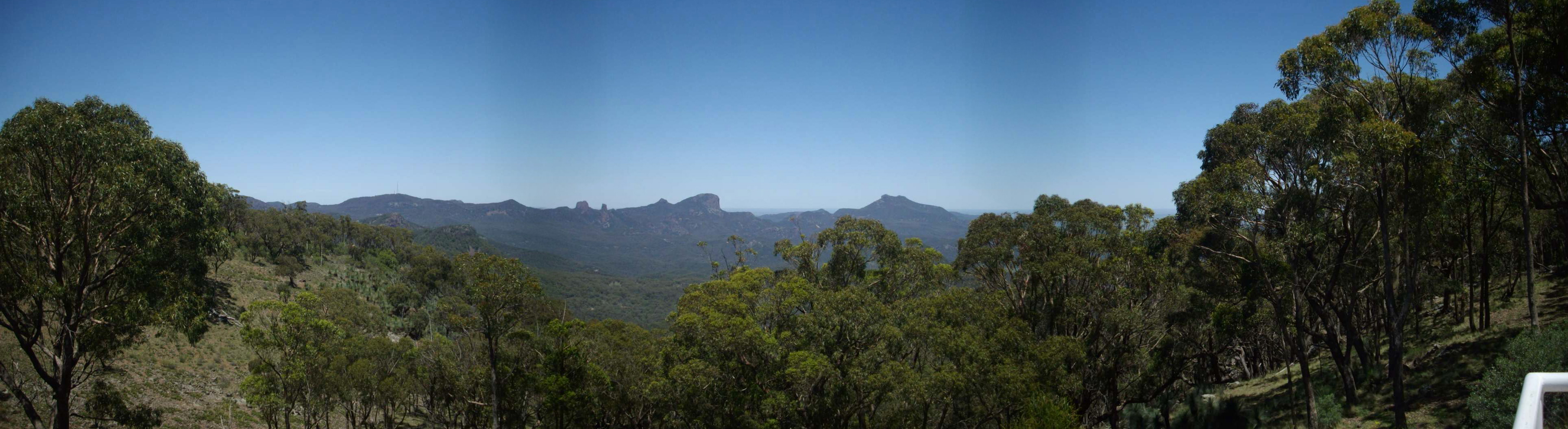
High in the Warrumbungle Mountains near Coonabarabran, NSW, sits the Siding Spring Observatory (SSO), Australia’s premier optical and infrared observatory.

Home of the Anglo-Australian Telescope, among others, this observatory is a delight to visit in and of itself.

Anglo-Australian Telescope

Panorama of the Warrumbungle Mountains from the Observatory

Central core cut from the telescope’s primary mirror before polishing and reflective coating was applied

In addition, in an effort to boost tourism, the observatory created the world’s largest solar system drive. There are five beginning points,

  1. Dubbo
  2. 6km south of Birriwa (north of Gulgong)
  3. Merriwa
  4. Tamworth
  5. Bellata (south of Moree)

Route overview

All the drives end at the Siding Spring observatory; since I was at the observatory already and I have a friend in Dubbo whom I wanted to visit, I began here and did the drive backwards.

Here is the itinerary:

Object Location Distance (km) Time
The Sun Siding Spring Observatory 0 0
Mercury Observatory Road, west of Coonabarabran 1.2 1 min
Venus Observatory Road, west of Coonabarabran 1.9 2 mins
Earth Observatory Road, west of Coonabarabran 4.1 3 mins
Mars Timor Road, west of Coonabarabran 5.5 5 mins
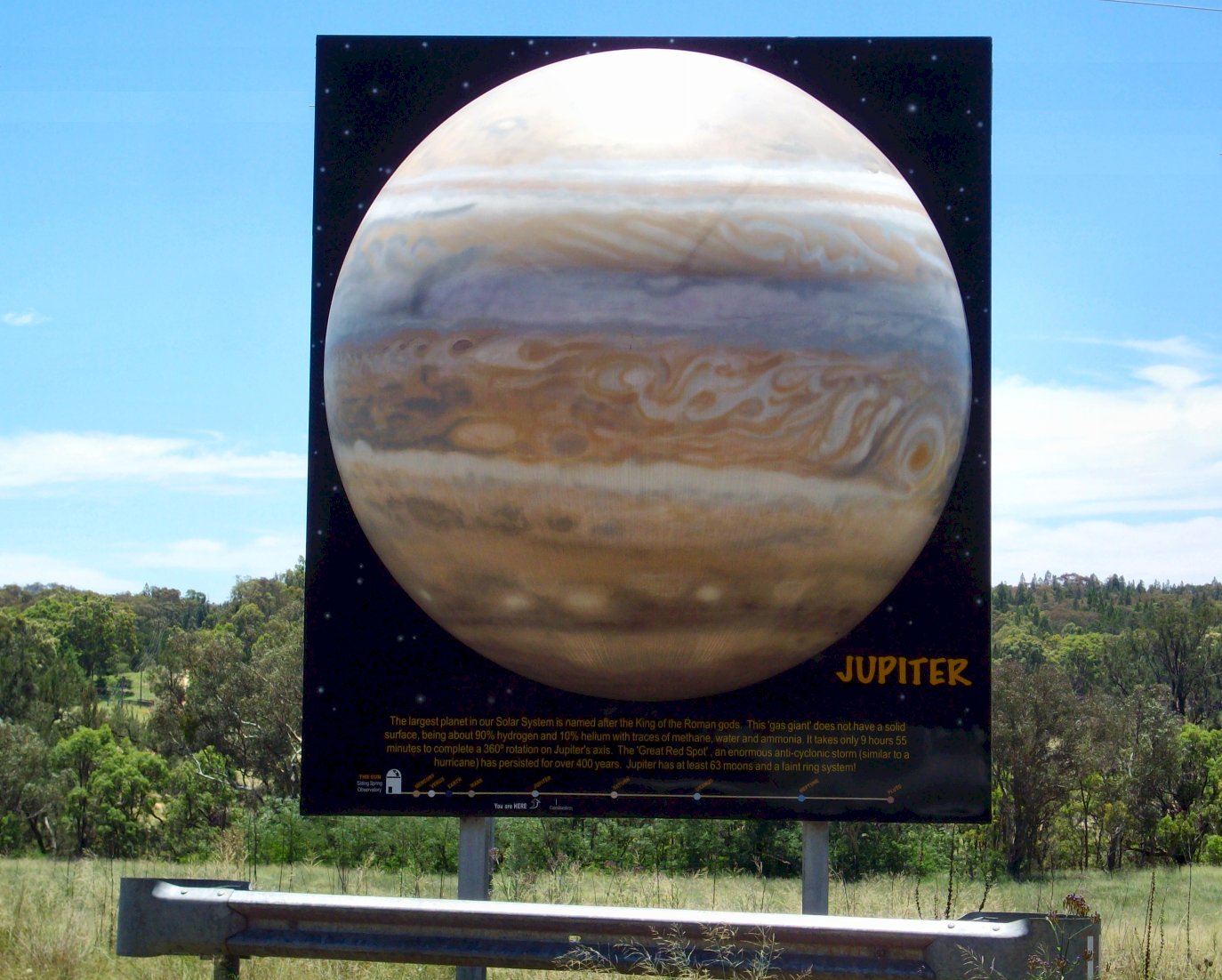
Jupiter Timor Road, west of Coonabarabran 21.5 20 mins
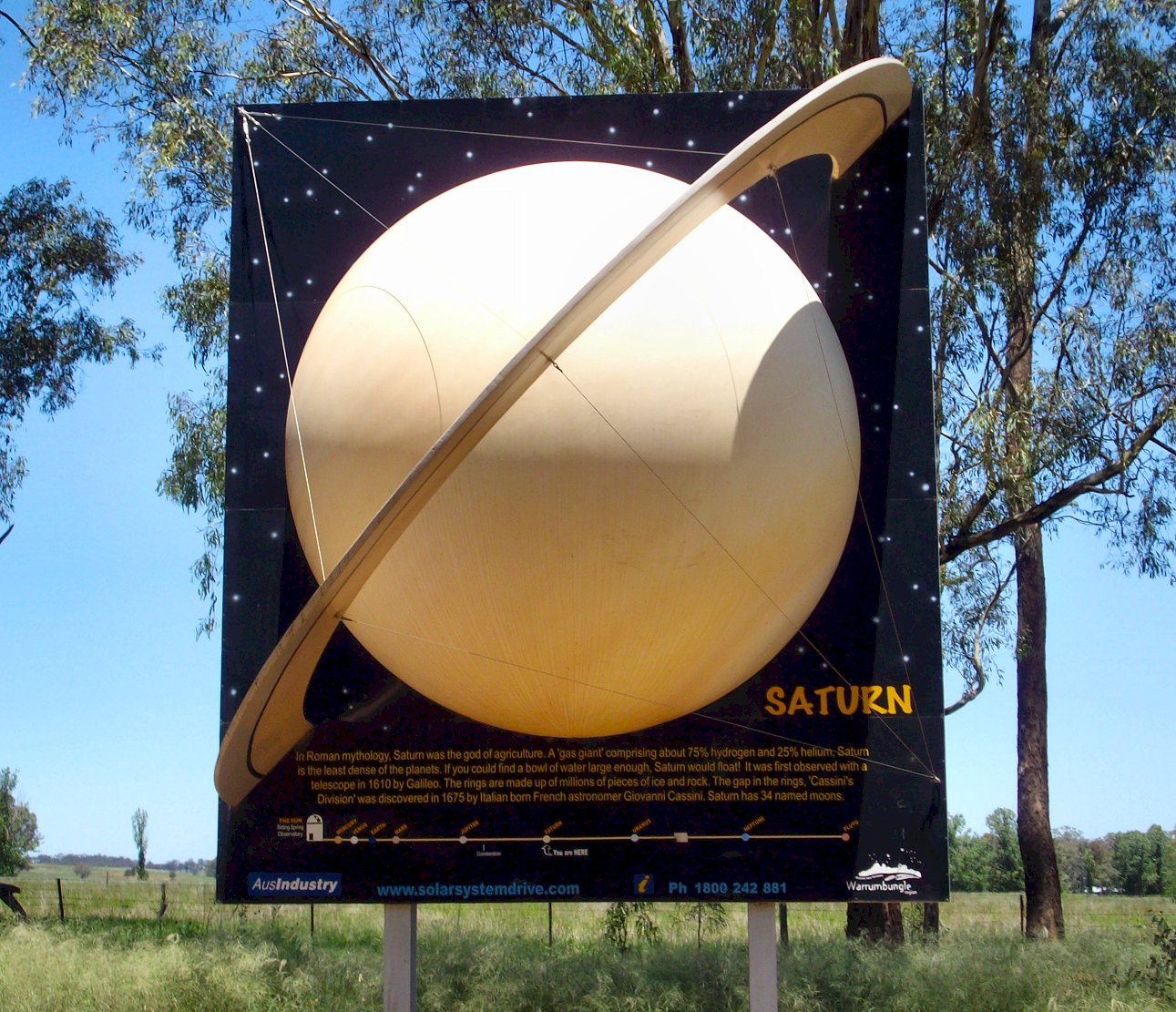
Saturn Camkeena Rest Area, Newell Hwy 40 40 mins
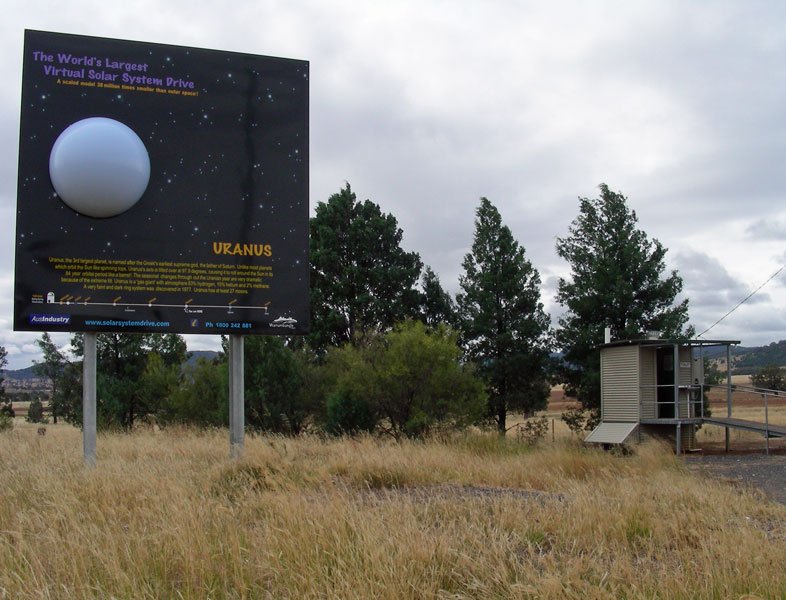
Uranus Tooraweenah Rest Area, Newell Hwy 79 70 mins
Neptune Gilgandra Cooee Heritage Centre, Newell Hwy 119 1.5 hours
Pluto Dubbo Visitor Centre, Newell Hwy 190 2.25 hours

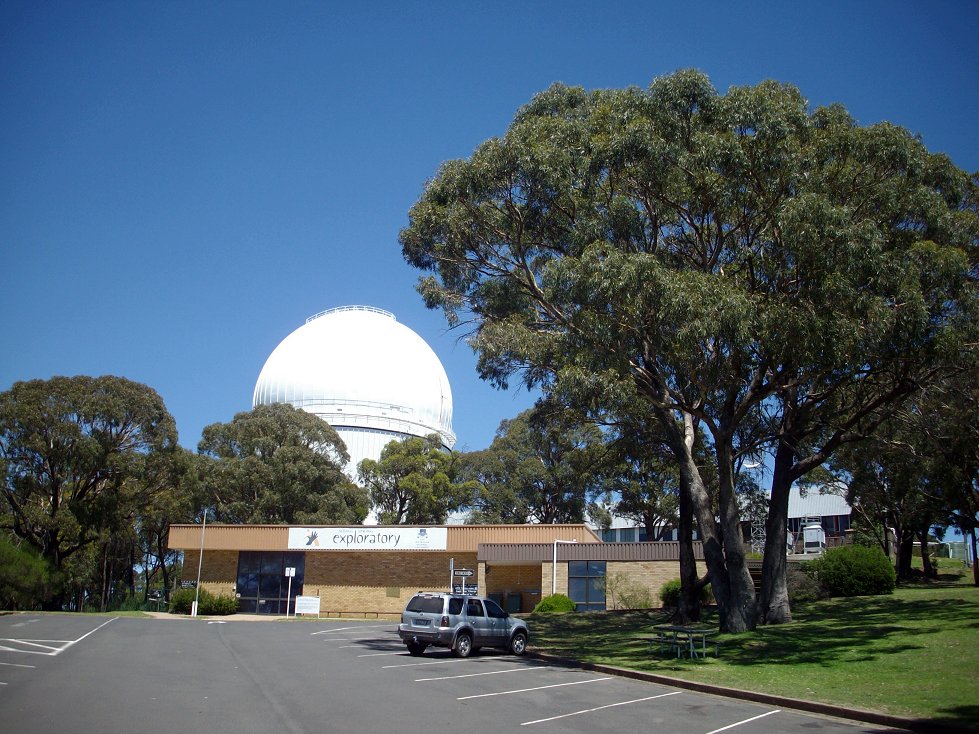
The observatory dome, representing the sun at 1:38,000,000 scale. All other placards on the drive are accurate (in relative terms) with regard to distance and size. For reference, traveling in your car at 100km/hr along the Solar System Drive, you’d be “virtually” hurtling through space at a million kilometers per second – more than three times faster than the speed of light.

I missed Mars, this was taken by another traveler.

Missed Uranus and Neptune;  this image, along with the one below, was found at A Snail’s Eye View.

The drive ended at the Dubbo Visitor’s Center, at which a representation of Pluto is located. Please notice: Pluto.

It is a scientific fact that Pluto and its moon Charon were most likely Kuiper Belt objects captured by the sun, and probably did not coalesce out of the original accretion disk. But as far as I’m concerned,

This drive was one of the most enjoyable experiences I’ve had. I’d love to go back and do the other routes, just to see the scenery.

Australia for the win!

The Old Wolf has Spoken.

The Noun Project

Recently happened across a video promoting The Noun Project, an effort to build a global visual language. While I love linguistic innovation and would love to see either Terran Standard or a Universal Translator à la Star Trek, based on the minimal penetration of experiments like Esperanto or even the linguistic behemoth English, I’m not certain a project like this will ever have more than a niche impact.

And I’ll tell you why.

First, let me re-iterate: It’s a lovely idea. I’m not dissing it for its own sake, nor am I wishing it failure.

To illustrate what the project is up against, let’s look at an example from one of my favorite Star Trek TNG episodes, “Darmok”.

Picard and Dathon at El-Adrel

Imagine a race of people who communicates solely by metaphor. The Tamarians were just such a race; their opening dialog with the Enterprise went like this:

“Rai and Jiri at Lungha. Rai of Lowani. Lowani under two moons. Jiri of Ubaya. Ubaya of crossed roads. At Lungha. Lungha, her sky grey.”

A headscratcher, to be sure. As the episode progresses, the Enterprise team learns in various ways that the Tamarians communicate solely via metaphor, as though “Juliet on her balcony” were being used to express the concept of love, or beauty, or desire. They realize, however, that content is valueless without context; anyone unfamiliar with Romeo and Juliet would have no idea what the metaphor referred to.

Even though Picard was able to speak to the Tamarians and deflect hostilities between the two races with the few phrases he had learned, there are some logical gaps in the premise. In Tamarian you can say,

  • Temba, his arms open: “Here, take this.”
  • Sokath, his eyes uncovered: “Understanding! He gets it!”
  • Mirab, with sails unfurled: “Let’s get out of here.”
  • The river Temarc, in winter!: “Hold your tongue!”

But how do you say something like “Move that lever to the second position from the top, and then tighten that nut one-quarter turn”? This glaring plot hole doesn’t detract from my enjoyment of the episode and the delightful linguistic idea, but it illustrates that context is everything.

Symbols like this are pretty straightforward:


But even these would have little meaning in a culture not familiar with chopsticks or the red cross. The meaning and the concept would have to be taught, and thus  would, in effect, be no more valuable as an ideograph than “อาหาร” or “食” or “manĝo”. The first thing that actually came to my mind when I saw these were a portable medkit from Duke Nukem 3D, and joss sticks. The first was close, the second, not even.

Then you get into the intricacies. What would you do with a symbol like this:

Is this a banana, or some really kinky ninja sex toy?

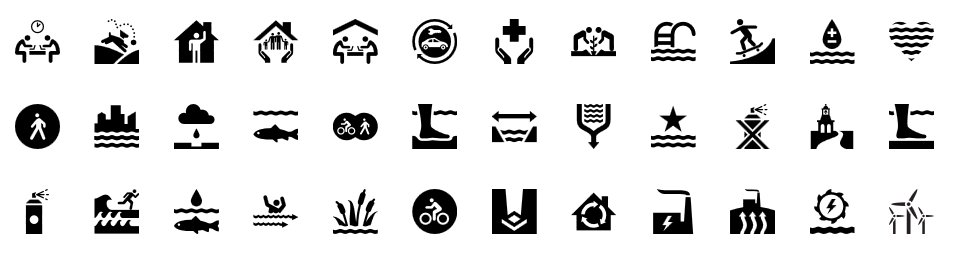
Presented with a bewildering array of nouns like this,

I find that my lifetime of experience in the fields of linguistics and translation give me only the barest hint of what some of these mean. Certainly, I could learn them, but each symbol would have to be learned in the same way that I am learning that “חלוץ” means “pioneer” in Hebrew or that “牛肉” means “beef” in Japanese. Both a context and a precise meaning would have to be provided.


Now, the visual hooks into things from our everyday world would indeed make the process somewhat easier.

This symbol will mean “wind farm” or “green energy” to a large part of the world’s population because they have become familiar with the idea of wind energy; in the same way, a Japanese person or advanced student of Japanese who is presented with a rare or unfamiliar character (such as 醤) will at least have a shot at guessing at the meaning because of the way Kanji are constructed – he or she will automatically recognize the bits and pieces that the character is made of, and be able to make an educated guess at its meaning. In the same way, I can read the following paragraph without much difficulty…

“Erat una fria morning de Octubre und ein low fox noyabat las benches der park. Algunos laborantes magrebinos collectabant der litter singing melanconic tunes. Aan el 200th floor des Euro Tower el Chef Inspector General del Service des Bizarre Dingen, Mr What, frapped sur the tabula y said: -Dit is kein blague. Appel rapid Cabillot!” (from Eurolingua Salad)

… but only because I have a working knowledge of Latin, English, French, German, Spanish, Catalan, Dutch, and a few others spoken in and around Europe. Without that background and context, it would be as impenetrable to me as Hungarian, of whose intricacies I am blissfully ignorant.

In the final analysis, the Noun Project is constructing another artificial language, one of many that have attracted fans and adherents but made little headway in facilitating communication across linguistic boundaries. Inherent in the project are some good ideas that will have value, but if a linguist such as myself can look at the lists of icons and say “Vaff?” I suspect that most people less steeped in the intricacies of signans and signatum will approach the idea with all the enthusiasm of a high school French student confronted with the passé surcomposé for the first time. Even French people don’t go nuts over all the glorious intricacies of the Gallic tongue.

Der viejo loup has parlat.

Fastelavn (the children’s carnival): Denmark, ca. 1930

This picture appears in numerous places around the net with the caption “Danish children trick-or-treating.” While the thought of children dressing up in scary costumes and going door to door begging for treats sounds every bit like Hallowe’en, the Danish tradition of Fastelavn (carnival), celebrated in February, has more in common with Mardi Gras. The Danish word means “the evening before the fast,” and represents the night before the beginning of of the Lenten season. The word ‘carnival’ stems from a Latin expression meaning “farewell to meat,” and originally was a period of celebration and feasting which preceded the six weeks of fasting and penance which marks the lead-up to Easter.

The children in the picture above are holding “raslebøsse”, or “rattle boxes” – small cans with a slotted top used to collect money. They go from house to house, calling “Fastelavn er mit navn” (my name is Fastelavn) and expect coins or candy; they also gorge themselves on “Fastelavn boller” or Lenten buns, which are cream filled sweet rolls covered with icing.

Danish children will also play “Slå katten af tønden” (beat the cat out of the barrel). A Pinata-like barrel decorated with black cats and stuffed with candy is hung, and costumed children are given a chance at breaking it. The child who first breaks the barrel and releases the candy is given the honorary title of “kattedronning” (queen of cats), while the child who knocks out the last piece of the barrel is dubbed “kattekongen” (king of cats).

While the barrel is now simply decorated, at one time it actually contained a black cat. Since these creatures were believed to harbor evil spirits, breaking the cat out of the barrel (whereupon the terrified creature would run off like a bat out of Hell), was said to banish evil to make way for spring.

Beating the cat out of the barrel, around 1866

Modern Fastelavn