Are you triangulating mission-critical units?

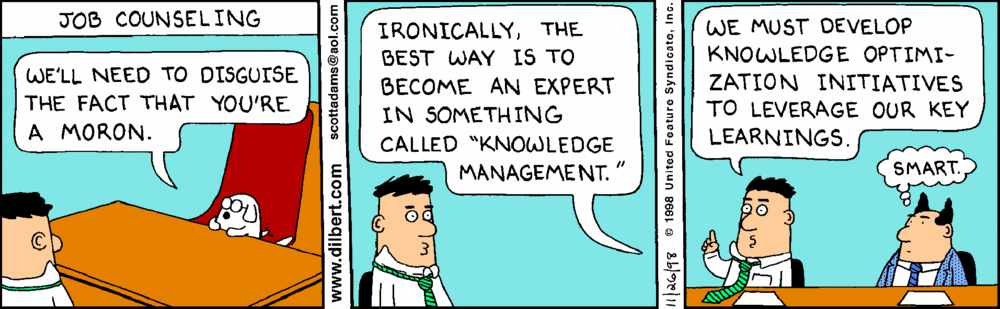
15 years ago, Scott Adams was making fun of business buzzwords.

12950.strip.zoom

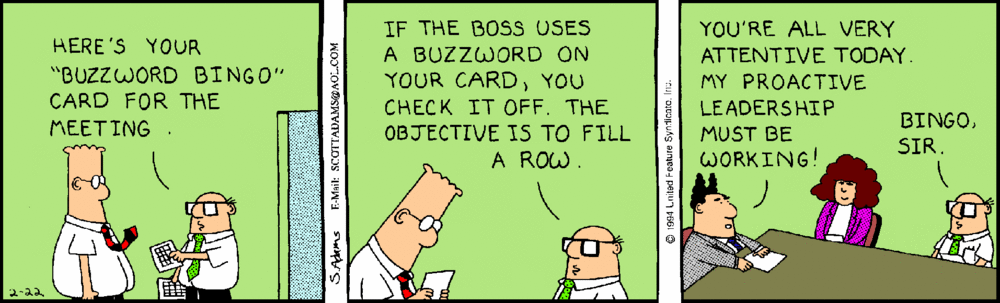
In fact, something called “buzzword bingo” became a thing for a while, at least before managers caught on to the fact that they were being mercilessly mocked in meetings:

23657.strip.zoom

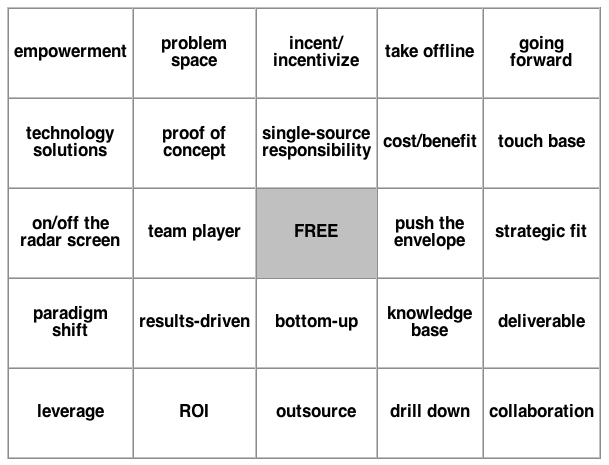
Here’s an example of a typical bingo card:

buzzword-bingo-stephanie-fierman

Rank and file employees, who are less concerned with leveraging proof of concept paradigm shifts than with trying to get their daily work done have long realized that management’s core task is to look impressive to the next level of management; the following chart has been in my files since the late 70’s:

Virtual Storage Buzz Phrase Generator

Imagine, then, my dismay to find out that this phenomenon has infiltrated the world of education. A recent article at Slate, “Parents Left Behind: How public school reforms are turning American parents into dummies,” takes a hard look at this phenomenon.

The author lamented,

“Then my friend Duncan helpfully explained that he was as confused as I was about the pedagogical objectives and aims of his child’s public elementary school in rural North Carolina. Until he realized that the school had seamlessly adapted Stephen Covey’s The 7 Habits of Successful People into its curriculum, and his first grader started accusing him of failing to be sufficiently “proactive.” Last year I was grappling with rationalizing my son’s fractions. Suddenly I am also failing to employ proactive strategically dynamic new paradigms as well.

I have nothing against Covey personally, but his writings – along with those a plethora of other one-minute-manager types – have been adopted by bureaucracies and executive food chains nationwide in a frantic attempt to boost the bottom line, not realizing that giving a 5¢ item a $10.00 name doesn’t change the nature of the beast. Jennifer understood this all too well and saved herself from a career of servitude in the worst of all possible companies:

17082.strip.zoom

Only marketing departments have failed to grasp the essential truth that buzzwords are a sham, and an excuse for not obtaining actual results:

20110214

Doc Rat by Jenner

The important thing to remember is that results are often harsh, but always fair. If schools are focusing on finding new ways of describing “teaching,” which is what they should be doing, then they are spending needless time and effort on one-off tasks, and the quality of their results will suffer.

I want to see schools do the following, at a bare minimum:

  • Spend less time “teaching to the test,” and instead focus on the needs of individual students. In other words, “If students cannot learn the way we teach them, then we must teach them the way they learn.” [1]
  • Put as much emphasis on the character/social development of their charges as they do on the “3 R’s”
  • Pay teachers a living wage and make it easier to offload unproductive, burned-out or ineffective ones.

Make no mistake – in order for our schools to become effective at teaching again, instead of administering, the entire system will need to be overhauled. That means taking a good hard look at the power vested in teacher’s unions. I have nothing against unions themselves – my parents were proud members of AFTRA and SAG – but if a union has shifted its goal from ensuring fair treatment to the preservation of all jobs at any cost, it has missed its mark and needs to be reformed.

If you want to amaze your education colleagues, you can wax eloquent about disintermediating mastery-focused learning; if you want to turn out well-rounded, well-educated students, you can get away from the bureaucratic camel-ejecta and simply teach your kids, looking at them as distinct individuals instead of statistics on a performance chart which will determine next year’s funding.

The Old Wolf has spoken.


[1] This quote has been attributed to Kenneth Dunn, Kenneth and his wife Rita, Robert Buck, and a number of others. Regardless of who said it, I consider it valid.

If you found a wallet, would you return it?

949599-0-20130914052823

Hottest buzz in the travel world: a human error caused United Airlines to offer tickets for $0 for a brief time. Some of the comments are telling.

One Houston woman booked a Christmas trip back to Washington to visit her parents for $5; the return leg was $220, but it was still a cheap ticket. But why wait? She decided to try booking a cheap flight to surprise her parents today. “It was $5 round-trip, no fees, nothing,” she says. “This is nuts.” She checked in right away and printed her boarding pass hoping to increase her chances of being able to use the ticket.

United, to their credit, decided to honor the fares.

One attorney – irony! – who got six tickets to LA for all of $60, said “They took the high road, said, ‘We made a mistake.’ It may cost them some money on the front end, but it saves them potential litigation and bad press.”

The bad behavior of corporations is always good for a public outrage fest or a media frenzy, and there’s no disputing the fact that many businesses, large and small, are out to get as much as they can from the public and their employees as the law will permit. It’s natural, then, that people should see a chance to get their own back when the opportunity presents itself as a well-deserved entitlement, but there’s something fundamentally wrong with this attitude. Taking advantage of an obvious error is no better than finding a wallet on the street, stuffed with cash, and keeping it.

Speaking of lost wallets, it appears that according to one study, honest people outnumber the dishonest by a margin of three to one – but from where I sit, a 25% failure rate is still a pretty dismal showing. You can say all you want about times being tough, but honesty is an absolute: you don’t take, nor do you have a right to, that which is not yours. An Ethiopian cab driver in Las Vegas understood this when he found $200,000 left in his cab and promptly returned it; the owner tipped him $2,000 for his honesty, but I was unsettled by some of the comments from his friends:

“That’s all? How about 10 percent, at least? That’s $20,000. How about 15 or 20 percent? That’s the going rate for tips in Vegas, after all.”

There is no greater reward for honesty than the knowledge in one’s heart that one has done the right thing. Even if the owner of the money had been a thermonuclear cheapskate – had he given the cabbie nothing at all, or $5.00, for example – the fact remains that the money was never the cabdriver’s in the first place, and he had no right to a penny of it; this concept was obviously lost on his friends, who saw an opportunity to profit from someone else’s mistake and were disappointed when it wasn’t as lucrative as they hoped.

So our lawyer friend, who had the good fortune of scoring six – count them, six – free tickets due to United’s error, was not only reveling in his good fortune, he was also dangling the litigation card by implying that if United had failed to honor their error, they would have been sued – and sadly, there’s no question that he is right. In fact, I’m sure he would have happily jumped on the bandwagon for a share of the settlement, or at the very least, the billable hours from his work on the case. United understood this, and decided quickly that it would be cheaper to eat the costs of their error than face a rash of lawsuits and bad publicity – none of which would have been possible without a universal sense (or at least, extrapolating from the wallet study, a 25% sense) that “finders keepers” trumps “thou shalt not steal.”

Justification for dishonesty takes many forms. Conversations with Nigerian scammers have shown that there is a country-wide sense that any money extorted from rich westerners is payback for decades of colonial rape (from the 419eater Ethics page):

  1. Nigeria was a happy and peaceful country until the west came along.
  2. Western companies, such as Halliburton and Shell, bribed their way into the country and proceeded to strip Nigeria of its assets leaving the inhabitants poverty stricken and struggling to survive.
  3. The West is responsible and now it is payback time.

One scammer wrote,

“Ok, I don’t really call it cheating, most times the smart person become victorious. Some body has to pay what we call retribution. From what Africa went through during the Slave trade era, the west took all our resources, manpower, and our cultural and traditional wares… Some body will pay some how what your lineage owed.”

On top of this, there is a culture in Nigeria that esteems those who can make money without working.

On the other hand, sometimes dishonesty is born of countrywide desperation – a perfect example of a society that functions more or less based on the Ferengi “Rules of Acquisition” is Kinshasa, in the Democratic Republic of Congo. An article in the September, 2013 issue of National Geographic paints a vivid picture of a society that is doing its best to survive plunder from within and without:

Despite its status as the capital city of the second largest country in all of Africa, Kinshasa is a marvel of dysfunction. Each of the government ministries has to be, as one U.S. official tactfully puts it, “basically self-financing”—meaning much of the money it has is generated by bribery and extortion. This is especially true of the police, who, says the aid adviser, “are one hundred percent on the take. Every one of them is an officer for one reason: to collect for himself.”

You would be right to expect anarchy from this collision of burgeoning poverty and state failure. But the West’s faith in institutions happens to be irrelevant in this slapdash confluence of metropolis and village. Nor is Kinshasa’s story the familiar African tale of woe, oppression, and no way out. Having first gained independence in 1960 from their Belgian colonizers, who left behind no governing capacity to speak of, and having then been deceived and plundered by the dictator Mobutu Sese Seko, the Congolese have long since discarded expectations that their civil institutions and elected leaders will perform as promised. The miracle of Kinshasa is that it has not discarded hope along the way. On the contrary: This is a city of frenzied entrepreneurship, where everyone is a salesman of whatever merchandise comes along, an uncertified specialist—self-employed, self-styled—a creator amid chaos, an artist in a shed.

I’ve been to Kinshasa four times, and experienced this first hand.

  • I brought some computer equipment into the country on behalf of a gentleman who was providing it for his friends. $200.00 “duty” had to be paid before it would be released, and I’m certain that fee was determined arbitrarily by the customs agent on duty for that day, to be shared with my “escort” who facilitated all my dealings while in the country.
  • When leaving the airport, I was surrounded by people who demanded money for everything and nothing; the sleepy-eyed “official” lady at the gate who asked if I had any Congolese francs; when I said yes, she said, “Give them to me.” Now, there is a government requirement that no Congolese money can be taken out of the country, so she was justified in asking – but the fact that I produced a handful of currency worth only about 50¢ clearly annoyed her, and it was plain that the government would see little, if any, of what she collected. [1] Other people, none of whom I knew, simply asked directly: “Give me twenty dollars.”
  • My above-mentioned escort was a leading member of the Church community I was there interacting with. A rising star among the congregation, he was a trusted advisor to the mission president and a member of Church leadership. He ended up plundering the office safe and throwing away an astonishing opportunity to advance both in his country and in the world… all for a few dollars within easy reach that he thought he was entitled to because he could take them.
  • On the subject of missionaries, the Church in Congo was obliged to re-supply their missionary apartments after every transfer, because everything that had value was stripped by the departing missionaries, sold on the street, and the funds sent back to waiting families. At the time, the administration was instructed that there was to be no disciplinary action for such things, because this behavior was so deeply-rooted in the culture.

It gets sticky, doesn’t it? When your entire country is based on “catch as catch can,” there seems little hope for breaking out of the cycle. For what it’s worth, I love the Congolese people that I have known, and I wouldn’t presume to judge them; I can’t imagine living in such chaos, nor do I know what I would do in their shoes. But we live in a different society than Nigeria or the DRC; the poorest of the poor in our nation would be considered solidly middle-class by many African cultures.

United Airlines made a mistake, and stood by it; from a strictly ethical point of view they were not obliged to, but from a public-relations point of view they made the best choice possible. It gets them some positive karma (which they sorely need, after the “United Breaks Guitars” debacle) and ends up being cheaper in the long run. But the episode serves to point out that we have a serious breakdown of ethics in our own country, one which will surely cause our nation more collateral damage in the future.

The Old Wolf has spoken.


[1] I am reminded of the attitude of Praetor Garovirus in “Asterix in Switzerland”:
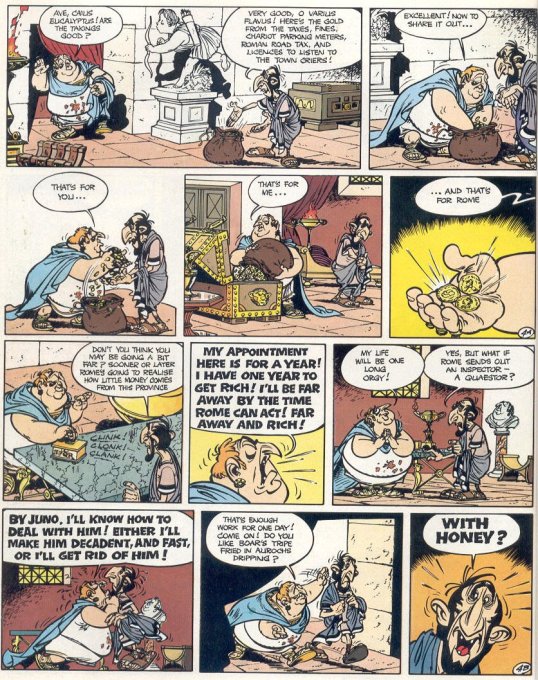
asterix

Be of Good Cheer.

I grew up reading Peanuts™. In fact, I learned to read with Peanuts™. They may have used Dick and Jane in school, but at home, I read the delightful work of Charles M. Schulz. I even remember encoutering the strip below, and thinking about it at a tender age.

peanuts

Schulz had a habit of working a bit of theology into his strips, especially with Linus, and especially around Christmastime, but later in life as I became more acquainted with Scripture, I immediately thought of this strip when I read:

“And one of you say unto them, Depart in peace, be ye warmed and filled; notwithstanding ye give them not those things which are needful to the body; what doth it profit?” (James 2:16. King James Version)

In modern English, that translates as:

“If you say to that person, “God be with you! I hope you stay warm and get plenty to eat,” but you do not give what that person needs, your words are worth nothing.” (New Century Version)

Pat Bagley is a cartoonist for the Deseret News, and he has done much humor orbiting around the faith of his fathers, specifically the Church of Jesus Christ of Latter-day Saints. We have this program called “Home Teaching,” in which members of the congregation visit others to make sure all is well, to bring words of comfort and inspiration, and to take care of needs that are not being met.

The cartoon below echoes the same sentiment expressed in the work by Schulz above:

HomeTeachingBagley

The sad part is, I’ve seen this happen. When you’re in charge of a family’s welfare, it behooves you to find out if there is anything amiss that the community can help with. But when needs are screaming at you with the force of a turbocharged bugle, and you “make that visit” to check off your list and bump your statistics, brother or sister, you’re missing the point.

We’re supposed to help one another. In fact, that help is often coming and going.

A story:

In 1980, my young family moved to Olympia, Washington to take a job after my research staff position at a university was eliminated due to lack of funding. Shame, too, because it was a wonderful project. But at the time, IT jobs were hot in the Pacific northwest, so up we went to work for the State of Washington. The money was good, but only just barely – we had bought a home and were renting it to university students, and had to find a place to rent while we were there. The student’s rent didn’t cover the mortgage, so in effect we were paying two house payments, and things were tight, I mean, tight. We wuz po.

We knew we were stretched, but we didn’t feel poor – we had our year’s supply of food with us (that’s one of the self-reliance programs of the Church), and by scrimping here and there – mixing milk half and half with powdered, walking the two miles to work to save the quarter for bus fare, making pies out of the blackberries that grew abundantly in our backyard and everywhere else, we made it through. And when two years later we moved back home and were able to move into our house, things got a lot better.

But in the meantime, we were very tight on cash.

Around Thanksgiving time, it’s common for congregations to pitch in together and pool food for gift boxes for needy families. We raided our abundant food storage and took a box over to the chapel to add to the effort; and the day before Thanksgiving, we returned from doing errands to find a box on our own doorstep. It was an odd feeling; we were almost insulted, as we didn’t consider ourselves “needy;” but in retrospect, we were – and once we had gotten over the initial discomfort, the gift was most welcome. A turkey with all the trimmings, which is something we might have done without.

I’ve learned along the way that it’s often much harder to receive than to give. But it gets easier, especially when I think about the fact that someone (like myself) who receives help today might just be giving it tomorrow, or next year.,

The painting by David Linn, “The Ascent,” is a marvelous metaphor for life:

Helping Each Other

There’s no getting around it: Life is tough. It’s a lot less tough for the 1%, but even having more money than God is no guarantee that things might not go sideways in other areas of one’s life, as many a celebrity, politician, or CEO have shown us in recent years. When we band together as a team, as communities, as nations, as a species, and reach out to those struggling – only to have those people pass us on the way and offer us a helping hand further along the path – we all win. We all rise. We all walk into the light of a better world, a world that works for everyone, with no one left out.

I’ve been able to help a lot of folks along the way, and I’ve been the recipient of a lot of help as well. There’s no shame in it. It adds to our humanity, which – in the end – is all we come with , and all we can really call our own.

Reach and take my hand, and pull me up – so that I can do the same for others. In the meantime, be of good cheer.

The Old Wolf has spoken.

Bluegrass, Celtic, or Old Time?

I love all of these genres, so I was delighted to see a blog post over at Bluegrass Nation which lays out in very clear terms how to tell the difference between them. Some of their article may be tongue-in-cheek or at least light-hearted, but I found it a great read.

Lushpup-Images-Inst-Makers41-e1316041723518-640x198

The Music

Old Time and Celtic songs are about whiskey, food and struggle. Bluegrass songs are about God, mother and the girl who did me wrong. If the girl isn’t dead by the third verse, it ain’t Bluegrass. If everyone dies, it’s Celtic…

The Instruments

Banjo
A Celtic banjo is small and quiet. An Old Time banjo is open-backed, with an old towel (probably never washed) stuffed in the back to dampen sound. A Bluegrass banjo has bell bronze mastertone tone ring and a resonator to make it louder…

Fiddle
The Bluegrass fiddler paid $10,000 for his fiddle at the Violin Shop in Nashville. The Celtic fiddler inherited his fiddle from his mothers 2nd cousin in County Clare. The Old Time fiddler got theirs for $15 at a yard sale…

Read the full post over at Bluegrass Nation.

The Old Wolf has spoken.

The fruits of abuse

Almost everything I post here is designed to uplift, to interest, and to inspire. In general, I do my best to avoid the depressing, the shocking, or the bizarre. Today I make an exception, but only because there’s an important message behind the event.

The children of Marianne Theresa Johnson-Reddick published an obituary for their mother in the Reno Gazette-Journal. In contrast to this beautiful tribute, the one published in the RGJ was anything but kind. It has since been removed by the newspaper as they investigate the circumstances surrounding its publication, but here is the text in full:

Marianne Theresa Johnson-Reddick born Jan 4, 1935 and died alone on Aug. 30, 2013. She is survived by her 6 of 8 children whom she spent her lifetime torturing in every way possible. While she neglected and abused her small children, she refused to allow anyone else to care or show compassion towards them. When they became adults she stalked and tortured anyone they dared to love. Everyone she met, adult or child was tortured by her cruelty and exposure to violence, criminal activity, vulgarity, and hatred of the gentle or kind human spirit.

On behalf of her children whom she so abrasively exposed to her evil and violent life, we celebrate her passing from this earth and hope she lives in the after-life reliving each gesture of violence, cruelty, and shame that she delivered on her children. Her surviving children will now live the rest of their lives with the peace of knowing their nightmare finally has some form of closure.

Most of us have found peace in helping those who have been exposed to child abuse and hope this message of her final passing can revive our message that abusing children is unforgiveable, shameless, and should not be tolerated in a “humane society”. Our greatest wish now, is to stimulate a national movement that mandates a purposeful and dedicated war against child abuse in the United States of America.

Let’s make a couple of things clear before we go on:

  1. This is the Internet, and hoaxes are as common as mosquitoes in Winnipeg.
  2. The accuracy of the facts surrounding this brutal obituary have not been independently confirmed, neither have they been refuted.
  3. The world is full of people as toxic and abusive as the alleged decedent; if you doubt me, just plug into the domestic violence feed, but be warned – it’s not for the faint of heart.

For the sake of argument, I’m going to assume that the events are accurate, that the woman in question was as horrific as stated, and that the family members are using this as a legitimate vehicle to obtain some measure of closure and healing. It is to their credit that instead of becoming monsters in their own right, they have done their best to turn the tide and mitigate the effects of child abuse, transforming their own agony into positive energy for the benefit of others.

Doubtless some will invoke de mortuis nil nisi bonum [1] and say that this obituary was heartless and spiteful. Without question, forgiveness is a healing balm; Azim Khamisa and Ples Felix have demonstrated this convincingly by turning tragedy into redemption for thousands of others. Mary Mullaney in the other obituary I referenced above used to say, “Never say mean things about anybody; they are “poor souls to pray for,” and Disney’s Thumper recited his father’s good advice: “if you can’t say somethin’ nice, don’t say nothin’ at all.” But no man knows another’s pain, and sometimes peace cannot be obtained without the opportunity to express things that have been long hidden, long suppressed.

Child abuse is much more common that we would like to think. In the context of some personal development work, I’ve heard stories that would curdle your blood, and shared a few of my own. It is only by getting these stories out, where they can be looked at, dealt with, and worked through, that sufferers of abuse can hope to burn that negative energy off and be able to move their lives forward. So, yes – it was an angry and hurt-filled obituary, and I can only hope that through its writing and publication, the children of this woman can find both release and closure. I wish them well.

The Old Wolf has spoken.


[1] “Of the dead say nothing but good.”

A message from myself

Scam


Found this in my mailbox the other day. It was from me, to me. Except for the fact that I hadn’t sent myself any spam recently.

At first I wondered if my email had been hacked, but I have a pretty strong password on that account (it’s AGHwqeiraas23894!!abaouUAWU, in case you were wondering) – it looks like Gmail picked it up as a spoofed sender, and no one else has contacted me with foul abuse, so I’m pretty sure that’s not what happened.

But I was curious as to who was sending out this garbage – rubber stamps? Well, not really. What I ended up with is this:

Scam2


Make Money with Meghan. Sheesh. Another get-rich-quick scam… except the only people who are getting rich are a few top-level bottom feeders (how’s that for a metaphor?)

In order to make money from these scams, you have to be willing to do one thing:

  • Sell the hope of making money to others, whose job will be to sell the hope of making money to others.

In order to do this, you pay these drones for the privilege of setting you up with one or more websites, and open yourself to a neverending round of upselling, which will cost you far more than you’ll ever make.

There are a few red flags associated with all of these internet scams:

  • Do a little digging, and you’ll see that many of them trace back to Tim Atkinson And Zak Meftah, a couple of young snake-oil salesmen who have saturated the internet with incarnation after incarnation of their scummy “opportunity”.
  • If you get onto a website and hit your “back” or “close” buttons, you’ll invariable get one or more of these popups:

bullshit2


I mentioned the one above in an earlier post about work-from-home scams, , but the concept is the same. Some of these websites will offer you discount after discount just for saying “no, thanks” – and even if you take the bait for the low, low price of $9.00 instead of $49.50, or whatever their initial fee is, they’ve got their foot in your door and will likely make up anything they lost from your enrollment on upsells and additional worthless training.

  • Just type the words [system] scam into Google; invariably the first several pages, or more, will be filled with websites advertising [system], or telling you that [system] is totally bogus and inviting you to sign up with [other system].
  • In all likelihood you found out about [system] through a dishonest and deceptive spam email, as I did.

All of these money-making schemes are full of sound and fury, and signify nothing. Yes, people are making money – the ones at the top who don’t give a rat’s south-40 about the thousands of people below them who will never see a dime of profit. Remember – these systems are selling nothing but the system itself! They add no value, create no lasting worth, and are designed only to give false hope to countless victims and enrich the ones at the top of the pyramid.

Do you really want to work with people who base their income on fraud and deception?  Be smart – stay away from such “opportunities.” There are a few legitimate companies out there, selling legitimate products, who offer their affiliates the chance to make money from a home-based business, but they are few and far between. 99% of the schemes being advertised on the net today are pure jiggery-pokery, and you would do well to avoid them like the plague.

The Old Wolf has spoken.


Space Rock

But not the way you might think.

4y5795Y


This is a hydrophane opal, found in mines at Welo, Ethiopia. You can read more about these opals at the School of Gemology.

When I first saw this posted over at reddit, people were mentioning that it looks like an ocean bottom – but the first thing I saw was this:

pillars-of-creation


The “Pillars of Creation” in the Eagle Nebula

Whatever you see, the stone is beautiful. Some of the other pictures of the stone reminded me of Ammolite, which I first encountered in Vancouver, BC.

ammolite-raw_f1


Nature is amazing.

The Old Wolf has spoken.

Know : Languages List and their Writing direction

Propel Steps added a pingback to my article on writing systems, and this article is fascinating in its own right.

Propel Steps's avatarPROPEL STEPS

Language direction

This is an index of the all the writing systems on this site arranged by the direction in which they are written. Some writing systems can be written in a number of different directions, others were originally written in various directions but eventually settled on one direction.

Why some writing systems are written in one direction, and others in other directions is a bit of a mystery. It might have something to do with the writing surfaces and implements originally used, fashion, the handedness of the creators of the writing systems, or other factors.

Directions

  • Left to right, horizontal
  • Right to left, horizontal
  • Left to right, vertical, top to bottom
  • Right to left, vertical, top to bottom
  • Left to right, vertical, bottom to top
  • Right to left, vertical, bottom to top
  • Boustrophedon
  • Variable


Example of Armenian written from left to right

Left to right, horizontal

The following writing systems are written from left to right in horizontal lines:

View original post 1,079 more words