Watch that fine print

spectrum

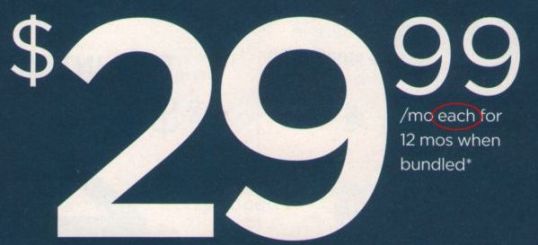
Wow, TV + Internet +Voice, $29.99! That certainly grabs the attention.
Spectrum 2.jpg

“Each.” That means the total price is about 90 bucks. Hmm, not such a great deal after all. And “Standard rates apply after 1 year,” says the teeny-tiny print on the back.

This is not exclusive to Spectrum – pull just about any flyer out of your mailbox or newspaper, and you’ll be likely to see something similar. Sales, marketing, and advertising – three industries that drive our economy, and all dependent on

  • persuasion
  • puffery
  • deception, and
  • outright fraud.

It’s scary, and except for the last one, it’s almost 100% legal.

1. Persuasion – the key to your wallet

Let’s look at the key points from Influence: the Psychology of Persuasion by Robert Cialdini:

  • Reciprocation: Consider the in-store wine tasting, or the free scone at the coffee shop. We think we’re coming out on top, but the expectation to give back is strong within us, and leads us to buy something.
  • Consistency: We like to see ourselves as consistent souls with unwavering beliefs. So if you ask me to publicly declare my devotion to animal rights, for example, I’m more likely to donate money to PETA later.
  • Authority: Four out of five dentists recommend using the reassuring gloss of authority to sell this toothpaste.
  • Social Validation: Rugged individualist fantasies aside, we are more likely to do something if we see that many other people like us have also done it.
  • Scarcity: Anyone who has grabbed a plain, overpriced t-shirt from another’s hands at a “one-day-only” sale understands how persuasive limited-time and limited-quantity offers are.
  • Liking: If you like someone, you are more likely to say “yes” to her request. If she is pretty, you’re even more likely. And if she compliments you, well, that works, too.

The book goes into great detail about how marketers invoke the “click, whirr” response in us, but this is the core of the book. Ironically, it can be read either as a consumer guide or a training manual for salespeople!

But you see these techniques in place everywhere. JC Penney tried ditching frequent sales for “everyday low pricing” and it didn’t work. People like sales. Never mind that a sweater that’s marked $39.95 today, and goes on sale tomorrow at $42.95 (slashed from $79.95!) is more expensive “on sale” that it was yesterday, people will buy it because a) they have short memories, b) they’re not savvy shoppers, and c) it was on sale!!!

Need to pop into the grocery store for a gallon of milk or a loaf of bread? They are likely in the farthest corner of the store, so you have to walk by everything else to get there. High-profit items are carefully placed at convenient height, and the location of goods is regularly rotated to keep shoppers off balance – the longer you’re in the store searching for things, the more you’ll buy. Most items in grocery flyers are not “on sale” – they’re just there to make you think they are. Colors, smells, relaxing music and clever signage (“Only $1.00” – even though it’s always just been a dollar) add to the myriad ways stores try to part you from your cash.

2. Puffery – Marketing’s license to lie.

In law, puffery is a promotional statement or claim that expresses subjective rather than objective views, which no “reasonable person” would take literally. (Wikipedia.)

Thanks to the machinations of countless generations of attorneys, advertisers are free to say pretty much what they want about their products. The claims made via puffery may be patently false, but they are “not really lies” because they can’t be disproved. “The World’s Best Hot Dog” is an unassailable statement because no “reasonable person” could be expected to believe it, and it can be neither proved nor disproved, being a completely subjective statement – and puffery creates no express warranty or guarantee for the consumer. Some examples of puffery include:

  • Meals fit for a king!
  • Our mattresses are softer than a cloud!
  • Better ingredients, better pizza!
  • The Best Coffee in Town!
  • Lose Weight Fast!

If something is demonstrably false – i.e. “nature’s perfect food” can be challenged by science – then it’s probably punishable by law. Opinions, however, are not statements of fact.

3. Deception
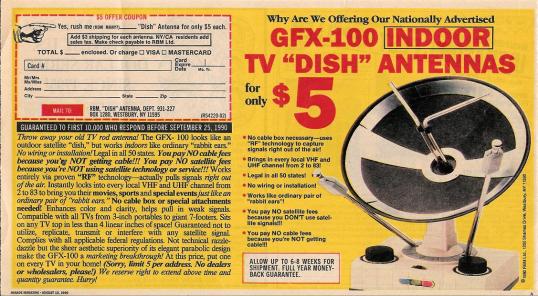
Hall of Shame Advertisement

My favorite deceptive ad of all time, which I have referenced before. This is the crown jewel of shameful advertising. If you strip away all the puffery, this ad says “Buy our rabbit ears – they’re prettier!” But every statement in the ad can be interpreted in more than one way, and taken together (by someone who’s not especially sophisticated) they imply some incredible technological breakthrough at a dirt-cheap price.

Advertising restrictions were not as stringent a generation ago:

The jingle in this retro ad is a bit different from the one I remember:

If you want shoes with lots of pep, get Keds, kids, Keds.
For bounce and zoom in every step, get Keds, kids, Keds.
Those shock-proof arches can’t be beat
They sure are great for growing feet
You’ll be a champion athlete!
Keds, kids, Keds.

Equally bad was this ad for Kellogg’s Apple Jacks from the 60s:

“A bowl a day keeps the bullies away!” How many kids begged their moms for a box of this cereal, only to find that they got slammed into the lockers just as hard the next day?

If you want deceptive advertising, just head for the nutritional supplement industry. I take these people to task at every opportunity, as I recently did with ProBioSlim. I made the manufacturer so mad that I actually got my first cease-and-desist letter, out of which came precisely nothing.

4. Outright Fraud

Frankly, I feel like most affiliate-marketer-sponsored nutritional or weight-loss products are criminally fraudulent; just type “snake oil” in the search bar of this blog for myriad examples. But in this section I mention a few cases that actually spawned legal action and forced advertisers to change course.

  • In 2014, Red Bull paid $13 million to settle a class-action suit because it claimed “Red Bull Gives You Wings.”
  • In 2010, Kellogg claimed Rice Krispies could boost your immune system. In 2011. Kellogg agreed to pay $2.5 million to affected consumers, as well as donating $2.5 million worth of Kellogg products to charity.

  • New Balance was accused of false advertising in 2011 over a sneaker range that it claimed could help wearers burn calories. Nope. In 2012, New Balance agreed to pay a settlement of $2.3 million.
  • Lumos Labs: In January 2016, the makers of popular brain-training app Luminosity were fined $2 million by the FTC for deceptive advertising, claiming that the app could help prevent Alzheimer’s disease, among other things.

  • In the 1990s, the “Airborne” herbal supplement was everywhere. It claimed to hold off harmful bacteria and germs, preventing everyday ailments like the flu and common cold. The claims ended in a class-action lawsuit involving over $30 million in settlement payments.

Puffery is one thing, outright lies are another. While the FTC and the FDA are underfunded and overburdened, they do their best to protect the consumer from fraud and abuse wherever they can.

Ultimately, caveat emptor along with a healthy dose of skepticism, social awareness, and a willingness to do the necessary research is the consumer’s best defense against fraudulent advertising practices.

As usual, be careful out there.

The Old Wolf has spoken.
WOT: (Web of Trust) – A valuable extension

I’ve mentioned WOT in a number of my previous posts, but I thought I’d give it a bit more exposure, given the amount of scams, fake news websites, and general internet douchebaggery that is so prevalent right now.

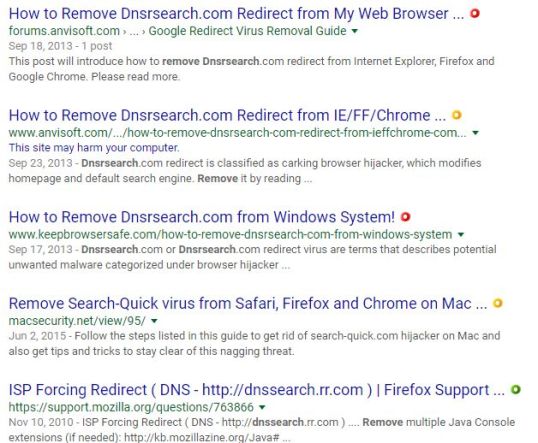
Web of Trust is a FREE extension that adds a small circle after any clickable link on your computer to let you know how trustworthy that site is. Here’s an example – recently I was trying to remove a hijacker that redirected me to Spectrum’s search service when an unknown URL was encountered:

WOT

Notice that the circles can be green, yellow, and red – just like  stoplight. That’s your first clue – but it pays to drill down for more information as I mention below. Green is generally trustworthy, yellow is questionable, and red is downright dangerous. A gray circle with a question mark means there is no information (yet) about the site in question.

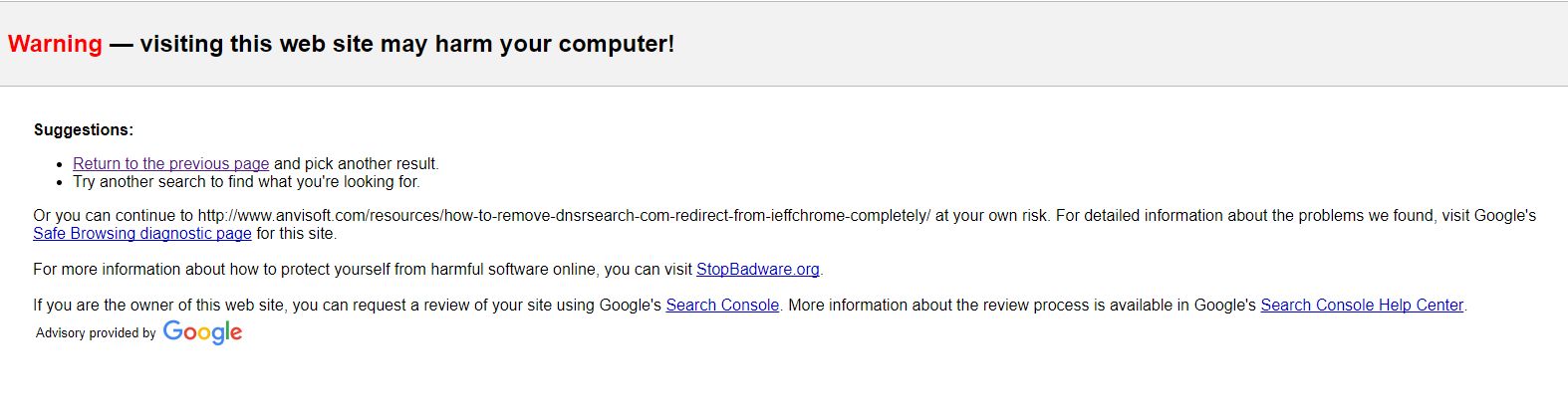
Some dangerous websites will be flagged by Google directly (Click image to enlarge)

Google1

If you have a paid version of Malwarebytes, known malware websites will be automatically blocked:
Malwarebytes

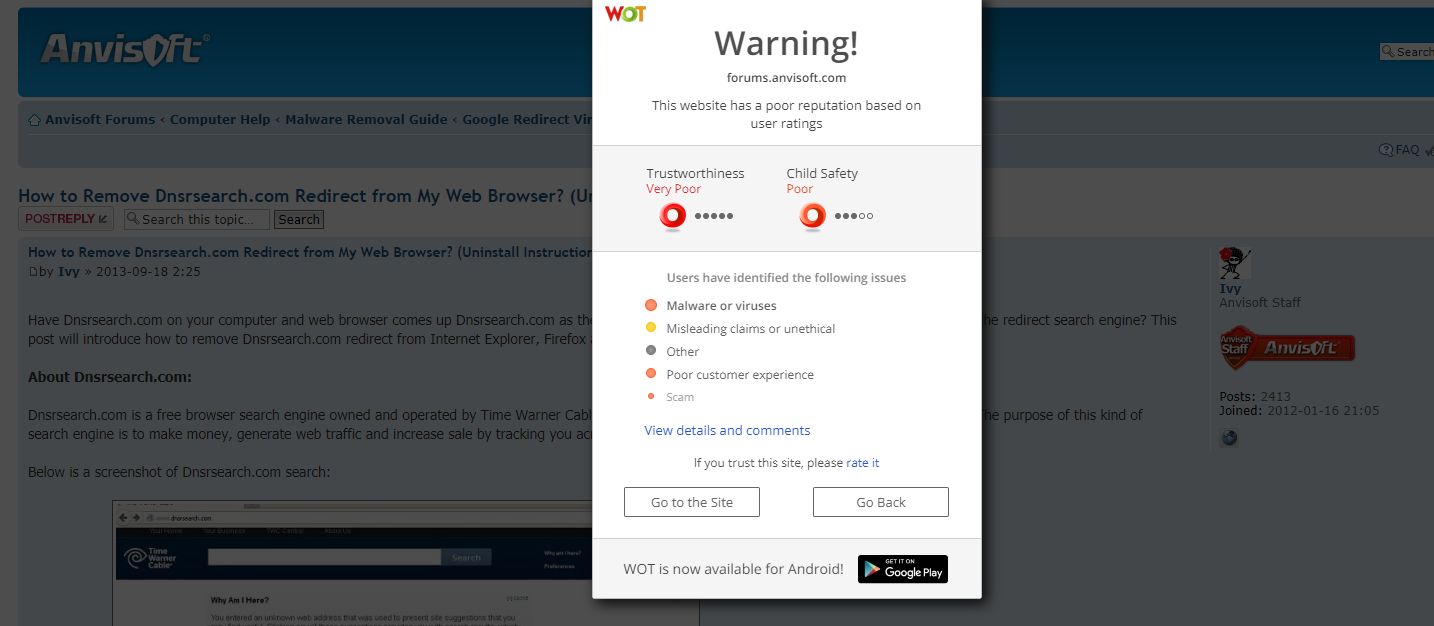
But if neither one of these help, WOT will give you a warning for red-circle links that looks like this (Click image to enlarge):

WOT1

You’ll notice that you get a summary of ratings and reasons why the website is not trusted.

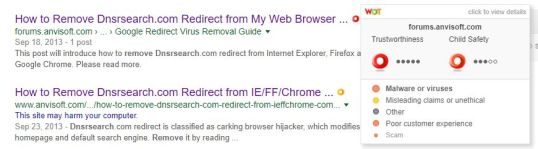
In addition, search engine results can be previewed simply by hovering your mouse over the colored circle:

WOT2

and then you can follow the “click to view details” link to get a full page of information about the website.

WOT3

As with anything that is crowdsourced, one needs to be cautious. A tool like this could be used to give bad ratings to a website by an unethical competitor, so look at the dates of the reviews and get an overall feel for the page in question. In general, though, I’ve found that this tool tends to be self-correcting, so if one person rates a site untrustworthy for malware, and five other more recent users give reasons why it’s safe, I feel pretty confident that the first review is either spurious or outdated.

If you want to rate websites yourself, you can create a free account, log in, and provide details of your experience.

In addition to protecting you from viruses or other malware, WOT can be very useful for verifying whether news sites are reliable or not.

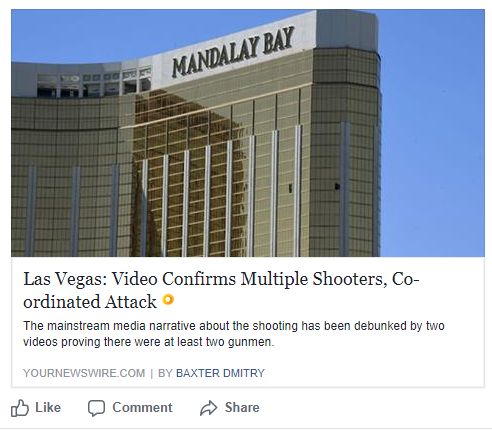
An example: Today on Facebook I saw a link to a story that there was a second shooter in Las Vegas:

Facebook

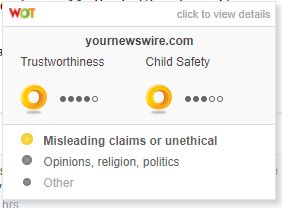
That yellow circle told me right off that this story is questionable. Hovering over the warning gave me this:

WOT4

And a subsequent search on Google for yournewswire.com confirmed that this is a notorious clickbait, inflammatory, fake-news website:

Founded by Sean Adl-Tabatabai and Sinclair Treadway in 2014. It has published fake stories, such as “claims that the Queen had threatened to abdicate if the UK voted against Brexit” (Wikipedia)

It pays to be safe, and it pays to be careful. This little extension works well with Window 10 and earlier versions (I’ve tried it on XP and 7 both), it’s free, and it provides a wealth of information about internet dangers. I highly recommend it.

The Old Wolf has spoken.

Marketing by Deception Redux

I’ve written about deceptive marketing practices before, notably here and here. Finding people who are willing to ascribe to ethical business practices is a challenge in this world, and in marketing and advertising the phenomenon is well-nigh absent.

Here’s an example of an egregious bait-and-switch ad I received in the mail last week (click images to enlarge)

Deception Front

Deception Back

Now, before we go any further, some will already be shouting “But it’s a car dealership! What do you expect?” Yes, well, more about that later, but let’s look at the flyer in question.

The front clearly states,

“If the number you scratched off matches to any of the prize numbers, you have definitely won! Proceed immediately to Tucker Chevrolet to confirm and collect your prize.”

You’ll see that the scratched-off number matches the $250.00 prize in my case. I’m not a fool – I had no real illusions that I had won anything of value, but I went down the rabbit hole to see how the game is played.

And, as it turns out – as in so many instances – the large print giveth, and the small print taketh away. Look on the back, and you’ll see this:

If the number printed next to your name in the address panel of this mailer matches exactly to the winning number on the prize board at the sales event, Setp. 27 – Oct. 2, 2017, then you win the prize that matches your number. The number you scratched off does not give you a choice, but an opportunity to win a prize. (Odds of winning grand prize of $25,000 cash 1:499,999. Odds of winning 60″ HDTV (value $499) 1:499,999. Odds of winning $25,000 cash 1:499,999. Odds of winning $1000 cash 1:499, 999. Odds of winning $250 Walmart card 1:499,999. Odds of winning five dollar want Walmart card 499,995:499,999.

In plain English, you’re walking out of there with a five-buck Walmart card, unless you’re the kind of person that regularly wins the lottery. I’d love to see a reddit AMA from someone who actually scored the grand prize in one of these “giveaways.”

The bold text in the disclaimer above seems to directly contradict the blaring statement on the front of the mailer, but it should be noticed that “you have definitely won” does not specify what you have won. The mind, however, fills in the gaps and brings you down to the dealership, which is the whole point.

The salesman who showed me the board, patronizingly explained to me that I was not a large prize winner, and handed me my $5.00 Walmart card “so you don’t walk away with nothing” indicated that he’d like a chance to earn my business whenever I wanted to trade in my Prius.

Odds of earning my business at a dealership that resorts to such deceptive advertising: 0:7,571,086,556 (number changes continually).

For all the good that car dealerships do – sponsoring Little League teams, funding scholarships for disadvantaged children, donating vehicles to first responders, paying their taxes and flying big flags, people generally have an unfavorable opinion of auto dealers, both used and new. And that reputation is deserved, even though some are better than others. There are just too many rotten apples in the barrel for the entire industry to clean up its own act.

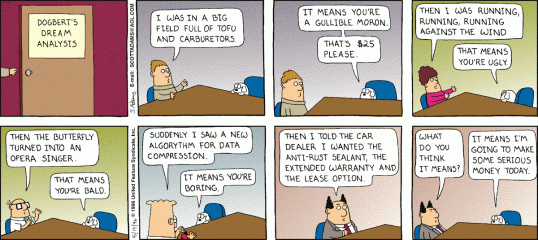
Car sales is a business where the goal is to make the sale, get the commission, get the customer to agree to as many worthless add-ons as possible, buy the gold service contract, use dealer financing at the highest possible rate (if you manage to score 0%, you know they’re making money on unadvertised holdbacks or something else that you can’t see), and if the customer is really stupid, go for the lease option.

dt960519shc0

There are too many hungry salesmen and sales managers out there, some of whom would make Alec Baldwin in Glengarry Glen Ross look like Miss Julie from Romper Room. Ethics isn’t even in their vocabulary. And based on the kind of advertising campaign we’re discussing, it doesn’t really seem to have a presence in corporate boardrooms either.

“But it’s just advertising, nobody really expects the truth!”

Well, yes. Yes, they do. I went into this little exercise with my eyes wide open, so coming away with a $5.00 Walmart gift card is actually more than I had expected. But I know there are many people who truly thought they had won something significant, and left feeling used and cheated – or, if they were really unlucky, with a new car.

TANSTAAFL: There’s no such thing as a free lunch. It’s good to remember, especially in the world of advertising. Be careful out there.

The Old Wolf has spoken.
The scammers don’t give up

scam1

The “Microsoft Customer Support” scam: Today’s number is 866-587-7384.

Your screen locks up. You can’t close your browser. You can’t go back. A computerized voice starts talking to you about pornographic malware. A warning message tells you your data is being stolen. You are given a phone number to call for help removing the malware.

Do NOT call this number. It has nothing to do with Microsoft. The page you are seeing is a malicious script that has been loaded from a website that you visited, probably from a banner ad or something else that the page owner is unaware of, and is designed to scare you. If you follow the steps the “support agent” gives you, he or she will have you  give them total control of your system. From there, anything can happen and none of it will be good.

In the event that you went through this process with an “agent,” it will be critical for you to run an anti-malware program such as Malwarebytes (I don’t work for them), or have your computer cleaned by a professional, before you do anything else.

Be careful out there.

The Old Wolf has spoken.

Pity the poor translator

One doesn’t work in the translation industry for decades without having some strong feelings about seeing bad translations.

Once when I was in an oriental market, I picked up a packet of dried squid for snacking on.

I already know what you’re thinking. Shut up. 

I think it’s a product of Taiwan, but I’m not sure, because it looks like it’s destined for both the US and Japan.

On the package, it says (spelling errors are transcribed as found):

“This product is under strict ouality control with perfect packing and quality when leaving the factory. Please keep away from damp, high temp or sun expose. If found any defectives when purchasing please retrn the product by airmail to our Administration section and inform the purchase for our improvement we shall give you a satisfactory reply. Thanks for your Patronage and welcome your comments.”

If “ouality” is such a priority, why don’t such asian exporters ever run their documentation or packaging under the eyes of a native English speaker? I could think of a number of reasons:

  1. They’re cheap
  2. Their own estimation of their English ability exceeds actuality
  3. They know the product will sell just as well even with lousy translations
  4. They don’t give a rat’s ass
  5. All of the above

Me, I’d be embarrassed to sell a product in a foreign market with errors like this – but it’s a problem of long, long standing. Translation is often given short shrift in business plans. Too many managers think, “Oh, my secretary Miss Yin speaks English, she can do the translation and I’ll save money.”

With the concept of “face” so prominent in Asian cultures, it surprises me that they don’t understand this sort of cost-cutting makes their enterprise look bad. On the other hand, perhaps the average American consumer doesn’t care either.

I’ve mentioned this elsewhere when writing about translation, but I wish I had kept a copy of an ad that appeared on our bulletin board in the early 80’s when I was working for a now-defunct translation software firm. It showed a manager reaming out some poor drone, and the caption was “Because you let your brother-in-law do the translation, our ad says that our new camera exposes itself automatically!

People in the translation industry are certainly aware of the problem, and resolving it would certainly create a lot of work for a lot of people… but would also deduct from the bottom line of the manufacturers, and that has always seemed to be the driving factor.

Automation has affected a lot of industries for good and for ill. Plumbers, electricians, carpenters, many trades have been relatively untouched except for better tools and a proliferation of codes and regulations. But thanks to CAT tools¹ and the Internet, the translation industry has been radically transformed from a field where educated professionals could seek out high-quality clients and agencies vied to find high-quality translators into an absolute circus where millions of people in third-world countries offer abysmal services for 3¢ per word and agencies expect the lifelong journeymen and journeywomen to meet these kinds of prices (with concomitant reductions for repeated text, of course.)

The professional translators who have been willing to buy the tools and deal with the agencies to stay in their field have my undying respect; I got out of the circus years ago as a way to make a living.

The Old Wolf has spoken.


¹ Computer-Assisted Translation tools. This is the only CAT tool I still have:

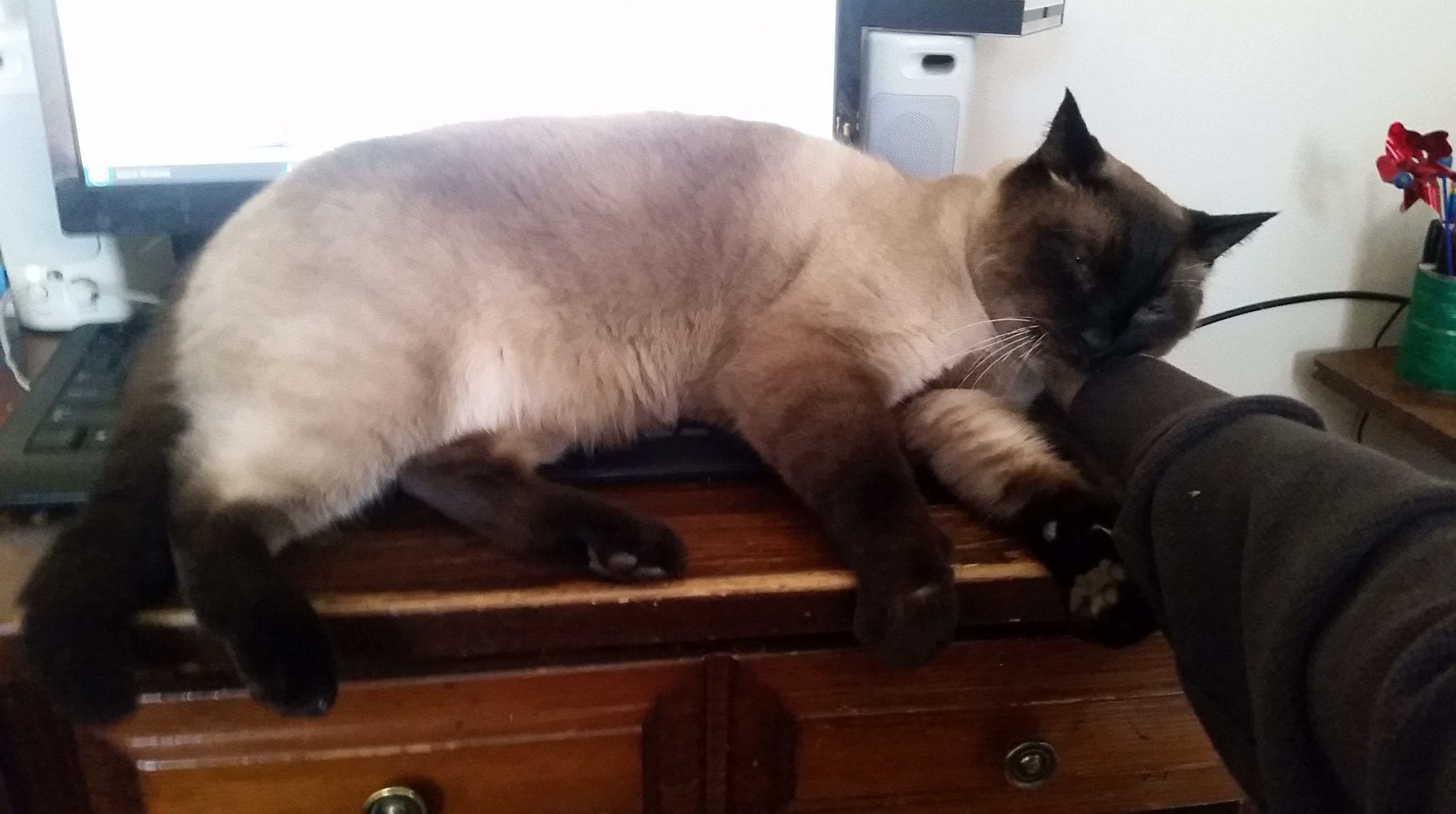
20161209 Sensei Helping.jpg

And, frankly, he’s not much help in the work arena, but he does a world of good for my heart.

HOLLYWOOD DICTIONARY

VERBS

  • To schmooze    ‑ befriend scum
  • To pitch       ‑ grovel shamelessly
  • To brainstorm  ‑ feign preparedness
  • To research    ‑ procrastinate indefinitely
  • To freelance   ‑ collect unemployment

NOUNS

  • Agent          ‑ frustrated lawyer
  • Producer       ‑ frustrated writer
  • Writer         ‑ frustrated director
  • Director       ‑ frustrated actor
  • Actor          ‑ frustrated human

COMPOUND WORDS

  • High concept             ‑ low brow
  • Entry level              ‑ pays nothing
  • Network approved         ‑ has made them money before

FINANCIAL TERMS

  • Net            ‑ something that apparently doesn’t exist*
  • Gross          ‑ Michael Eisner’s salary
  • Back End       ‑ you, if you think you’ll ever see any
  • Deferral       ‑ don’t hold your breath
  • Points         ‑ see  “Net” or “Back End”

COMMON PHRASES

  • You can trust me              ‑ You must be new
  • It needs some polishing       ‑ Change everything
  • It shows promise              ‑ It sucks
  • I’d like some input           ‑ I want total control
  • Call me back next week        ‑ Stay out of my life
  • Try and punch it up           ‑ I have no idea what I want

Notes:

* Sir Alec Guinness, despite his lack of love for the cheesy dialog in Star Wars Episode 4, made out like a bandit as his agent negotiated a deal for 2.25% of receipts. (There are stories that he was promised 2.5%, but didn’t quibble over it when the offer was confirmed in writing.) It’s estimated that his and his estate’s take over time was between 50 and 75 million.

A good article about why there is never a “net” profit can be found at TechDirt. If you’re an actor/actress and you’re offered part of the net, negotiate for a ham sandwich instead. At least you’ll get something.

Final Exam for Know-it-Alls

This has been around for a long time, but I thought I’d put it here so I don’t forget where to find it.

If you think you know everything, this is the final exam for you.


FINAL EXAM

Name: _________________________________         Date: ______________

Instructions: Read each question carefully. Answer all questions.  TimeLimit: 4 hours.

HISTORY

Describe the history of the papacy from its origins to the present day, concentrating especially, but not exclusively, on its social, political, economic, religious, and philosophical impact on Europe, Asia, America, and Africa. Be brief, concise, and specific.

MEDICINE

You have been provided with a razor blade, a piece of gauze, and a bottle of Scotch. Remove your appendix. Do not suture until your work has been inspected. You have 15 minutes.

PUBLIC SPEAKING

Twenty five hundred riot crazed aborigines are storming the classroom. Calm them. You may use any ancient language except Latin or Greek.

BIOLOGY

Create life. Estimate the differences in subsequent human culture if this form of life had developed 500 million years earlier, with special attention to its probable effect on the English parliamentary system. Prove your thesis.
MUSICWrite a piano concerto. Orchestrate and perform it with flute and drum. You will find a piano under your seat.

PSYCHOLOGY

Based on your degree of knowledge of their works, evaluate the emotional stability, degree of adjustment, and repressed frustrations of each of the following: Alexander of Aphrodisias, Rameses II, Gregory of Nicea, Hammurabi. Support your evaluations with quotations from each man’s work, making appropriate references. It is not necessary to translate.

SOCIOLOGY

Estimate the sociological problems which might accompany the end of the world. Construct an experiment to test your theory.

MANAGEMENT SCIENCE

Define management. Define science. How do they relate? Why? Create a generalized algorithm to optimize all managerial decisions. Assuming an 1130 CPU supporting 50 terminals, each terminal to activate your algorithm; design the communications interface and all necessary control programs.

ENGINEERING

The disassembled parts of a high powered rifle have been placed in a box on your desk. You will also find an instruction manual, printed in Swahili.  In ten minutes a hungry Bengal tiger will be admitted to the room. Take whatever action you feel is appropriate. Be prepared to justify your decision.

ECONOMICS

Develop a realistic plan for refinancing the national debt. Trace the possible effects of your plan in the following areas: Cubism, the Donatist controversy, the wave theory of light. Outline a method for preventing these effects. Criticize this method from all possible points of view. Point out the deficiencies in your point of view, as demonstrated in your answer to the last question.

POLITICAL SCIENCE

There is a red telephone on the desk beside you. Start World War III. Report at length on its socio political effects, if any.

EPISTEMOLOGY

Take a position for or against truth. Prove the validity of your position.

PHYSICS

Explain the nature of matter. Include in your answer an evaluation of the impact of the development of mathematics on science.

PHILOSOPHY

Sketch the development of human thought; estimate its significance. Compare with the development of any other kind of thought.

GENERAL KNOWLEDGE

Describe in detail. Be objective and specific.

*** EXTRA CREDIT ***

Define the universe; give three examples.

Just change one letter…

Following were the winners of a New  York magazine contest in which contestants were to take a well‑known  expression in a foreign language, change a single letter, and provide a  definition for the new expression.

HARLEZ‑VOUS  FRANCAIS
Can you drive a French motorcycle?

EX POST FUCTO
Lost in the mail.

IDIOS AMIGOS
We’re wild and crazy  guys!

VENI, VIPI, VICI
I came,  I’m a very important person, I conquered.

COGITO  EGGO SUM
I think; therefore I waffle.

RIGOR MORRIS
The cat is dead.

RESPONDEZ S’IL VOUS PLAID
Honk if  you’re Scottish.

QUE SERA SERF
Life is feudal.

LE ROI EST MORT. JIVE LE  ROI
The king is dead. No kidding.

POSH MORTEM
Death styles of the rich  and famous.

PRO BOZO PUBLICO
Support your local clown (or politician, your call)

MONAGE A TROIS
I am three years old.

FELIX NAVIDAD
Our cat has a  boat.

HASTE CUISINE
Fast French  food.

VENI, VIDI, VICE
I came,  I saw, I partied.

QUIP PRO QUOA
Fast retort.

ALOHA OY
Love;  greetings; farewell; from such a pain you would never know.

MAZEL TON
Tons of luck

VISA LA FRANCE
Don’t leave your chateau  without it.

AMICUS PURIAE
Platonic friend.

L’ETAT, C’EST  MOO
I’m bossy around here.


ZITGEIST
The  clearasil doesn’t quite cover it up.

E PLURIBUS  ANUM
Out of any group, there’s always one asshole.

NOMO ARIGATO
No thanks to you.

VIVE LE DUFFERENCE
Long live  golfing.

Note: The next two violate the “one letter” rule, but they’re here anyway.

COGITO, ERGO SPUD
I think, therefore I Yam.

VENI, VIDI, VELCRO
I came, I saw, I  stuck around.

About those Confederate monuments…

There are basically two schools of thought floating around the public’s consciousness about confederate monuments right now, especially in light of recent events in Charlottesville, Virginia.

  1. These are monuments to slavery, hatred, bigotry and the losing side of a war. They should be destroyed, or at the very least put in museums.
  2. You’re rewriting/destroying history. They should be left in place.

Now let me tell you a story:

In 1968 and 1969, I spent a year at Gettysburg College.

Old Dorm

Pennsylvania Hall, also known as Old Dorm, was built in 1837 and was used as a signal station and field hospital by both Union and Confederate forces. It was gutted and restored the year I was there, and underwent additional restoration in subsequent years. The entire campus is steeped in the history of the Civil War.

Decades later I returned to visit the campus, and had more time and more mobility to visit the historical sites, museums, and the battlefields.

20090518 - Michael Contemplates Gettysburg

In May of 2009, my son contemplates a battlefield.

The silence that hangs over those fields, where about 8,000 people lost their lives and over 57,000 were listed as casualties, is haunting. In Lincoln’s words, “The brave men, living and dead, who struggled here, have consecrated it, far above our poor power to add or detract.” Standing on that quiet land, listening, one can almost hear the tumult and terrors of war – and it’s important to note that Lincoln did not single out either Union or Confederate soldiers in his appellation “brave men.” Those who fought and died, regardless of how just their cause or how willingly or not they served, deserve to be remembered. They belong to the annals of our nation.

The word nigger appears 219 times in Huckleberry Finn by Mark Twain, but it was a product of its times and remains a classic piece of literature – an ode to the evils of slavery – just as it stands. I’ve seen “sanitized” versions of the work, which has long been one of my favorites, and they just feel wrong.

When I visited Albania numerous times in the early 90s, shortly after the fall of Communism, I found a land in which almost every reference to Enver Hoxha had been purged, except for the national museum in Tiranë. And I understood that national sentiment as well. After 41 years of brutal repression, very few Albanians had any desire to “remember” that part of their history, that they had so recently been relieved of.

In our case, the civil war is now 150 years behind us, but the history of slavery in the USA was almost 100 years longer than that, beginning on 31 August 1620, when John Rolfe recorded that “there came in a Dutch man-of-war that sold us twenty negars.” And the ripples and ramifications of slavery extended well into my lifetime; although I personally never saw scenes like this one, I was 14 the year of the Selma to Montgomery marches, 15 when Bobby Seale and Huey Newton founded the Black Panthers, and am watching the social media storm swirling around the Black Lives Matter today. If black lives really mattered, there would be no need for such a movement.

The record shows that most Confederate monuments were put up during the eras of Jim Crow segregation and the civil rights movement. They were put up, many with financial support from  The United Daughters of the Confederacy, to influence the narrative of the Civil War; the message was that the Civil War was not an issue of slavery but rather an issue of states rights.

On one hand, historical revisionism is a slippery slope. Humans are imperfect, and there will always be unpleasant truths in our past that must be acknowledged and remembered if we are not to repeat them. On the other hand, while my experience has been one of white privilege I can at least begin to imagine the gut feelings of those who have been impacted by the legacy of slavery at viewing – or even thinking of the existence of – monuments to people who fought, killed, and died to keep their people in bondage.

There are no monuments in Germany venerating Hitler or Göbbels or Eichmann. According to Joshua Zeitz, writing for Politico,

“The generation of Germans that came of age in the 1970s and 1980s confronted the country’s Nazi past and forcefully repudiated it. It took several decades of hard self-reflection, but a reunified Germany emerged from the Cold War as one of the great mainstays of democracy and human rights.”

Even though America stood for freedom and self-determination during the many wars of the last century, at home our own legacy of keeping a large part of our own population in miserable servitude for centuries remains not only unrepudiated but continues to be celebrated under the guise of another kind of historical revisionism.

It’s not enough to remove bronze and stone monuments to human wretchedness and cruelty; the underlying attitudes of the antebellum South and the Civil War remain enshrined in the hearts of too many people and too many textbooks. But it’s a step that we owe to the descendants of those who sweated under the loads and suffered under the lash and who have endured second-class status since their forefathers were emancipated, a step that must be taken if we are to eradicate those attitudes.

And what of private Buford Liles who marched off to war believing that the cause of the South was just and who never came home to wife and children, and all the privates and sergeants and fighting men like him who laid down their lives? A nation that has turned its back on the inhuman excesses of the past and that strives to build a society that works for everyone, with no one left out, can honor the bravery of these men and women, and all the victims of that wretched conflict, in memory without celebrating the flawed cause that moved them.

A contemplative visit to a peaceful battlefield would suffice.

The Old Wolf has spoken.

“My hat, it has three corners…”

I learned this song as a child, as many of us probably did at camp or elsewhere.

My hat, it has three corners,
Three corners has my hat.
And had it not three corners,
It would not be my hat!

Or, in German:

Mein Hut, der hat drei Ecken,
Drei Ecken hat mein Hut,
Und hätt er nicht drei Ecken,
So wär es nicht mein Hut.

It’s sung to an old Italian folk tune, “The Carnival of Venice“:

Only recently, thanks to a Facebook post by a respected friend and colleague, did I learn that the tune has a lot more attached to it than one simple verse.

The starkly minimalist play by Samuel Beckett, “En Attendant Godot” (Waiting for Godot) contains the following song in French, which is endlessly iterative:

Un chien vint dans l’office
Et prit une andouillette;
Alors à coups de louche
Le chef le mit en miettes.

Les autres chiens en ce voyant
Vite vite l’ensevelirent
Au pied d’une croix en bois blanc
Où le passant pouvait lire:

Un chien vint dans l’office…

A dog went into the kitchen
And stole a piece of bread;
The cook came out with a ladle
And beat him till he was dead.

Then all the dogs came running
And dug the dog a tomb,
And wrote upon the tombstone
For the eyes of dogs to come:

A dog went into the kitchen… (repeat forever)

There are other translations of this song as well; some claim that the German version is the original, which Beckett appropriated for his play:

Ein Mops kam in die Küche
Und stahl dem Koch ein Ei.
Da nahm der Koch den Löffel
Und schlug den Mops entzwei.

So kamen alle Möpse
Und gruben ihm ein Grab
Und setzten einen Grabstein,
Auf dem geschrieben stand:

Ein Mops kam in die Küche…

(Like most folk songs, there are numerous versions with slightly varying words; there is a bawdy German song, non-iterative, that begins “Ich bin ein junges Weibchen” that uses the same melody as well.)

And here’s the Hebrew version:

אל המטבח בא כלב
ועצם שם חטף
אז הטבח חבט בו
הרג אותו עם כף

כל הכלבים אז באו
וקבר לו חפרו
ומצבה הקימו
עליה הם כתבו:

אל המטבח בא כלב…

El hamitbach ba kelev
Ve-etzem sham chataf
Az hatabach chavat bo
Harag oto im kaf.

Kol haklavim az ba’u
Vekever lo chafru
Umatzeva hekimu
Aleiha hem katvu.

El hamitbach ba kelev…

It is interesting to note that all of these versions can be sung to the same tune, although it is not always used in every interpretation of “Godot.”

The concept of the eternally iterating song poked my memory, and I recalled that when I was a young child, my mother and I would end up rolling in laughter after doing this one for what seemed like hours:

Twas a dark and stormy night!
Three robbers sat in a cave!
“Tell us a story!” said one,
And this is how it begun:

‘Twas a dark and stormy night…

Mother was an actress, and a good one – so every iteration took on a different character when it was her turn.

Finally, there’s this gem written by writer/composer Norman Martin in 1988:

Be grateful. Be grateful, I say, that I didn’t choose to post the 10-hour version!

Many thanks to my colleagues in the translation community for the various versions (whom I shall not name unless they tell me they wish to be identified!)

The Old Wolf has spoken.