Art

Life
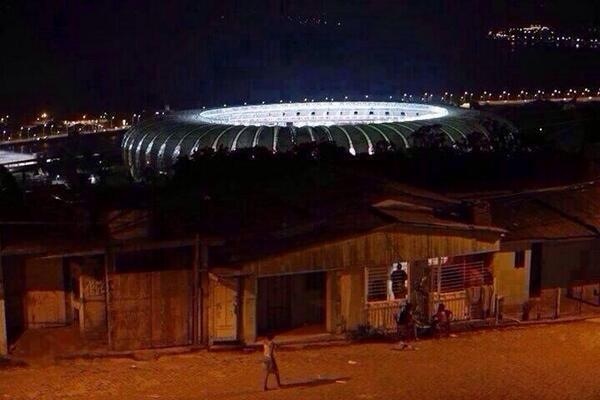
A picture is truly worth a thousand words. This is not to disparage Brazil or fútbol, but just to point out a disparity that needs to be addressed.
The Old Wolf has spoken.
A picture is truly worth a thousand words. This is not to disparage Brazil or fútbol, but just to point out a disparity that needs to be addressed.
The Old Wolf has spoken.
In a previous post, one of the things I reminisced about was television, and that’s what my mother always told me. I guess she didn’t happen to see this picture
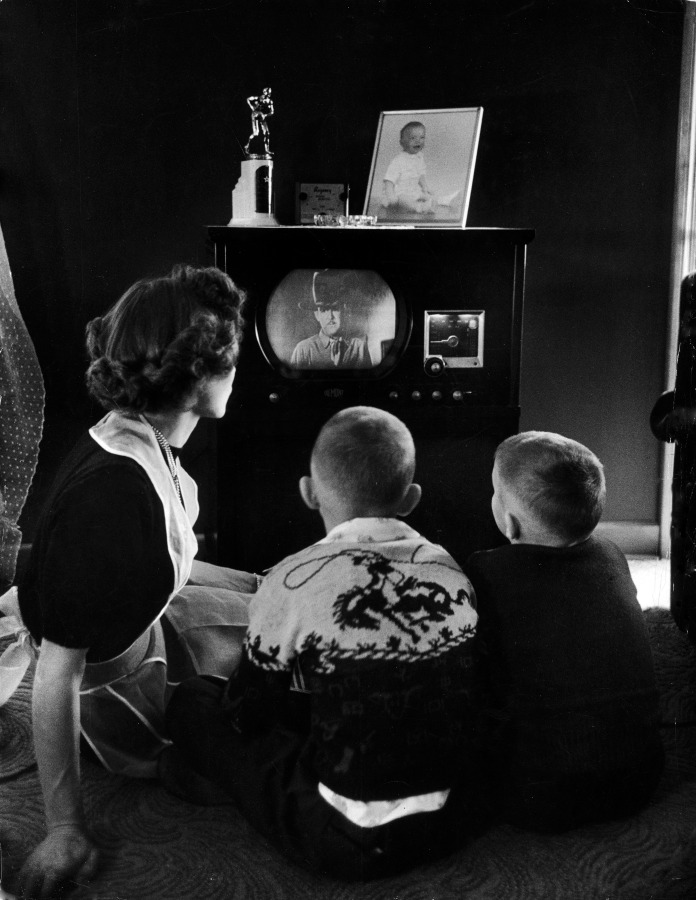
which shows a mother and her two children watching TV in 1950. Happily, science has given the lie to this old wives’ tale.
That said, the image is from a wonderful LIFE magazine photo essay entitled “World Television Day: LIFE watches TV.” The entire essay is intriguing; the very first image shows RCA executives watching a prototype television in 1938:
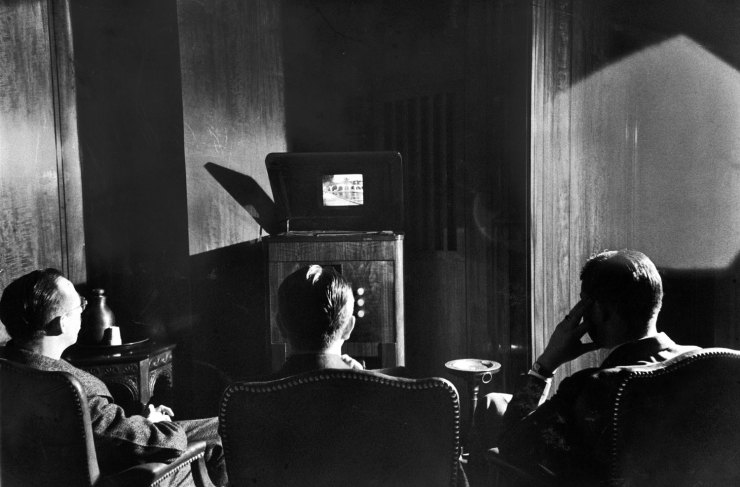
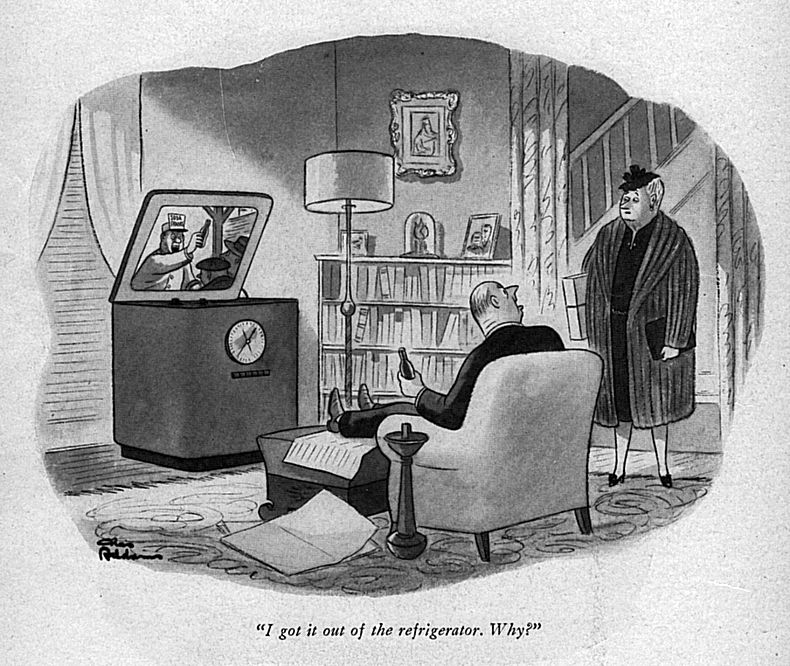
Notice that the image is being reflected in a mirror, the screen being on the top of the set instead of in the front. Charles Addams drew a set like this once, and I always thought it was very strange, never having seen a television like this.
But however it looked, TV was a big part of my life for as long as I can remember. When I was around 4 or 5, I’d watch Superman religiously:

That theme music would come on, and I’d stand on my chair:

With my legs on the arms, in the same position as George Reeves (my mother had even made me a wonderful Superman costume that I would put on for the event) and along with Superman, fight for truth, justice, and the American Way.
When I wasn’t watching Superman, there were other shows: Popeye cartoons by Max Fleischer, Mighty Mouse, Gerald McBoingBoing, Tom Terrific, just to name a few. And there was Winky Dink, which featured in the LIFE essay:
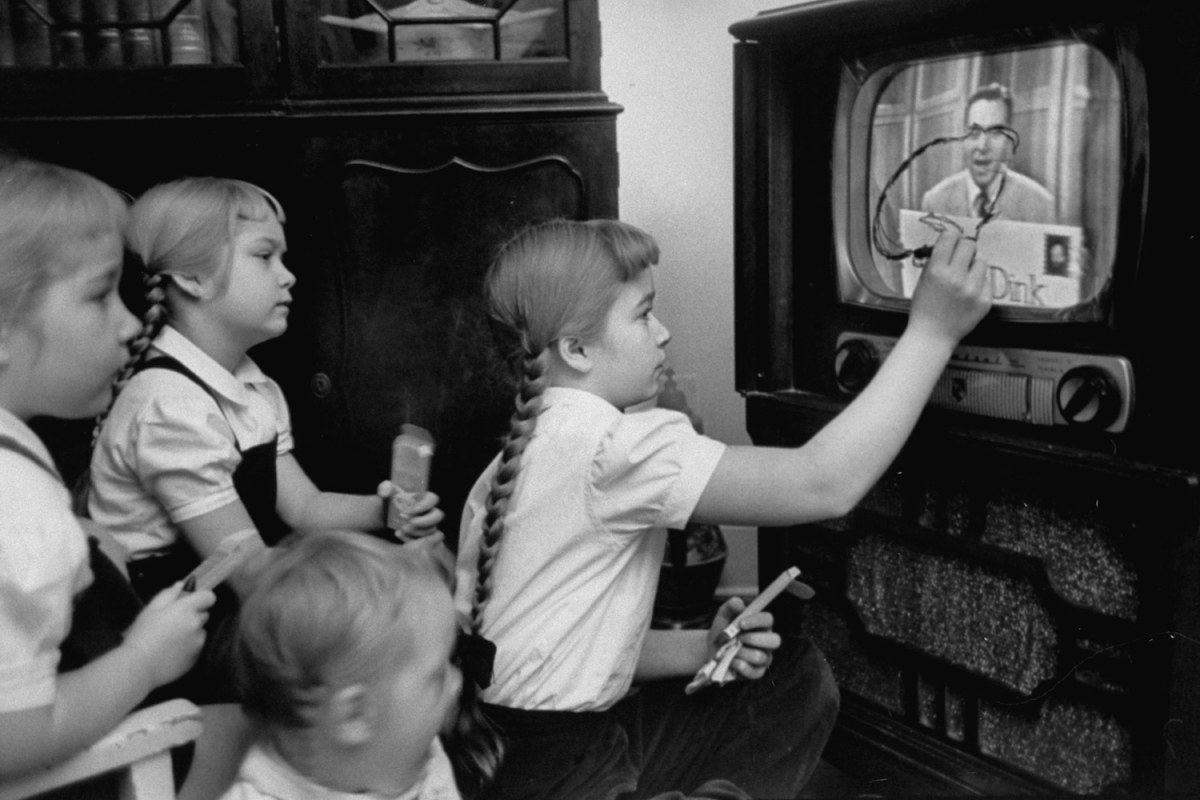
Six-year-old girls use a “Winky Dink” drawing kit on their home TV screen as they watch the kids’ program, 1953. The show, which aired for four years in the 1950s, has been cited as “the first interactive TV show,” especially in light of its “magic drawing screen” — a piece of plastic that stuck to the TV screen, and on which kids (and, no doubt, some adults) would trace the action on the screen.
I had one of those. I remember using that kit to help Winky Dink save the world on more than one occasion.
As I grew older, mom was gone a lot and I recall fondly watching The Late Show (there were also the Late Late show and the Late Late Late show, which I would sometimes make myself stay up for), as well as the Million Dollar Movie, which often featured monsters and horror, as you can see in this lovely tribute:
New York television had its own home-grown kids’ shows:
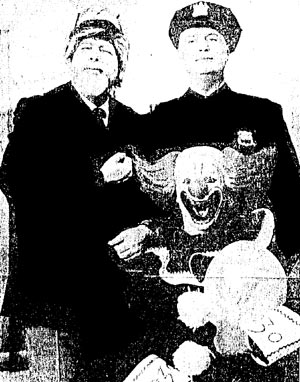
Here we see Captain Allen Swift from the Popeye show (I cried when he was replaced by Captain Jack McCarthy), Officer Joe Bolton from the Three Stooges, and of course, Bozo the Clown.
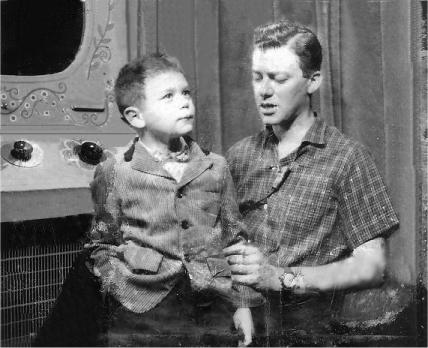
Then there was Sandy Becker – the photo above also appears on the Wikipedia article, and happens to feature yours truly as a guest on the Sandy Becker Show, thanks to some judicious string-pulling by my theatrical mother. Sandy’s show was introduced with Bert Kaempfert’s “That Happy Feeling” – if it sounds strangely similar to “Swingin’ Safari,” that’s no coincidence, since Kaempfert wrote that one too.

Not to be forgotten was Claude Kirschner’s Three Ring Circus, proudly sponsored by Junket Rennet Custard (which I don’t think I ever tried), Cocoa Marsh, a competitor to Bosco (that’s Kirschner doing the voice-over), and Bonomo’s Turkish Taffy, the latter of which has made a miraculous and most welcome comeback. Like many of the TV shows of the era, a lot of it was live and impromptu, and when cartoon time came around, Claude would often not know what was being shown; I recall he’d make something up on the fly like “Clowny’s Friends.”
But one of my very favorites was, of course, Captain Kangaroo – my generation’s “Mr. Rogers.”
“Puffin’ Billy” will forever conjure up images of dear Bob Keeshan in my mind.
This is a rabbit hole I could follow forever, the memories just keep coming back in waves. Rabbit hole? Why, that makes me think of Crusader Rabbit… but I’ve got places to go and a dairy assignment to fulfill, so I’d better wrap this up or I’ll be here all day.
The Old Wolf has spoken.
The text below is summarized and redacted from an article at PolicyMic – I wanted to share the information but there’s too much that’s unrelated or unsavory at the original site.
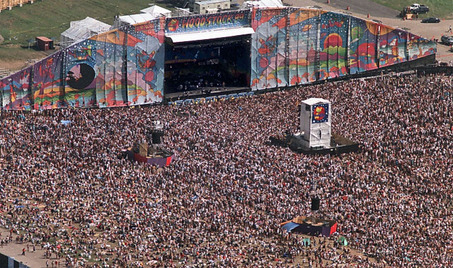
There are plenty of reasons to avoid music festivals in 2014.
From the $12 Bud Lights and vomiting 16-year-olds to sexual assault-ridden crowdsurfing and white people in Native headdresses, your range of deterrents is limitless.
But one stands head and shoulders above the rest: the price of admission.
1967’s Fantasy Fair and Magic Mountain Music Festival, considered the modern era’s first such event, charged $2.00 for a bill that included the Doors, the Byrds and Captain Beefheart.’
Today, you can’t find a decent toothbrush for that price, let alone see some of the most legendary acts in rock history.
Two years later, Woodstock organizers charged $18 for all three days of the iconic festival, which featured performances by Jimi Hendrix and Janis Joplin. That’s $120 in 2014 money, but considering the lineup and how door prices dropped to “free” once more attendees showed up than expected, that might go down as the deal of the century.
For $1 a pop in 1972, you could see pretty much every famous soul singer of the ’60s and ’70s at Wattstax in Los Angeles:
But times have changed. Weekend passes to the 2014 Coachella Valley Music and Arts Festival — America’s most profitable festival — asked a starting price of $375.
Lollapalooza and Bonnaroo clocked in at $234 and $250, respectively. Meanwhile, the “secondary market” costs for people who got edged out by stampeding ticket buyers are astronomical. Forbes reports that Coachella’s average ticket price in this arena was a whopping $825, while festivals like Lolla and Bonnaroo make closer to a humble half thousand.
And of course there’s the Ultra Music Festival, an EDM extravaganza where you pay $399.95 for people to whip their sweaty hair against your face and otherwise freak out in your general vicinity. “Next year, I won’t be going,” former Ultra attendee Matthew Agramonte told the Miami Herald. “Ultra is isolating its fan base that simply can’t afford outrageous prices. What was once a great experience is a ripoff and a great shame.”
Concurrent with these hikes was an influx of corporate brands and advertisers, all chomping at the bit for exposure to the festivals’ captive young consumers. Ad Age reports that brands will spend more than $1.34 billion sponsoring live music events this year, up 4.4% from 2013.
That means plenty more Heineken, Red Bull, Samsung and Sephora between you and the music. Hair washing stations by Garnier and “gaming tents” by Mattel are welcome to some but completely pointless to others who just came to check out the acts.
Such interlopers have become fixtures of the modern live music experience, so profitable, in fact, that corporate events are even popping up on their periphery:
“You can create your own environment,” General Motors’ David Barthmus told Ad Age, referencing an “off-Coachella” party co-sponsored by GM, McDonald’s and L.A. nightclub Bootsy Bellows. “Plus it’s more cost efficient because there isn’t the cost of being on the Coachella grounds.”
Some attribute these skyrocketing prices to industry monopolization. Some say illegal downloading forces artists to tour and charge more. Others blame venue rental costs, while others still say artists are greedy and know they can charge whatever they want without consequence.
Whatever the case, today’s festival-goers are suffering. It’s absurd that the term “payment plan” now goes hand-in-hand with your ticket purchase, but that’s the sad reality, and there’s little you can do about it.
Affordable festivals do exist, though they seem to be disappearing by the day. And it’s easy to romanticize the economic ethos of a bygone era while ignoring that challenges facing the usic industry were markedly different then.
But the next time you drop $400 on a festival pass, think of the pulsating hordes of molly-popping frat bros and trust fund babies flailing in a sea of ads and $15 hot dogs while multi-millionaires kick back in their air-conditioned offices, counting your money and laughing at how easily you were duped. Then think about Woodstock, Magic Mountain and the salad days of a time far gone.
That’s probably harsh, but so are these prices.
Welcome to 2014.
It’s not just music festivals. The price of Broadway shows has gone beyond what most people would consider reasonable; want to see “Wicked”? That’ll be $97.00 for the nosebleed section, all the way to $222.00 for premium orchestra seating, and that’s not even considering what scalpers charge. Even a family of 4 will now spend $400.00 for a single-day entry to Disneyland. Unless you want to drive to Tooele, Utah to see Three Dog Night like we did last July 4, and paid what would be considered a reasonable price for the privilege, many music concerts don’t fit the budget of those at whose heels economic terror is daily snapping.
And I don’t even have any answers, because I don’t understand the entire landscape, or the economic factors that are driving these soaring prices. All I know is that it takes a special performance and a special occasion, or a gift from some lovely friends, to make attending possible, and most of the time we look for other, cheaper forms of entertainment.
The Old Wolf has spoken.
Edit: Corrected attribution. Not sure where the “R. Bell” came from.
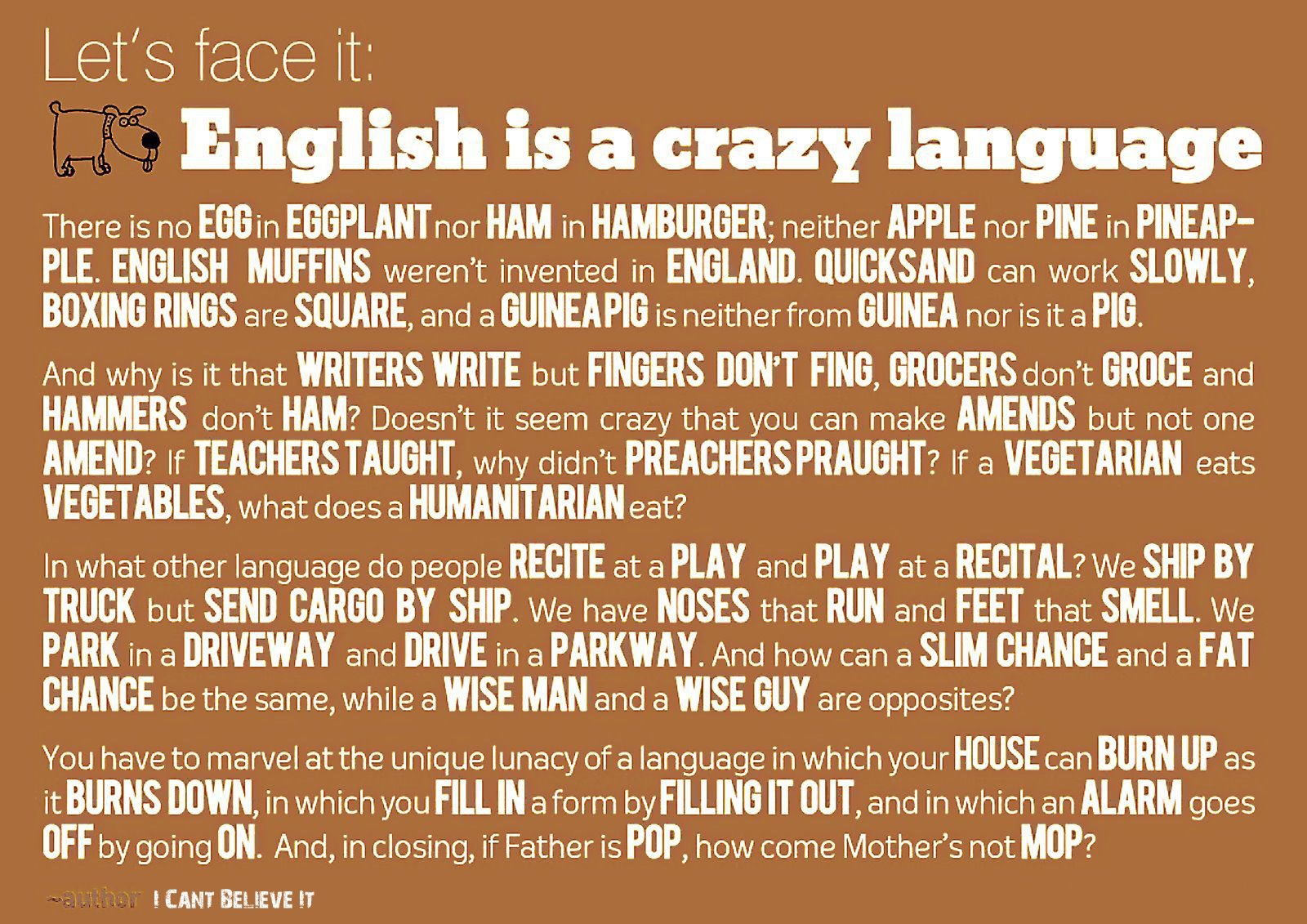
I just read an article over at the Spectrum entitled “The English language is state of in demise” (sic) in which writer Dan Murphy laments the abysmal condition of our language among modern speakers, largely thanks to the ubiquitous text/chat/Twitter/Facebook phenomenon. As to the headline itself, I don’t know if that’s just a terribly ironic typo or whether I’m missing something.
Regardless (or irregardless, depending on which side of that argument you happen to fall), the article reminded me of this little piece; the terminology is more at home in a beatnik coffee shop and has largely ceased to have meaning in the 21st century, but you will find it familiar enough to get the drift. I thought it was worth sharing.
Psychedelirium Tremens
By Jane Goodsell, printed in the April 18, 1969 Congressional Record
Remember when HIPPIE meant big in the hips
And a TRIP involved travel, in cars , planes and ships?
When POT was a vessel for cooking things in
And HOOKED was what grandmother’s rug might have been?
When FIX was a verb that meant mend or repair
And BE IN meant simply existing somewhere?
When NEAT meant well-organised, tidy and clean
And GRASS was a ground cover, normally green
When lights and not people were TURNED ON and off
And the PILL might have been what you took for a cough!
And CAMP meant to quarter out-doors in a tent
And POP was the way that the weasel went?
When GROOVY meant furrowed with channels and hollows,
And BIRDS were winged creatures like FINCHES and SWALLOWS?
When FUZZ was a substance that’s fluffy like lint,
And BREAD came from bakeries, not from the mint?
When SQUARE meant a 90-degree angled form
And COOL was a temperature not quite so warm?
When ROLL meant a bun, and ROCK was a stone,
And HANG_UP as something you did to the phone?
When FUZZ was a substance that’s fluffy like lint,
And BREAD came from bakeries, not from the mint?
When SQUARE meant a 90-degree angled form
And COOL was a temperature not quite so warm?
When ROLL meant a bun, and ROCK was a stone,
And HANG_UP was something you did to a phone?
When JAM was conserves that you spread on your bread
And CRAZY meant barmy, not right in the head?
When CAT was a feline – a kitten grownup
And TEA was a liquid you drank from a cup?
When SWINGER was someone who swung in a swing
And PAD was a soft sort of cushiony thing?
When WAY OUT meant distant and far, far away?
And a man couldn’t sue you for calling him GAY
When DIG meant to shovel and spade in the dirt
And PUT-ON was something you did with a shirt?
When TOUGH described meat too unyielding to chew
And MAKING A SCENE was a rude thing to do?
Words once so sensible, sober and serious
Are making the FREAK SCENE quite PSYCHEDELIIOUS
It’s GROOVY MAN GROOVY But English it’s not
Me thinks that our language has gone straight to POT….
For those of you born long, long after Haight-Ashbury was the scene, a couple of glosses:
Hang-up: problem, neurosis
Crazy: awesome
Tea: weed
Pad: your home, where you crash
Way out: awesome (or, if you’re from Boston, “wicked pissah”)
Birds: girls
Fuzz: The police
Dig: understand[1]
The Old Wolf hath goodly spoke.
[1] It has been suggested that “Do you dig it” has a connection to the Gaelic “An dtuigeann tu” (do you understand), which on the other side of the pond morphed into “do you twig it?”
Comment posted in my blog a few days ago:
Hiya very nice web site!! Man .. Beautiful .. Wonderful .. I’ll bookmark your website and take the feeds also? I’m satisfied to search out so many useful information right here in the put up, we need develop extra strategies on this regard, thank you for sharing. . . . . .
Who the hqiz writes these blog spam comments? They all sound like they were crafted by schoolchildren from Kazakhstan. And the links in those comments? They invariably ead to an entire linked community of scammy, scummy, spammy, and R-rated (to attract more attention) websites promoting various and sundry snake-oil weight loss products, cheap knockoff goods, pornography, or any number of other unsavory enterprises. Here’s another one:
After I originally left a comment I appear to have clicked the -Notify me when new comments are added- checkbox and from now on every time a comment is added I recieve 4 emails with the same comment. Perhaps there is a way you can remove me from that service? Thanks!
Seriously, people (and I use that term very loosely), can’t you think of a better way to make a living than spamming other people’s blogs for links to your barely-legal enterprise? I enjoy sending your comments to the trash.

The Old Wolf has spoken.
Putting each other back together is harder.
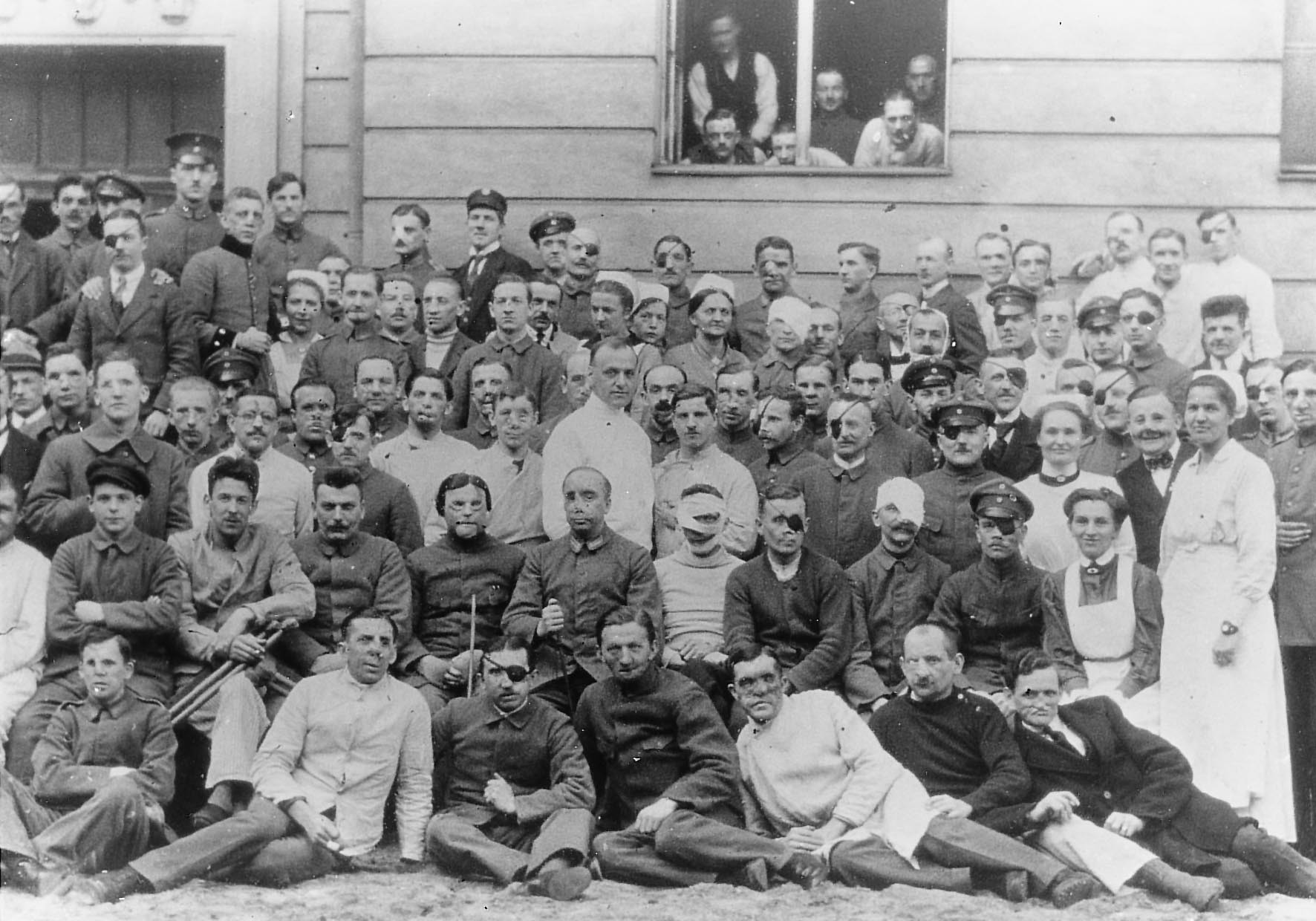
J.F.S. Esser, the renowned Dutch plastic surgeon (with the white coat) surrounded by his patients, all in different stages of reconstruction. Berlin – 1920
Found at /r/HistoryPorn, submitted by /u/Senexz
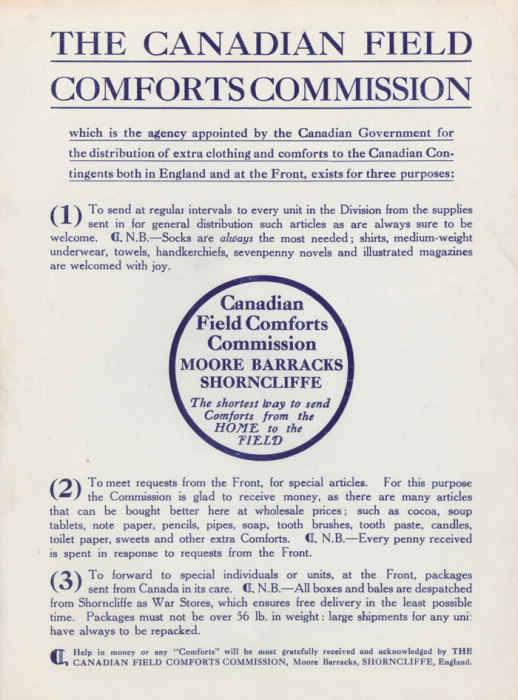
Above: brochure from the Canadian Field Comforts Commission, 1915. These packages were sent to Canadian soldiers on the Western front. Below: A soldier sits in front of crates ready to be sent to soldiers on the front in 1918.
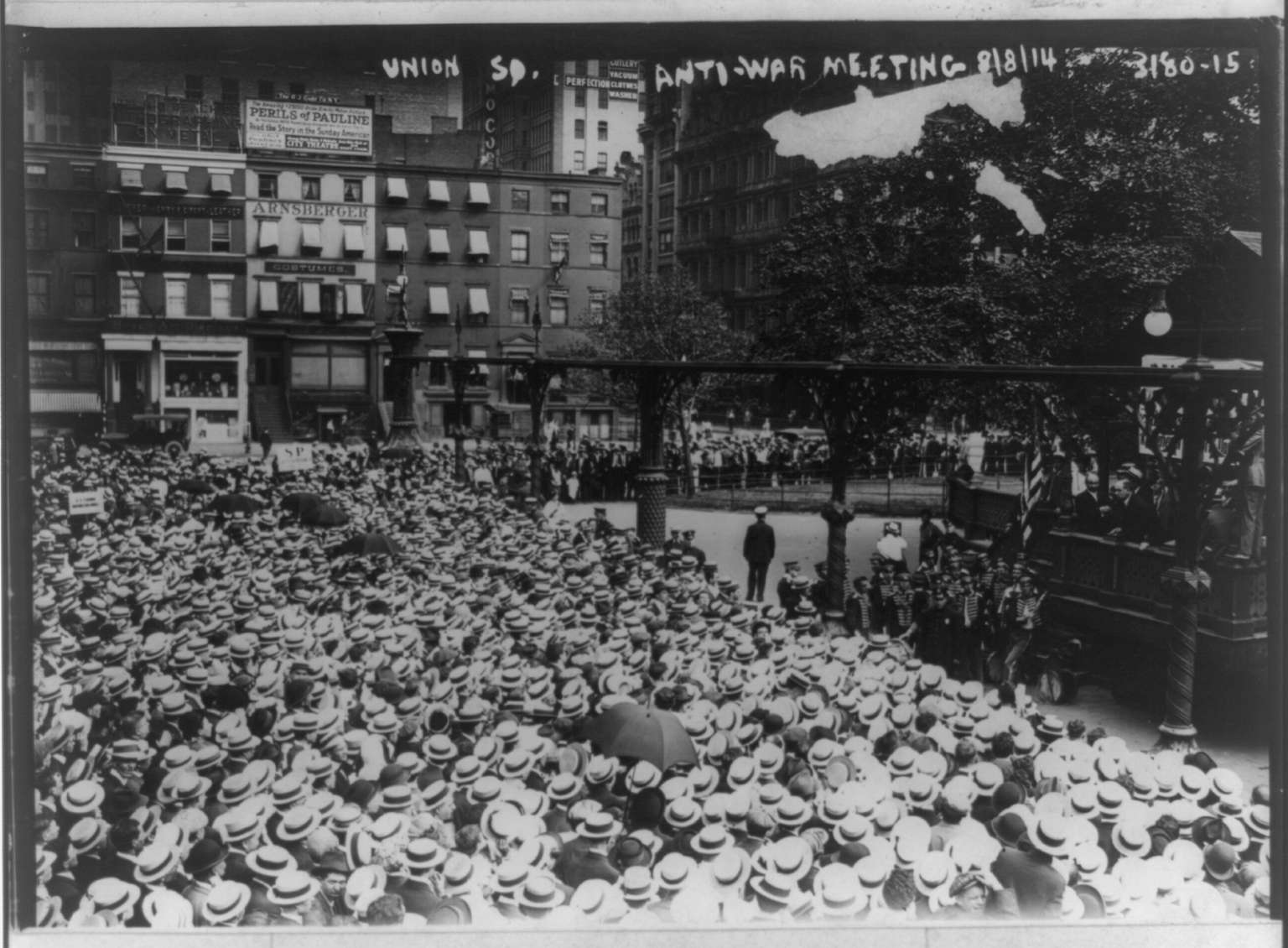
Anti-war meeting in Union Square, New York City – August 8, 1914
Found at /r/HistoryPorn, posted by /u/rpilek
Time to yank another scammer’s chain. As usual, my side of the conversation is in blue. Notes point out the kinds of red flags that reveal email messages like this as cruel and dishonest scams, just in case you were wondering.
Got this in my email yesterday – no body text, just this in the subject line.
I have a project. If interested. reply,
What kind of project? I would need more details.
-Wolfington X. Analemma
Good day
This is my personal reference number law/chamber/solicitors/je/rs/WILL/928473012 and My Name is Mrs. Bella Fernandez. please send this to my attorney with the contact information below – he would provide all information to you. Due to my Sickness [1], i have been touched by God [2] and want my WILL to be donated to you rather than allow my relatives to use my Late husband hard earned funds ungodly. My doctor told me that I have limited days to live due to the cancerous problems I am suffering from as I will be going in for an operation later today. What bothers me most is the stroke that I have in addition to the cancer. With this hard reality that has befallen my family and me I have decided to donate this fund to you and want you to use this gift which comes from my Late husbands effort to fund the upkeep of widows, widowers, orphans, destitute, the down- trodden, physically challenged children, barren-women and persons who prove to be genuinely handicapped financially. [4]
I am currently sending you this mail from my sick bed in the hospital, I do not need any telephone communication [3] in this regard due to my deteriorating health and because of the presence of my Late husbands relatives around me. I do not want them to know about this development. With God all things are possible. I believe in Charity and I believe your faith is guarantee for me to trust you. Contact on the Attorney Kennedy Email: ( legalconsultantkennedy@live.co.uk) I sold my Inherited All belongings and deposited the sum of All $ 5.2 million dollars with A Security Company. I am diagnosed of cancer and have a time limit to live on this planet.
As for how I got your email, it was gotten after a proper search via your area zip code with the help of the lord leading me. At the moment I cannot take any telephone calls right now and my Doctor knows i have changed my Will.Lord will Bless you Abundantly as you extend the good works to others and Ensure to use a greater portion of the funds for its purpose in fulfillment of my last wish .. My contact on the Attorney Email – legalconsultantkennedy@live.co.uk
Sincerely,
Mrs. Bella Fernandez.
I have been instructed to contact you regarding the disposition of this fund, reference number law/chamber/solicitors/je/rs/WILL/928473012. Please forward further instructions.
-Wolfington X. Analemma
Dear Beneficiary,
It is my great pleasure to read through your mail, I wish to inform you that this WILLED funds claim is at its peak of legitimacy, please if you wish to claim the WILLED Funds, send below information for funds release. In respect of Mrs. Bella Fernandez’s Will, it might interest you to know that Late Mr.Wilson Fernandez and his wife (Mrs. Bella Fernandez) are very honest and a nice family you could ever think of [4], It’s so sad now, to see Mrs. Bella Fernandez suffering from cancer disease for about 2 years [1], I still have the faith that nothing is too difficult for God to do in her case [2]. As a matter of fact, she has told me that anybody that writes me either she is dead or alive and quote the reference numbers, I should not hesitate to deal with the person in respect of the deposited cash of $5.2 Million US Dollars to carry out her Charity assignment on physically challenged persons and orphanage. Right now, the cash is currently deposited with a save keeping Security Company/Security Firm. [4]
If am sure and pleased with your willingness and sincerity to carry the responsibility in accordance to the donor’s good intention, am going to give you proceeding for funds release to you. Please you have to be highly confidential in this transaction [5], till we finalize this project and you now have the funds in your hand/custody because I would not want anything to jeopardize the funds release to you.
However, Attached to this email is a scan copy of The Affidavit Of WILLED FUNDS, you must print out the Affidavit form, fill in the required information [6] in Black or Blue ink with the a passport photo size as required and return back to us as an ATTACHMENT. You are also required to send any form of ID PROOF/DRIVERS LICENCE [6] that will proceed the funds release documents to you and the requested detail will also enable the British High Court Commision to validate the WILL of Mrs. Bella Fernandez. You need not to worry because this transaction is problem free & legit. [7]
I have just been informed earlier today by the doctor that Mrs. Bella Fernandez is in coma. [1] She had earlier told me about you that if situation gets worse I should contact you in order to process all relevant documents in your favor regarding the status of her account to your name. You are being reminded of the task ahead to use a reasonable part of the funds to build a temple of worship and also help the less privileged in your society [4] and also remember that 30% of the fund should be for your personal use. I want you to include her in your prayers. [2]
MY CONDITION
-The total sum of US $5.2 Million Dollars will be transferred/released to you confirm able in 2 working days.
– All correspondence will be strictly by private email / telephone, for security purposes.
– There should be no other third parties [5] as most problems associated with such payments are caused by their agents/representatives/advisers.
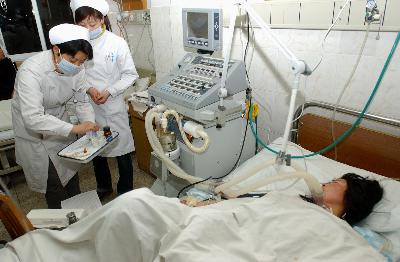
Note: You may as well view the attached pictures of Mrs. Bella Fernandez before she went into coma. [8]
If you AGREE with my conditions, l will advise you to send the requested information earlier asked for action and to enable the British High Court validate the WILL funds transfer Documents in timely manner.
I await your response.
Best regards,
Barr. Kennedy Andrew Esq.
Tel: +(44)7017043832 [9]


So I fill out the “affidavit” and include a bogus driver’s license from California that I’ve photoshopped together:
Dear Barrister Kennedy Andrew Esq.:
Attached please find my completed affidavit and a driver’s license photo for your consideration.
Please let me know how the funds will be transferred.
Sincerely,
Wolfington X. Analemma
[If these bottom-feeders had any brains at all, they’d see things on the affidavit that would be immediately recognized as red flags that they were being taken for a ride, but the truth is that they don’t.]
———————–
KENNEDY ANDREW AND VICTOR LAW CHAMBER
179 GREAT PORTLAND STREET,
LONDON, W1A 2AW.
UNITED KINGDOM.
Tel: +(44)7017043832.
20/02/2014
Dear Beneficiary,
This is to inform you that Barr. Kennedy Andrew Esq has received your information (Filled Affidavit of Willed Funds)and its content was well read and noted, it will interest you to know that we are working on the preparation of the necessary WILLED Fund release documents in your NAME, and as mandatory by the UK Acts/Laws, we are to submit to the High Court Commission here in United Kingdom, for final endorsement after preparation, so that the funds can now be transferred to your Bank Account.
Further more, You will have to wait a maximum time of 24 hours for the preparation to be completed, once preparation is completed, you will be notified by ordinary email and detail of submission to the High Court Commission will be emailed to you.
I will immediately write an application to the British High Court to grant a letter of authorization which would enable you contact the bank, I will inform you immediately it is granted. And also this project is meant to be kept strictly confidential[5], that is the wish of my client and i hope you honor it until the whole transfer is completed.
I want you to inform me on how you intend to make use of the funds to affect those around you, and also do you have any investment in mind that you would want to put some of the funds into in order to sustain the projects?.
I await your response.
Best regards,
Barr. Kennedy Andrew Esq.
Tel: +(44)7017043832.
Dear Barr. Kennedy Andrew Esq.,
Note: Please fill in the Blank space in the attached document with your information as required before you sending to the Bank.
To: Fibibank London
Good day. I have been instructed by Barr. Kennedy Andrews Esq. to contact your bank with regards to the attached Letter of Authorization, so that the bequest in THE WILL can be transferred to my account. Please contact me with any further questions.
Most sincerely yours,
Wolfington X. Analemma
————————–
Fibi Bank Plc
24 Creechurch Ln, London,
EC3A 5JX. United Kingdom.
Direct Tel: +44 70 10046144
EMAIL: fibi-bnk-desk@outlook.com
APPLICATION FORM FOR CHANGE OF ACCOUNT OWNERSHIP.
24/02/2014
Dear Esteemed Customer,
FIBI Bank (UK) plc is authorised and regulated by the FSA. I am Mr. Thompson Mog, your assigned account officer to assist in the change and re-activating of account.
The account of which its details and ownership will be stated in your name shall be released to you in the earliest.
Please see attachment and download the application form print out and fill in your data correctly and completely then send back to us.
On receipt of the information, you shall be educated on the process
mastered to facilitate this transaction in the earliest.
Yours faithfully,
Mr. Thompson Mog
For FIBI Bank:
CC: GENERAL MANAGER (Fibi Plc)
Fibibank is apparently a legitimate concern, a subsidiary of the First International Bank of Israel. The address given by the scammers is correct, but the phone number is (again) one of those 44-70 redirects which is transferred to some throwaway cell phone in Nigeria. Notice also the email address – legitimate businesses will almost never use a generic email service like hotmail, outlook, or rogers.com – a valid email from Fibi Bank would be something @fibi.co.uk
I send them a form which I have filled out via computer, and get this back:
Fibi Bank Plc
24 Creechurch Ln, London,
EC3A 5JX. United Kingdom.
Direct Tel: +4470 10046144
EMAIL: fibi-bnk-desk@outlook.com
APPLICATION FORM FOR CHANGE OF ACCOUNT OWNERSHIP.
Dear Esteemed Customer,
Thanks for your email to this Bank and on the inquiring about the Funds of Mrs Bella Fernandez, we have all instruction and permit to connect with you on this matter. However, you have failed to complete the necessary document as regards to the Letter of Authorization which is required to be filled in BLACK or BLUE INK PIN and return to us for immediate transfer procedure.
You must fill the Letter of Authorization with a BLACK or BLUE INK (NOT WITH A COMPUTER EDITING) before you send the Document to us, we can only commence further transfer once we have the Letter of Authorization filled and sent by you.
On receipt of the information, you shall be educated on the process
mastered to facilitate this transaction in the earliest.
Yours faithfully,
Mr. Thompson Mog
For FIBI Bank:
CC: GENERAL MANAGER (Fibi Plc)
Now, that’s interesting. I’ve never had one of these drones reject a certificate. Perhaps they are using this ploy to lend a certain cachet of legitimacy to their scam. I’ll never know, but I send them the following form anyway:

Since sending this form in, I have heard nothing and it’s been over a month. So I send them the following email:
Dear Mr. Thompson Bog,
The takeaways, as usual: NEVER send money by Western Union or Money Card anywhere, to anyone, unless you are initiating the transaction and you know your recipient. NEVER give out personal or financial information to unknown parties on the internet. ALL SUCH EMAILS are SCAMS.
The Old Wolf has spoken.
[1] The Pity Pitch – feel sorry for me, I’m dying. This fraudulent email is full of repeated references to terminal illness
[2] The God Ploy – Faith, blessings, prayer, Christianity – all are mentioned and used heavily to influence potential victims into parting with their cash.
[3] Unable to talk by telephone – because “Mrs. Bella Fernandez” is actually some sweaty, flea-ridden scumbag working out of an Internet cafe somewhere in Lagos (most likely).
[4] Humanitarian work – this is what I want you to do with the money.
[5] Plea for confidentiality – don’t talk to the authorities or anyone else (because they would be sure to put the kibosh on the deal.)
[6] Request for personal information. Even if their scam fails, the scumbags will have details that can later be used to defraud you or others via identity theft.
[7] Sincerity – Look, nothing up my sleeve…
[8] Some random picture from the Internet – notice that Mrs. “Bella Fernandez” is decidedly Asian
[9] The Global Redirect phone number: All 4470 prefixes are global redirects; this scammer is probably in Nigeria, or Ghana, or somewhere in Africa.
Back in 2008, I bought a shiny new HTC Incredible II, an Android-powered phone.
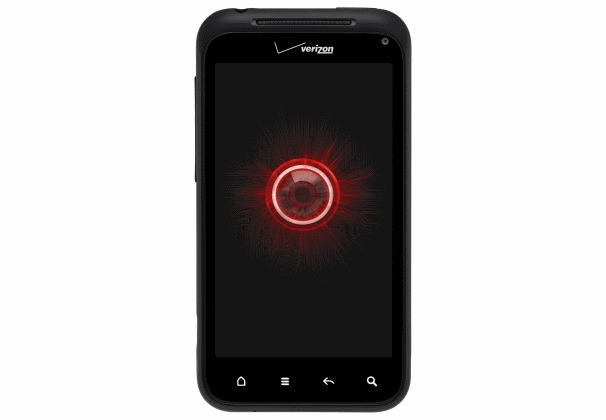
It was the cat’s pajamas – did everything I needed it for, and I loved it. Then, time passed, and as happens in the computer world – these smartphones are really just tiny computers, although more powerful in some ways than the mainframes I worked on in the 70s – the software surpassed its capability and it began to develop cruft that wasn’t clearable even with a factory reset. So it came time to upgrade.
I toddled down to my local Verizon store and compared the Samsung Galaxy S5 with the HTC M8, two comparable brands. My wife bought an S4 last year, so I ultimately decided on the Galaxy, although I was pretty much on my own – the very young salesman was totally unable to answer any questions I had as to the comparative merits of each model. I kept pumping him for an executive summary, based on “This phone is good if you want X, that phone is good if you want Y.” He spouted inane and vapid answers like, “This one comes in red,” until my eyes hurt from rolling so hard – although I tried not to let him know I thought he was a blithering idiot. I did ask him if there were anyone in the store who was intimately acquainted with both phones, and he offered to let me speak to his manager who uses the HTC. Sometimes half a loaf is better than no bread, but in this case I saw immediately that these people don’t really know what they’re selling – they just point to the little placards by the display and expect you to figure it out for yourself. I ultimately made my decidion based on the previous research I had done online, because the store personnel were no help at all.
When the time came to sign on the dotted line, the numbers didn’t add up. The total was too much, given the price of the phone and the screen protectors (I respectfully declined the protection plan, the case, the accessories, the bundle, the venus flytrap, the fresh haggis, the Johnnie Walker Blue, and everything else they tried to get me to buy at the same time. “You need a car charger.” “I have one.” “Oh, those old ones are no good, the fuse blows out and they overcharge the device.” “Wait, what? The fuse blows out but it keeps working? That makes no sense at all.” “I recommend a new charger.” And so on, ad nauseam. But back to the total: “Oh, there’s a $30.00 upgrade fee.”
Upgrade fee? What the hell is that? It’s a load of steaming horse crap, that’s what it is, and unethical. It’s just extra profit, but Verizon is too cowardly to call it that. I asked for it to be waived. No dice. They were willing to let me walk out of the store without a sale. The manager of the outfit was a total dickbag… he could have simply said, “Yeah, it’s just extra profit for Verizon, but I’m not authorized to waive it. That’s just the way it is.” But no, he was a coward, and kept spouting the corporate line that I was getting “wireless workshops, online educational tools, and consultations with experts” for my money, which is a festering pile of camel ejecta – that fee is nothing more than a way of advertising a phone for $X, and when you go to pay, without even telling you the fee exists, charging you $X+30. It’s corporate highway robbery. CEO Lowell McAdam earned around $14 million in 2010 – about enough to waive that “upgrade fee” for 466,000 customers. Stuff like this makes my blood boil, and they can get away with it because it’s enough to make you mad, but not enough to kill the sale if you need a phone. And every carrier does it. So you’re basically fooked.
Then there’s that “protection plan.” When I bought my HTC, the coverage was $5.00 per month, with a $50.00 deductible. Now it’s $10.00 per month and a $100.00 deductible, and the cretin manager tried to tell me it had never been any different, and shame me into buying it on the spot. Again, more than the way it is, it’s the disingenuousness that gripes me. It makes me hate salespeople with the fiery passion of a thousand VY Canum Majorum.
Then there was the question of transferring my contacts and messages from the old phone to the new one. “We can only transfer your contacts. You can do the messages yourself with Verizon Cloud.” Great. I let them transfer my contacts – and as it turns out, they took everything from my Google links and put them on the phone, resulting in about 2500 duplicated entries that I had to delete by hand. And my messages? Well, there’s a little problem with that. See, my old phone is now deactivated…
All in all, I like my new phone.

It’s got some neat features, many of which I have not explored yet – but I’m enjoying what I’ve found thus far. The little heart rate monitor on the back and the fingerprint-activated unlock are pretty spiffy.
But I’m still conflicted about whether I want to gamble on that protection plan or not – with insurance of any sort, you’re always gambling against the house, and the house always wins. But I feel ripped off, manipulated, and abused by the buying experience, and it shouldn’t be that way. It’s always unpleasant to deal with a company that has you by the short hairs and knows it. Sadly, there are really no better alternatives for my needs at the moment, or I’d be done with Verizon in a heartbeat just on general principles… and I know they don’t care, and wouldn’t miss me.
The Old Wolf has spoken.
 Playing in the World Game