This was an odd one. It happened at a Naval Air Station, where people essentially carry weapons for a living. So that muddies the water a bit. And, it turns out that the perp was a Saudi national, and an aviation student to boot, which raises a *whole* lot of questions in my mind, but that’s a discussion for another day.
Before anything else, my heart is broken for those impacted; the victims, their families, and their loved ones. People die every day from all sorts of reasons – illness, unavoidable accidents, natural causes, even violence – but death by terrorism is especially hard on those left behind. And I make no apologies for calling it that. I am deeply sorry for your loss.
But now comes the summum bonum of this post: According to CBS News, ” The number of mass shootings across the U.S. thus far in 2019 has outpaced the number of days this year, according to a gun violence research group. Before this year has even ended, 2019 has already had more mass shootings than any year since the research group started keeping track.”
This doesn’t even take into account the little ones. Individual shootings by unbalanced or patently evil people. As of today, the total is 36,518. Now, in terms of national statistics, that’s only roughly 3/4 the number of deaths by suicide from any cause, according to the CDC, and almost the same number as automobile fatalities in 2018. So some might argue that in terms of overall numbers, it’s not a big deal.
But it is. It’s a big deal. It’s too many, and too horrible, and too traumatizing, and gun violence takes adults, and children, and breaks hearts and shatters families and reduces our safety (the NRA would argue the opposite) and the quality of our life.
So here’s the question, directed at those of my friends and associates who fall on the “cold, dead hands” side of the equation:
What are you going to do to stop this carnage. What are you doing right now to make sure that guns don’t get into the wrong hands, the hands of people who will use them to destroy the innocent?
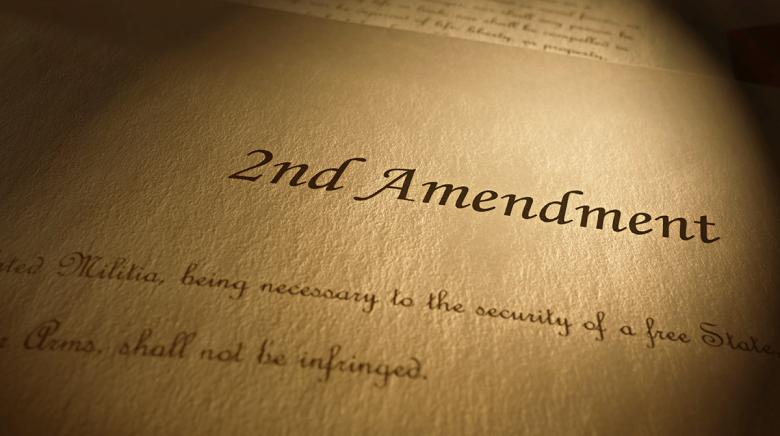
I exhort you: don’t get me wrong. I support the 2nd Amendment as long as it remains part of the Constitution.
These are patches and such that I earned as a youth. I remain proud of them to this day. I learned gun safety and responsibility and enjoyed target shooting immensely. (Thanks, Hutch.) We own a 30-30. I’m not a “gun grabber,” as the NRA loves to pigeonhole people who advocate for gun control. But the situation today has far exceeded what I consider madness.
The courts have repeatedly ruled that you have the right to assemble an arsenal that would be the envy of a small nation. I think that if the Founders, in their wisdom, could see what that those 27 words had wrought in our day and age, they would weep in outrage and promptly need to go home and change their pants. But that’s my interpretation, and the wisdom of the 2nd is not what I’m discussing. It’s a fact, and we need to deal with things as they are.
I think our nation would be far safer if there were no guns in private hands, but if the right to bear arms is never going away, it needs to be tempered with a responsibility to bear arms safely, and I support treating guns in the same way we treat cars, none of which contravenes the wording of the 2nd Amendment:
Gun owners should be trained, licensed, and insured for each type of weapon owned.
All weapons should be annually registered, inspected, and taxed.
So what are your solutions? How will you preserve your rights and still stop the daily carnage? Change my mind.
Go.¹
¹ Note: I’m inviting comments for this post, despite the fact that it’s a divisive and often inflammatory issue. I have attempted to be as impartial and even-handed as possible in laying out my feelings. Comments that are ad-hominem attacks (i.e. “You gun-grabbing pussy!”) or not based on reason (“I disagree!”) will simply be deleted without ever being seen. I want to know how you would fix things, and preserving the status quo is not an option. So choose your words wisely.
Cross-posted from Livejournal and updated 11-8-2018
☞ The executive summary is, “Because it doesn’t go far enough.” ☜
A photo gallery at Time Magazine brought this issue to the front of my mind again, where it has been many times. Swirling around in the mass of insignificant facts and rabid squirrels that inhabit my brain are thoughts that keep coming back to me over and over again, many of which have to do with the overwhelming societal cost that we are paying for a failing war on drugs.
If recent statistics (CDC, 2009) are to be believed, 6.6% of people over 12 were using marijuana at least once a month – a total of 23.1 million people (minus the ones under 12). That’s us. We’re the ones who are funding the carnage in Mexico as drug cartels battle for turf and slaughter countless people in their quest for American drug dollars.
Prohibition is Ineffective
We saw how well Prohibition worked… all it did was put the country’s alcohol revenue into the hands of the criminal element. Whenever money is to be made, the bad guys will be there in force, because they don’t care how they get it.
“Although consumption of alcohol fell at the beginning of Prohibition, it subsequently increased. Alcohol became more dangerous to consume; crime increased and became “organized”; the court and prison systems were stretched to the breaking point; and corruption of public officials was rampant. No measurable gains were made in productivity or reduced absenteeism. Prohibition removed a significant source of tax revenue and greatly increased government spending. It led many drinkers to switch to opium, marijuana, patent medicines, cocaine, and other dangerous substances that they would have been unlikely to encounter in the absence of Prohibition.”Cato Institute Policy Analysis
The Social Costs are considerably less than those associated with tobacco and alcohol
The societal costs of alcohol are enormous, whereas the social impact of cannabis use is significantly less.
“In terms of (health-related) costs per user: tobacco-related health costs are over $800 per user, alcohol-related health costs are much lower at $165 per user, and cannabis-related health costs are the lowest at $20 per user.”(Cannabis, Tobacco and Alcohol Use in Canada)
I can’t recall the last time I heard of some high-flying husband beating his wife and children; it’s hard to be aggressive when you’re giggling. That’s said somewhat tongue-in-cheek, but in all my life I have never encountered an angry pot user, whereas the number of bar fights that go on in cities and towns all around America, followed by nights in the slammer and subsequent taking out of infantile anger on innocent domestic partners and children is beyond anyone’s ability to count. The same holds true for violent crime, sexual assault and date rape.
Ask any emergency-room doc, nurse, or EMT: alcohol use contributes to reckless behavior and serious injuries, and it is highly associated with emergency room visits; such visits directly associated with cannabis would hardly make a blip on the radar.
Take the Money Away From the Criminal Element
Drug tunnels like these, as well as illegal farms in national forests and elsewhere, with all their associated risks to innocent citizenry, would become a thing of the past if cannabis were freely available, regulated and taxed in the same way tobacco is.
“The libertarian Cato Institute just issued a detailed statistical analysis on how ending prohibition – a favored term for supporters of pot reform – could help America’s budget woes. According to the much-discussed study, legalizing all illicit drugs would save the government $41.3 billion a year in law-enforcement costs and generate some $46.7 billion in tax revenue; marijuana would account for $8.7 billion of the savings, and another $8.7 billion in taxes. Legalized marijuana would certainly help fatten state coffers in debt-crippled California, where pot is the biggest agricultural crop, with $14 billion a year in sales that never appear on tax returns.” (Newsweek, “The Conservative Case for Legalizing Pot”).
Further thoughts on the tax advantages appeared in the LA Times on 8/27/10.
Prosecution of recreational THC users and those who require it for valid medical reasons is wasting billions of tax dollars directly and indirectly, and taking valuable law enforcement hours away from issues that are significantly more important. Based on everything I’ve seen, heard and read, legalization will have a negligible impact on usage which is already there, and will have societal benefits far greater than any potential increase in disadvantages.
I’m by no means for blanket legalization of all illicit drugs, but at this point marijuana appears to be a no-brainer in terms of cost-benefit analysis. The usage is already there. In a sense, not legalizing it is an immoral act, given how much blood and carnage is resulting from the activity of the Mexican cartels which we are directly funding.
If people could walk down to their local package store for some quality-controlled, legal cannabis, who in their right mind would risk buying it from illegal sources? The illegal marijuana market would simply dry up.
There will be those who question why I’m taking such a position, especially in light of my own religion’s stance on the use of things as mild as tea and coffee, let alone alcohol, tobacco and illegal drugs. Make no mistake: I’m convinced that if people would give up the use of all harmful and/or addictive substances, the physical, emotional and spiritual health of our nation would rise dramatically, and countless billions of dollars would be saved. That said, I am simply looking at the numbers. Legalization would save lives, free up law-enforcement resources, and redirect funds from the criminal element to other critical social needs. I can’t look at it any other way.
Progress is being made. Canada has legalized marijuana, and just this week they experienced a severe legal problem: there isn’t enough of it.
In the United States, the non-medical use of cannabis is decriminalized in 13 states (plus the U.S. Virgin Islands), and legalized in another 10 states (plus the District of Columbia and Northern Mariana Islands), as of November 2018. (Wikipedia)
It’s time to get cannabis out of the hands of criminals, and good people – who have committed an offense no worse than a three-martini lunch – out of prison.
Now, put away your pitchforks and torches and listen to this amazing video by Aya Korem (it’s in Hebrew with English subtitles, but you’ll have to read fast because she does the equality run in less than 12 parsecs¹:
I asked this question over on Facebook:
Answer me this: why should more than 50% of the earth’s population be given a single day of celebration? Just sayin’.
Listening to Ms. Korem, I was reminded of the following exchange Morgan Freeman had with Mike Wallace on 60 Minutes:
WALLACE: Black History Month, you find …
FREEMAN: Ridiculous.
WALLACE: Why?
FREEMAN: You’re going to relegate my history to a month?
WALLACE: Come on.
FREEMAN: What do you do with yours? Which month is White History Month? Come on, tell me.
WALLACE: I’m Jewish.
FREEMAN: OK. Which month is Jewish History Month?
WALLACE: There isn’t one.
FREEMAN: Why not? Do you want one?
WALLACE: No, no.
FREEMAN: I don’t either. I don’t want a Black History Month. Black history is American history.
WALLACE: How are we going to get rid of racism until …?
FREEMAN: Stop talking about it. I’m going to stop calling you a white man. And I’m going to ask you to stop calling me a black man. I know you as Mike Wallace. You know me as Morgan Freeman. You’re not going to say, “I know this white guy named Mike Wallace.” Hear what I’m saying?
So yes, I get it. Happy International Women’s Day. It’s never inappropriate to celebrate the accomplishments of anyone. But in today’s world of #MeToo and #TimesUp, it seems jejune to celebrate half (more than half, statistically) of humanity by giving them a single day.
When we achieve the kind of gender equality that people of humanity strive for, the kind of equality that Morgan Freeman was alluding to, then we can truly celebrate.
¹ Any respectable Star Wars fan knows that a parsec is a measure of distance, not speed. It’s a joke.
On the Media is “WNYC’s weekly investigation into how the media shapes our world view. Veteran journalists Brooke Gladstone and Bob Garfield give you the tools to survive the media maelstrom.”
A recent segment intriguingly addresses the PEOTUS’ twitter-storm, and how the media should appropriately respond.
As we all know, Donald Trump’s tweets have become a potent force in our new era. On the one hand, a single tweet can cripple opponents, activate supporters, move markets, and subsume the news cycle. On the other, they’re a window into Trump’s wee-hours, unfiltered id. But when his tweets are full of half-truths, distortions, and often bold-faced lies, should journalists treat them as normal presidential utterances, or something else? Cognitive linguist George Lakoff believes that the press must understand how Trump uses language if we’re to responsibly report on his tweets, not just magnify their misinformation. He talks with Brooke about the categories he’s come up with for thinking about Trump tweets.
A summary of the categories:
Preemptive Re-framing – Trump’s tweet stated, “In addition to winning the Electoral College in a landslide, I won the popular vote if you deduct the millions of people who voted illegally.” This was rated “Pants on Fire” by Politifact, but it effectively re-frames the popular vote in the minds of those who see the tweet, thus distorting the facts in the public arena.
The Diversion Tweet – This kind of tweet is akin to the magician’s misdirectional “nothing up my sleeve.” While you’re busy looking at his or her sleeve to be sure, jiggery-pokery is happening elsewhere. A good example is focusing on Hamilton, as Trump did when he tweeted “The Theater must always be a safe and special place.The cast of Hamilton was very rude last night to a very good man, Mike Pence. Apologize!” In this way, people focus on Hamilton rather than the $25 million settlement in the case of fraud allegations against Trump University.
The Trial Balloon – Send up something and see how the public reacts, so you’ll know what to do in the future. When Trump tweeted, “The United States must greatly strengthen and expand its nuclear capability until such time as the world comes to its senses regarding nukes,” he watched to see how the public responded to this idea; in this case there was a brief discussion about nuclear policy which quickly faded from the public consciousness.
Deflection – In which you attack the messenger. After being pointedly called out by Meryl Streep for mocking a disabled reporter, Trump attacked the messenger: “Meryl Streep, one of the most over-rated actresses in Hollywood, doesn’t know me but attacked last night at the Golden Globes. She is a Hillary flunky who lost big. For the 100th time, I never “mocked” a disabled reporter (would never do that) but simply showed him “groveling” when he totally changed a 16 year old story that he had written in order to make me look bad. Just more very dishonest media!” The video is out there; no matter how much he denies it, Trump’s actions can not be interpreted as anything other than cruel mockery of a man’s afflictions – but attacking Ms. Streep, one of the most accomplished and versatile actresses of this generation, deflect’s the public’s view from the issue at hand. This was also evident as Trump attacked Buzzfeed, CNN, and the BBC around reports on the supposed Russian dossier.
Lastly, Lakoff presents an example of a Trump tweet that uses all four strategies at once:
“Intelligence agencies should never have allowed this fake news to “leak” into the public. One last shot at me.Are we living in Nazi Germany?”
Pre-emptive framing: “This is fake news.”
Diversion – Getting the public to discuss whether or not this is fake news rather than addressing the issue itself.
Deflection – Attacking the messengers
Trial balloon – Will the intelligence agencies be stopped, and are they working like Nazi Germany?
And, of course, tucked away in the tweet is the invocation of a corollary to Godwin’s Law: In any online discussion, whoever first brings up a reference to Hitler has lost the argument, and the discussion is ended.
Lakoff’s suggestions for the press on how to handle the onslaught of 3 AM tweets, as well as the entire podcast (it’s only about 8 minutes long) are well worth the listen.
Updated 2/23/2018 after the Pennsylvania school shooting and the Las Vegas Massacre.
Edit Again, after the Uvalde massacre: Sensible and meaningful gun control is more critical now than ever before.
Note: This blog is not a place for debate. If you have a pressing need to prattle the NRA poison, do so on your own website, not here.
An image has resurfaced on Facebook lately highlighting a quote from former Supreme Court Chief Justice Warren Burger:
I did a litte digging just to make sure this wasn’t Snopes-worthy, and it turns out that this quote came from a PBS News Hour interview in 1991 and is correctly attributed to Chief Justice Burger.
With two school shootings in two weeks, (Oregon last week, and Arizona yesterday), it seems only right to be asking questions.
An article originally published in Parade magazine in 1990, asks some really good ones (excerpt below), and I submit it here for consideration. At the time of this update, you can still see the full article at Google Books (click the link for page 377):
The Constitution does not mention automobiles or motorboats, but the right to keep and own an automobile is beyond question; equally beyond question is the power of the state to regulate the purchase or the transfer of such a vehicle and the right to license the vehicle and the driver with reasonable standards. In some places, even a bicycle must be registered, as must some household dogs.
If we are to stop this mindless homicidal carnage, is it unreasonable:
to provide that, to acquire a firearm, an application be made reciting age, residence, employment and any prior criminal convictions?
to required that this application lie on the table for 10 days (absent a showing for urgent need) before the license would be issued?
that the transfer of a firearm be made essentially as with that of a motor vehicle? to have a “ballistic fingerprint” of the firearm made by the manufacturer and filed with the license record so
that, if a bullet is found in a victim’s body, law enforcement might be helped in finding the culprit?
These are the kind of questions the American people must answer if we are to preserve the “domestic tranquillity” promised in the Constitution.
What is clear is that in today’s society, the domestic tranquility is not being preserved, nor are the inalienable rights of life, liberty, and the pursuit of happiness mentioned in the Declaration of Independence. School shootings appear in the news regularly, but less-reported is the daily slaughter in our inner cities and elsewhere, for example the recent murders of a dog walker and a backpacker by three drifters in California. Articles like this surface, are news for a day, and are then forgotten, and nobody seems to care that gang-bangers are killing each other and innocent bystanders with reckless abandon. For the victims of such acts of violence, somehow those inalienable rights are failing to apply, and it must stop.
By Warren E. Burger, Chief Justice of the United States (1969-86) Parade Magazine, January 14, 1990, page 4
The gun lobby’s interpretation of the Second Amendment can be summarized by two flags that I’ve seen flying in my own neighborhood:
both of which echo the “cold dead hands” sentiment originated by the Citizens Committee for the Right to Keep and Bear Arms and popularized by Charlton Heston.
One of my European colleagues asked, at a Facebook discussion of this issue,
You do realize that, seen from abroad, you all seem to have taken leave of your senses?
A libertarian friend of mine responded,
And from an American’s perspective, … you appear to be incredibly vulnerable.
These are the views from the polar opposites. We have to find a middle ground, and we have to stop the carnage. Not to do so is to sacrifice our humanity at the altar of death. With the words of Warren Burger ringing in my ears – and it’s to be remembered that he was a conservative justice, not a liberal one – the questions he asks appear both valid and sane.
In January of 2015, Washington DC approved D.C. ACT 20-593, effectively modifying the Human Rights Act of 1977 to ensure that people could not be discriminated against for their use of reproductive technologies (contraception, in-vitro fertilization, etc.). To wit:
“(c) For the purposes of this section, the term “reproductive health decisions” includes a decision by an employee, an employee’s dependent, or an employee’s spouse related to the use or intended use of a particular drug, device, or medical service, including the use or intended use of contraception or fertility control or the planned or intended initiation or termination of a pregnancy.”
It appears that Congress is trying to pry open the door allowing bosses to fire workers if they disagree with their employees’ reproductive choices.
Let no one think that by my posting this that I am in favor of abortion. With the exception of rare medical conditions affecting mother and/or child, or in cases of rape or incest, I sincerely wish people would opt for adoption. But until SCOTUS overturns Roe v. Wade, it’s legal, and employers have no right to discriminate against anyone for their reproductive behavior.
The ACLU may be taking things a bit too far with this article, which trumpets “Congress Just Launched Its First Strike Against Women and LGBT People Under the Guise of Defending Religious Liberty.” On the other hand, knowing how polarized the political and theological divide in this country is, they may be spot on. Only time will tell.
I could think of a hundred issues that I’d rather see Congress spending their time on.
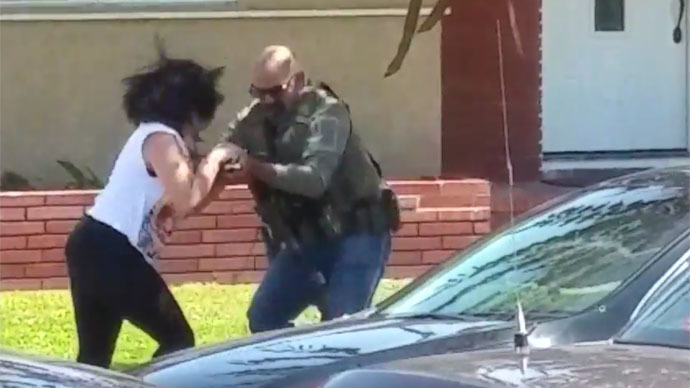
This is Stacia A. Hylton, Directorn of the US Marshals Service.
This is a disgraceful scumbag, identified as a US Marshal, ripping a smartphone away from a woman who was recording police about 15 feet away. In the video this was captured from, he throws the device on the ground and kicks it away.
Ms. Hylton, since you don’t provide a general contact email address, this will have to be an open letter.
This individual has brought disgrace to your entire outfit, if your training program allows such wanton behavior. Reports say that federal agents are “investigating.”
Please, in the name of all that’s holy, don’t let this event fade away with a “proper procedure was followed.” How this abuse of power is dealt with will say a lot about your administration.
Every time I see an article posted about bad police behavior, someone chimes in about the officer being given “paid vacation” for his or her transgression.
It is not “paid vacation.”
Below a comment from redditor /u/thatsnotminesir, a police officer who gave a comprehensive explanation of what “administrative leave” really means, at least in his department – and it sounds like this is how it should work.
The myth I see the most of reddit is that when officers get in trouble, they just get “paid vacation.”
When an accusation of misconduct comes up, especially criminal misconduct, the officer is placed on Administrative Leave with pay. This is NOT the punishment. This is to get them off the streets while the investigation is being conducted, while at the same time, not punishing them (financially at least) until the accusations are investigated and proven.
When an accusation of Police Misconduct is investigated, there are TWO separate investigations. One is an Administrative Investigation, the other is a Criminal Investigation. They have to be separate because of Garrity.
Garrity is like the evil twin of Miranda for government employees, mostly police. After the Garrity admonitions are read to us, we MUST answer all questions, and MUST answer them truthfully. If we refuse to answer, or lie, we can be fired just for lying or refusing to answer.
That completely violates our 5th Amendment Right against self incrimination. Because of that, nothing said after Garrity can be used against us in criminal court. It can only be used in administrative actions against our employment.
Therefore, two separate investigations are conducted. An Administrative Investigation where they read us Garrity, and a Criminal Investigation where they read us Miranda. Nothing found in the administrative investigation can be used against us in the criminal, but things found in the criminal CAN be used against us in the administrative. So the criminal is usually done first, then the administrative afterwards.
Because the administrative is usually done after the criminal, that’s why it often takes time for the firing to happen, because the firing won’t happen until after the Administrative. While that seem strange to the laymen, if the Administrative was done first, and officer could say “Yeah I stole the money” under Garrity and it couldn’t be used against him in court. But if the criminal is done first, and he says “Yeah I stole the money” after Miranda, it can be used to prosecute him AND to fire him.
Once the two investigations are complete, THEN the punishment is handed down if the charges are sustained. Media articles don’t always follow up on the case, so all people read in papers is “officer got in trouble, is on paid leave.” Administrative Leave is just the beginning, not the end of the story.
Even then, the Administrative Leave isn’t fun. The take your badge and gun and you are basically on house arrest between the hours of 8am and 5pm on weekdays. You cannot leave your home without permission of your superiors, even it its just to go down the street to the bank or grocery store. You must be available to come into the office immediately at any time for questioning, polygraphs, or anything else involved in the investigation. Drink a beer? That’s consuming alcohol on duty, you’re fired. So even when officers are cleared of the charges and put back on the street, Admin. Leave still isn’t “paid vacation.”
EDIT: I did not realize the wiki explained garrity, but gave such a poor example of the admonitions, leading to some confusion. Here is a much better example.[3]
Here’s the original wiki[5] for those who wonder what I changed.
This was an eye-opener for me. Anyone who has watched cop shows knows about Miranda rights, but I had never heard of Garrity. The post was a good education – forever after, I will never wince the same way I used to when a news article mentions administrative leave.
There are a lot of stories in the media this year about police misconduct. That may be a good thing, but a lot of it seems like clickbait, low-hanging fruit for getting eyeballs on ads. It would be critical for our nation for every police department in the country to weed out its rotten apples and bad actors, but even if this were to happen, the number actually purged would be very small in comparison to the majority of men and women who entered law enforcement for better motives.
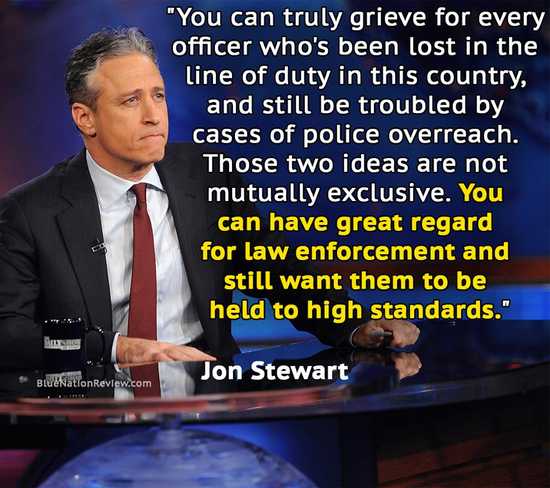
Let’s not forget what Jon Stewart recently said:
“You can truly grieve for every officer who’s been lost in the line of duty in this country and still be troubled by cases of police overreach. Those two ideas are not mutually exclusive.”
More information about Garrity
The Garrity rights, Garrity rule or Garrity warning is a protection that is utilized by many law enforcement officers each year. Simply, Garrity is an invocation that may be made by an officer being questioned regarding actions that may result in criminal prosecution.
The Garrity Warning
This article is geared toward law enforcement, but the Garrity Warning is also available for other employees of state and local government organizations.
The Garrity Warning is often misunderstood as it is inconsistently applied throughout the country. In some states it may be read to the employee before questioning begins. In other states, the employee must invoke his or her Garrity Rights.
Simply, our Constitution protects everyone from having to criminally incriminate themselves. We cannot be forced to testify against ourselves.
By invoking the Garrity, the officer is invoking his or her right against self incrimination. Any statements made after invoking Garrity, may only be used for department investigation purposes and not for criminal prosecution purposes.
The Garrity Rule stems from the court case Garrity v. New Jersey, 385 U.S. 493 (1967), which was decided in 1966 by the United States Supreme Court. It was a traffic ticket fixing case of all things.
Officers were advised that they had to answer questions subjecting them to criminal prosecution or lose their jobs. The Court held that this was Unconstitutional.
Technically, there are two prongs once Garrity has been triggered.
First, if an officer is compelled to answer questions as a condition of employment, the officer’s answers and the fruits of those answers may not be used against the officer in a subsequent criminal prosecution. Second, the department becomes limited as to what they may ask. Such questions must be specifically, narrowly, and directly tailored to the officer’s job.
Thus, the basic thrust of the Garrity Rights is that a department member may be compelled to give statements under threat of discipline or discharge but those statements may not be used in the criminal prosecution of the individual officer. This means that the Garrity Rule only protects a department member from criminal prosecution based upon statements he or she might make under threat of discipline or discharge.
Also, the Garrity Rule is not automatically triggered simply because questioning is taking place. The officer must announce that he or she wants the protections under Garrity. The above statement should be prepared in writing, and the officer should obtain a copy of it. If a written statement is being taken from an officer, the officer should insist that the Garrity Warning actually be typed in the statement. Consult your attorney and union delegate for the laws regarding Garrity in your state before providing any statement.
In New Jersey, the Garrity Warning is actually covered in the New Jersey Attorney General Guideline on Internal Affairs. Simply, if an officer being questioned invokes his Garrity Rights, the agency can contact the county prosecutor. The county prosecutor can elect to grant use immunity which will prohibit any part of the officer’s statement from being used against him or her in a criminal proceeding. But, if use immunity is granted, the officer is required to answer the questions.
Below is an excerpt from the Guideline:
If the subject officer states that he refuses to answer any questions on the grounds that he may incriminate himself in a criminal matter, even though the investigators do not perceive a criminal violation, the department should discontinue the interview and contact the county prosecutor.
If the department wants to continue its administrative interview, and the county prosecutor agrees to grant use immunity, the department shall advise the subject officer, in writing, that he or she has been granted use immunity in the event his or her answers implicate him or her in a criminal offense. The officer must then answer the questions specifically related to the performance of his or her official duties, but no answer given by him or her, nor evidence derived from the answer, may be used against the officer in a criminal proceeding. At this point, if the officer refuses to answer, he or she is subject to disciplinary charges for that refusal which can result in dismissal from the agency.
It is, of course, always recommended to seek advice from an attorney qualified in the field before answering any formal questions.
Below is the actual Garrity Warning:
1. I am being questioned as part of an investigation by this agency into potential violations of department rules and regulations, or for my fitness for duty. This investigation concerns
2. I have invoked my Miranda rights on the grounds that I might incriminate myself in a criminal matter.
3. I have been granted use immunity. No answer given by me, nor evidence derived from the answer, may be used against me in any criminal proceeding, except for perjury or false swearing.
4. I understand that I must now answer questions specifically, directly and narrowly related to the performance of my official duties or my fitness for office.
5. If I refuse to answer, I may be subject to discipline for that refusal which can result in my dismissal from this agency.
6. Anything I say may be used against me in any subsequent department charges.
7. I have the right to consult with a representative of my collective bargaining unit, or another representative of my choice, and have him or her present during the interview.
Assistant Prosecutor/Deputy Attorney General Authorizing: __________________________
Signature:________________________________
Date:_______________ Time:_____________
Location:_________________________________
Witnessed by: ______________________________
______________________________
These are sometimes referred to as the Garrity rights.
In light of the recent tragedy in Paris at the offices of Charlie Hebdo, a discussion sprung up on Facebook when a friend of mine, in reference to this article at the Daily Beast, asked the question, “where does humour cross the line into something rather ugly, threatening and repellent?”
I commented as below:
In some ways, Charlie Hebdo is the Westboro Baptist Church of the literary world. It’s a partially flawed analogy because WBC produces nothing positive whatsoever except hatred and misery, while Charlie Hebdo satirizes many things that deserve satire. Are they offensive? Absolutely… but then so is South Park, which show is afraid to pillory nothing. Mad and Cracked back in the 60s and 70s were very similar [1]; the French outfit simply doesn’t have the same restraints on them as American television or magazines, so they’re free to add all the crude sexual [and religious and political and social] humor they want. It may be this “crossing of the line” that some people find so offensive rather than the actual satire itself.
Nonetheless, the same principles of free speech apply here:
1) You’re free to say and publish what you want, and the government can’t come after you for it.
2) You are *not* free from the consequences of your speech.
In this sense, I agree with the thesis of the article. Charlie can be pretty nasty; just look at the comments of Dutch cartoonist Bernard Holtrop (Willem):
“We have a lot of new friends, like the pope, Queen Elizabeth and (Russian President Vladimir) Putin. It really makes me laugh,” Bernard Holtrop, whose pen name is Willem, told the Dutch centre-left daily Volkskrant.
“Marine Le Pen is delighted when the Islamists start shooting all over the place,” said Willem, 73, a longtime Paris resident who also draws for the French leftist daily Liberation.
He added: “We vomit on all these people who suddenly say they are our friends.”
The authors and cartoonists who work at Charlie Hebdo are not necessarily nice people, but they know who they are and they know the risks they are taking by being deliberately offensive. Unfortunately, this week some of them paid the price for taking those risks. This is sad, and unconscionable, and they didn’t deserve to die… but in the grand scheme of things this was not totally surprising.
I remember buying some of the first editions of Charlie when I was living in Italy in 1970. There was a parallel publication in Italian called, interestingly, “Linus.” I now wish I still had them – they’d be worth quite a bit.
As part of the discussion, another member of our community indicated she could identify with Willem’s disgust, citing the world leaders who are marching in Paris while pursuing national policies of destruction and/or oppression. And that’s a valid debate. I replied,
It is another debate entirely, and one that needs to continue. There are many who see the outpouring of support for Charlie as a good thing, others see it as superficial lip-service. And certainly, In that crowd of thousands marching in Paris, you would find thousands of reasons for being there.
In this particular case, I see Willem’s reaction (and those of many, many others in the blogosphere) as a confirmation of the axiom that reality is perception. We see things not as they are, but as we are.
Charlie Hebdo in many ways crosses the boundaries of responsible journalism into the realm of “we’re going to be assholes just because we can.” And while that aspect of satirical organs is repugnant to many, even those not the targets of their caustic commentary, it is and must remain protected – because if you shut them down, where does the censorship stop?
What happened in Paris is a tragedy of immense significance, and it has ignited a vigorous debate on the nature and aims of the Islamic extremist movement. In these attacks some have seen more than just revenge for offensive cartoons; journalists and analysts all over the world have chimed in suggesting that the true motive was to actually inflame hatred for Islam, making it easier for the terrorist groups to recruit the uneducated and the ideologically susceptible.
In the end, Charlie Hebdo is a pretty lowbrow publication, but I will defend to the death their right to be that way (as Voltaire’s biographer stated, although not Voltaire himself) – because if I don’t, it clears the pathway to the censorship of all writing, including my own, just because it happens to offend somebody, somewhere. And by the same token, I’m free to read it or not read it, and free to choose whether or not I will be offended.
So, yes. As Albert Uderzo so elegantly said by coming out of retirement:
“I’m Charlie too.”
The Old Wolf has spoken.
[1] Check out this tasteful ad for a revival of Disney’s Snow White from Mad’s December, 1970 issue:
And that’s sad. But in a larger sense, there is a time and a season for everything.
Cleese’s announcement was made public in The Mirror, reflecting comments made at a promotional event at the Cheltenham Literary Festival at which time he said in typical style, “I have only got five or six years left and I will be gone – I won’t have to worry about ISIS or Ebola, I am looking forward to it.”
Sorta the same sentiment as the above, although the honored Mr. Cleese is nowhere near this decrepit. He’s 74, about 11 years older than myself, and I’m looking forward to as many good years as I can squeeze out of this body before I have completed my work on this earth. But there comes a time when one is ready.
Just recently someone pointed me to Cleese’s wonderful eulogy at Graham Chapman’s memorial service:
Should I be fortunate enough to outlive John Cleese – we never really know when the bus will come for us, after all – I will be most curious to see if someone can eulogize him in the same irreverent manner or as appropriately.
Of interest was a comment that Cleese made revealing that the Python team were never “huge friends”.
John said: “The key to understanding Python now is we have all driven off in completely different directions. Michael [Palin], as you know, makes those travel programs that I put on any time I can’t sleep. Eric Idle is very good at lyrics so he is writing songs. Terry Gilliam is off trying to raise money for one of his plotless extravaganzas. And Jonesy [Terry] is just insane – he writes children’s books and recently went to Lisbon and directed an opera about vacuum cleaners.”
Their recent reunion and grand farewell in London is an event that I was very sad not to be able to attend. These gentlemen, Chapman included, brought me many a belly-laugh and much joy in the theater of the absurd. While all of them but Chapman are still with us, in ten years or so, most of them will probably have gone on to the grand cheese shop in the sky. And I may be there with them; I hope they have some of that Venezuelan beaver cheese available.