Just a random musing: When I was around 8 or so, my beloved centenarian aunt gifted me with a cedar box full of hard raspberry candies for Christmas. The candies evaporated quickly, but the cedar box continued to delight for years. There is nothing like the smell of solid cedarwood. Coming back from her last trip to Maine, my beloved brought me back a little kiss of cedarwood from Bailey Island (points for the reference). It smells heavenly.
Nowadays you go to a furniture store and they trumpet “Cedarwood Drawers!” or similar things. What they mean is that human technology has managed to slice cedar into a veneer about three molecules thick, whose smell will have evaporated before they even get it off the truck
Case in point: Espresso Cedar Chest, for sale at RC Willey in Orem, Utah for $229.00.
Crafted for functionality as well as elegance, this cedar chest makes a charming and sensible addition to your home. Solid wood construction and a plush seat cushion provide sturdy usability. Classic styling ensures it will be a family heirloom for years to come.
Solid wood… but what they don’t say is that at that price it’s going to be solid pine, with one of those vanishingly-thin cedar veneers inside. The odor will be like lipstick: one kiss and its’ gone.
It’s an abomination. Give me solid cedar, or give me death.
I found this intriguing series of images over at /r/historyporn, and boy did it bring back some memories. No, not because I was there – I may be old, but I’m not that old – but because I remember when I was about 10 or 12 or so, my mother brought home a model kit of the tower for us to build together. I was into models, especially the great old monster models (like this one), but this looked like a great project.
It was a nightmare.
And thanks to the miracle of the Internet, here it is, exactly as I remember it.
Eiffel Tower, Pyro, 3 feet tall, No. 336-5.98
I seem to recall that the plastic it was made of, or the paint used to coat the plastic, wouldn’t hold your standard Testor’s glue. Mom was an actress, not an enginer, and I was too young to have either understanding or real patience, so I recall the project was an exercise in self-mortification. It did get done, and the thing stood in my room for a while, I remember it looked a bit skewed once we finally got the whole thing together. I’d love to find one and have another go at it, but I doubt I could find an unbuilt one at a reasonable price.
In modern English, “grabbing the brass ring” or getting a “shot at the brass ring” means to go for the gold, or to strive for the best possible reward. The phrase has been found in dictionaries as early as the late 19th century.
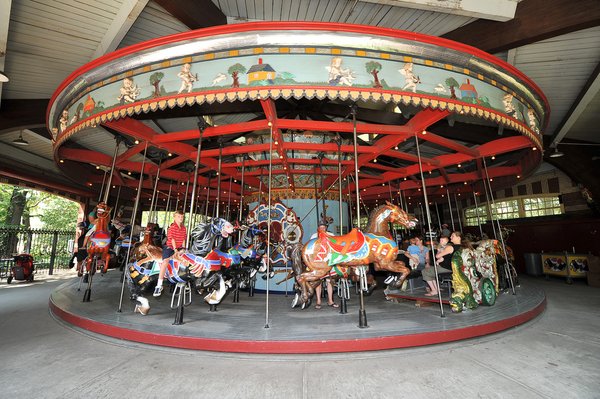
Coney Island, 1958, photo by Harold Feinstein
The phrase originated with carousels in the late 1800’s; according to Wikipedia:
“A brass ring is a small grabbable ring that a dispenser presents to a carousel rider during the course of a ride. Usually there are a large number of iron rings and one brass one, or just a few. It takes some dexterity to grab a ring from the dispenser as the carousel rotates. The iron rings can be tossed at a target as an amusement. Typically, getting the brass ring gets the rider some sort of prize when presented to the operator. The prize often is a free repeat ride.”
I grew up in New York in the 50s, and the first carousel in Central Park was opened in 1871. The current one, the Friedsam Memorial Carousel, was installed in 1950, but I don’t ever recall a brass-ring device; if they ever had one, it must have been removed earlier before its relocation from Coney Island.
It’s a great analogy for life. To get that brass ring, you have to stretch, to reach out, to take a risk. Those who sit on the inside, or who watch that little dispenser go by ever turn without reaching for it, will never know what it means to succeed, or even to fail while trying.
Finding our dreams in life is often difficult because we’re too busy living our fears, but one thing is certain: reaching for the stars will always get us farther than sitting in the mud.
A curious side effect of the 50th anniversary of President Kennedy’s assassination is a resurgence of interest (albeit a small resurgence) in New York’s infamous “Dr. Feelgood,” formally known as Dr. Max Jacobson. I grew up in New York in the 50s and 60s, and my mother was an actress there; I remember her speaking fondly of Dr. Max. In fact, his name was a household word around our home. She got me an appointment with him one time – I was probably around 16 – for Mogg only knows what reason, but I remember the experience vividly.
At the time I had no clue Max was so notorious, although an article which came out some time before 1968 ² in a local publication had made reference to “Doctor A,” “Doctor B,” and “Doctor C” – it was some sort of investigative report on unconventional medical treatments, and I wish I could find it again, because there’s no question in anyone’s mind who ever visited him that “Doctor C” was Max. Scanning the Internet now, I was surprised to find that a book was written about Max by by Richard A. Lertzman and William J. Birnes, whence the quote and patient list below were extracted. There seems to be no question that he was treating a large range of patients with methamphetamines, which is why they loved his treatments… he made them happy happy happy! President Kennedy’s visits to and by Max are well-documented, and about the injections Kennedy said, “I don’t care if it’s horse piss. It works.” Among Max’s other clients were:
President Harry S. Truman, J. Edgar Hoover, Richard M. Nixon, Rod Serling, Jacqueline Kennedy, Spiro Agnew, Sir Winston Churchill, Cecil B. DeMille, Robert Goulet, Marlene Dietrich, Elizabeth Taylor, Doris Shapiro, Eddie Fisher, Truman Capote, Bette Davis, Eartha Kitt, Maurice Chevalier, Ludwig Bemelmans, Mike Nichols, Gertrude Lawrence, Burt Bacharach, Sheilah Graham, Margaret Leighton, Rita Moreno, Frank Sinatra, Tennessee Williams, Paul Lynde, Alan Jay Lerner, Howard Cosell, Mike Todd, Hermine Gingold, Jose Ferrer, Anais Nin, Henry & June Miller, Andy Warhol, Yul Brynner, Arlene Francis, Johnny Mathis, Martin Gabel, Franchot Tone, Igor Goran, Rosemary Clooney, Nelson Rockefeller, Burgess Meredith, Ronny Graham, Roy Cohn, Marilyn Monroe, Josh Logan, Hedy LeMarr, Edward G. Robinson, Emilio Pucci, Billy Wilder, Leontyne Price, Senator Claude Pepper, Paul Robeson, Igor Stravinsky, Cary Grant, Peter Lawford, Bob Cummings, Van Cliburn, Tony Franciosa, Phyllis McGuire, Ellen Hanley, Sam “MoMo” Giancanna, Judith Campbell Exner, Mel Allen, Mickey Mantle, Marion Marlowe, Shelley Winters, Leonard Bernstein, Ingrid Bergman, Henry Morgan, Rosalind Russell, Marianne Anderson, Dr. Niels Bohr, Tony Curtis, Greta Stuckles, Mabel Mercer, Richard Burton, Andy Williams, Ambassador Eusebio Morales, George Kaufman, Mark Shaw, Pat Suzuki, Burton Lane, Alice Ghostley, Felice Orlandi (Alice Ghostley), Rex Harrison, Eddie Albert, Maynard Ferguson, Roscoe Lee Browne, Zero Mostel, Bob Richardson, Cicely Tyson, Maya Deren, Milton Blackstone, Elvis Presley, Chuck Spalding, Col. Tom Parker, Stavros Niachros, Gore Vidal, Lee Bouvier Radziwill, Prince Stash Radziwill, Vincent Alo (“Jimmy Blue Eyes”), Katherine Dunham, Peter Lorre, Judy Garland, Franco Zefferelli, Gypsy Rose Lee (Rose Havoc), Otto Preminger, Anthony Quinn, Rebekah Harkness, Edie Sedgewick, Roddy McDowell, Patrick O’Neil, Kurt Braun, Leonard Silman, John Hancock (director), Kay Thompson, Bob Fosse, John Murray Anderson, Hugh Martin, Arnold Saint-Subber, Louis Nizer, Sharon Tate, Barbara Harris, Christopher Plummer, Thelonious Monk, Jim Thompson, Florence Eldridge, Frederic March, Harry Belafonte, Stavros Niarchos, Brigid Berlin, Arthur Laurents, Leo Lerman, Maria Callas, Albert Dekker, Brian Jones (Rolling Stones), Andrew Oldham (Rolling Stones Manager), Ruth Yorck, John LaTouche, Don and Phil Everly (Everly Brothers), Louis Jourdan, Jason Wingreen, Mike Nichols, Pablo Casals, Ayn Rand, and Montgomery Clift
Max seemed pleasant and inoffensive, coming across as the absent-minded professor type, and I recall his office well, a jumble of odds and ends, jars of orange solutions with glowing colored stones being “irradiated” with ultraviolet light, and a hodgepodge of other things. Max examined me, drew up a syringe full of I don’t think I want to know, and injected me RIGHT UNDER THE FLIPPING BREASTBONE with a needle that looked big enough to terrify Big Jake. I don’t think I fainted, and in reality the needle was probably a small subq, but I had never had an injection there and it rattled me considerable. I don’t remember going out singing, as some of his patients seemed to do – maybe I got the low-octane stuff. But I’ll never forget it, and I’m tickled that I had an encounter with one of New York’s more infamous characters.
There was another set of stories that got told frequently at home, and I’m not sure if they are related to Dr. Max or not. In my mind, however, they were – so I’m going to relate them here anyway. I was put in mind of these stories by a delightful article over at “Oh God, my Wife is German” where the author talks about his wife’s love of “King of the Thorns.” Unless I’m totally off the mark, Max had a nurse at one point who was Teutonic in origin, and whose English was often flavored with Germanisms. The three instances I recall hearing the most often are:
“I’m sorry, you can’t see the doctor right now – he’s right in the middle of somebody very important!”
“Now this may hurt a bit, but don’t worry, you won’t last long!”
Patient: “Nurse, I need a vase.” [1] Nurse: “Ja, and how big is your bouquet?”
The Old Wolf has spoken.
Footnotes:
[1] For the uninitiated, “vase” was hospital parlance for those portable urinals for bedridden patients.
[2] A subsequent search in 2017 turned up the article in question, from New York magazine and actually published on February 8, 1971.
When I was little, my mother used to sing bits and snatches of songs to me that she remembered from her own childhood. One that always stuck in my mind was “The Czar of the Tenderloin,” which she told me she often heard sung by her uncle, Leo Marshall.
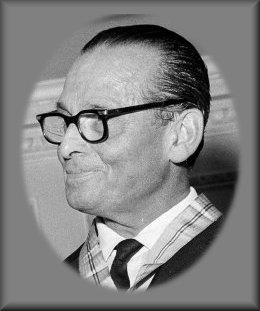
Leo Marshall, center in rear, with his wife Lucile Rogers Marshall (right front) and her siblings Frances, William, and Victor, December 1970
Years later, at the 80th birthday party of my grandmother Frances, (Leo’s sister-in-law), he sang it for the assembled family one last time. It was two years before his death, and the rendition was hesitant and shaky, but all the more lovely for his still being able to remember as much as he did.
As I grew older, I often wondered about the origins of the song, and if there were any more of it than the little bits Mother sang.
And then came the Internet, the modern-day Areopagus (Acts 17:21). As the body of the world’s knowledge is slowly but surely gathered and preserved online, not everything happens at once. For years I searched and scraped the web, but always came up poor… until today.
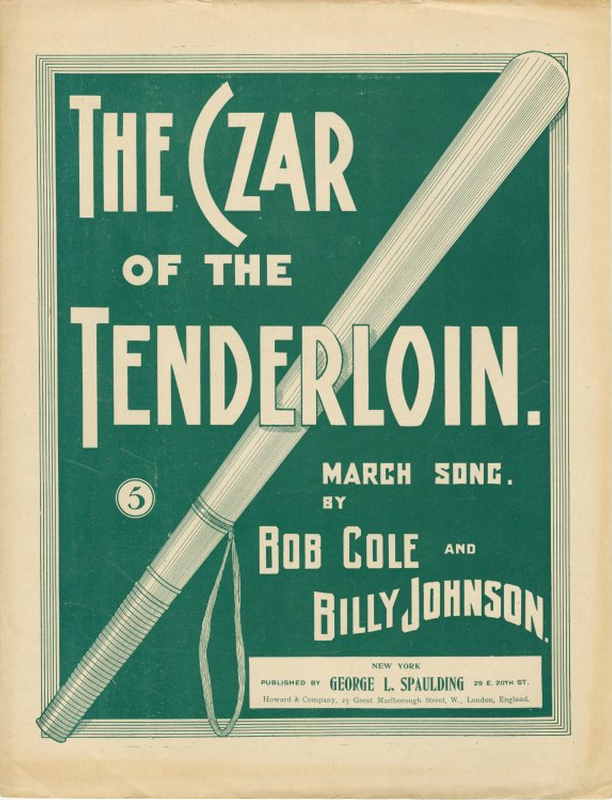
Notice the nightstick on the cover.
The Lyrics
America has a President and England has a Queen,
While Germany’s great Emperor sits ruling all serene,
The Indians have their medicine man, Bavaria a king,
But none of these high diplomats are quite the proper thing.
For in gay New York where the gay Bohemians dwell,
There’s a Colony called the Tenderloin, though why I cannot tell,
A certain man controls the place with no regard for coin,
The Czar, the Czar, the Czar of the Tenderloin.
Chorus:
The Czar of the Tenderloin,
With great propriety, seeks notoriety,
But the girls all shun the society
Of the Czar of the Tenderloin.
Each evening through the Tenderloin the Czar will gayly prance,
With whiskers well divided just to give the wind a chance,
His bodyguard behind him scouting for a finish fight,
Arresting everything that’s left because it isn’t right.
Piano legs must now be clothed with care,
And he’s ordered all the trees cut down because their limbs were bare,
He’s going to build a little church which everyone must join,
The Czar, the Czar, the Czar of the Tenderloin.
Chorus
His hobby is arresting shoes whenever they are tight,
He also nabs electric lights when when they go out at night,
The sun came out one morning and he ordered its arrest,
The moon was full, he pulled it in and claimed it was a pest.
One day on the Tenderloin, a maiden changed her mind,
Now the Czar thought that was naughty so the girl was quickly “fined.”
He arrested a cook for beating an egg, now don’t that take the coin,
The Czar, the Czar, the Czar of the Tenderloin.
Chorus
This 1897 song by Bob Cole and Billy Johnson is based on the life and times of Alexander S. “Clubber” Williams, a notoriously corrupt but effective police inspector who ruled over New York’s Tenderloin district with an iron fist and a wooden club. At the end of his career he was reputed to have said that he never clubbed anyone who didn’t deserve it. The name of that part of town, the northwest corner of which is now Times Square, came from William’s statement that “I’ve been having chuck steak ever since I’ve been on the force, and now I’m going to have a bit of tenderloin,” said because of the lucrative business of protection payments from legitimate and illegitimate businesses alike. Prior to Williams’ reign, the district was known as “Satan’s Circus.” San Francisco also has a Tenderloin district, and the term has come to be synonymous with a seedy, ill-reputed or red-light district of town.
Manhattan’s historical districts, the Tenderloin indicated by a star.
Emile Berliner’s Gramophone 78 rpm record. “The Czar of the Tenderloin,” sung by Will F. Denny. Recorded July 14, 1897
With thanks to Tim Gracyk, you can hear Will F. Denny singing an abridged version of the song at YouTube, but I can still hear Uncle Leo singing it as clearly as though it were yesterday.
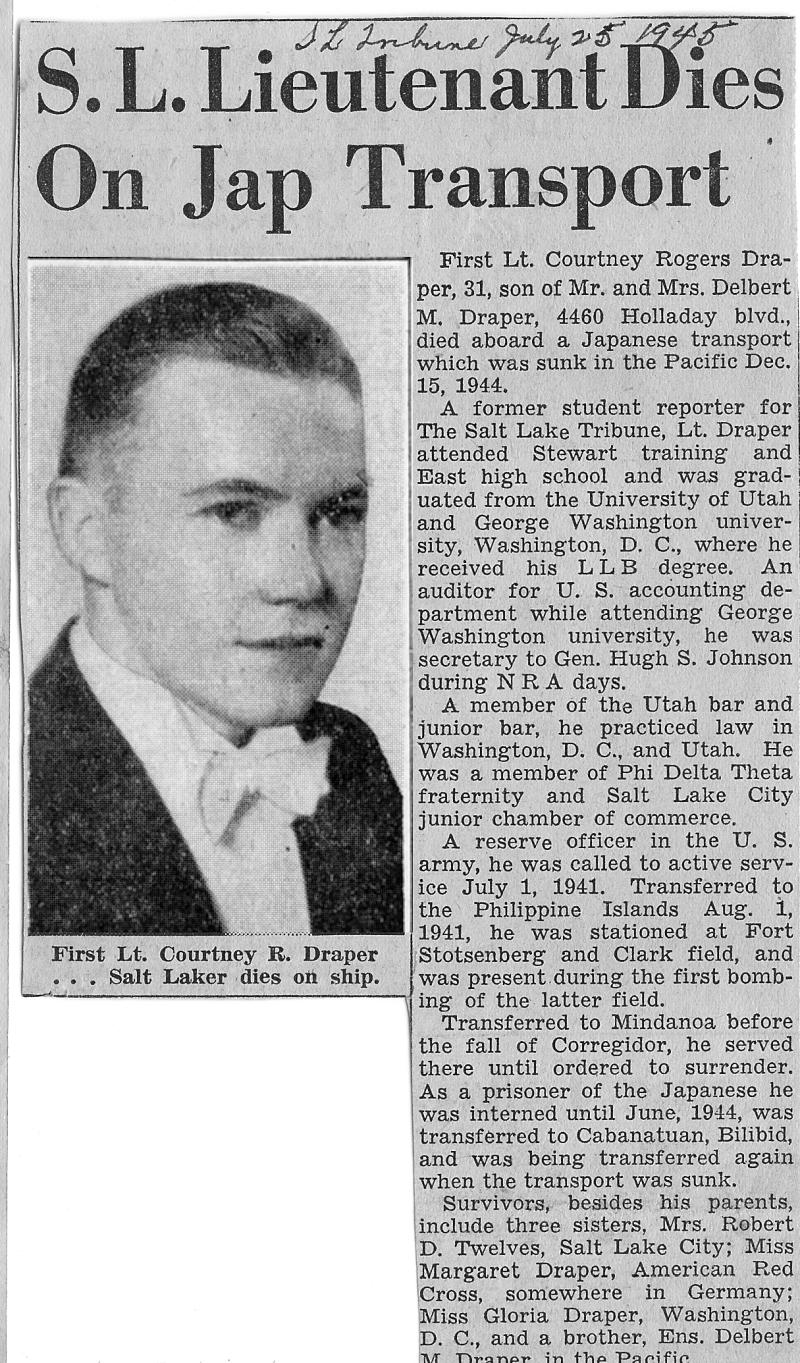
This post is dedicated to the memory of my maternal uncle, Courtney Rogers Draper, who lost his life on one of the Japanese “Hell Ships” in December of 1944.
Obituary from the Salt Lake Tribune of July 25, 1945. Courtney’s parents received the telegram the previous day.
Strike photo showing the sinking of the Enoura Maru in Takao Harbor (now Kaohsiung, Taiwan). The allies were unaware that the ship was packed to the gills with allied prisoners, as the Japanese ships were unmarked.
Painting of the Ebara Maru, a ship of the same class as the Enoura Maru. The Ebara was not used as a Hell Ship.
Monument in Memory Grove, Salt Lake City.
A photo of Lt. Draper in the Philippines before his capture, along with his purple heart ribbon.
The official POW record reads as follows:
World War II Prisoners of War, 1941-1946 Name: Courtney R Draper
Race: White
Residence State: Utah
Report Date: 7 May 1942
Latest Report Date: Jan 1945
Grade: First Lieutenant or Chief nurse or Head dietitian or Head physical therapy aides
Grade Notes: First Lieutenant or Lt. Jr. Grade
Service Branch: Army
Arm or Service: Air Corps
Arm or Service Code: Air Corps
Area Served: Southwest Pacific Theatre: Philippine Islands
Detaining Country: Japan
Camp: 502
STATUS: Executed, Died in Ship’s Sinking or Result of Ship Sinking, Shot While Attempting Escape
Notes: Enoura Maru
POW Transport Ship: December Sinkings: See code in previous field (REP). (B)DS=Brazil Maru; (E)DS=Enoura Maru; (O)DS=Oryoka Maru; (X) Died during transportation from Olongapo to San Fernando, PI.
Report Source: Individual has been reported through sources considered official.
Manila American Cemetery and Memorial, also known as Fort William McKinley Cemetery, honors the American and allied servicemen who died fighting the Japanese in World War II. The Cemetery offers repose to soldiers who died in the Pacific theatre, which included the Philippines, New Guinea, and the Pacific islands. Courtney’s last official status is “missing,” his remains “unrecoverable.”
Courtney was a promising and rising young attorney in his father’s practice before his death; his siblings, including my mother, always told me what an outstanding person he was. I’m saddened that I never knew him, but I honor his memory, as I do that of all the honored dead. May they rest in peace.
Edit: I found dër Ratskeller mentioned on another blog post about defunct Salt Lake City pizzerias here:
Edit 2: Added a pretty darn good roquefort recipe
I’ve touched on the subject of pizza several times before, but today a map I found over at Maps on the Web inspired me to follow through on an earlier promise.
Having lived in Italy from 1970 to 1971, I mentioned Neapolitan pizza, which is the grandfather of the art form, and followed up with a much longer ramble about it in the next post.
When I came back from Italy, my first real job off-campus was at Dër Ratskeller Pizza Shoppe, at 250 South 300 East[1], which I mentioned here. Unfortunately that chain is now defunct, and it’s a real pity; there are some good pizzerias in this country, but the Ratskeller was a cut above.
I began working at their first location in 1972, after my return from overseas. The chain was owned by a car dealer and restaurant entrepreneur named Roy Moore, and he had several pizza joints in Idaho including the Rathaus Pizza Shoppes in Boise and Moscow, the Gay Ninties in Idaho Falls, and the Red Baron in Lewiston; this was his first venture in Utah.
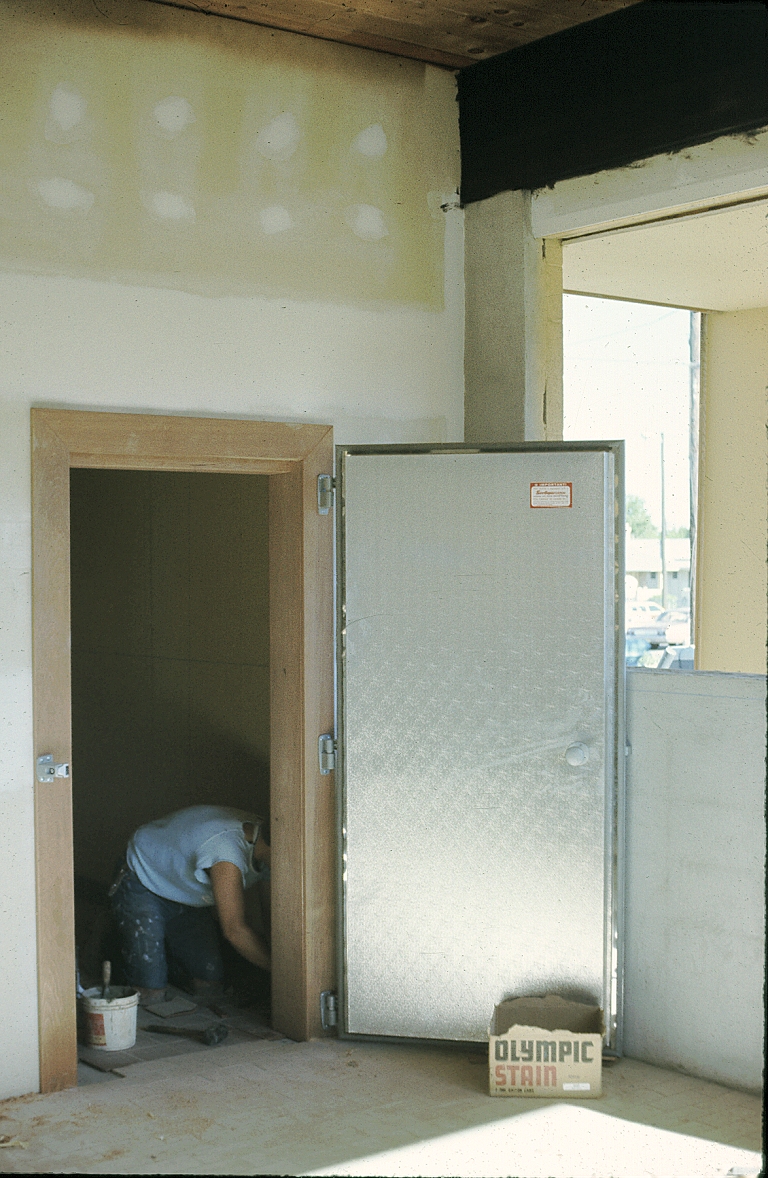
The following year, the company opened a second location in Sugarhouse, Utah, at 827 East 2100 South – I was tapped to become the assistant manager of that location and actually helped with finishing the construction. In the process, I learned a lot about making pizza.
The sugarhouse store looked very much like the downtown location.
Finishing the walk-in refrigerator
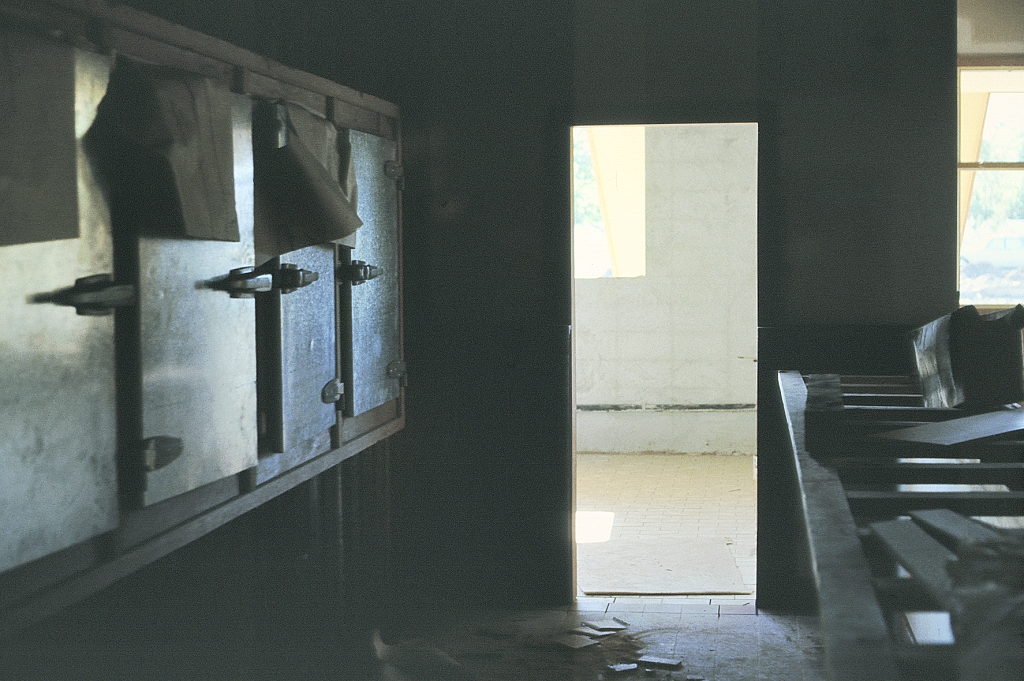
Behind the bar and looking into the kitchen. From those doors were dispensed bottles of Budweiser, Heineken, and Beck’s beer.
The bar (left) and serving window (right)
The fireplace being framed in.
Restaurant construction looking south – you can see the Snelgrove’s sign in the background.
Front entrance
‘
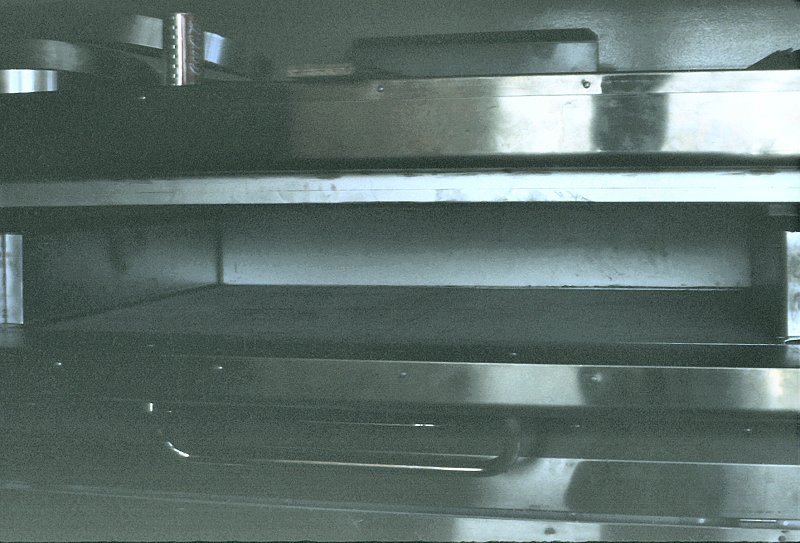
Pizza Oven
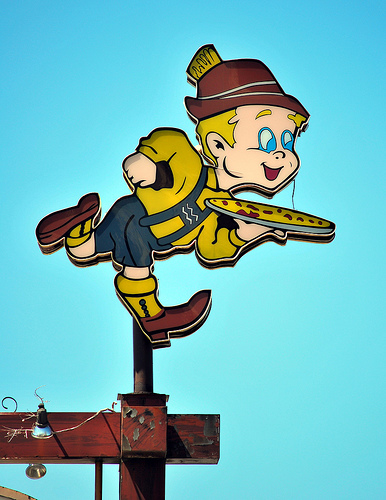
Ratskeller Logo
The first two shops were managed by Roy’s nephews, Michael and Don Pope.
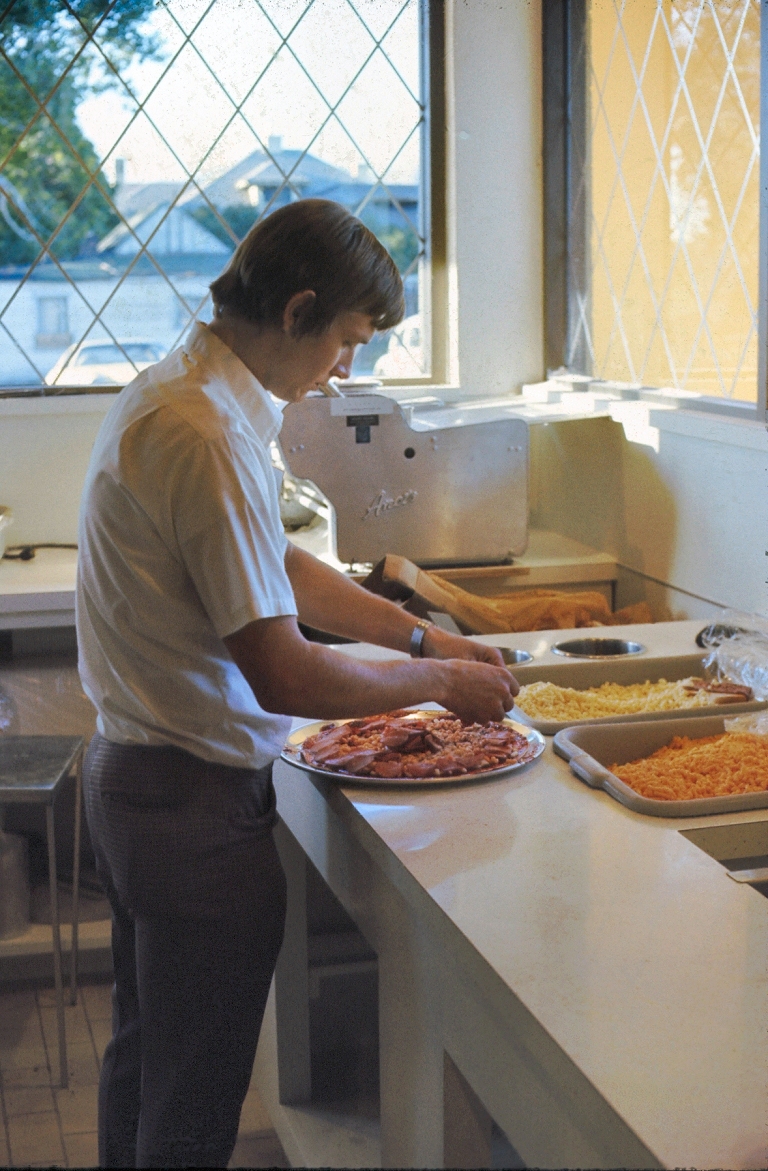
Mike creating the first pizza at the Sugarhouse location. Notice the dough-roller on the back table; windows were arranged so that customers could watch the entire pizza creation process, and rolling out the skins was always an attraction.
Ratskeller pizzas were made differently from any other I had experienced. The sauce was a proprietary blend of spices created by Roy and his mother, Grandma Moore, (the latter also being responsible for a kick-ass Roquefort dressing.) The spice packets were mixed up off-site, and transported to the restaurants where they were combined with brown sugar, red dye, and tomato sauce in large plastic barrels. The sauce was thick, and applied to the pizza skins with a large basting brush.
The cheese used was nothing extraordinary, but a mixture of about 75% mozzarella and 25% cheddar was used, each being crumbled through a grinder (you can see the two cheeses in the bins above.)
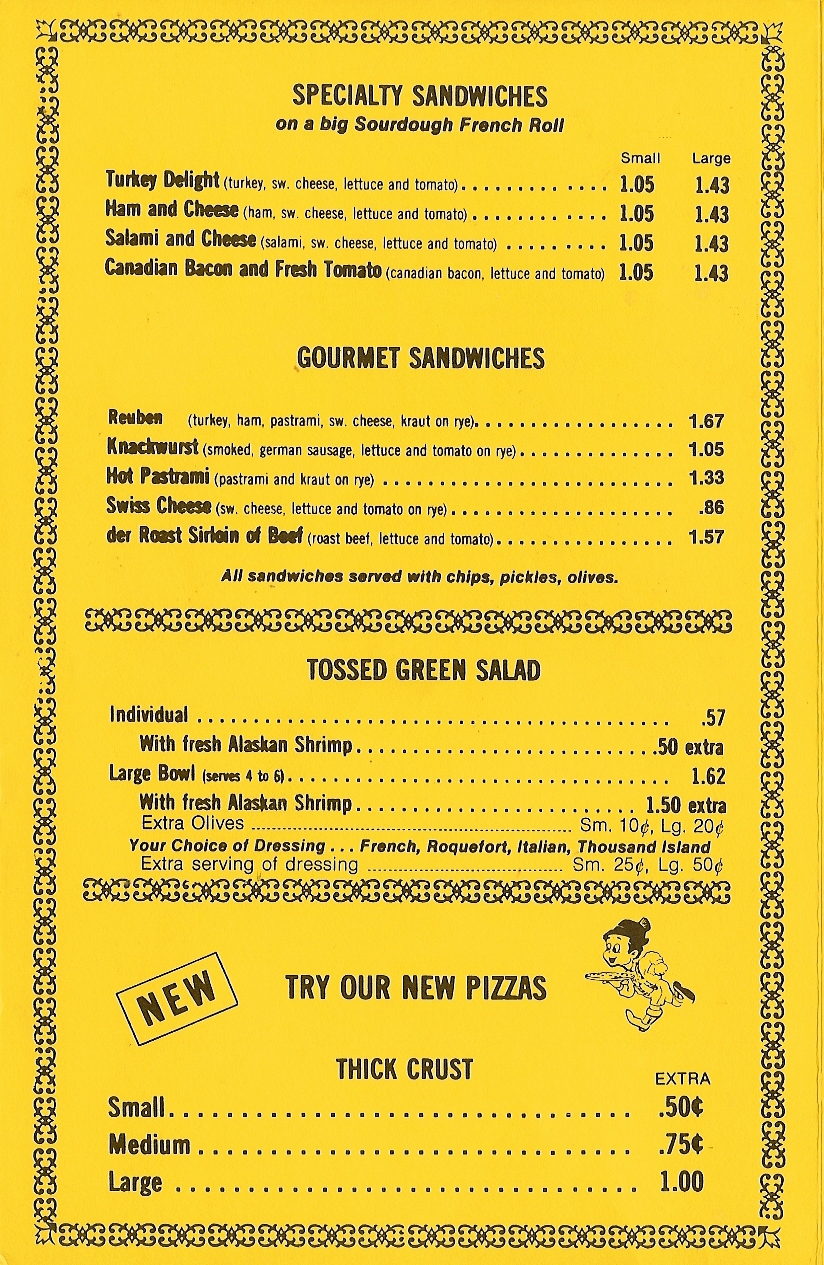
The menu above shows a later iteration of the restaurant’s offerings than they served in the first two stores, but most of the old standbys were there.
The Ratskeller made an effort to use only the best ingredients. They used Hormel dry Italian salami and pepperoni, which was sliced at the restaurant for freshness. The ground beef was mixed with red Burgundy wine, onions, salt and pepper; and the sausage was mixed with Sauterne, salt, pepper and caraway seeds. Abundance was the watchword. A “Rat” was made by loading a crust with sauce, cheddar and mozzarella; placing salami on the pizza as closely as possible without overlapping the slices; and then filling in all the gaps with pepperoni so that no cheese was visible. Heavy amounts of beef and sausage were added, followed by mushrooms, split black olives (placed by hand, face down!) and if desired, onions and green peppers. A pepperoni pizza was made such that the entire surface of the pizza was covered with meat – no cheese visible. The Country Club was a Ratskeller combination with anchovies. Portuguese linguiça was a specialty sausage that was not available at other pizza restaurants.
The pizza crust was also unique, and that I can tell you how to make – at least, in 50-pound batches.
42.5 lbs flour
1 C Powdered Milk
1 C Salt
1 C Sugar
1 C Diastatic Diamalt
6 oz. active dry yeast
2 lb. lard
3 gal. hot water
2 T. baking soda
The lard was melted in the hot water in a large commercial mixer, and the other dry ingredients (except the flour) were added. When everything was mixed, the flour was put in – we never weighed it, but you got a feel for where to pinch the 50-lb bag off to get just the right amount. Mixing dough was more of an art than a science – you mixed it until it looked like it was still too dry, and then dumped it out into a large plastic bucket lined with a plastic bag, and left it to rise overnight. In the morning it was perfect – and when it was punched down, it would exhale enough carbon dioxide to asphyxiate the entire Chinese army, or give a kitchen worker a real buzz (but you never heard that from me).
The dough was then rolled out with an industrial roller into a ribbon about 17” wide, and the skins were cut out with huge cookie-cutters, well-floured, pierced, stacked on pizza tins in groups of a dozen, and refrigerated. These could then be peeled off and loaded as needed. Rolling skins was also an artistic venture, and I learned from the fastest roller in the company, Bill Medlin.
For your gratuitous pleasure, here’s the same recipe cut down to family size:
Proportional Recipe (Makes 2 crusts)
3 C flour (1 lb.)
1 ¼ tsp. Powdered Milk
1 ¼ tsp Salt
1 ¼ tsp Sugar
1 ¼ tsp Diastatic Diamalt
¾ tsp active dry yeast
4 Tbsp. lard
1 1/8 C water
1/8 tsp. baking soda
Into hot water, mix lard until dissolved. Add all dry ingredients except flour and mix until dissolved. Add flour. Mix until dough begins to form together – it may look too dry, but you don’t want to mix the dough until it’s soft and elastic like you would for bread dough.
Turn out into a greased bowl, cover, and let rise overnight.
Punch down, turn out, and cut into two pieces.
Roll out the crust with a rolling pin to 1/8” thick. You may want to fold the dough in half twice and roll it out a couple of more times. Pierce with a fork in numerous places to avoid bubbles. Load up and bake on a pre-heated pizza stone on the hottest setting your oven can manage.
Roquefort Dressing Recipe:
Ratskeller also made some really nice sandwiches, on French sourdough or nice rye rolls brought in from local bakeries. Working there for a full shift, you always got a meal – either a sandwich or a personal-sized pizza which you could make yourself, and I always experimented with numerous odd combinations. My favorite was Canadian Bacon with mushrooms, fresh tomatoes, and smoked oysters.
I lived on pizza for about three years. Mistakes were not common, because the staff was well-trained, but when one was made – either a wrong order or an overdone pizza – it was usually placed on top of the oven where it evaporated quickly. As I mentioned in another post, sometimes (not often), the guys in the kitchen would get tired of pizza, and we’d trade a bunch of food with the guys across the street at Piccadilly Fish and Chips.
As time went on, the restaurant opened branches across from the Salt Palace, in Millcreek, and in Cottonwood Heights. Working double shifts with no overtime got to be more than I could handle, and I left the Ratskeller in January of 1974 and moved to Pipes and Pizza. As a result, I’m not privy to the remaining story of expansion and decline, but I know the quality of the food was not an issue – they made the best American pizza I have ever had. My suspicion is that they expanded too far and too fast, had management problems in their additional locations, and that their generous formulas became economically unviable. Whatever the case, I remember their food with great fondness; as the company has not existed for decades, I wish dearly that I could get my hands on their sauce recipe for my own use at home. And I wouldn’t say no to that roquefort formula, either.
Oh, and that map I mentioned at the beginning? Here it is, showing the nearest pizza chain of the most popular national brands:
An old forum acquaintance of mine, who went by the handle “Grassy Noel,” came up with the best pizza-related slogan I have ever heard:
“Pizza will get you through times of no answers better than answers will get you through times of no pizza.”
So If you’re distraught, this map will give you an idea of places you don’t want to be.
The Old Wolf has spoken.
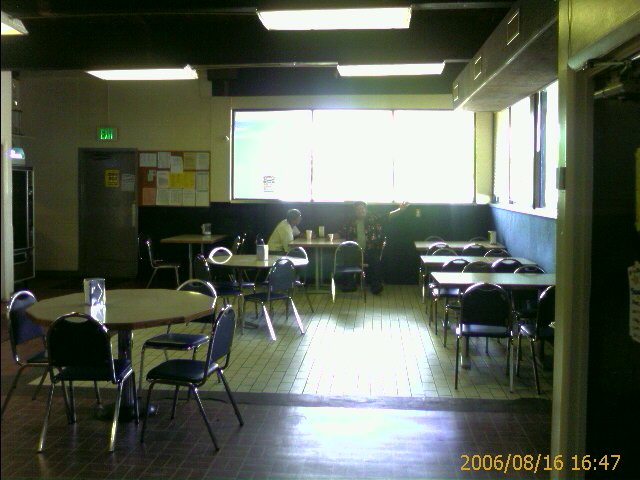
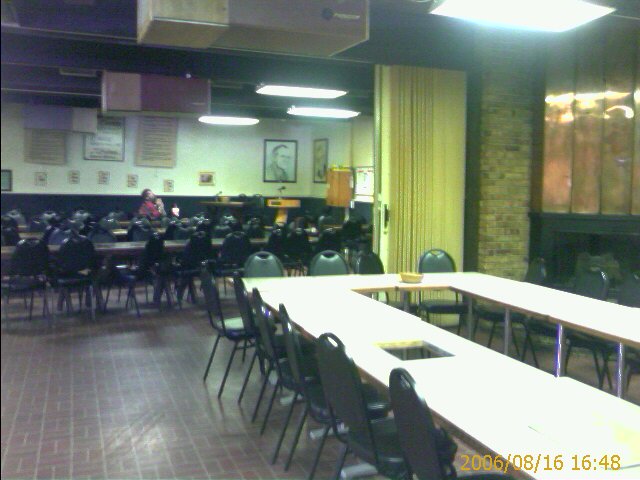
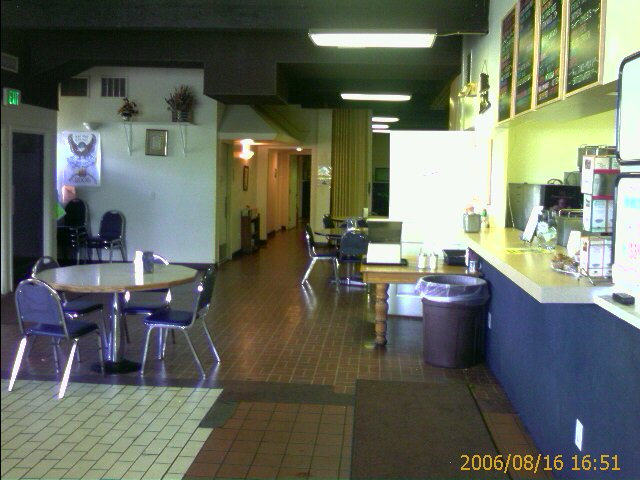
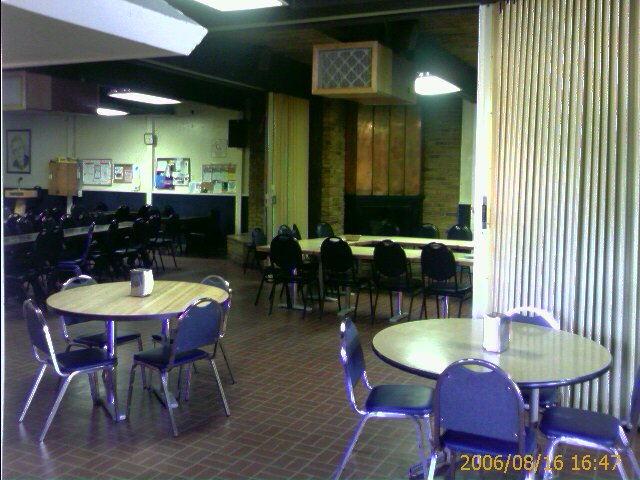
[1] Now a French patisserie, the Gourmandise. The Sugarhouse location became “Fellowship Hall,” a drop-in center for veterans where 12-step meetings were also held. The pictures below show the interior, and some features are still recognizable.
The kitchen area converted into dining tables.
The fireplace and dining areas are still largely the same.
When I was around 8, and living in New York City, my mother – a single mom pursuing an acting career – arranged to have a nanny come over from England to take care of me. Mavis was with us for 4 years, after which she went off to seek her own fortune, married a fine Italian gentleman, and raised a fine American family. She was a lovely lady, and we stayed in touch for 50 years until she passed in 2016.
On one occasion I recall she came back from one of her days off and gave me this card as a souvenir:
The hand was coated in glow-in-the-dark ink, and I thought it was awesome. For what it’s worth, I wish I had been able to keep it, but it got lost somewhere in the passage of time.
Mavis had gone to see “Mr. Sardonicus,” a horror film by William Castle, one of the more flamboyant showmen of the 50’s and 60’s. Castle promoted his films with clever and (for the times) novel gimmicks, of which the “Sardonicus Punishment Poll” was one; for the film “Zotz!” (1962), each patron was given a “Magic” (gold colored, plastic, glow-in-the-dark) coin.
So here I had this great gimmick card, and from the description brought home by Mavis, the film was far too terrifying for a young child. She was probably right – a couple of years earlier I had seen two other horror films and survived, but they gave me nightmares for years. But up until last weekend, I had never seen the film.
I finally got a chance to watch it, and it’s a good thing I hadn’t seen it as a child. For an adult in the 21st century, it was pretty cheesy, but well-done; even though Rotten Tomatoes only gives it a 38% rating, I suspect the numbers would have been higher if it were rated from a 60’s perspective. I’ve seen worse B-grade movies by far.
The movie is based on Ray Russell’s novel Sardonicus.
Guy Rolfe stars as Mr. Sardonicus, a wicked and wealthy count (once a poor peasant who won a fortune in a lottery) whose face was frozen into a hideous grin from the shock of seeing his father’s rotting corpse. Sardonicus hires Sir Robert Cargrave (played by Ronald Lewis), a brilliant doctor who has had great success with muscle massage techniques, to help him. Complicating the matter is the fact that Sardonicus’ wife Maude is Robert Cargrave’s old love. Cargrave travels to Sardonicus’ castle and is met by the dedicated servant Krull, who has a badly-scarred eye. During the course of the visit, Sardonicus explains what happened to him, and threatens to torture his wife (the way he had earlier tortured Krull) if Cargrave will not help him. Cargrave agrees, but even when a highly-radical treatment is a success, Sardonicus is not freed from his torment; in fact, William Castle appears and asks the audience to hold up their glow-in-the-dark cards to indicate mercy or punishment. Regardless of the vote, it appears that the audience has voted for punishment, and the movie ends with Sardonicus facing additional horrors for his evil, horrors administered in part by Krull, who takes the opportunity for a little revenge of his own.
By today’s standards, that sweet face would be considered a cheap effort at horror, but in the 60’s, it was sufficient to send moviegoers into a swoon. But viewed through the lens of historical perspective, this movie was a worthy effort, even if it was quickly slapped together by a man who many considered to be the P.T. Barnum of film-making in his day. I’m glad I finally got to see it, and lay my curiosity about that card to rest.
Nowadays I’m more careful to keep odd bits of memorabilia filed away – I remember when we first rode the Indiana Jones attraction at Disneyland, they were passing out these cards so we could transliterate the Mara inscriptions throughout the ride:
Some day this might be worth a few bucks on eBay, but it will have to be my grandchildren who find out.
A friend of mine from Norway, on the way back home from a visit to New York (although he didn’t eat at Piccolo Angolo, and is therefore in the doghouse forever), had an interesting experience when, 45 minutes into the flight, his plane began losing cabin pressure and had to return to Newark for servicing. It was newsworthy because Norwegian ski star Aksel Lund Svindal happened to be on the flight as well; a Norwegian website, Aftenposten, recorded the event (you can run it through Google Translate for a fairly readable English version). ABC also briefly mentioned the incident.
This put me in mind of my own scary story, which took place when I was 11 years old and journeying from New York to Salt Lake to visit my mother’s brother for the summer. The plane I was flying in, United Airlines flight 725, lost partial hydraulic power and were not sure what kind of landing they would be able to accomplish. Pilots managed to lower the landing gear manually, and operate the flaps with a backup electrical system; the flight was diverted to Hill AFB in Ogden, which had a longer runway, and the landing was uneventful. However, the stewardesses (that’s what they were called back then, not “flight attendants”) duly gathered up all sharp objects from the passengers, passed out pillows for us to tuck under our seatbelts, and we spent what seemed like an eternity in “crash position.” I remember being intrigued, but not afraid; I think at that age, I wasn’t truly aware of my own mortality, and I don’t think I understood how serious the situation could have been.
The thing that miffed me the most at the time was that I didn’t get a mention in the article as the youngest passenger on board. Ever the attention-seeker, it would seem. At any rate, here for your gratuitous pleasure is the news article from the Salt Lake Tribune of June 29, 1962, chronicling the near-disaster.
In retrospect, of course, boring and anonymous is much better than burned to a crisp and famous.
I can’t tell you when I heard this song for the first time – it’s literally been decades. But today I happened to use the phrase “it’s a penny to a quid” (similar to the US expression “it’s dimes to dollars”), and every time I hear or use that phrase, this song pops into my mind. And thanks to the miracle of the Internet, which is busy recording for posterity almost everything that can be salvaged – what a great historical tool it is, too – I can share it with you.
Lonnie Donovan was a British skiffle musician (Americans, think Jug Band) popular in the 1960’s.
Lively!
by Lonnie Donegan
Now, “lively” is a funny word
It means a lot of things
But to the burglar people
An urgent call it brings
Cause’ when they breakin’ open safes
Or nailin’ up mail vans
Lively! just means “Scarper boys”
To all the different gangs
Chorus:
Lively, lively, the night is going fast
Lively, lively, we both got murky pasts
Lively, lively, don’t leave that bloke untied
Cause’ if you did it’s a penny to a quid that we both end up inside!
Solo 1
We broke into a spinster’s house
While she was knelt in prayer
She was praying for a man
what sort she didn’t care
We had to dive beneath the bed
The dust fair made us sneeze
“Cor, that was quick!” the old girl cried
And jumped up off her knees!
Repeat Chorus
Solo 2
Now we rehearsed for days and days
A smash an’ grab to do
“You throw the brick” one bloke said
“And I’ll leave the grab to you”
The brick went through the window
“Now grab! – they cried – “And quick!”
It wasn’t till we got away I found I’d grabbed our brick!
[spoken]
Oh lively, lively…
Here…
I sung this song once at a policemen’s dance
But I was only singing for coppers
Oooo what a gagster
Whilst on the run once from the law I rushed into a church
I mixed with lots of people just to confuse the search
I’ve found meself right up the front, the best place I could hide
I had a fright when some bloke said “Got the ring? Here comes the bride!”
Whoops!
Chorus
Solo 3
The shop steward of our union was up before the judge
Who sentenced him to 18 months, our steward lodged a grudge
The maximum is twelve M’lud[1], the judge replied “What rot!”
You always wanted time and half and that’s just what you’ve got!”
Lively, lively, the night is going fast
Lively, lively, we both got murky pasts
Lively, lively, don’t leave that bloke untied
Or if you did it’s a penny to a quid
Oh Gawd Blimey, here comes Hymie
La, La, twopence[2] on your jar
(Different Voice) Rosin on the bow and here we go!
(yet another voice) Good luck then snapper, here comes the coppers!
(Lonnie again) I’ve had some beer, if we run in here…
We both end up insiiiiiiiiiiiiiiiide!
[1] M’lud = “My Lord”
[2] *twopence (pronounced “tuppence”) – The price you would get for taking clean Glass Jam Jars back to the shop, along with most types of glass bottles.
Here’s another example of Donovan’s work – Grand Coulee Dam
Lastly, a more modern example of Donegan’s work (he passed away in 2002), in the framework of an appearance on Michael Barrymore’s show (a British “Tonight Show” sort of thing.) Ignore Barrymore, he sort of mucks up the performance, but it shows Donegan toward the end of his life, still “lively!”.




















 Playing in the World Game