A number of lists of these great “quotes” have been circulating ever since the days of fax machines, even before “forwards from Grandma.” They’re funny and great to read, but is there any truth to any of them? Let’s explore.
The most famous one that I know of has been thoroughly debunked:
“640K ought to be enough for anybody.” – Bill Gates
An analysis at Quote Investigator ended with “Since Gates has denied the quotation and the evidence is not compelling I would not attribute it to him at this time. Thanks for this difficult interesting question.“
During the early days of computing, programs were often written in Assembly Language, producing very tight code that could run in minimal spaces. The original Wang v.2 word processor was designed to run on workstations with 32K of memory, even though later workstations had a standard 64K.
Wang OIS 64K Workstation
If you want apocrypha, here’s a good one. This story was told to me by a Wang Laboratories internal employee, and I can’t verify its authenticity, but having worked with Wang software and hardware for around 10 years back in the ’80s and ’90s, I would be willing to bet a steak dinner that it is true.
The Wang Word Processor, version 2, was – as mentioned above – written in Assembly language. The source code was kept on these 300MB swappable disk packs which at the time were very convenient for changing storage media.
300 MB Disk Pack
Disk Drive for use with removable packs
As the tale goes, somehow an entire rack of those disk packs got knocked over, destroying both the source code (in Assembly Language) and the backups for that impressively small and fast piece of software. It was for this reason that WP+, the next generation word processor from Wang, was entirely re-written in a slower, larger, higher level language. It emulated many features of the original and added others, but it was cumbersome and inelegant by comparison. Again, I can’t verify this 100%, but it came to me from what I consider a reliable source.
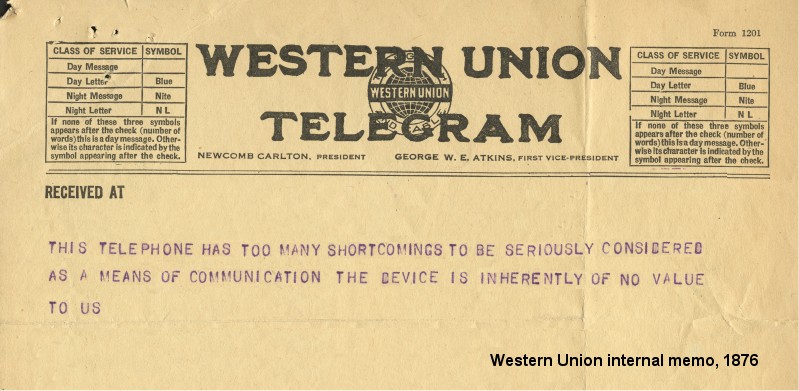
Western Union’s opinion of the telephone
Facsimile Telegram
This ‘telephone’ has too many shortcomings to be seriously considered as a means of communication. The device is inherently of no value to us.” — Purported Western Union internal memo, 1876.
Telegrams were pretty much the way to get a message from one place to another rapidly. Prior to the development of the electric telegraph system designed by Samuel Morse, optical telegraphy which used visual signals seen at a distance was one of the earliest methods of long-distance communication.
Wikipedia reports that “The smoke signal is one of the oldest forms of long-distance communication. It is a form of visual communication used over a long distance. In general smoke signals are used to transmit news, signal danger, or to gather people to a common area.” The use of smoke signals by the indigenous peoples of North America are probably the most familiar to Americans thanks to the popularization of western history in published and broadcast media.
Frederic S. Remington (1861-1909); The Smoke Signal; 1905; Oil on canvas; Amon Carter Museum of American Art, Fort Worth, Texas; 1961.250
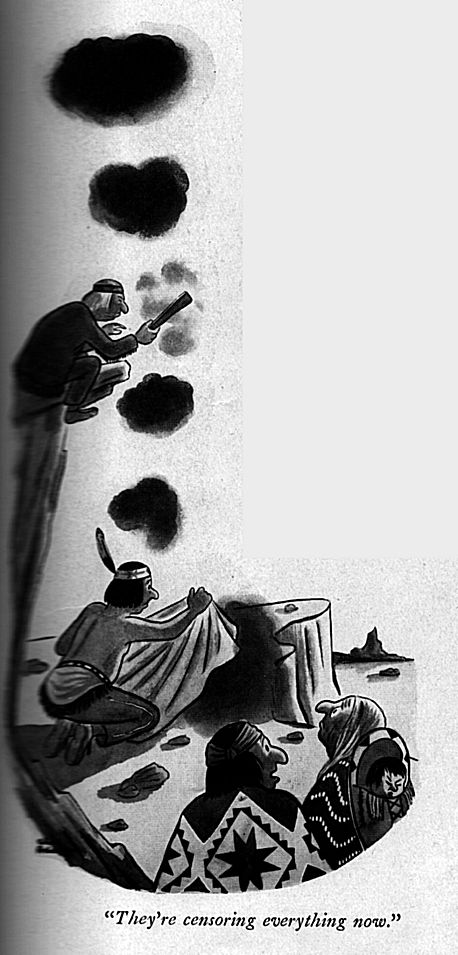
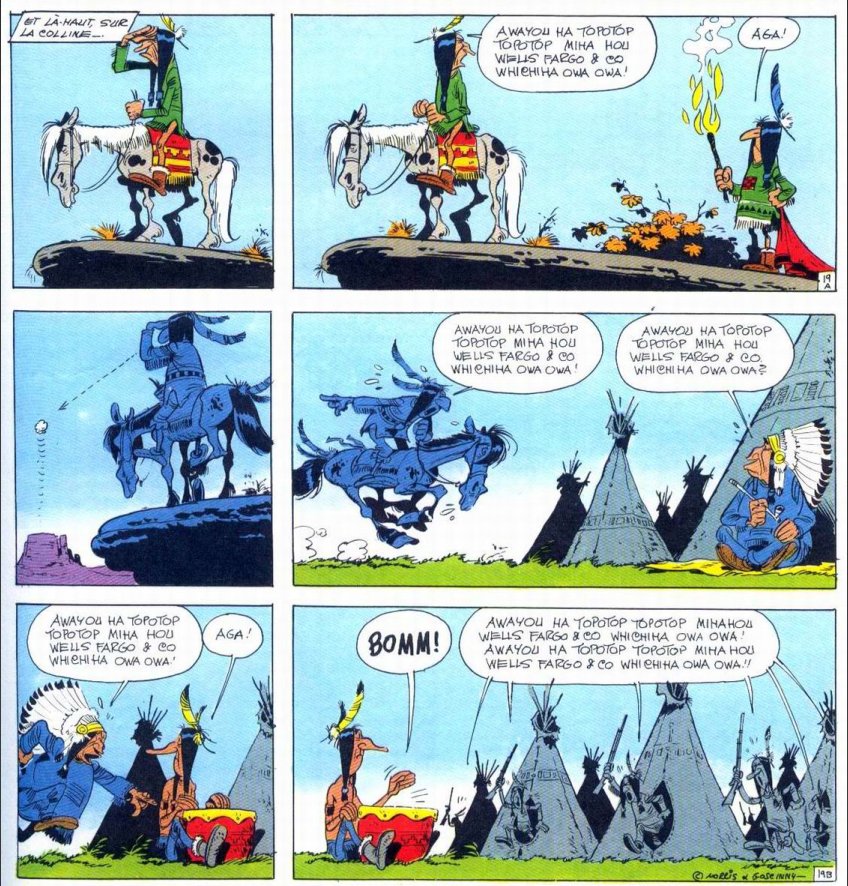
This method of communication has been the basis for much humor as well:
Charles Addams, The New Yorker
Lucky Luke – “La Diligence” (Dargaud, 1968 series) #32 by Morris and Goscinny
The joke here is that a single puff of smoke or one beat of a drum can communicate large quantities of information, which of course is not the case.
One of the most stirring cinematographic representations of optical telegraphy can be found in Peter Jackson’s version of J.R.R. Tolkien’s “The Two Towers,” where the beacons of Gondor – signal fires strategically placed on mountaintops – played a crucial role in summoning Rohan’s forces to help Gondor.
The Beacons of Gondor
Once electricity came on the scene, the electrical telegraph, augmented by Morse Code, became the dominant method of rapid long-distance communication, and was the underpinning of the telegram system for which Western Union became so famous.
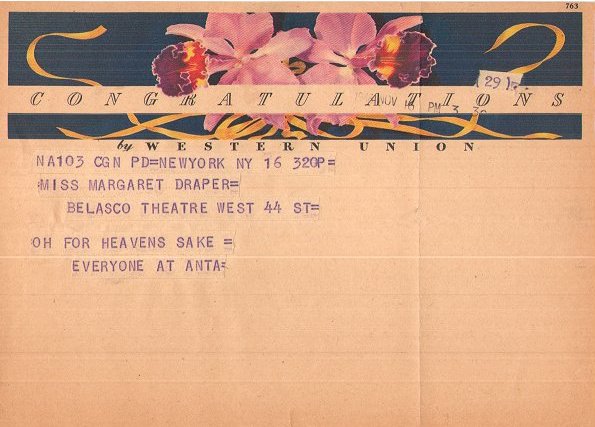
Telegrams – about which I have written elsewhere – were used for everything where information had to be transmitted rapidly, from business meetings, to military applications, to notifications of death, to congratulations on Broadway, and countless other uses.
Telegram sent to my mother from ANTA (American National Theater and Academy) wishing her good luck in “For Heaven’s Sake, Mother” on November 16, 1948. Sadly, the play only ran for fourdays.
So when the telephone made its debut on the world stage, Western Union supposedly turned up its nose and sniffed loftily that it was not anything worthy of consideration. While the invention of the telephone, followed by the modern Internet and the proliferation of smartphones, ultimately doomed the telegram to the vaults of history, at the time concern about the new technology was real. The supposed internal memo at Western Union, however, was not. A lovely article at Wondermark discusses the origins of this urban legend in great detail and is worth the read if such things interest you.
Be aware, however, that even the telegraph itself was met with skepticism by shortsighted individuals:
“I watched his face (Samuel F.B. Morse) closely to see if he was not deranged, and was assured by other Senators as we left the room that they had no confidence in it either.”
-Senator Oliver Smith of indiana, 1842, after witnessing a first demonstration of the telegraph
The Radio
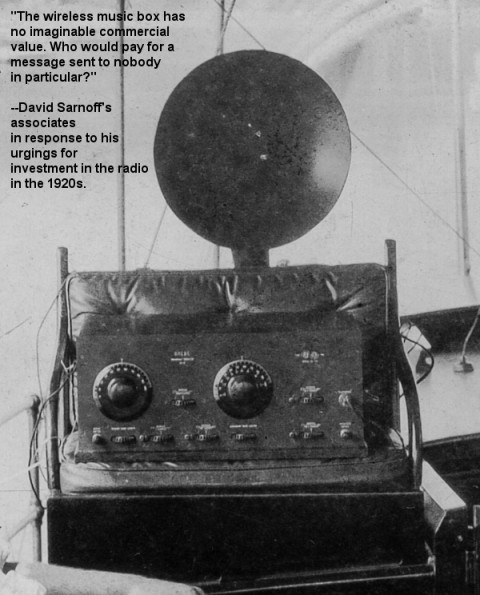
“The wireless music box has no imaginable commercial value. Who would pay for a message sent to nobody in particular?” — David Sarnoff’s associates in response to his urgings for investment in the radio in the 1920s.
David Sarnoff was an early pioneer in the promotion of wireless radio as a new technology. I asked Perplexity about the supposed response from investors, and it had this to say:
In summary, although the quote closely reflects real skepticism Sarnoff faced, there is no documented evidence that an investor sent this precise message to him—the wording appears to be apocryphal or retrospective, encapsulating broader contemporary attitudes
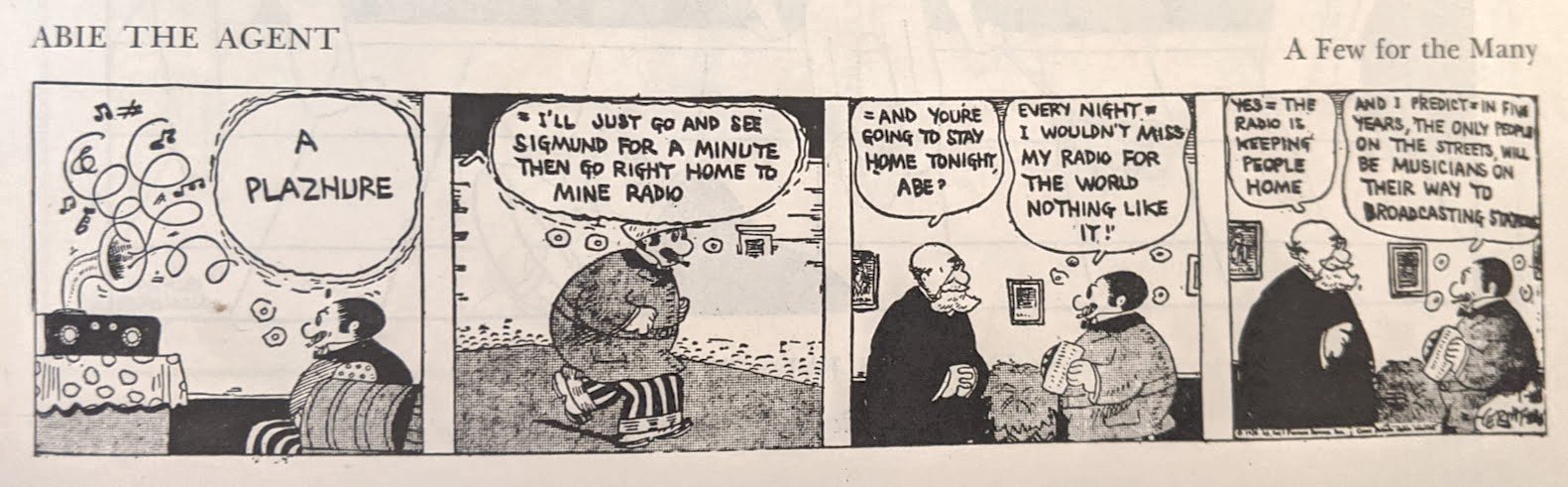
Obviously, “fear of the new, from those with a vested interest in the old” (from the Wondermark article linked above) didn’t keep the radio from becoming immensely popular.
The March of Technology
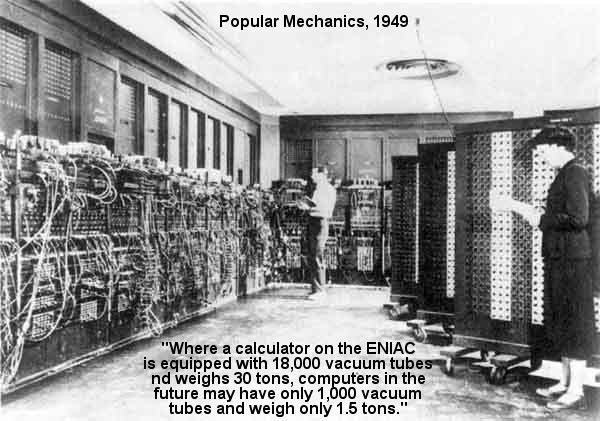
“Computers in the future may weigh no more than 1.5 tons.” attributed to Popular Mechanics from 1949
This is a true quote, but is often quoted out of context, unlike the quote in the image above. Popular Mechanics was making a forecast based on the technology of that time, suggesting computers could shrink significantly but still be very large by modern standards. This reflected an era when computers were massive and used vacuum tubes. The prediction was reasonable then but didn’t foresee transistor and integrated circuit breakthroughs that led to much smaller, lighter computers. You don’t know what you don’t know.
More about Computers
Once more, this quote is a misinterpretation; a very good background is found here. The short explanation is:
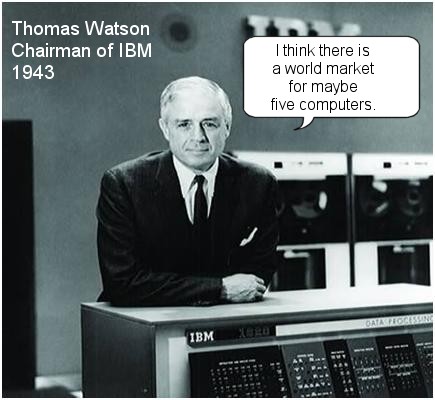
From a question on the history of IBM on their website, “Did Thomas Watson say in the 1950s that he foresaw a market potential for only five electronic computers?” IBM offers the following explanation:
We believe the statement that you attribute to Thomas Watson is a misunderstanding of remarks made at IBM’s annual stockholders meeting on April 28, 1953. In referring specifically and only to the IBM 701 Electronic Data Processing Machine — which had been introduced the year before as the company’s first production computer designed for scientific calculations — Thomas Watson, Jr., told stockholders that “IBM had developed a paper plan for such a machine and took this paper plan across the country to some 20 concerns that we thought could use such a machine. I would like to tell you that the machine rents for between $12,000 and $18,000 a month, so it was not the type of thing that could be sold from place to place. But, as a result of our trip, on which we expected to get orders for five machines, we came home with orders for 18.”
You don’t know what you don’t know
“I have traveled the length and breadth of this country and talked with the best people, and I can assure you that data processing is a fad that won’t last out the year.”
-The Editor in Charge of Business Books for Prentice Hall, 1957
“But what … is it good for?“
-Engineer at the Advanced Computing Systems Division of IBM, 1968, commenting on the microchip.
“There is no reason anyone would want a computer in their home.”
-Ken Olson, president, chairman and founder of Digital Equipment Corp., 1977
The three quotes above are not examples of obtuseness or stupidity, but rather the inability to predict the incredible rush of innovation that the computer industry would experience. I have written about the incredible shrinking data storage elsewhere, and even that article is now outdated; SanDisk has introduced a 4TB MicroSD card, whether or not something of this nature is even needed.
There’s nothing new under the sun
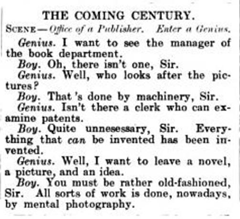
“Everything that can be invented has been invented.”
–Charles H. Duell, Commissioner, U.S. Office of Patents, 1899.
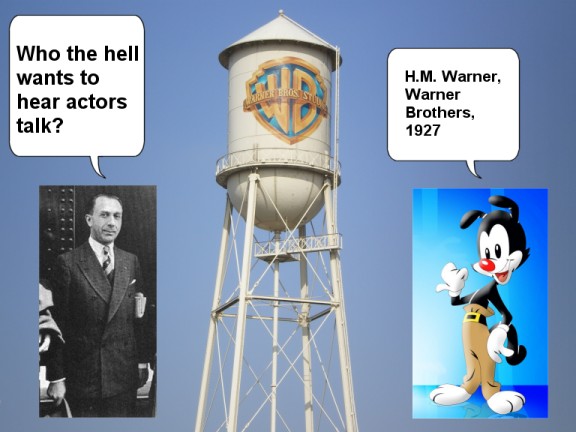
According to Quote Investigator, Warner probably said this but more confirmation would be useful. The linked article provides some interesting background about resistence to the inclusion of sound and voice in films, which up until that time were entirely silent.
There are many more “boneheaded quotes” out there, but the above dive into some of the most famous is an indication that each one deserves to be investigated for accuracy before spreading them around as 100% accurate.
This post was spawned by one of Heather Cox Richardson’s “Letters from an American” which was also posted on Facebook.
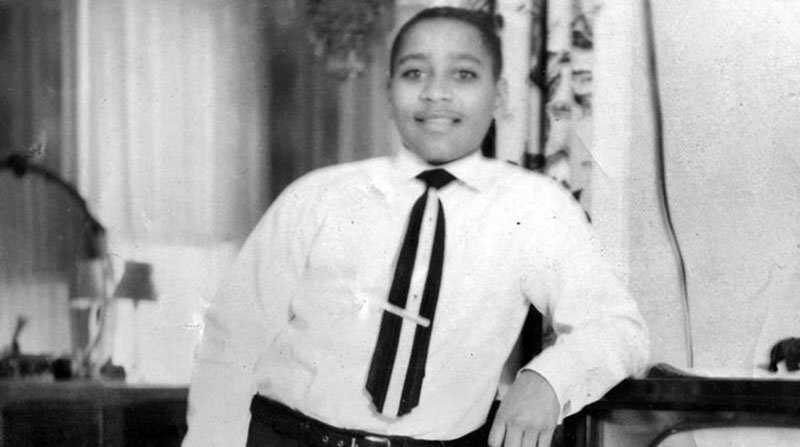
She wrote about the tragic 1955 murder of Emmett Till, an innocent 14-year-old boy, and about the hateful and unrepentant attitude of J. W. Milam, one of Till’s two killers.
Emmett Till
“What else could we do?” Milam said. “He was hopeless. I’m no bully. I never hurt a n* in my life. I like n*s, in their place (emphasis mine). I know how to work ’em. But I just decided it was time a few people got put on notice. As long as I live and can do anything about it, n*s are gonna stay in their place.”
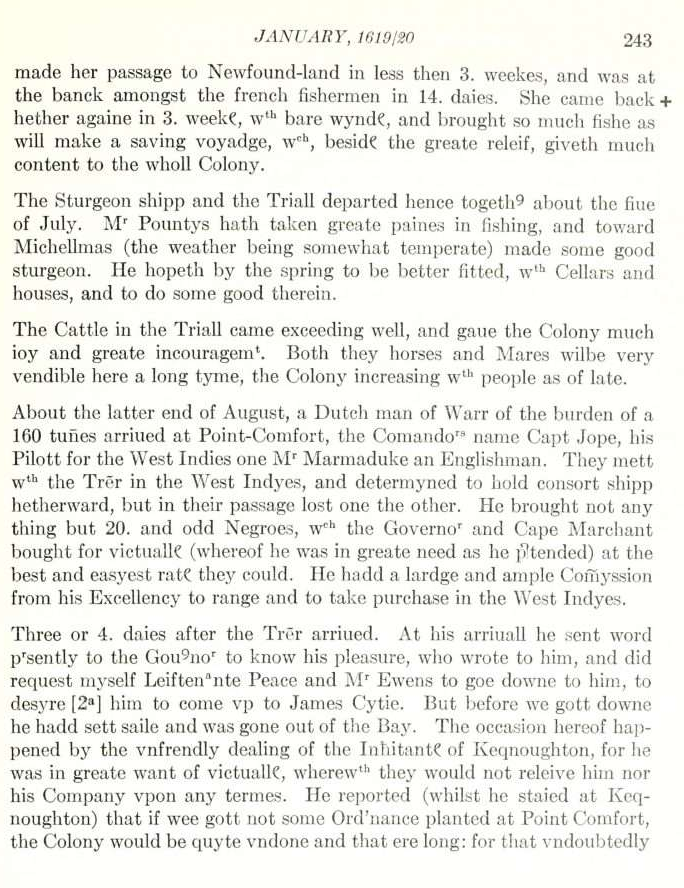
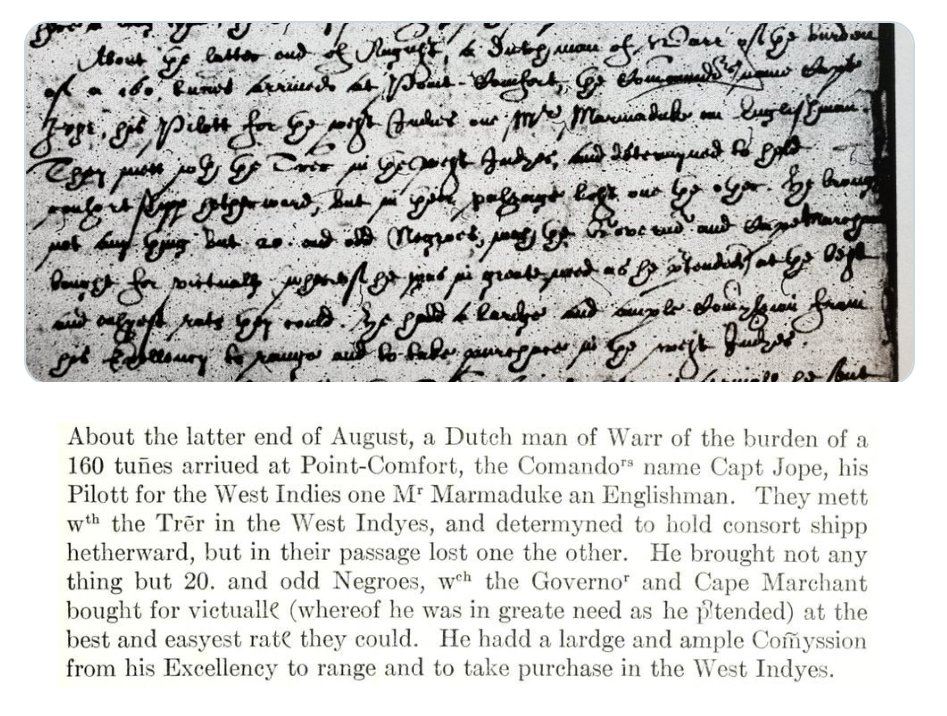
Milam’s attitude had it roots in 1620 when a Dutch man-of-war traded “20 and odd Negroes” for “victualle,” according to a letter from Virginia Colony secretary John Rolfe to Sir Edwin Sandys. From there, it evolved into a system of utter oppression and cruelty by whites, who used the principle of human bondage to treat their unfree laborers as less than cattle for their own petty satisfaction. These attitudes and the economy which arose as a result – largely the growing of cotton in the South – were officially and legally repudiated by the Civil War and subsequent amendments to the Constitution which guaranteed “life, liberty, and the pursuit of happiness” to all citizens, and not just wealthy white landowners – but the attitudes in the hearts of many in the South clearly did not die, as witnessed by the conditions that Blacks dealt with prior to the Civil Rights area, predominantly in the South.
While thinking about John Rolfe’s letter, I kept having flashbacks to elementary school, and of vague memories of learning about the arrival of the Dutch ship in Jamestown. I could have sworn that the text was recorded as “20. and odd negars,” (at that time the word was simply a corruption of the Portuguese word for “black,” and had not yet become the hateful slur of later times). So I started doing some digging, and was intrigued to find that I was not the only one who remembered things erroneously.
The following websites commemorating the 400th anniversary of the beginning of human bondage in America quote that passage from Rolfe’s letter in that manner:
Here is plainly transcribed “20. and odd Negroes.” If you were not sure about the accuracy of the transcription, below we can see a scan of the original letter:
Having been unsuccessful in finding any explanations on the Internet for the discrepancy, I turned to Perplexity, an AI search engine which provides references with everything it is able to find. What I asked:
“The first arrival of African slaves in America is recorded in a letter by Virginia colony secretary John Rolfe, in which he recounted – according to some – that a Dutch Man o’ War traded “20 and odd Negars” for “victuals.” But a scan of the letter itself shows that the word Rolfe used was “negroes,” and the Encyclopedia of Virginia provides an accurate transcript of the letter from Rolfe to Sir Edwin Sandys. Even a report from the Congressional Black Congress in 2019 uses the phrase “20 and odd Negars.” I want to know how Rolfe’s “negroes” was changed to “negars” in some reports.”
I was not unhappy with the result [emphasis added to the salient parts]:
John Rolfe’s 1619 letter documenting the first arrival of Africans in Virginia describes the sale of “20. and odd Negroes.” This exact phrase—using “Negroes”—is confirmed by direct transcripts from reputable sources such as the Encyclopedia of Virginia and republished excerpts of the letter, all of which indicate Rolfe wrote “Negroes” and not “Negars”.
The origin of the spelling “Negars” or its substitution for “Negroes” in some later reports seems to trace to evolving English usage and to historical misreadings or reinterpretations over time. Several factors contribute to this confusion:
The early 17th-century English language was not standardized, and words referring to people of African descent included a range of spellings—such as “negroes,” “negers,” “negars,” and, later, “[n-word]” — all derived from the Spanish and Portuguese “negro” (meaning black), and ultimately from the Latin “niger”.
The spelling “negars” appears in several 18th and 19th-century works, and was sometimes used interchangeably with “negroes” or as an early variant in American English, especially in regions influenced by Dutch or non-standard English dialects.
Some secondary sources and later historical writings incorrectly retrojected¹ these variant spellings into the context of 1619, perhaps due to faulty transcription practices, unfamiliarity with the original manuscript, or confusion regarding the shifting terminology used to describe African-descended people in colonial records.
In summary, John Rolfe’s original letter used the word “Negroes,” but through later historical reinterpretations, variances in early English spelling, and repeated citation errors, the term “Negars” emerged in certain secondary sources and reports. But direct examination of Rolfe’s correspondence confirms that “Negroes” was his actual word choice in the context of the 1619 arrival.
At least, at this point, I know that my original memory from my grade-school days was not imagined up, and have a good idea of what happened between John Rolfe’s penning his letter and subsequent reporting.
The Old Wolf has spoken.
Footnotes
¹ I love the word “retrojected,” to project into the past.
Note: This post is public. If you don’t like what’s being said here, leave your thoughts on your own wall. Comments supportive of MAGA, the GOP, or the Oligarchy will be summarily deleted.
—-
A few hours ago on the floor of the Senate, Bernie Sanders torched billionaires, scorched Trump, and burned every shred of political cowardice in his path.
Here is his fiery speech, word for word:
“Mr. President,
In the last couple of weeks, I’ve had the opportunity to travel in many parts of our country. And I have been able to talk to folks in Nebraska, in Iowa, Wisconsin, Michigan, Nevada, Colorado, and Arizona. And what I am hearing from in all of these states and in fact all over the country is that our nation right now faces enormous crises, unprecedented crises in the modern history of our country.
And how right now at this moment we respond to these crises will not only impact our lives, it will impact the lives of our kids and future generations. And in terms of climate change, the well-being of the entire planet.
And Mr. President, what I have to tell you is that the American people are angry at what is happening here in Washington, DC and they are prepared to stand up and fight back. In my view and what I have heard from many, many people is that they will not accept an oligarchic form of society where a handful of billionaires control our government, where the wealthiest person on Earth, Mr. Musk, is running all over Washington, DC slashing the Social Security Administration so that our elderly people today are finding it extremely difficult to access the benefits that they paid into.
Where Mr. Musk and his friends are slashing the Veterans Administration so that people who put their lives on the line to defend us will not be able to get the health care that they are entitled to or get the benefits that they are owed in a timely manner. Slashing the Department of Education. Slashing USAID.
And why is all of this slashing taking place? It is taking place so that the wealthiest people in this country can receive over $1 trillion dollars in tax breaks.
Now, I don’t care if you are a Democrat, a Republican, or an Independent. There are very few people in this country who think that you slash programs that working families desperately need in order to give tax breaks to billionaires.
Mr. President, I am the former chair of the U.S. Senate Committee on Veterans’ Affairs, and I have had the honor of meeting with veterans in my own state of Vermont—all over Vermont—but all over the country. These are the men and women who put the uniform of this country on and have been prepared to die to defend our nation and American democracy.
And these veterans and Americans all over our nation will not accept an authoritarian form of society with a president who undermines our Constitution every day. Every day there’s something else out there where he’s undermining our Constitution and threatening the very foundations of American democracy. That is not what people fought and died to allow to happen.
Mr. President, I am not a historian, but I do know that the founding fathers of this country were no dummies. They were really smart guys. And in the 1780s, they wrote a Constitution and established a form of government with a separation of powers.
A separation of powers—with an executive branch, the president; a legislative branch, the Congress; and a judicial branch.
These revolutionaries in the 1780s had just fought a war against the imperial rule of the King of England who was an absolute dictator, the most powerful person on Earth. And these revolutionaries here in America forming a new government wanted to make absolutely sure that no one person in this brand new country that they were forming would have unlimited powers.
And that is why we have a separation of powers. That is why we have a judiciary, a Congress, and an executive branch. In other words, way back in the 1780s, they wrote a Constitution to prevent exactly what Donald Trump is trying to do today.
So, let us be clear about what is going on. Donald Trump is attacking our First Amendment and is trying to intimidate the media and those who speak out against him in an absolutely unprecedented way.
Mr. President, he has sued ABC, CBS, Meta, the Des Moines Register. His FCC is now threatening to investigate NPR and PBS. He has called CNN and MSNBC “illegal.”
In other words, the leader—or the so-called leader—of the free world is afraid of freedom. He doesn’t like criticism. Well, guess what? None of us like criticism. But you don’t get elected to the Senate, you don’t get elected to the House, you don’t become a governor, you don’t become a president of the United States unless you are prepared to deal with that criticism.
And the response to that criticism in a democracy is not to sue the media, is not to intimidate the media. It’s to respond in the way you think best.
But Mr. President, it is not just the media that Trump is going after. He is going after the constitutional responsibilities that this body, the United States Congress, has. And I will say it amazes me, it really does, how easily my Republican colleagues here in the Senate and in the House are willing to surrender their constitutional responsibilities. Give it over to the president.
Trump has illegally and unconstitutionally withheld funds that Congress has appropriated. You can’t do that. Congress has the power of the purse. We make a decision. We argue about it here. Big debates, vote-aras, the whole thing. Make that decision. That money goes out. The president does not have the right to withhold funds that Congress has appropriated.
Trump has illegally and unconstitutionally decimated agencies that can only be changed or reformed by Congress. You don’t like the Department of Education, you don’t like USAID, fine. Come to the Congress. Tell us what reforms you want to see. You do not have the right to unilaterally do away with these agencies.
Trump has fired members of independent agencies and inspectors general that he does not have the authority to do.
But Mr. President, it is not just the media that he is trying to intimidate. It is not just the powers of Congress that he wants.
Now, in an absolutely outrageous, unconstitutional and extraordinarily dangerous way, he is going after the judiciary. His view is that if you don’t like a decision that a judge renders, you get rid of that judge. You try to impeach that judge. You intimidate judges so that you get the decisions that you want.
You know, I’m thinking back now as someone who is not a supporter of the Roberts court, and I’m thinking about one of the worst Supreme Court decisions that has ever been rendered—that is Citizens United. I’ll say more about that in a moment. And I’m thinking about the Supreme Court’s decision to overturn Roe v. Wade, taking away American women’s right to control their own bodies.
In my view, these were outrageous decisions, unpopular decisions. But it never occurred to me, because maybe I’m old-fashioned and conservative, and I believe that you live by the rule of law, to say, “Hey, look at the decision Roberts made. We’re going to impeach him.”
No, we try to elect a new president who’s going to appoint new Supreme Court justices. That is the system that people have fought and died to defend.
But it’s not just the movement toward oligarchy, which is outraging millions of Americans—Democrats and Republicans, by the way—and it’s not just the movement toward authoritarianism that we are seeing. The American people, especially with Mr. Musk and 13 billionaires in the Trump administration running agency after agency…
The American people are saying as loudly as they can that they will not accept a society of massive economic and wealth inequalities, where the very richest people in our country are becoming much richer while working families are struggling to put food on the table.
Having gone all over this country, I can tell you that the American people are sick and tired of these inequalities and they want an economy that works for all of us—not just the 1%.
You know, Mr. President, we deal with a whole lot of stuff here in the Congress, and you know, virtually all of it is important in one way or another.
But let’s do something, you know, fairly radical today. Let’s try to tell the truth—the real truth—about what is going on in our society today. Something that we don’t talk about too much here in the Senate. We don’t talk about it too much in the House. We don’t talk about it too much in the corporate media.
But the reality is that today we have two Americas. Two very, very different Americas.
And in one of those Americas, the wealthiest people have never ever had it so good. In the whole history of our country, the people on top have never ever had it so good as they have it today.
Today, we have more income and wealth inequality than there has ever been in the history of America. Now, I know we don’t discuss it. You don’t see it much on TV. You don’t hear it talked about here at all. But the American people do not believe that it is appropriate that three people—one, two, three—Mr. Musk, Mr. Bezos, and Mr. Zuckerberg, three Americans, own more wealth than the bottom half of American society. 170 million people. Really? Three people own more wealth than 170 million people? Anybody here think that is vaguely appropriate?
And by the way, those very same three people—the three richest people in America—were right there at Trump’s inaugural, standing right behind the president. So, you want to know what oligarchy is? I know there’s some confusion out there. What is oligarchy? Well, it starts off when you have the three wealthiest people in the country standing right behind the president when he gets inaugurated.
The top 1% in our country now own more wealth than the bottom 90%.
CEOs make 300 times more than their average worker.
And unbelievably—real inflation-accounted-for wages today—the average American worker, if you can believe it, despite a massive increase in worker productivity, is lower today than it was 52 years ago. And during that period, there was a $75 trillion transfer of wealth that went from the bottom 90% to the top 1%. That is the reality of the American economy today. And you know what? Maybe we might want to be talking about that.
And in our America today, in that top America, that one America, the 1% are completely separate and isolated from the rest of the country. You think they get on a subway to get to work? Think they sit in a traffic jam for an hour trying to get to work? Not the case.
They fly around in the jets and the helicopters that they own. They live in their mansions all over the world in their gated communities. They have nannies taking care of their babies. They don’t worry about the cost of child care. And they send their kids to the best private schools and colleges.
Sometimes they vacation not in a Motel 6, not in a national park, but on the very own islands that they have. And on occasion, for the very very richest—just to have for a kick, have a little bit of fun—maybe they’ll spend a few million dollars flying off into space in one of their own spaceships. Sounds like fun.
But it is not just massive income and wealth inequality that we’re dealing with today. We have more concentration of ownership than ever before. While the profits on Wall Street and corporate America soar, a handful of giant corporations dominate sector after sector—whether it’s agriculture, transportation, media, financial services, etc., etc.
Small number of huge corporations—international corporations—dominating sector after sector. And as a result of that concentration of ownership, they are able to charge the American people outrageously high prices for the goods and services we need.
Mr. President, we don’t talk about it too much. Maybe we should. But there are three Wall Street firms—BlackRock, Vanguard, and State Street—that combined are the major stockholders in 95% of our corporations. Got that? Three Wall Street firms—three—are the major stockholders in 95% of American corporations.
So, Mr. President, that is one America. People on top doing phenomenally well. Not only do they have economic power, they have enormous political power. That’s what’s going on there. They live like kings. That’s one America.
But there is another America.
And in that other America, 60% of our people are living paycheck to paycheck. And millions of workers from one end of this country to the other are trying to survive on starvation wages.
And unlike Donald Trump, I grew up in a family that lived paycheck to paycheck. And I know the anxieties that my mom and dad had, living in a rent-controlled apartment. Can we afford to buy this? Why did you buy that?
And that’s the story taking place all over America.
What does living paycheck to paycheck mean?
It means that every single day, millions of Americans worry about how they’re going to pay their rent or their mortgage. All over the country, rents are skyrocketing. And people are wondering: What happens—what happens to me and my kids if rent goes up by 20% and I can’t afford it? Where do I live? Do I have to take my kid out of school? Where do I put my kid? In worst case scenario, do I live in my car?
Let’s be clear. There are many people who are working today who are living in the back of their cars.
How do I pay for child care?
I talked to a cop, a guy the other day—a police officer—spending $20,000 a year for child care.
How do I buy decent food for my kids when the price of groceries is off the charts?
What happens if I get sick or my kid gets sick or my mother gets sick and I got a $12,000 deductible and I can’t afford to go to the doctor?
How, at the end of the month, am I going to pay my credit card bill—even though I am being charged 20 or 30% interest rates by the usurious credit card companies?
People are worrying about simple things. What happens if my car breaks down and the guy at the repair shop says it’s going to cost $1,000 and I don’t have $1,000 in the bank? And if I don’t have a car, how do I get to work? And if I don’t get to work, how do I have an income? And if I don’t have an income, how do I take care of my family?
Those are the crises that millions of Americans are experiencing today.
But it’s not just working-age Americans.
Today, in our country, half of older workers—older workers—have nothing in the bank as they face retirement. And they’re watching TV and they’re saying, “Mr. Musk is firing Social Security workers,” and actually worrying whether Social Security will be there for them.
And it’s not just older workers with nothing in the bank wondering what happens when they retire. Twenty-two percent of seniors are trying to survive on $15,000 a year.
I dare anybody in this country—let alone somebody who’s old, who needs health care, needs to keep the house warm—try to survive on $15,000 a year. And there are people here, by the way, talking about cutting Social Security.
Mr. President, it is not just about income and wealth inequality. It is about a health care system which everyone in the nation understands is broken, is dysfunctional, and is outrageously expensive.
I hear my Republican friends—you know, I don’t know where they are today—wanting to destroy the ACA. And my Democratic friends say, “Oh, we got to defend the ACA.” ACA is broken. It doesn’t work.
In my state, the cost of health care is going up 10, 15%. In America today, you got 85 million people uninsured or underinsured.
Function of the health care system today is not to do what a sane society would do—guarantee health care to all people in a cost-effective way—something which, by the way, every other major nation on Earth manages to do.
The function of our health care system, as everybody knows, is to make billions of dollars in profits for the insurance companies and the drug companies.
So I say to my Democratic friends: It’s not good enough to defend the Affordable Care Act. It’s a broken system. You got to have the guts to stand up and allow us to do what every other major nation does—guarantee health care to all people as a human right—not allow the drug companies and the insurance companies to make massive profits every year.
And Mr. President, I want to touch on an issue that gets virtually no discussion, but I think it is enormously important—and it says a hell of a lot about what’s going on in our society today.
In America, according to international studies, our life expectancy—how long we live as a people—is about four years lower than other countries. Most European countries—people there live longer lives. Japan—they live even more longer lives than in Europe.
So, question number one: Why is that happening?
We spend $14,000 a year per person on health care—almost double what any other country spends. And yet people around the world are living, on average, four years longer than we do.
But here is the really ugly fact—even worse than that.
And that is that in this country, on average, if you are a working-class person, you will live seven years shorter lives than if you’re in the top 1%. If you’re a working-class person, your life will be seven years shorter than if you are wealthy.
In other words, being poor or working-class in America today amounts to a death sentence.
Mr. President, it’s not only a broken health care system.
We have got to ask ourselves a simple question—and the Biden administration began a little bit of movement in this direction—and that is: Why are we living in a nation where one out of four people can’t even afford the prescription drugs their doctors prescribe?
Why are we in some cases paying ten times more than our neighbors in Canada or in Europe? How does that happen?
And the answer of course has to do with the greed of the pharmaceutical industry and their power right here—all of the campaign contributions that they make—which has prevented us from negotiating prices.
But it’s not just health care or prescription drugs.
When we look at what’s going on in America—in Vermont and throughout this country—we have a major housing crisis. Here we are, the richest country on Earth: 800,000 people sleeping out on the streets, and 20 million people are spending more than 50% of their limited incomes on housing.
Can you imagine that? You’re a working person, spending 50% of your income on housing. How do you have money to do anything else? And the cost of housing is soaring.
Do not tell me, Mr. President, that in a nation which could spend a trillion dollars on the military—a nation that gives massive tax breaks to the rich—that we cannot build the millions of units of housing that we desperately need.
So, Mr. President, why is all of this happening?
Why do we have a health care system that is broken? Prescription drugs that are the most expensive in the world? A housing system? Education in deep trouble?
Talked to educators in Vermont, all over the country. Talked to a principal the other day from Vermont. Their starting salary at a public school? $32,000 a year. But don’t worry—they can’t afford to even bring people in because they can’t afford the housing in the community.
Why have we let education sink to the level that it has?
So I think the bottom line of all this is: The American people, I think, are catching on. And Mr. Musk—I must thank him—because he has made it very clear we are living in an oligarchic form of society.
If anybody out there thinks that Mr. Musk is running around out of the goodness of his heart trying to make our government more efficient, you have not a clue as to what is going on.
What these guys want to do is destroy virtually every federal program that impacts the well-being of working people—Social Security, Medicare, postal service, public education, you name it—so they can get huge tax breaks for the rich and eventually make government so inefficient that they will have the ability, as large corporations, to come in and privatize everything that is going on.
So, Mr. President, this is a pivotal moment in American history. And I sense that the American people have had it up to here.
They are prepared to fight back.
They do not want a government run by billionaires who have it all—whose greed is uncontrollable.
You know, we have in Vermont—and I think a lot of this country—serious problems with addiction, with drugs. People drinking too much alcohol. People smoking too many cigarettes.
But the worst form of addiction that this country now faces is the greed of the oligarchy.
You might think that if you had 10, 20 billion dollars, it would be enough. You know—kind of enough to let your family live for the next 20 generations.
But it’s not.
For whatever reason—whatever compulsive reason they have—these guys want more and more and more, and they are prepared to destroy Social Security, Medicare, nutrition programs for hungry people in order to get even more.
That, to me, is disgusting.
So, Mr. President, we are at a pivotal moment in American history. But having been all over this country—or many parts of this country—I am absolutely confident that the American people (and I’m not just talking about Democrats, who are as complicit in the problems that we have right now as our Republicans, because we got a two-party system which is basically corrupt)…
You got Mr. Musk over on the Republican side saying to any Republican who dares to stand up and defy the Trump agenda, we are going to primary you.
And on the Democratic side, you got AIPAC and you got other super PACs saying, you stand up for working people—you’re in trouble as well.
We got a corrupt campaign finance system in which billionaires are able to buy elections. And that’s why all over this country, people are not happy with our two-party system—the Republicans and the Democrats.
So, Mr. President, this is a pivotal moment in American history.
But we have had difficult moments before. And I am confident, from the bottom of my heart, that if we stand together, and we do not allow some right-wing extremists to divide us up by the color of our skin, or our religion, or where we were born, or our sexual orientation…
If we stand together, we can save this country. We can defeat oligarchy. We can defeat the movement toward authoritarianism. And in fact, we can create an economy and a government that works for all—not just a few.”
—-
This nation needs more Bernies. More AOC’s. More people with good hearts and common sense who are willing to stand up to the fascists, the dictators, and the oligarchs who are raping our country for their own enrichment.
NOTE: This entry is a trip down memory lane, but be warned: At the end it gets political. As a result, I’ve disabled comments for this post. If you disagree with anything here, the Web is open – write your own blog. I have nothing against respectful dialog, but the Internet being what it is, I have no time for trolls.
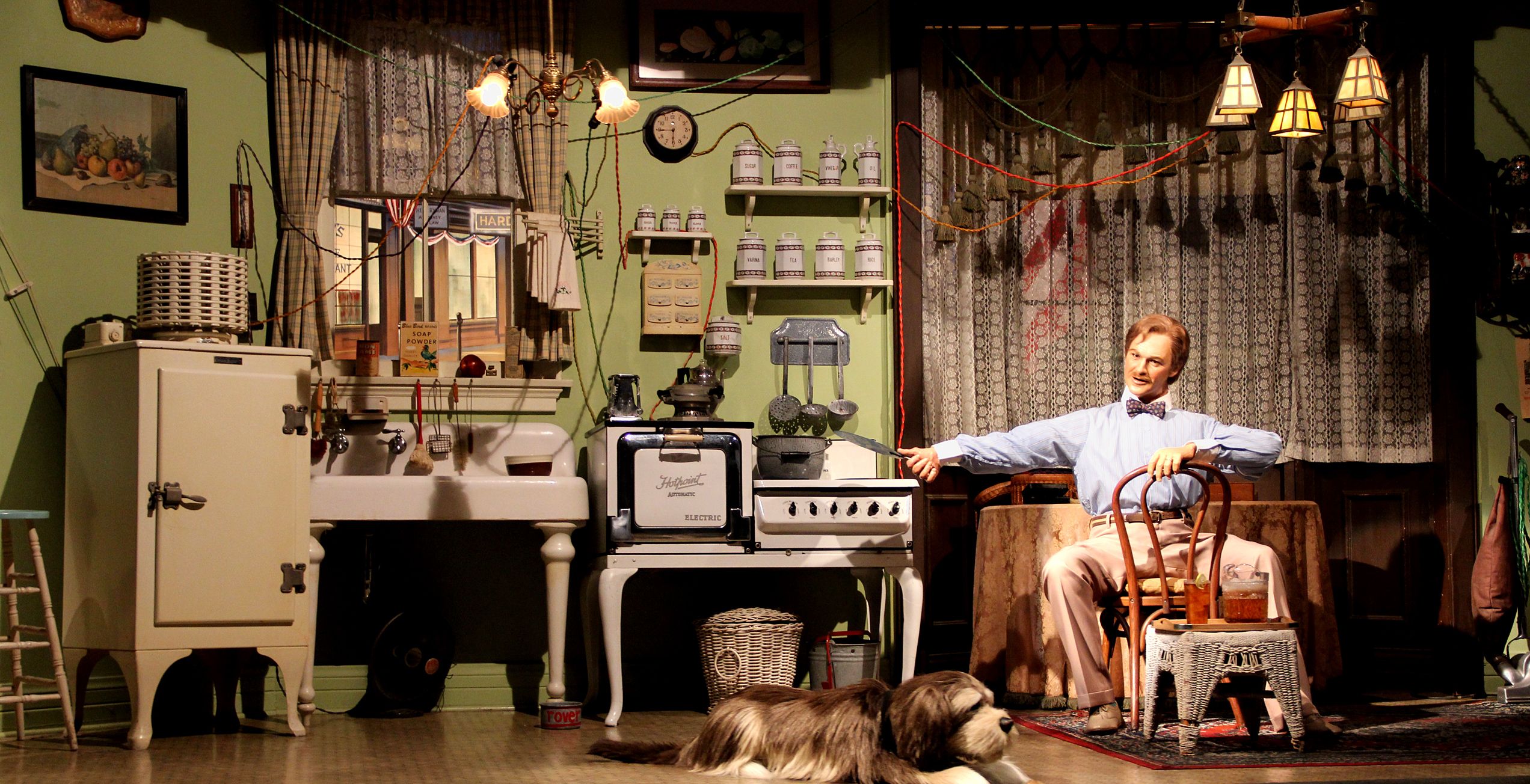
I first encountered this lovely exhibit when I attended the New York World’s Fair in 1965. Of all the presentations at the Expo (aside from the food – Belgian waffles, mmm) – along with the Picturephone demonstration, this is the one that stuck in my mind.
After the fair closed, the ride was moved to Disneyland, where I experienced it again, and thereafter found a home in Disney World in Florida, which we visited just last week. It was lovely to reminisce.
The 1900s. Life couldn’t be better with all the modern conveniences like gas lamps… and soon they’re supposed to have electric lights in the house!
As with anything, the ride did get a few updates over the years:
Notice in this version it’s Valentine’s Day – and the model has had a bit of an update as well.
The 1920’s. Electricity and gas are everywhere, and life couldn’t possibly be better. Happy 4th of July!
Hallowe’en in the 1940’s – this looks a lot like kitchens that I grew up with in the 50s.
Christmas in the 1960s – this tableau has now been supplanted by a 21st-Century version – in the back is a view of Disney’s model city of the future, part of the original idea behind EPCOT (Experimental Planned Community of Tomorrow). Which, unfortunately, because our nation has been focused on flinging its precious human and material resources into unwinnable and futile conflict, has yet to become a reality – despite that dream.
Another view of the 1960s.
The 21st Century – (click for a larger view). Most of what you see here is now real, including much better graphics on Virtual Reality devices.
If our 45th president and the climate-change deniers have their way, it might be necessary to replace the last tableau with one like this.
There’s a great, big, beautiful tomorrow Shining at the end of every day There’s a great, big, beautiful tomorrow And tomorrow’s just a dream away
Man has a dream and that’s the start He follows his dream with mind and heart And when it becomes a reality It’s a dream come true for you and me
The only dream of our current “leaders” seems to be to violate the planet, exterminate the poor and the different, and add to the bottom line of the wealthy. I do not support this, I will not support this, I will not be silent – or I will never be able to look my children and grandchildren in the eye with honor.
The image above shows two young girls purchasing a so-called “10,000-calorie sundae” from Blair Parson’s store in Lynchburg, Virginia, sometime in the 1950s. Price: 35¢.
Odds are that this was some marketing license; the average hot fudge sundae comes in at about 284 calories, and these don’t look like killers. But it’s a cute picture.
An inspiring work from a daughter of a calligrapher for the United States Treasury Department. Louise E. Jefferson is a fascinating figure that was a key part of the Harlem Artist Guild, author and mapmaker. Here her map for the many peoples that made the nation in the 1940’s
Our nation was built on the back of so many people, I find it surprising that a very small group of people are claiming this country as “theirs” and doing all they can to keep others out. This map is intriguing and historically revealing.
Colored School at Anthoston.
Census 27, enrollment 12, attendance 7. Teacher expects 19 to be enrolled after work is over. “Tobacco keeps them out and they are short of hands.” Ages of those present: 13 years = 1, 10 years = 2, 8 years = 2, 7 years = 1, 5 years = 1. Location: Henderson County, Kentucky
There appears to be no information regarding photographer or date, but it’s an intriguing photo.
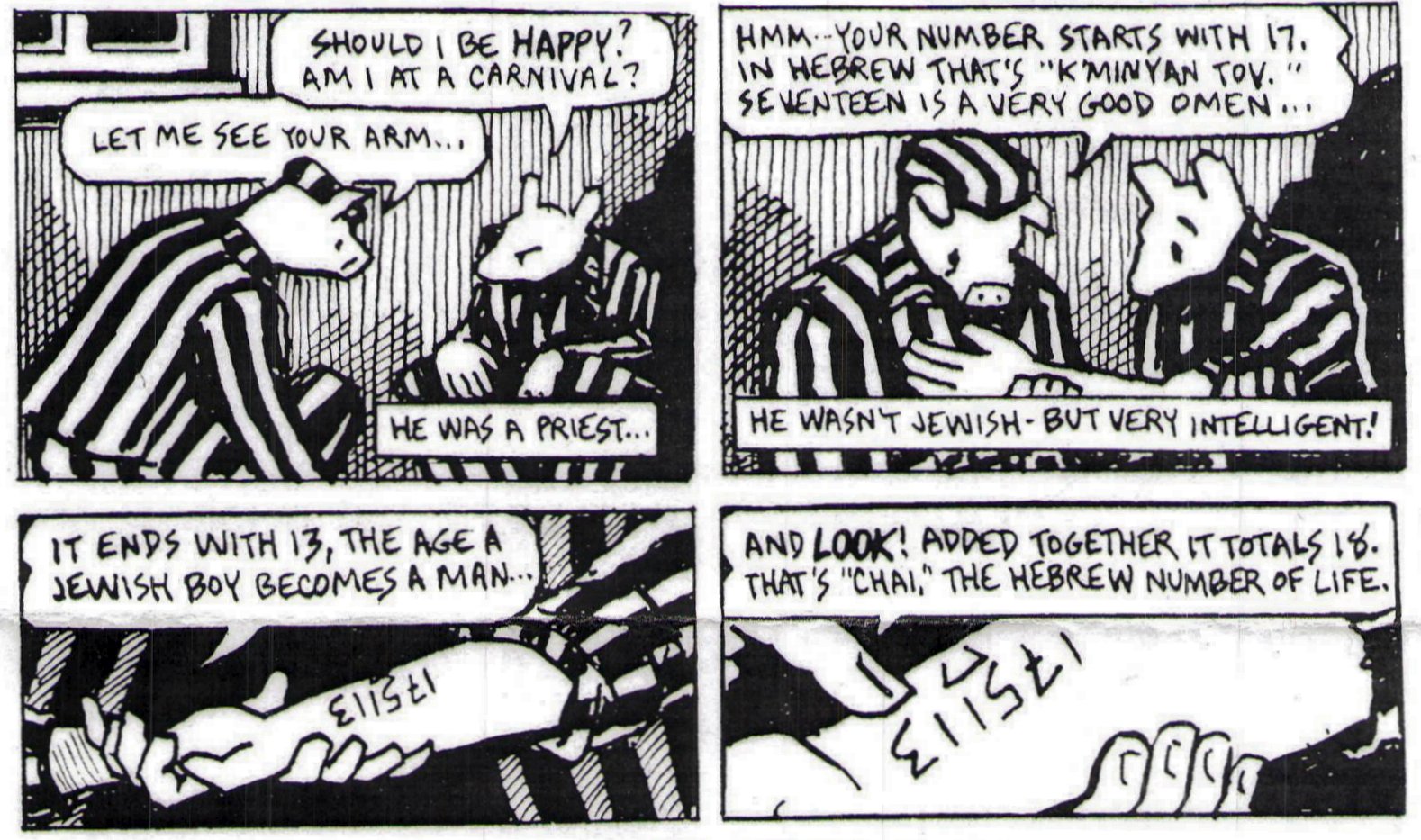
I have long loved and respected the work of Art Spiegelman, author of Maus and Maus II, two graphic novels which autobiographically recount the experiences of his father Vladek through World War II and the years previous.
One thing in his account puzzled me, though – the exchange recounted in the panels below, just after Vladek arrives at Auschwitz.
I had no idea why the priest said that 17 in Hebrew was “kminyan tov,” because seventeen is “shiv’a ‘asar.” The internet didn’t help, because every reference to “k’minyan tov” led back to Spiegelman’s work. I was stumped. It turns out I just didn’t know enough about Hebrew or kabbalistic customs.
After letting the matter rest for about five years, during which interval I began a study of modern Hebrew, I returned to it with a vengeance and did some more digging.
The Polish priest was learned in the ways of gematria, or the mystical assignment of numerical values to Hebrew letters, and divining meaning from how words add up; I first became aware of gematria when I read The Chosen by Chaim Potok.
I was coming at my puzzle all wrong, assuming that minyan was referring to the quorum of ten Jewish male adults required for certain religious obligations. The word itself also means “count,” with “k’minyan” meaning “like the count of.” That expression appears to be used almost exclusively in referring to values in gematria. Look at this post in a forum:
A week or two ago, a posting on the number of brakhot in shmoneh esrei suggested, IIRC, something like that the addition of birkat ha-minim in E”Y changed the 18 to 19. It appears, however that in E”Y there were originally 17 b’rakhot, gematria tov and the addition of birkat ha-minim made it 18, k’minyan chai.
This entire sentence is far over my head in terms of understanding the context, but to have found the expression in an external source was significant. It seems then that this phrase can be read “like the count of ____”, whatever number is being referred to.
Thus the priest reads Vladek’s number (175113) and notes that the first two numbers are 17 – with “טוב” (tov, meaning “good”) being the numbers 9+ 6+ 2 (each Hebrew letter is assigned a value corresponding to its position in the alphabet). Hence “tov” has the value 17; “k’minyan tov” can be interpreted in this case as “like the count of ‘good’.) This would be seen as a good omen. Another interpretation I found indicates that 17 would indicate the 10 men necessary for a minyan, plus seven more, making it a “good minyan” or a “strong prayer group.” I can’t speak to the accuracy of this interpretation, but it’s interesting nonetheless – this was the first thing that occurred to me, and it didn’t make sense. Now it does. Sorta.
Vladek’s priest friend notices that 1+7+5+1+1+3 equal 18, and the Hebrew word for “life” (חי – chai) is composed of the numbers 10 + 8, or 18, the number referred to in the quote above, which could be read as “like the count of ‘life’.” And this was sufficient for Vladek to express the feeling that he had been given another life. Vladek escaped, and the priest was never seen again.
I don’t think I have the intellectual discipline to pursue this any farther, but my curiosity has been silenced. At least I understand the basic meaning of what Spiegelman was relating in this scene, and that will have to do.
The Old Wolf has spoken.
(For what it’s worth, “Old Wolf” in English gematria is 522, which has the same value as Truth, Birthday, Stephen, Russia, Muslim, Bill Gates, Twelve, Justice, Victor, Vincent, Rand Paul, Priest, Person, Nothing, Lotus, Hail Mary, Yahuwah, Street, Stealing, The Sun, Blessing, Elishone, Cnaan Aviv, Noahs Ark, Elohiym, Lee Vayle, Dustin, Democracy, Praises, Potato, Euro Bay, String, Taav Aaleph, Myth U, Ninety, Baptist, Crackpot, Company, Inside Job, Architect, God Of Buddha, Different, Cotton, Buddhist, The Eyes, Chin Woo, Diaper Dude, Project, Break The Ice, Manifest, Charlemagne, Helsinki, Mackenzie, Gram Of Fat, Oh My God, Gnostic, Archigonic, Samskarda, Tornado, Forecast’, Paternal, Ho Chi Minh, Natural, Black On Black, Dream Logic, Swedish, Sonnet, Mind Of God, Cortez, Paul Rand, Indeed Jobs, Shelter, My Garden, Get Hay At, Consider, King Of All, Vietnam C, All Is One, Veronica, Punish, Fulfilled, Sam Bowie, The Gilded Age, Whether, Def Leppard, Get A T Hay, Pat Crock, טרוטה Truth, Canaanites, Dependent, Lumpy, Fallout, Frighten, Happily, Sticky, Pell Mell, The Mayan, Idiocracy, Pitagora, and Got Milk. Make of that what you will.)






















 Playing in the World Game