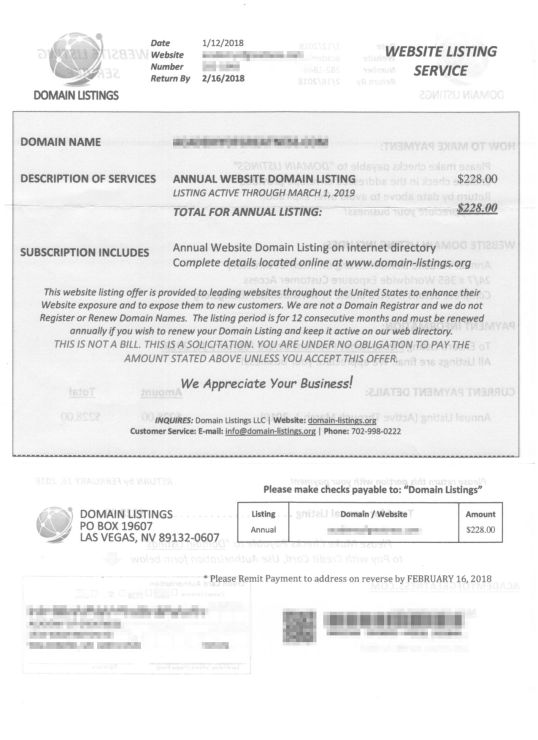
For a while now, people have been receiving deceptive solicitations from a company called “Domain LIstings, PO Box 19607, Las Vegas, NV 89132-0607.” I got one just last week.
You can see the letter they send out below:
The letter is designed to think that you have to pay to re-register your domain, but this outfit is nothing more than an American version of the “World Business List” – offering worthless services for an outrageous fee.
Please note that these bottom-feeders offer you virtually nothing that Google doesn’t do for free. Their “directory” will not give you a whit of exposure. They offer 24/7/365 exposure, which is exactly what you get when Google and the other search engines crawl your site.
Jenny Holzer (born July 29, 1950, Gallipolis, Ohio) is an American neo-conceptual artist, based in Hoosick Falls, New York. The main focus of her work is the delivery of words and ideas in public spaces.
Holzer belongs to the feminist branch of a generation of artists that emerged around 1980, looking for new ways to make narrative or commentary an implicit part of visual objects. Her contemporaries include Barbara Kruger, Cindy Sherman, Sarah Charlesworth, and Louise Lawler.
Holzer’s initial public works, Truisms (1977–79), are among her best-known. They first appeared as anonymous broadsheets that she printed in black italic script on white paper and wheat-pasted to buildings, walls and fences in and around Manhattan. These one-liners are a distillation of an erudite reading list from the Whitney Independent Study Program, where she was a student. She printed other Truisms on posters, T-shirts and stickers, and carved them into stone benches. In late 1980, Holzer’s mail art and street leaflets were included in the exhibition Social Strategies by Women Artists at London’s Institute of Contemporary Arts, curated by Lucy Lippard.
Her list of truisms follows below. While I don’t agree with all of her thoughts, cut from whole cloth, I find value in many of them. Your mileage may vary.
A little knowledge can go a long way.
A lot of professionals are crackpots.
A man can’t know what it is to be a mother.
A name means a lot just by itself.
A positive attitude means all the difference in the world.
A relaxed man is not necessarily a better man.
A sense of timing is the mark of genius.
A sincere effort is all you can ask.
A single event can have infinitely many interpretations.
A solid home base builds a sense of self.
A strong sense of duty imprisons you.
Absolute submission can be a form of freedom.
Abstraction is a type of decadence.
Abuse of power comes as no surprise.
Action causes more trouble than thought.
Alienation produces eccentrics or revolutionaries.
All things are delicately interconnected.
Ambition is just as dangerous as complacency.
Ambivalence can ruin your life.
An elite is inevitable.
Anger or hate can be a useful motivating force.
Animalism is perfectly healthy.
Any surplus is immoral.
Anything is a legitimate area of investigation.
Artificial desires are despoiling the earth.
At times inactivity is preferable to mindless functioning.
At times your unconsciousness is truer than your conscious mind.
Automation is deadly.
Awful punishment awaits really bad people.
Bad intentions can yield good results.
Being alone with yourself is increasingly unpopular.
Being happy is more important than anything else.
Being judgmental is a sign of life.
Being sure of yourself means you’re a fool.
Believing in rebirth is the same as admitting defeat.
Boredom makes you do crazy things.
Calm is more conductive to creativity than is anxiety.
Categorizing fear is calming.
Change is valuable when the oppressed become tyrants.
Chasing the new is dangerous to society.
Children are the most cruel of all.
Children are the hope of the future.
Class action is a nice idea with no substance.
Class structure is as artificial as plastic.
Confusing yourself is a way to stay honest.
Crime against property is relatively unimportant.
Decadence can be an end in itself.
Decency is a relative thing.
Dependence can be a meal ticket.
Description is more important than metaphor.
Deviants are sacrificed to increase group solidarity.
Disgust is the appropriate response to most situations.
Disorganization is a kind of anesthesia.
Don’t place to much trust in experts.
Drama often obscures the real issues.
Dreaming while awake is a frightening contradiction.
Dying and coming back gives you considerable perspective.
Dying should be as easy as falling off a log.
Eating too much is criminal.
Elaboration is a form of pollution.
Emotional responses ar as valuable as intellectual responses.
Enjoy yourself because you can’t change anything anyway.
Ensure that your life stays in flux.
Even your family can betray you.
Every achievement requires a sacrifice.
Everyone’s work is equally important.
Everything that’s interesting is new.
Exceptional people deserve special concessions.
Expiring for love is beautiful but stupid.
Expressing anger is necessary.
Extreme behavior has its basis in pathological psychology.
Extreme self-consciousness leads to perversion.
Faithfulness is a social not a biological law.
Fake or real indifference is a powerful personal weapon.
Fathers often use too much force.
Fear is the greatest incapacitator.
Freedom is a luxury not a necessity.
Giving free rein to your emotions is an honest way to live.
Go all out in romance and let the chips fall where they may.
Going with the flow is soothing but risky.
Good deeds eventually are rewarded.
Government is a burden on the people.
Grass roots agitation is the only hope.
Guilt and self-laceration are indulgences.
Habitual contempt doesn’t reflect a finer sensibility.
Hiding your emotions is despicable.
Holding back protects your vital energies.
Humanism is obsolete.
Humor is a release.
Ideals are replaced by conventional goals at a certain age.
If you aren’t political your personal life should be exemplary.
If you can’t leave your mark give up.
If you have many desires your life will be interesting.
If you live simply there is nothing to worry about.
Ignoring enemies is the best way to fight.
Illness is a state of mind.
Imposing order is man’s vocation for chaos is hell.
In some instances it’s better to die than to continue.
Inheritance must be abolished.
It can be helpful to keep going no matter what.
It is heroic to try to stop time.
It is man’s fate to outsmart himself.
It is a gift to the world not to have babies.
It’s better to be a good person than a famous person.
It’s better to be lonely than to be with inferior people.
It’s better to be naive than jaded.
It’s better to study the living fact than to analyze history.
It’s crucial to have an active fantasy life.
It’s good to give extra money to charity.
It’s important to stay clean on all levels.
It’s just an accident that your parents are your parents.
It’s not good to hold too many absolutes.
It’s not good to operate on credit.
It’s vital to live in harmony with nature.
Just believing something can make it happen.
Keep something in reserve for emergencies.
Killing is unavoidable but nothing to be proud of.
Knowing yourself lets you understand others.
Knowledge should be advanced at all costs.
Labor is a life-destroying activity.
Lack of charisma can be fatal.
Leisure time is a gigantic smoke screen.
Listen when your body talks.
Looking back is the first sign of aging and decay.
Loving animals is a substitute activity.
Low expectations are good protection.
Manual labor can be refreshing and wholesome.
Men are not monogamous by nature.
Moderation kills the spirit.
Money creates taste.
Monomania is a prerequisite of success.
Morals are for little people.
Most people are not fit to rule themselves.
Mostly you should mind your own business.
Mothers shouldn’t make too many sacrifices.
Much was decided before you were born.
Murder has its sexual side.
Myth can make reality more intelligible.
Noise can be hostile.
Nothing upsets the balance of good and evil.
Occasionally principles are more valuable than people.
Offer very little information about yourself.
Often you should act like you are sexless.
Old friends are better left in the past.
Opacity is an irresistible challenge.
Pain can be a very positive thing.
People are boring unless they are extremists.
People are nuts if they think they are important.
People are responsible for what they do unless they are insane.
People who don’t work with their hands are parasites.
People who go crazy are too sensitive.
People won’t behave if they have nothing to lose.
Physical culture is second best.
Planning for the future is escapism.
Playing it safe can cause a lot of damage in the long run.
Politics is used for personal gain.
Potential counts for nothing until it’s realized.
Private property created crime.
Pursuing pleasure for the sake of pleasure will ruin you.
Push yourself to the limit as often as possible.
Raise boys and girls the same way.
Random mating is good for debunking sex myths.
Rechanneling destructive impulses is a sign of maturity.
Recluses always get weak.
Redistributing wealth is imperative.
Relativity is no boon to mankind.
Religion causes as many problems as it solves.
Remember you always have freedom of choice.
Repetition is the best way to learn.
Resolutions serve to ease our conscience.
Revolution begins with changes in the individual.
Romantic love was invented to manipulate women.
Routine is a link with the past.
Routine small excesses are worse than then the occasional debauch.
Sacrificing yourself for a bad cause is not a moral act.
Salvation can’t be bought and sold.
Self-awareness can be crippling.
Self-contempt can do more harm than good.
Selfishness is the most basic motivation.
Selflessness is the highest achievement.
Separatism is the way to a new beginning.
Sex differences are here to stay.
Sin is a means of social control.
Slipping into madness is good for the sake of comparison.
Sloppy thinking gets worse over time.
Solitude is enriching.
Sometimes science advances faster than it should.
Sometimes things seem to happen of their own accord.
Spending too much time on self-improvement is antisocial.
Starvation is nature’s way.
Stasis is a dream state.
Sterilization is a weapon of the rulers.
Strong emotional attachment stems from basic insecurity.
Stupid people shouldn’t breed.
Survival of the fittest applies to men and animals.
Symbols are more meaningful than things themselves.
Taking a strong stand publicizes the opposite position.
Talking is used to hide one’s inability to act.
Teasing people sexually can have ugly consequences.
Technology will make or break us.
The cruelest disappointment is when you let yourself down.
The desire to reproduce is a death wish.
The family is living on borrowed time.
The idea of revolution is an adolescent fantasy.
The idea of transcendence is used to obscure oppression.
The idiosyncratic has lost its authority.
The most profound things are inexpressible.
The mundane is to be cherished.
The new is nothing but a restatement of the old.
The only way to be pure is to stay by yourself.
The sum of your actions determines what you are.
The unattainable is invariable attractive.
The world operates according to discoverable laws.
There are too few immutable truths today.
There’s nothing except what you sense.
There’s nothing redeeming in toil.
Thinking too much can only cause problems.
Threatening someone sexually is a horrible act.
Timidity is laughable.
To disagree presupposes moral integrity.
To volunteer is reactionary.
Torture is barbaric.
Trading a life for a life is fair enough.
True freedom is frightful.
Unique things must be the most valuable.
Unquestioning love demonstrates largesse of spirit.
Using force to stop force is absurd.
Violence is permissible even desirable occasionally.
War is a purification rite.
We must make sacrifices to maintain our quality of life.
When something terrible happens people wake up.
Wishing things away is not effective.
With perseverance you can discover any truth.
Words tend to be inadequate.
Worrying can help you prepare.
You are a victim of the rules you live by.
You are guileless in your dreams.
You are responsible for constituting the meaning of things.
You are the past present and future.
You can live on through your descendants.
You can’t expect people to be something they’re not.
You can’t fool others if you’re fooling yourself.
You don’t know what’s what until you support yourself.
You have to hurt others to be extraordinary.
You must be intimate with a token few.
You must disagree with authority figures.
You must have one grand passion.
You must know where you stop and the world begins.
You can understand someone of your sex only.
You owe the world not the other way around.
You should study as much as possible.
Your actions are pointless if no one notices.
Your oldest fears are the worst ones.
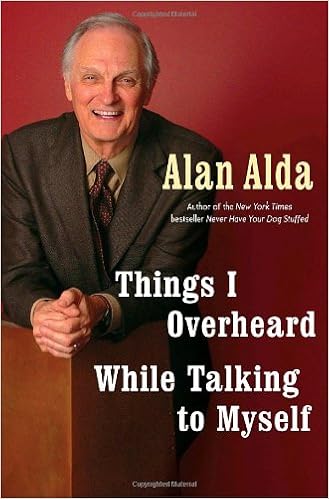
The following words were offered by Alan Alda in 2001, at the graduation of a friend’s daughter. Alda was referring to a piece written by a Chicago newspaper columnist named Mary Schmich, which was virally circulated on the Internet but erroneously attributed to Kurt Vonnegut.
And that’s what makes this Internet event a great image for the age in which we live. There are probably just as many lies going around now as ever before, but these days they’re traveling at the speed of light. There are just as many people who want to fool you into thinking they’ve got it all figured out for you, but now you don’t have nearly as much time to think it over.
And with the help of an engine for repetition that works on a scale unheard of in the past, the lies stick. People are still sending around the talk, thinking it was written by Vonnegut. I was sent a copy just last week.
It’s a delightful piece of writing. But if it’s presented as if it were by someone other than the person who wrote it, it steals that person’s good name and gives itself a certain credibility before it has a chance to earn it honestly. So, as good as it is, it’s a cheat. At least in the way it’s offered to us.
So, you may be thinking, big deal. It’s just a few good jokes. But think about it… It could be selling you anything. It could be a cult religion that could separate you from friends and family, or a quack medicine that could lead you paralyzed, or bogus political information that cause you to elect a numbskull to the presidency.
God forbid.¹
These are great words with regards to the internet and its impact on the dissemination of information – both genuine and bogus – but eerily prescient in view of the political developments of recent years. For what it’s worth, the entire book is a wonderful, human, and relevant read.
The Old Wolf has spoken.
¹ Alan Alda, Things I Overheard While Talking to Myself (New York: Random House, 2007), 121.
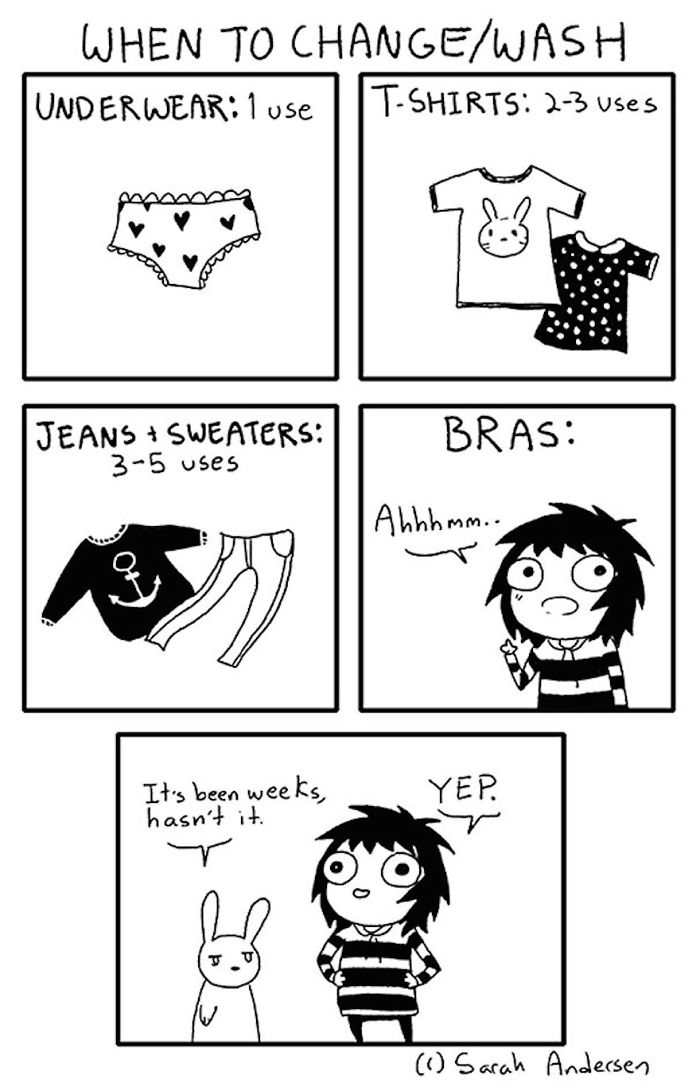
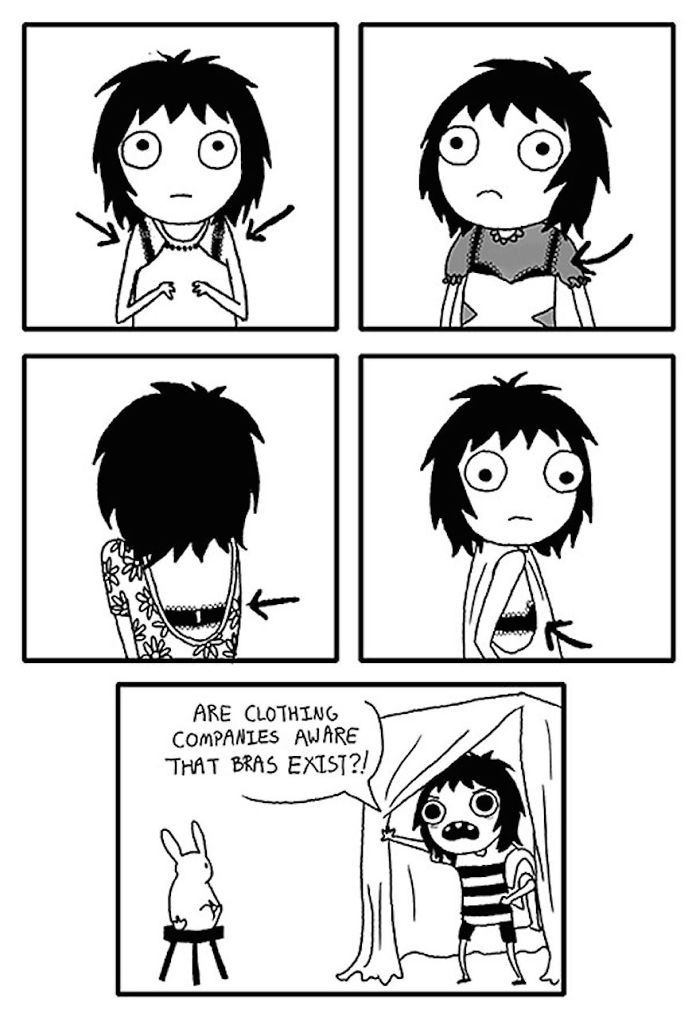
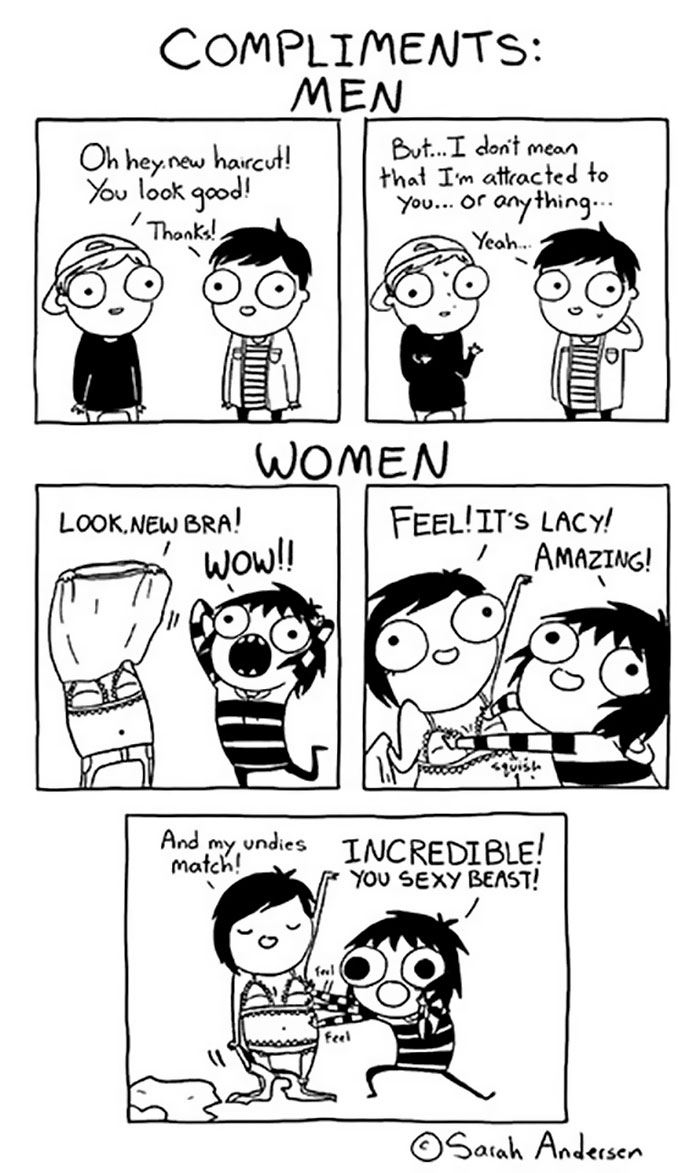
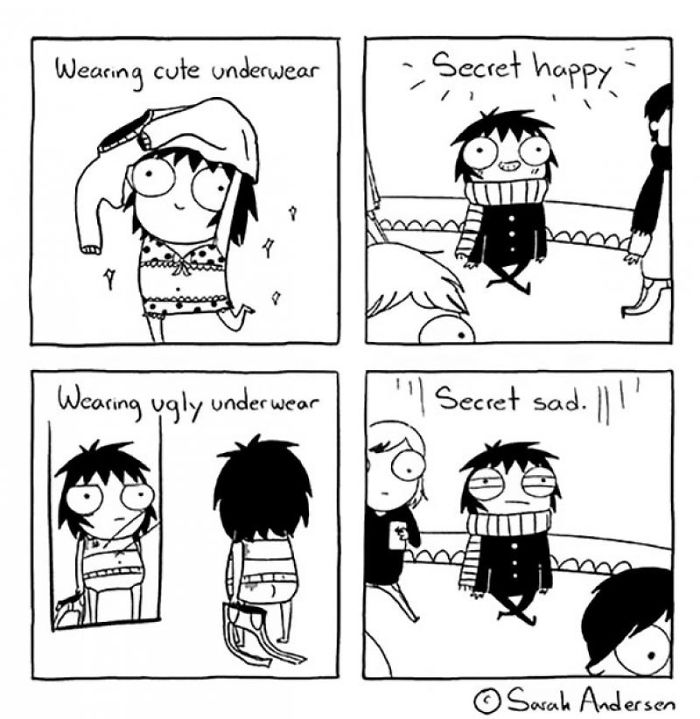
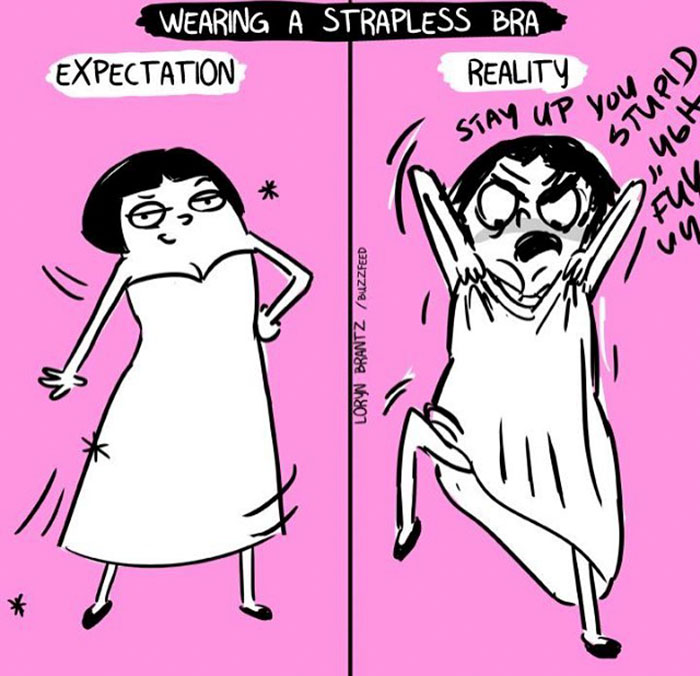
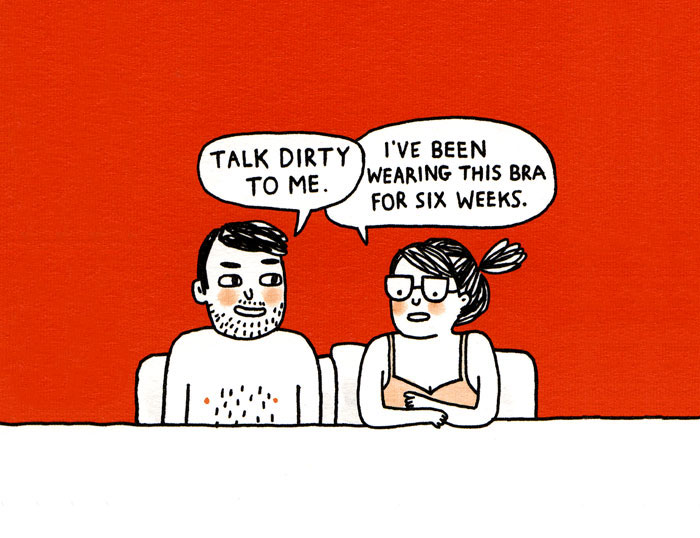
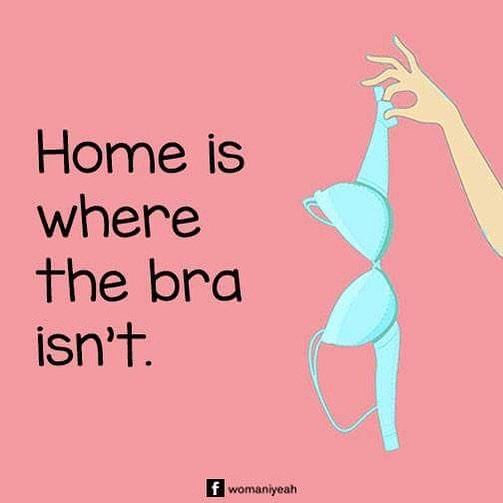
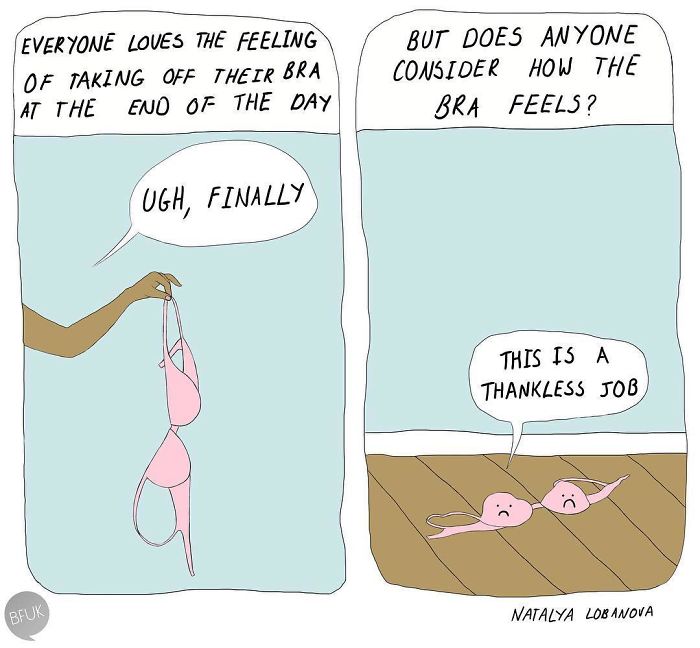
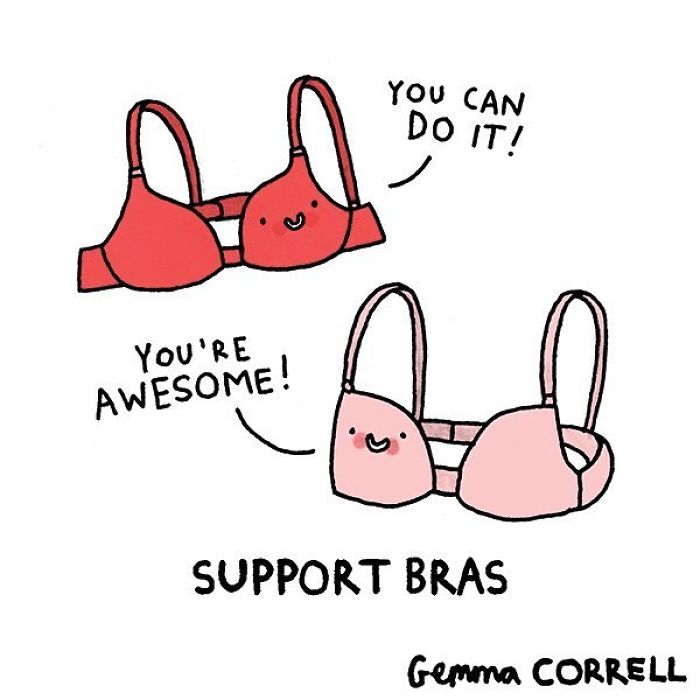
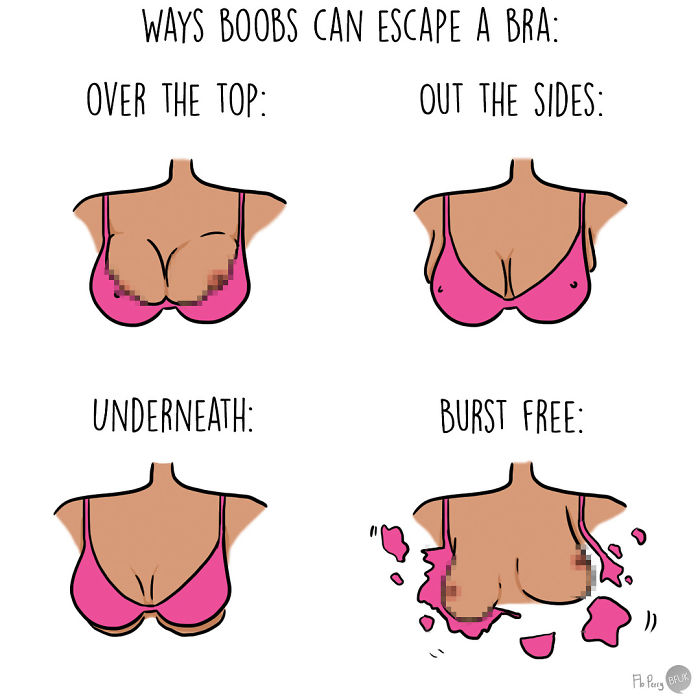
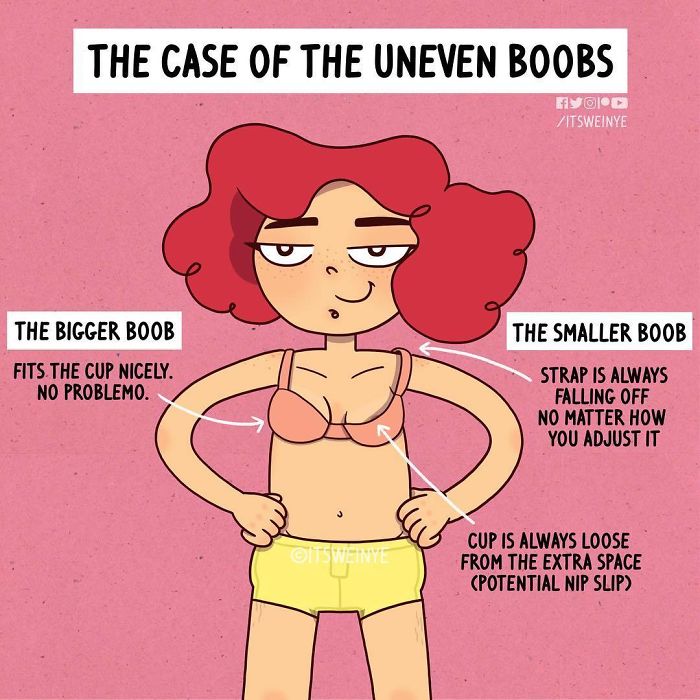
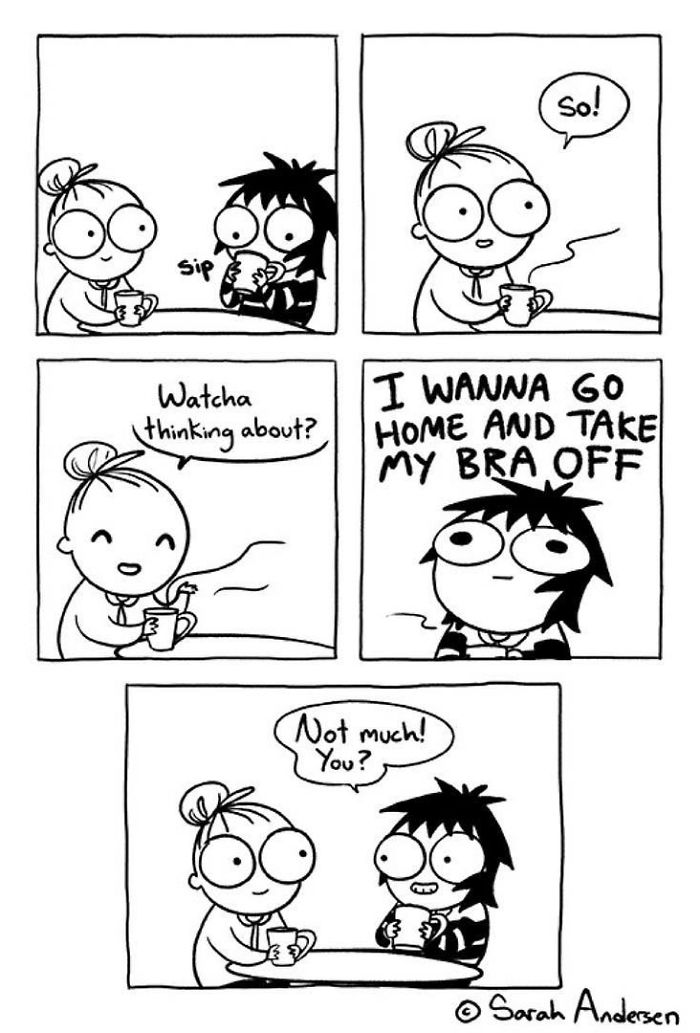
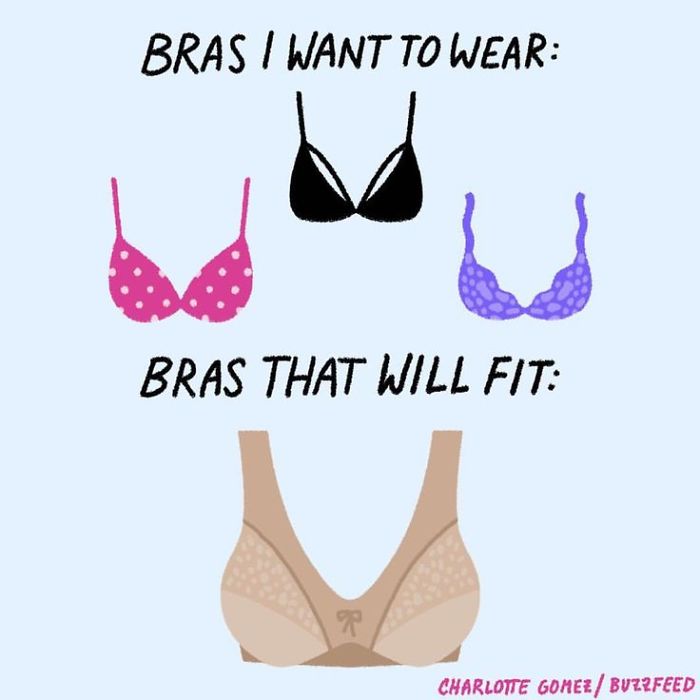
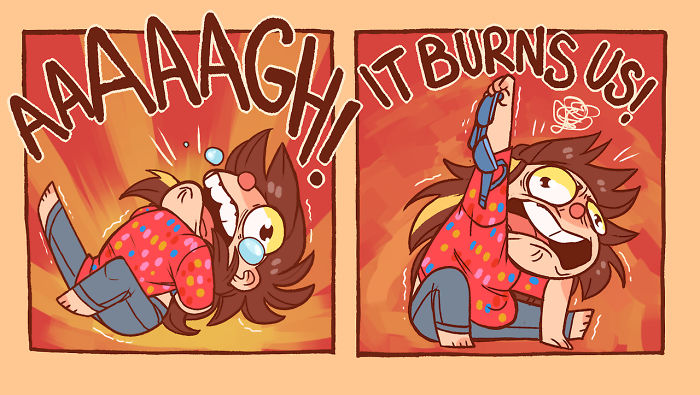
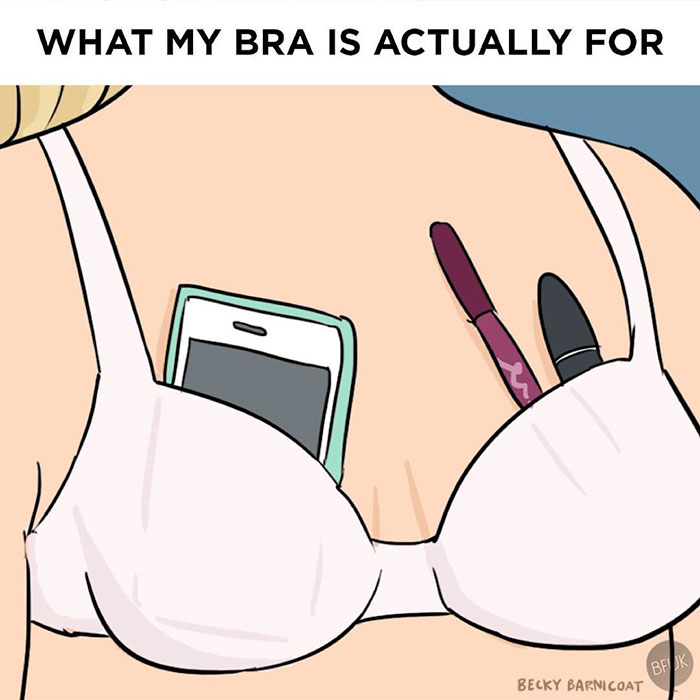
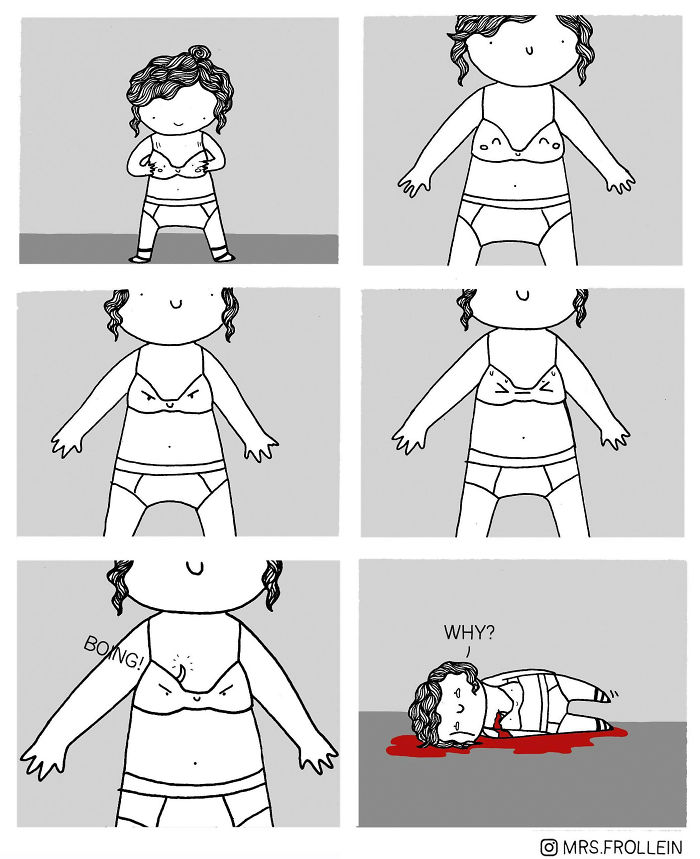
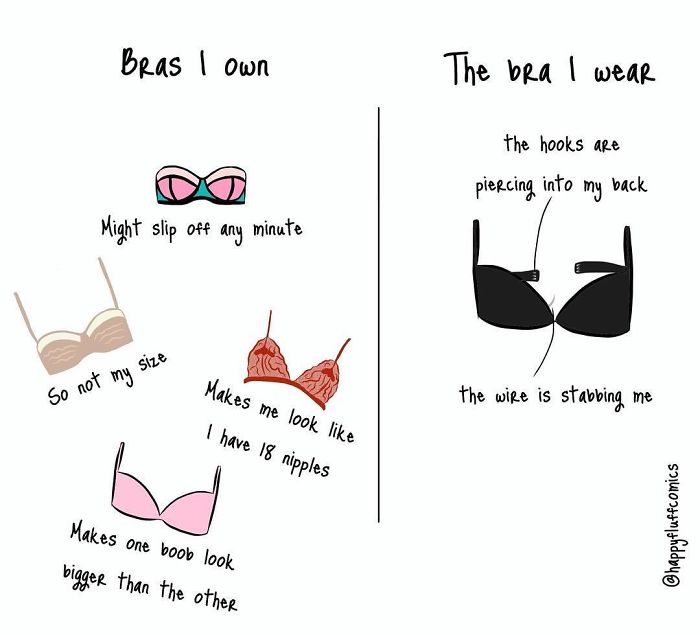
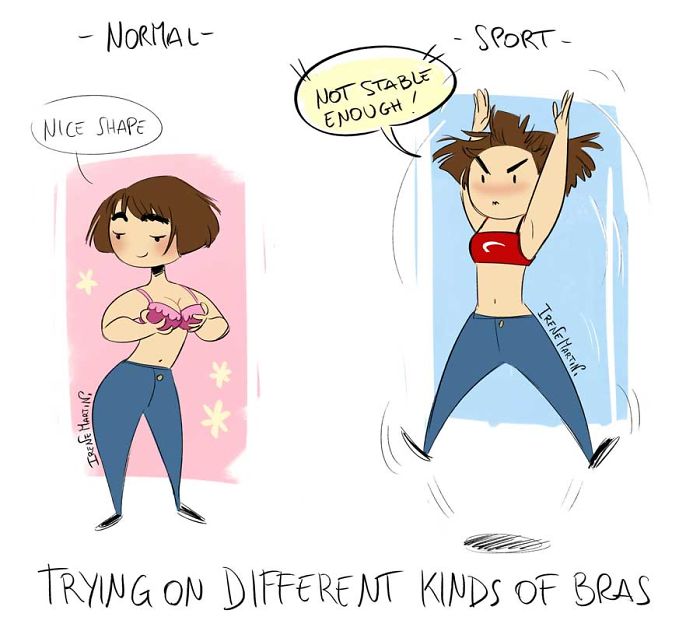
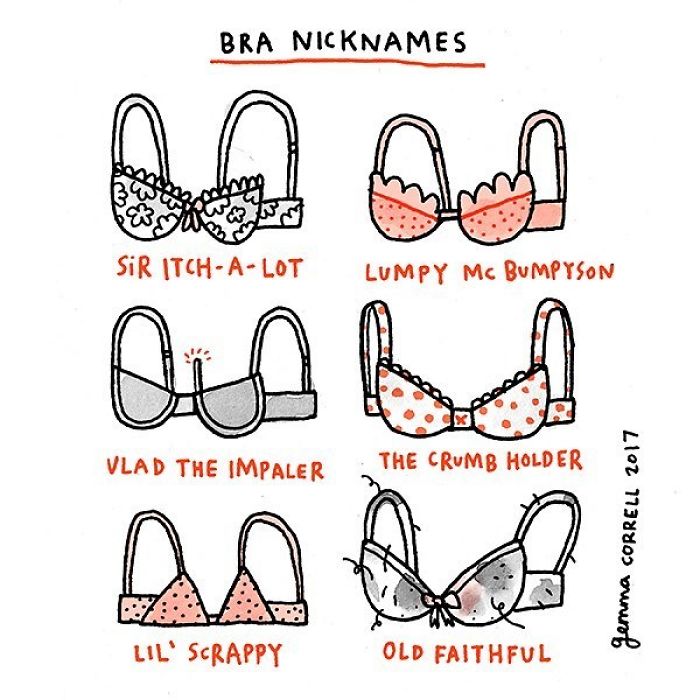
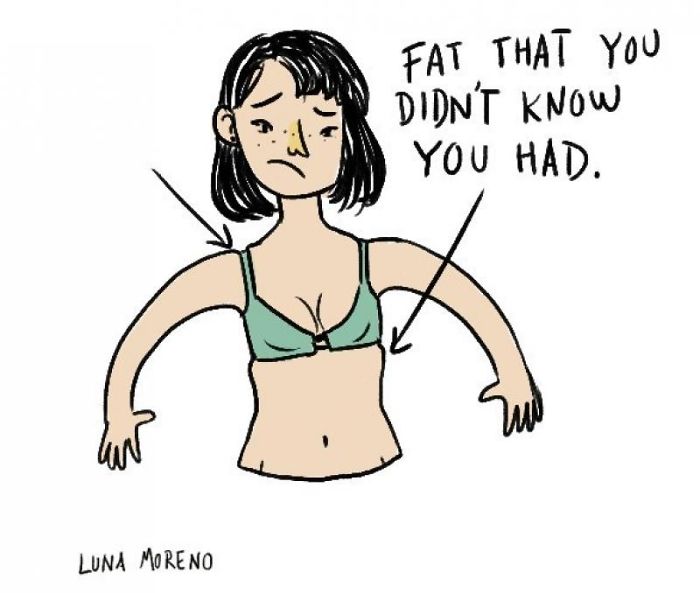
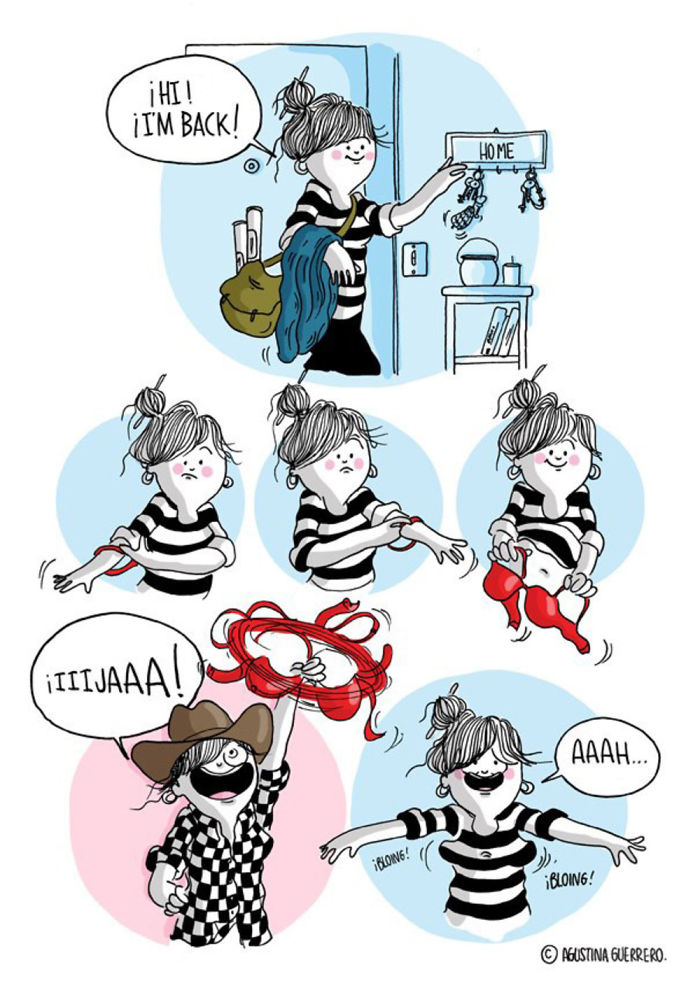
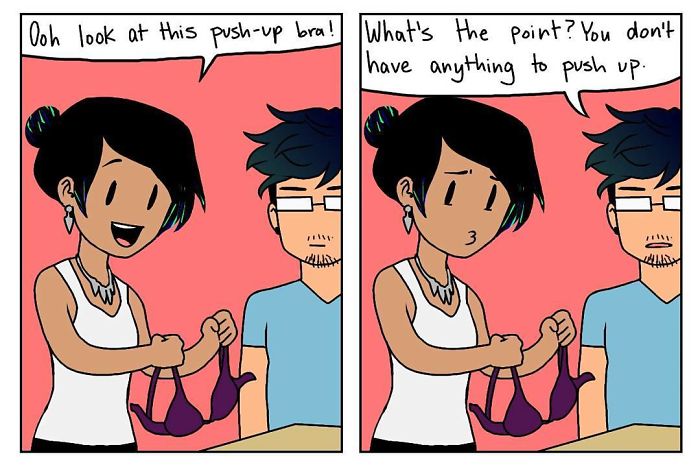
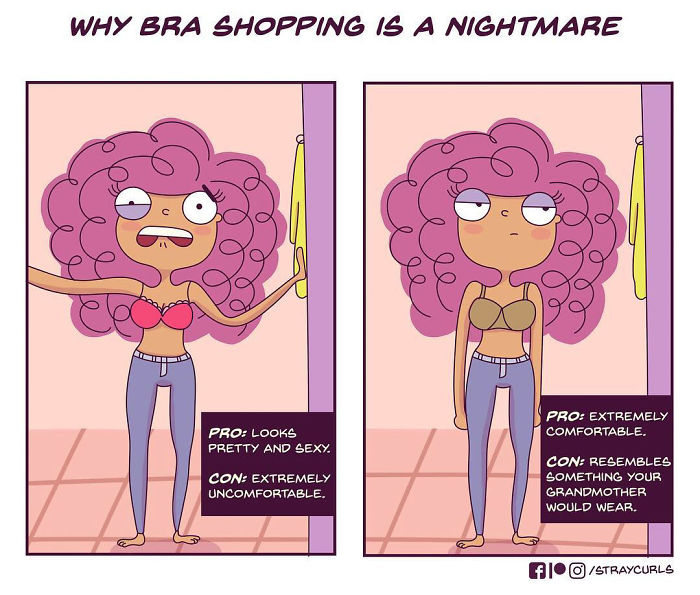
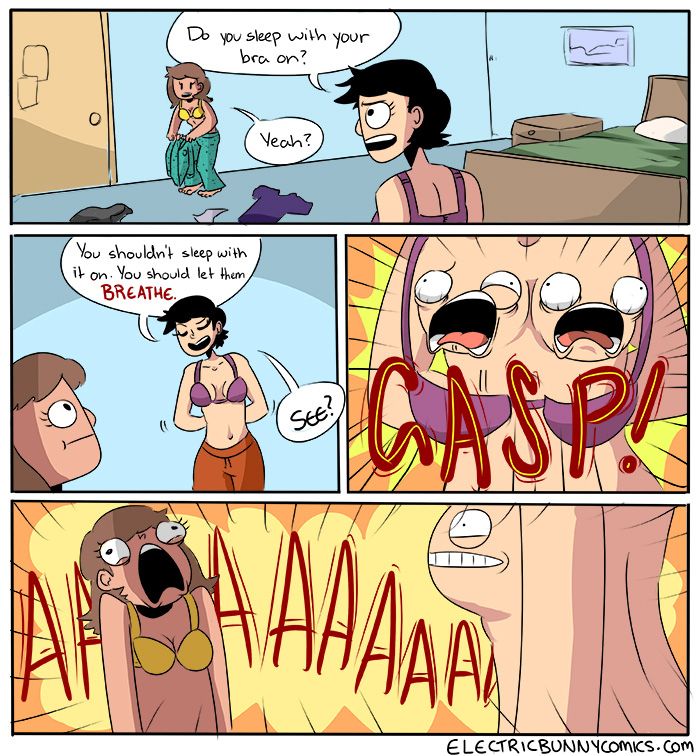
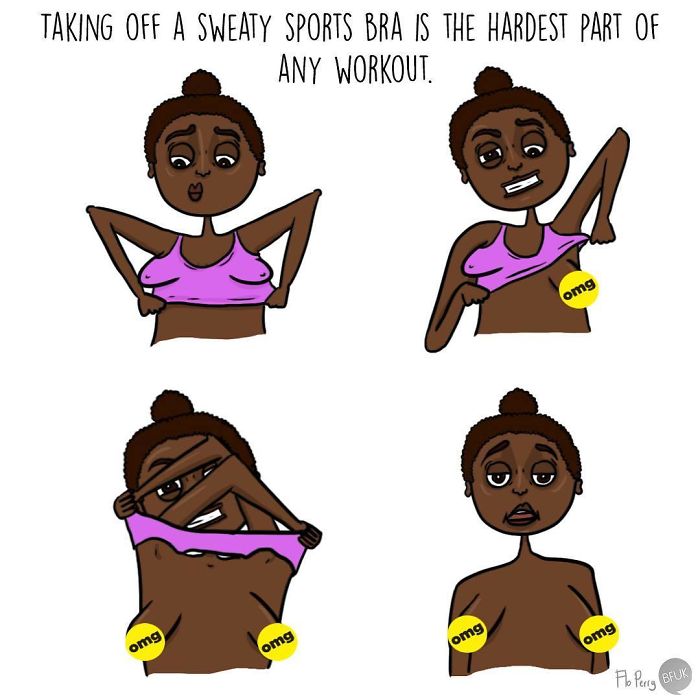
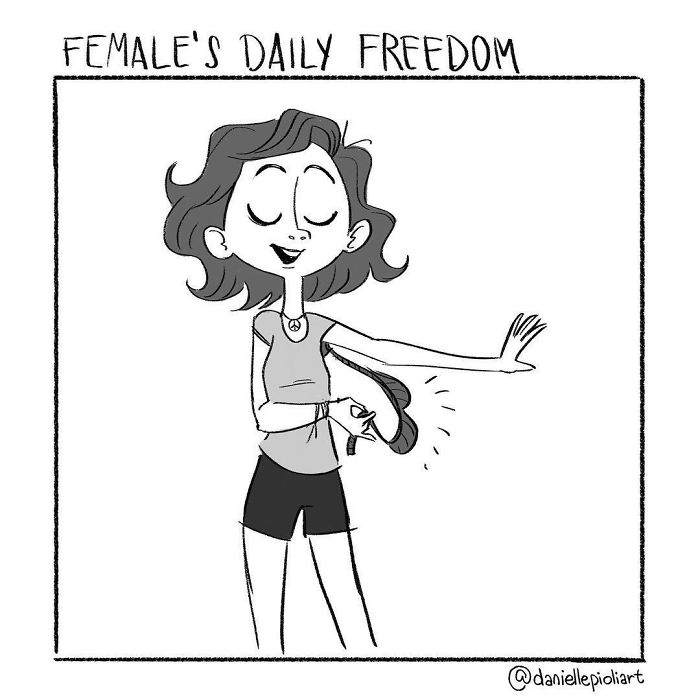
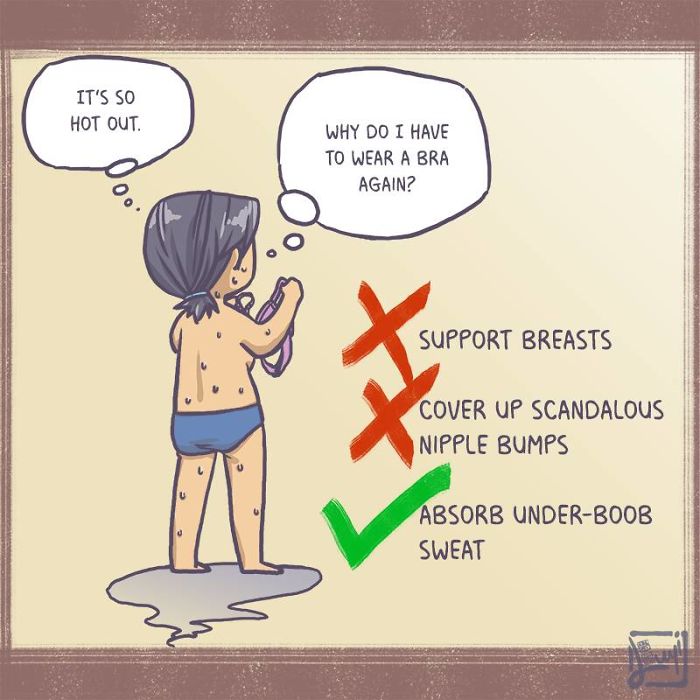
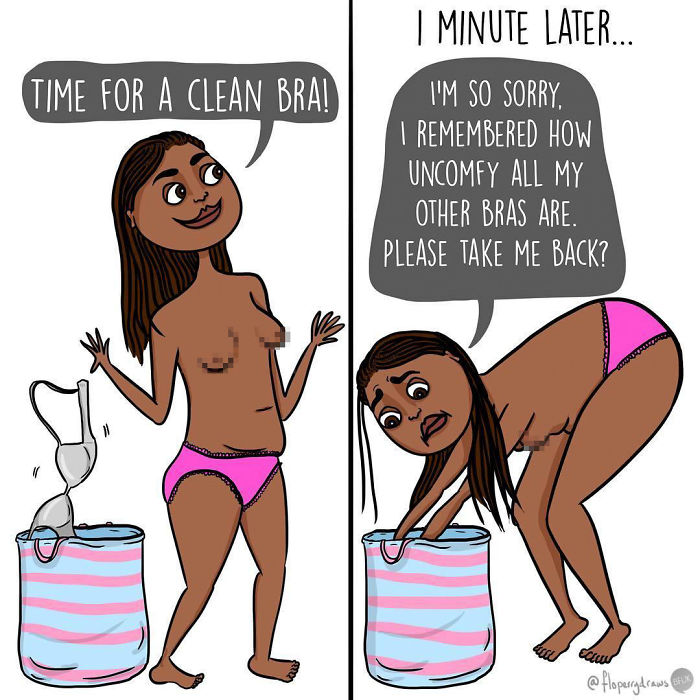
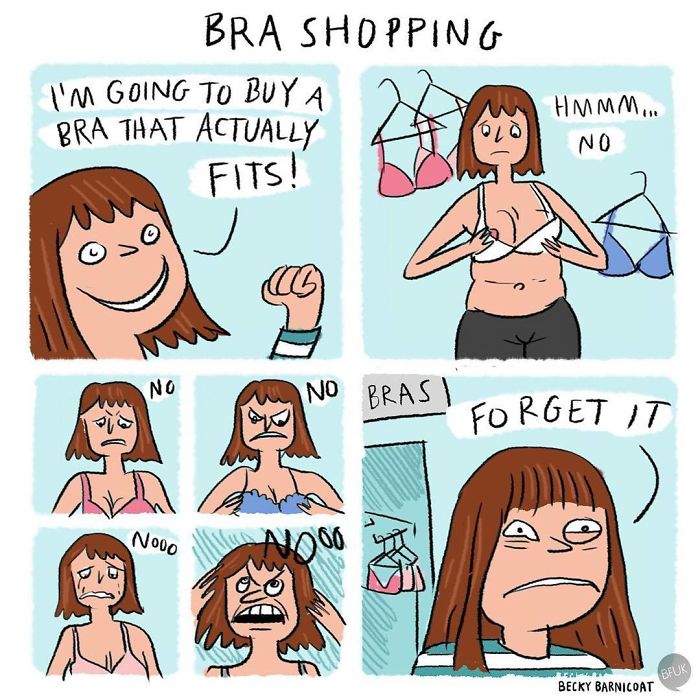
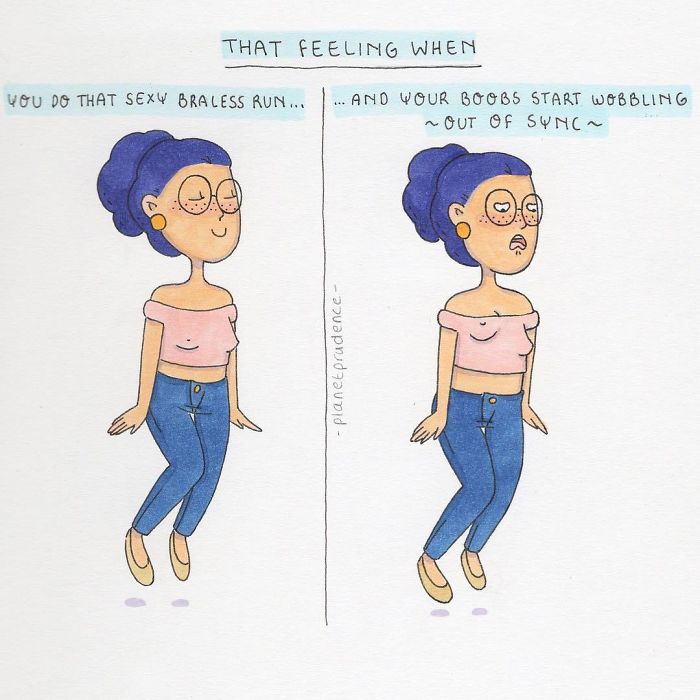
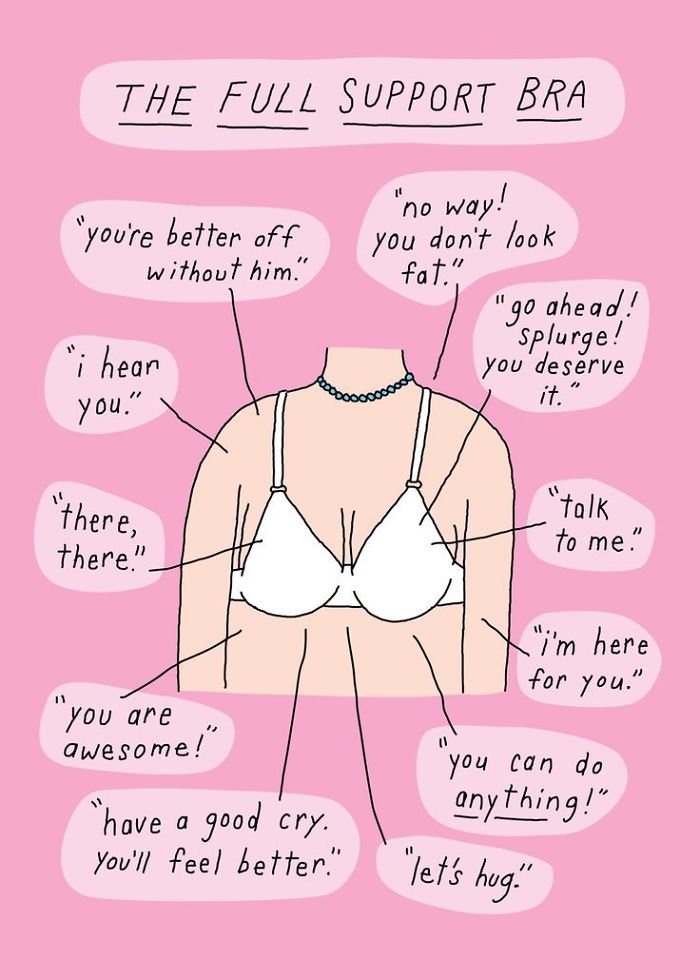
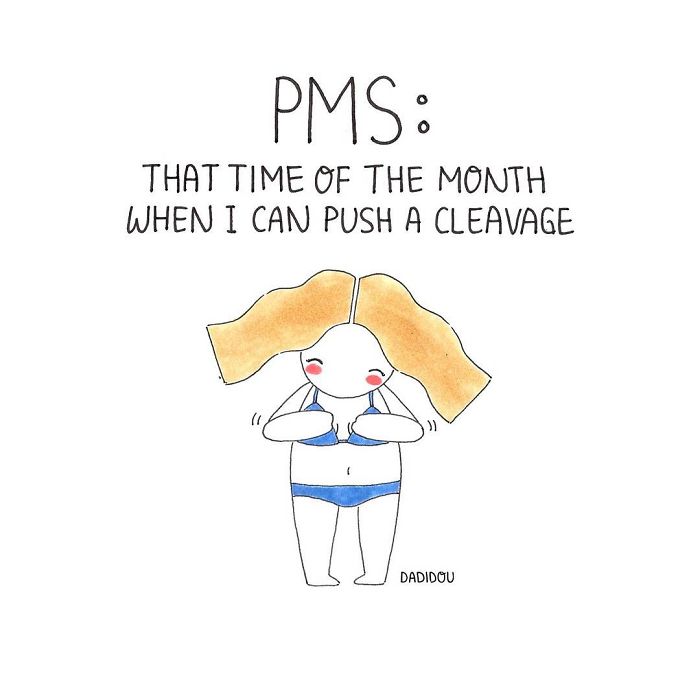
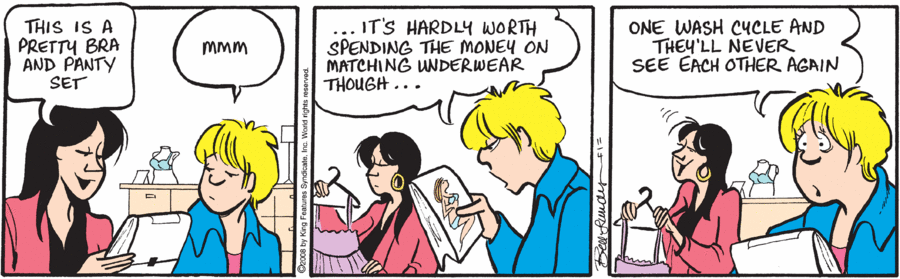
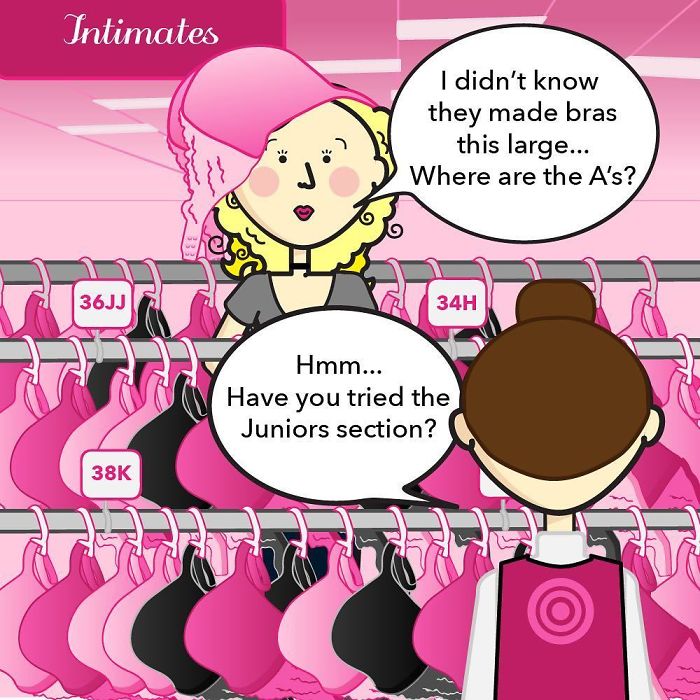
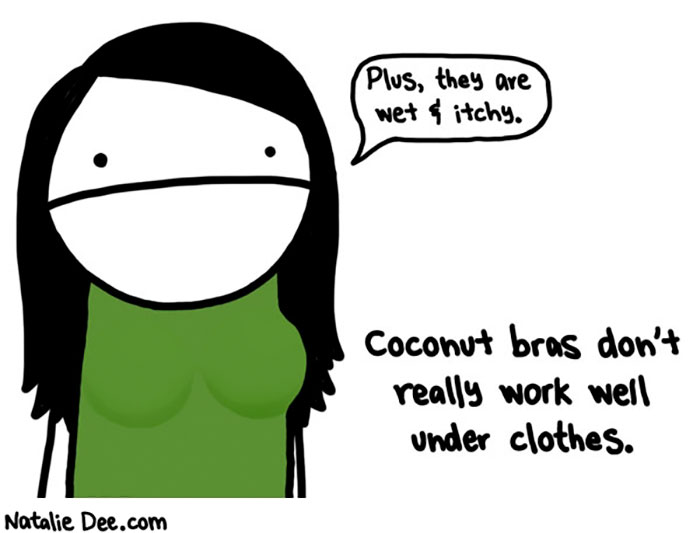
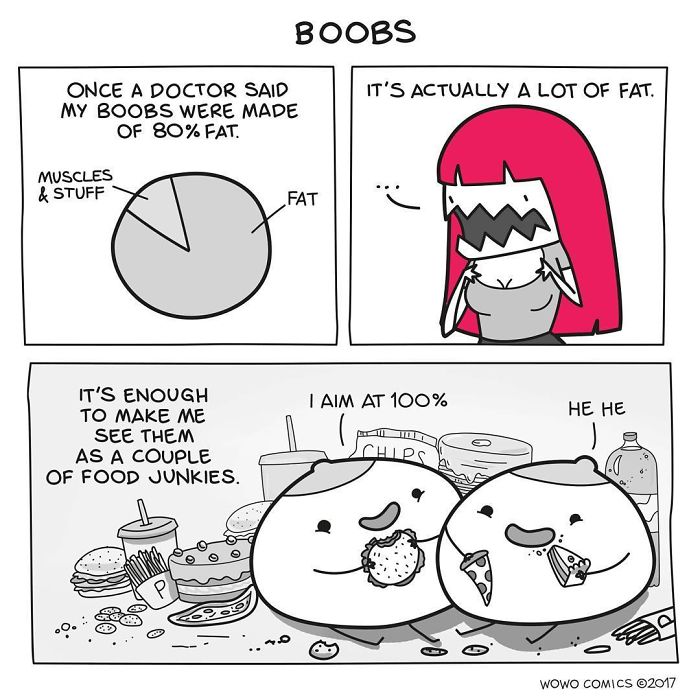
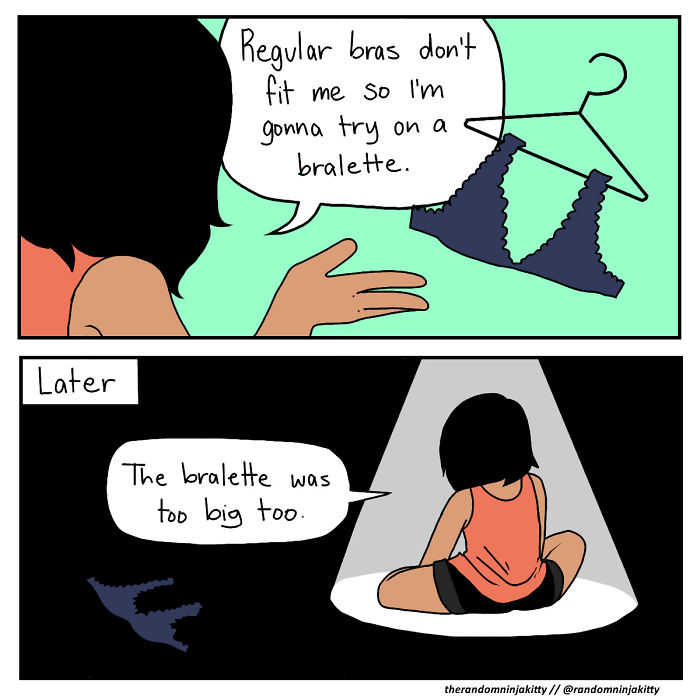
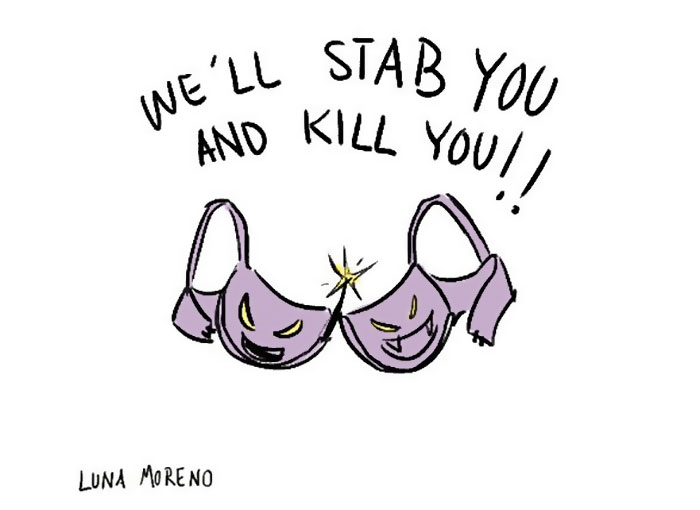
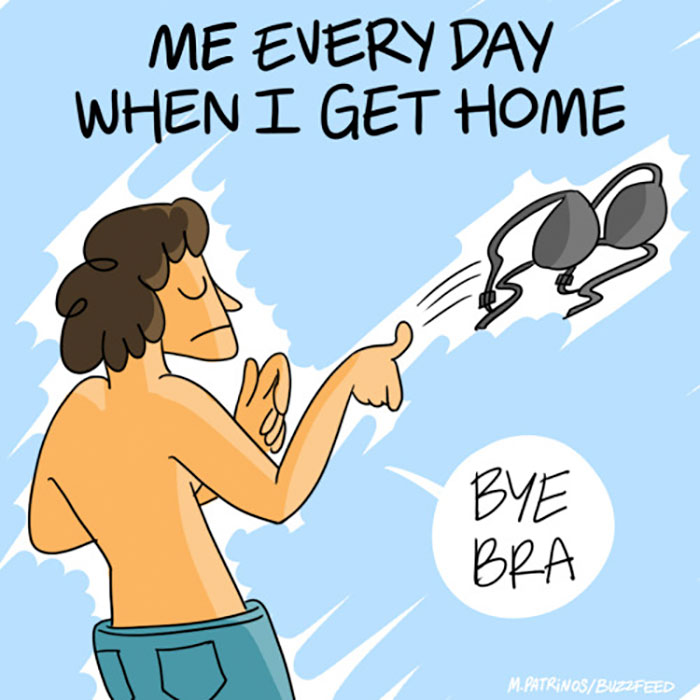
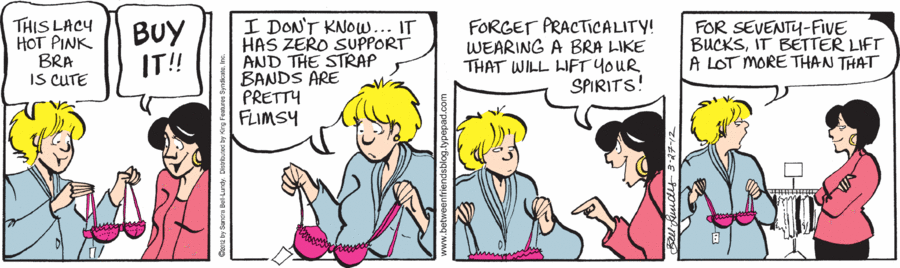
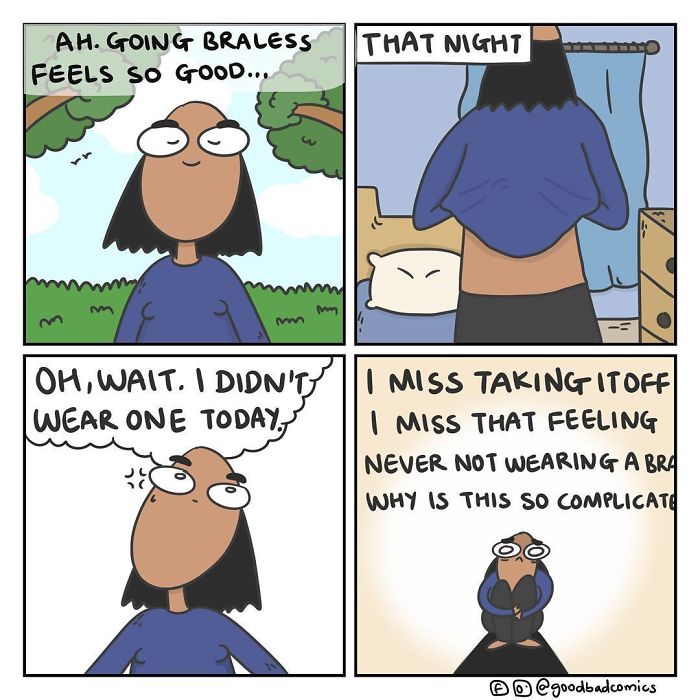
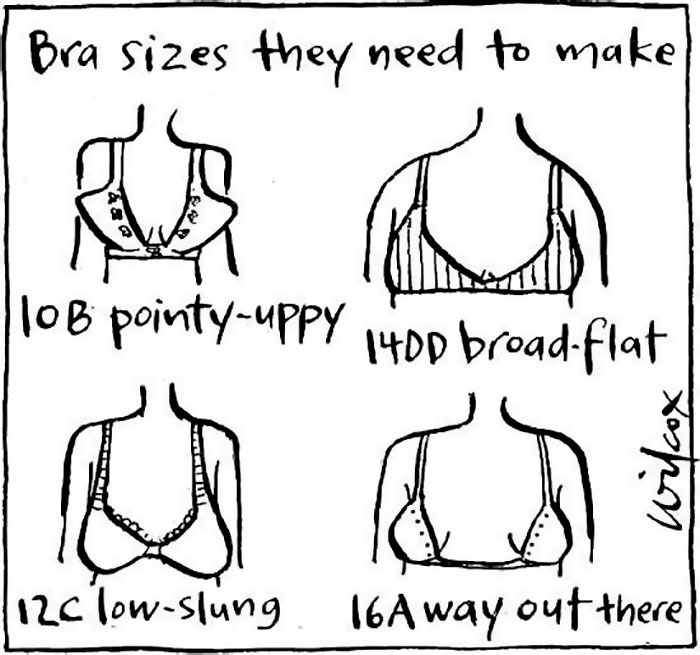
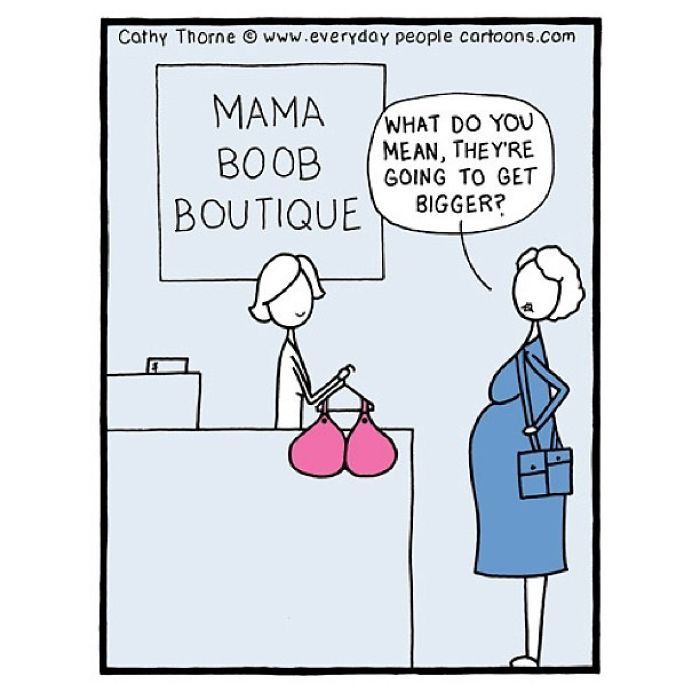
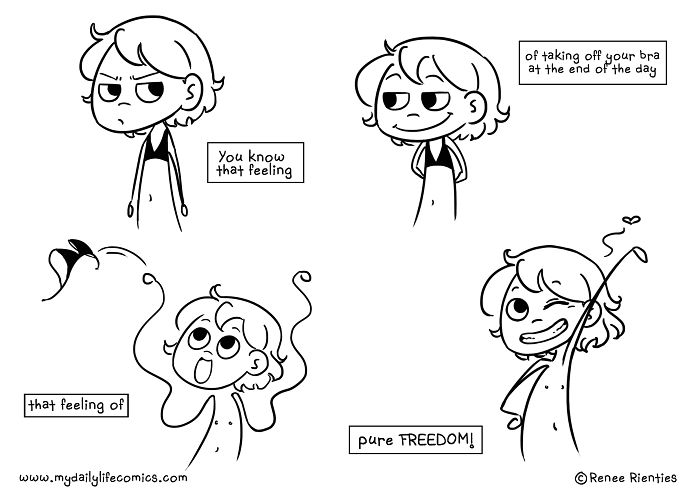
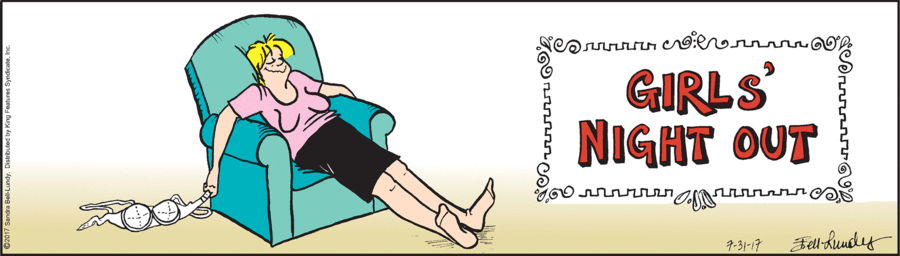
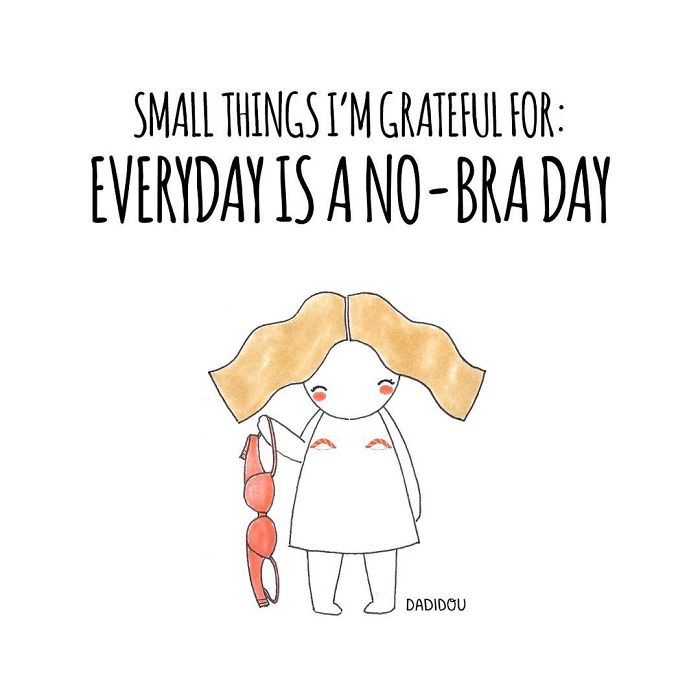
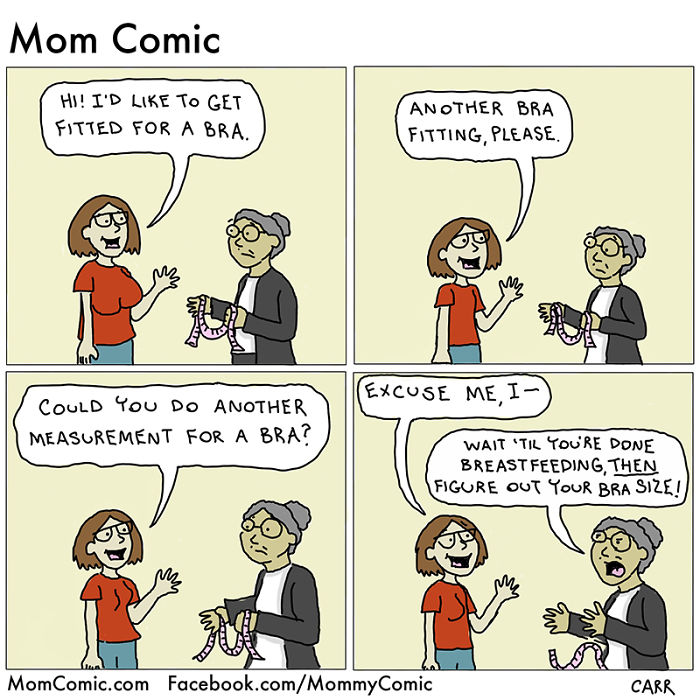
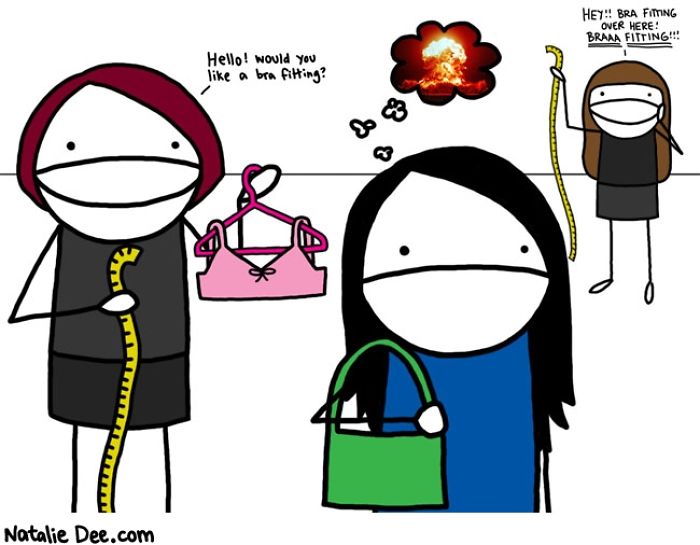
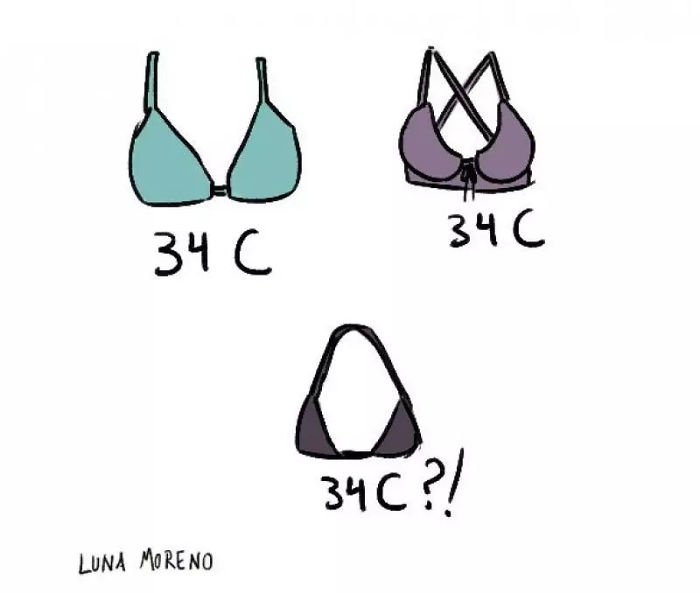
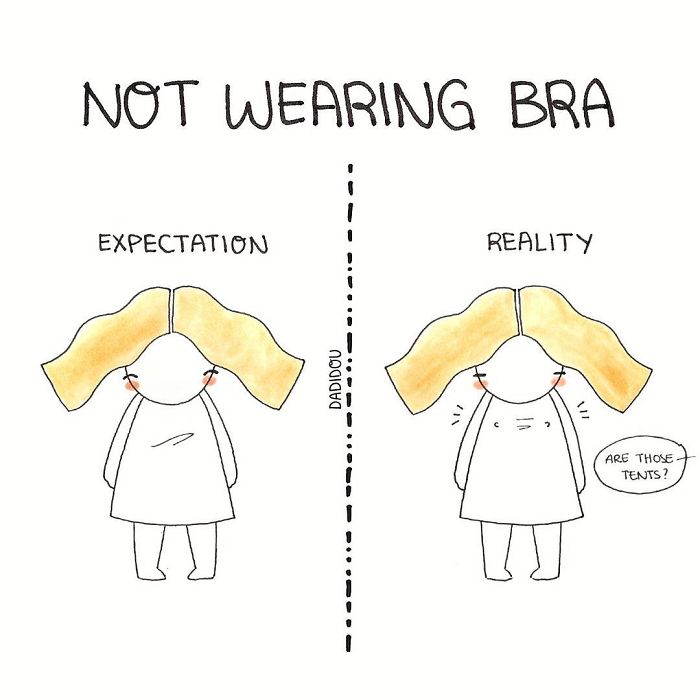
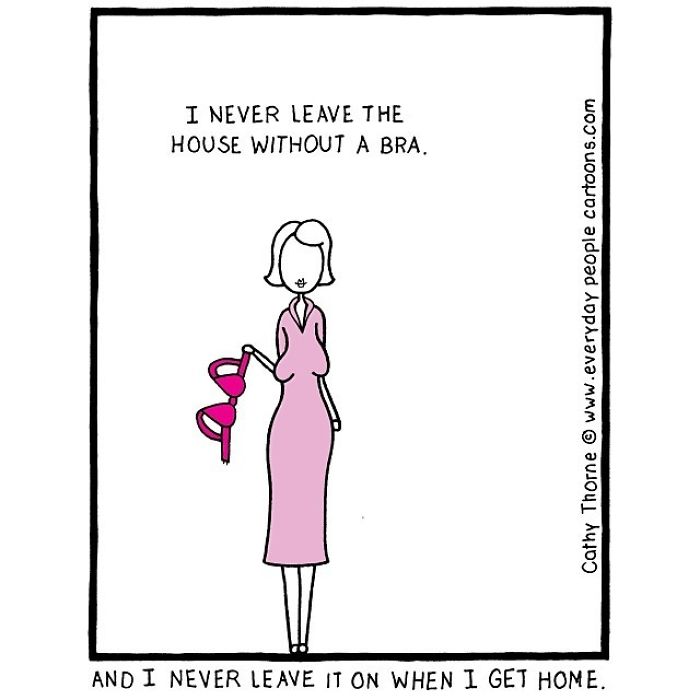
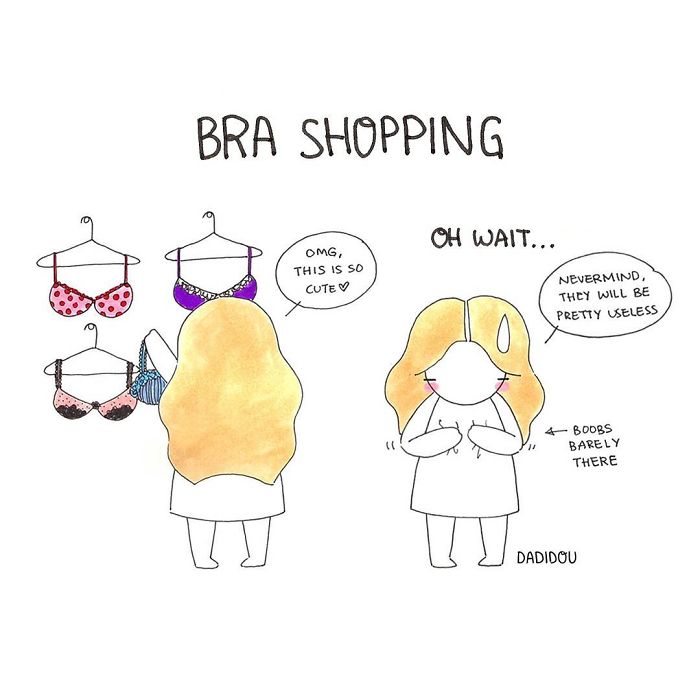
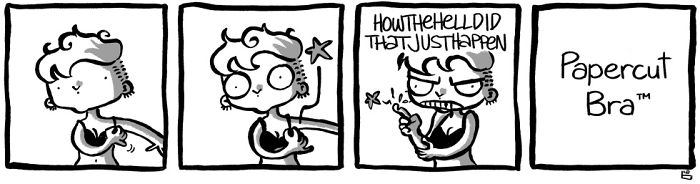
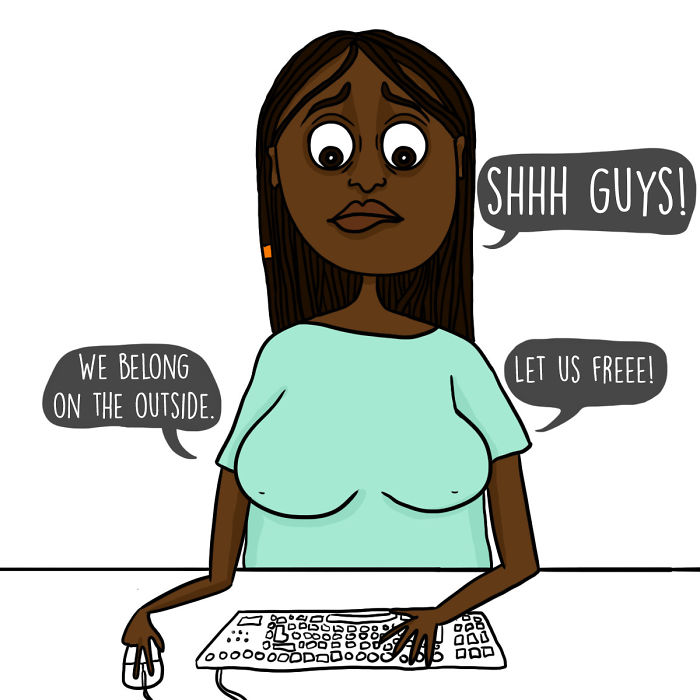
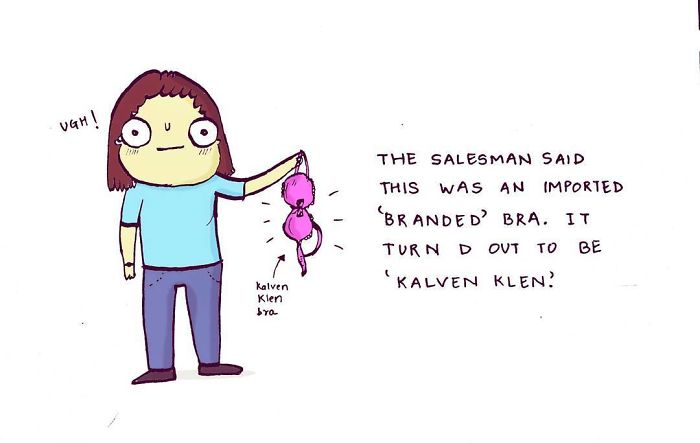
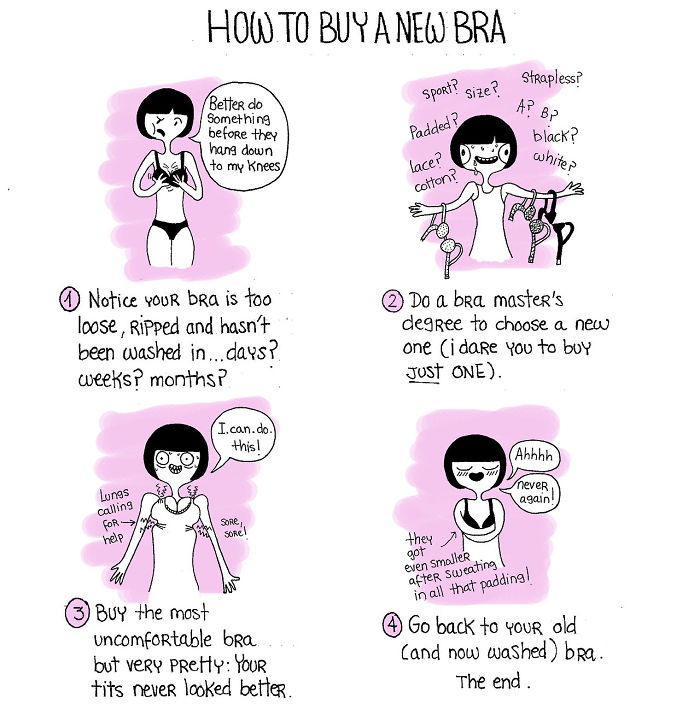
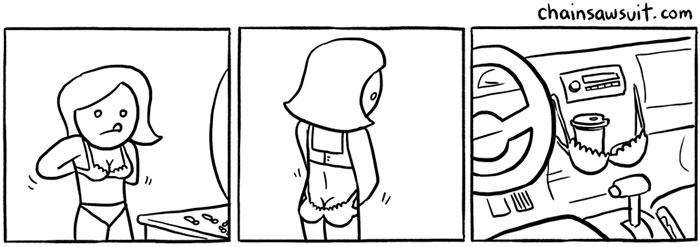
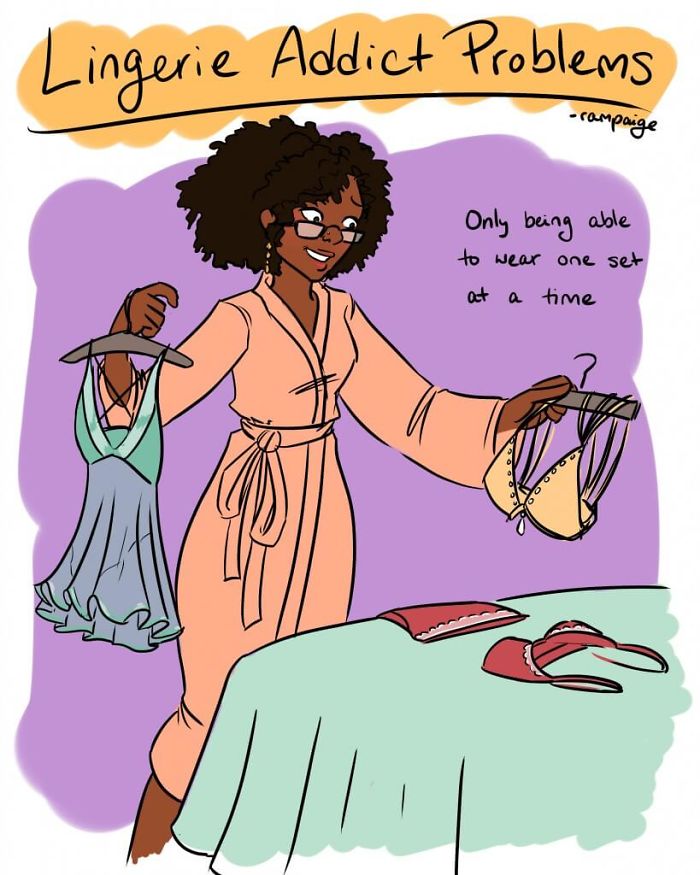
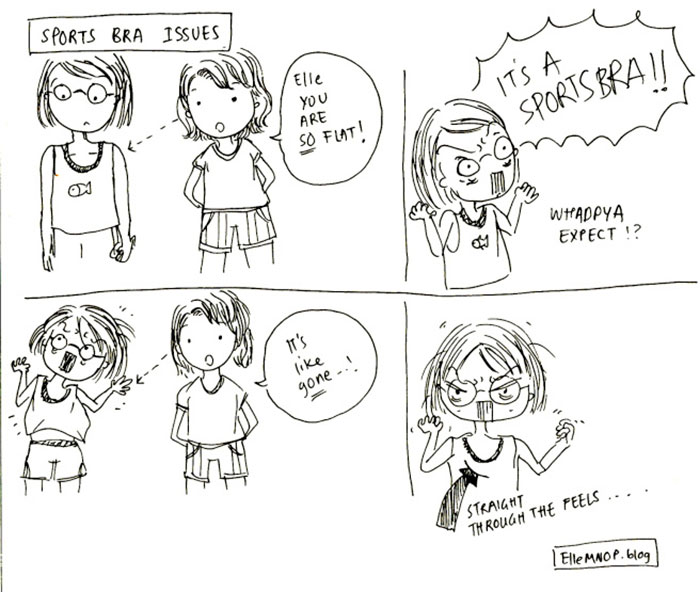
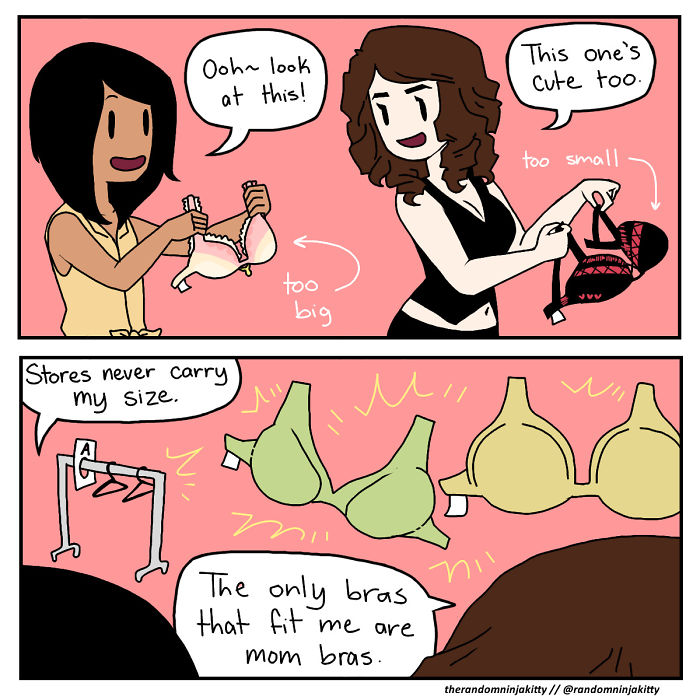
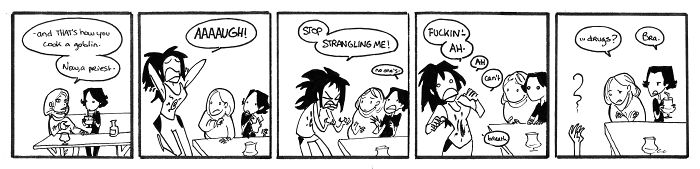
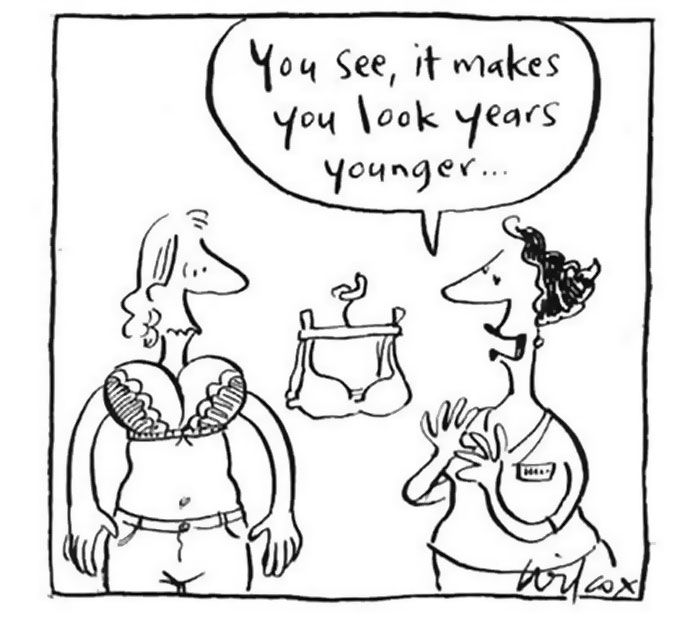
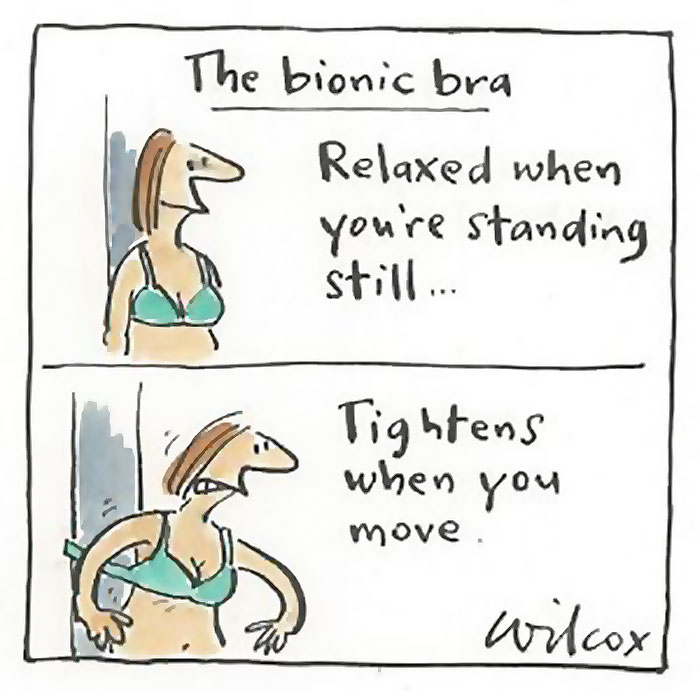
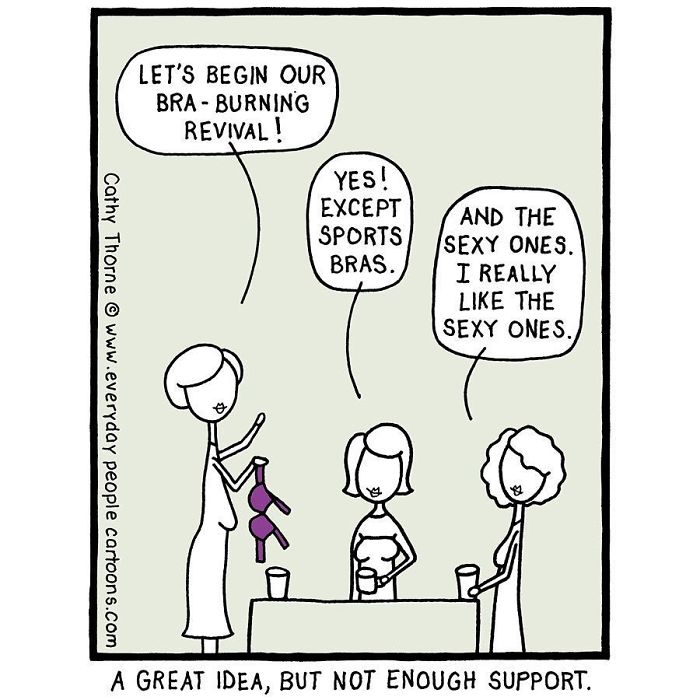
I first saw this at BoredPanda. It’s a great collection of webcomics that most ♀-type people will relate to, and that any ♂-type person who wants a relationship with a ♀-type person should be aware of – because your significant other is (guaranteed!) dealing with any number of these issues. So guys, take note – and be sensitive.
I share it here in single-page format with correct attribution to the respective artists, so you don’t have to scroll through 12 pages of clickbait ads and deal with all the comments.
Just because reasons.
This came to my attention via Paul Taylor, author of the inimitable Wapsi Square webcomic, and as a result I’ve put his own contribution to the cause first on the list. Plug: If you’ve never experienced Wapsi, it’s an wonderful [normal | paranormal] [slice of life | adventure | mythology | coming-of-age | relationship challenges | self-esteem | body image] strip with strong female characters – difficult to describe, but very easy to enjoy.
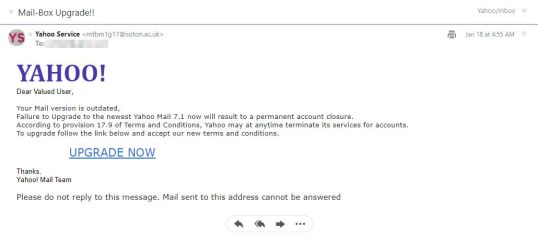
Found this in my mailbox just today, although it arrived last week.
The “Upgrade Now” link leads to “https://ravenbiotech.com/oluwamide/yahoo/image.htm,” but the link is now dead. Raven Biotech is a legitimate firm, but some scumbag somewhere managed to get onto their server and add the malicious page – probably designed as a phishing scam or drive-by malware downloading.
Never click on links in emails. Notice where the link goes by hovering your mouse over the link, and then visit the page directly.
If you’re not sure an email is valid, contact the company by phone.
Never provide sensitive banking, financial, or password information on the internet if you don’t know who you are dealing with. Be careful out there.
Edit: The Times on January 8 responded to reader criticism of the obituary in question. Their response, while acknowledging some failings, essentially circled the wagons and justified their position. This is still unacceptable.
On January 3, The New York Times published an obituary for Thomas S. Monson, late president of the Church of Jesus Christ of Latter-day Saints, who was revered by its members as their prophet, seer, and revelator.
Instead of taking the opportunity to pay tribute to an honorable and humble servant of humanity who spent most of his 90 years of life ministering to the lonely, the widowed, and the forgotten, they took an opportunity to turn what should have been an expression of respect into a reprehensible potshot at the Church and its doctrine, commonly known as Mormonism.
A respected newspaper that is charged with reporting facts objectively and without bias instead decided that the Church of Jesus Christ of Latter-day Saints was fair game for mockery and disparagement, and prostituted their reputation for a chance to take a reprehensible Cheap Shot at an organization of 15 million members that has done immense good throughout the world since its inception. Instead of an obituary, the piece became a virtual hatchet job, echoing the complaints of disaffected members and sounding like something that might have been written by Gerald and Sandra Tanner.
The Church is a community of faith that believes in ongoing, modern revelation, that believes in a Church led directly by the Lord Jesus Christ. It’s not a democratic institution where people can agitate and effectuate changes in doctrine. They are free to participate, or not. They are free to follow their leaders, or not. They are free to remain members, or not. They don’t even have to think the same way as their leaders if they don’t want to, and they can remain members in good standing. If the Church is not for them, let them go where they may and find joy – but a vocal minority that captures the attention of a click-hungry press seems to think that they, not God, are directing the affairs of the Church, and they are bitterly angry about this.
It is these feelings and protesting voices that the Times chose to bring to the forefront of President Monson’s obituary, not his nearly a century of life and virtual decades of compassionate service on a personal level as well as an administrator in the Church’s hierarchy. This represents a gross contravention of decency and reputability, for which the Times owes every Latter-day Saint and every lover of respectable journalism a heartfelt apology.
The Times is a newspaper. There is nothing that says they can’t do all the investigative journalism or “exposé” pieces that they want, as long as the facts they report are verifiable and accurate. That’s what journalists do. But to rest this sort of poison-pen letter on the memory of a good, honest, and decent man, possibly one of the most Christlike individuals I’ve ever had the pleasure of associating with, is the ultimate abrogation of all principles of decent journalism that there could be, worthy of a trash publication like The National Enquirer and not one of the nation’s flagship newspapers. Shame, shame, the very deepest shame on The Times.
I trust that they will do the right thing, and express appropriate regret for this horrible lapse of judgment, from writer to editors to publisher. They are, of course, free to choose – but they should remember that every choice has prices and benefits, and choose wisely.
If your computer running Chrome suddenly locks up and you get these display screens:
do NOT under any circumstances call the number shown (888-710-4402). You’ll be connected to scammers in India who will tell you all sorts of incomprehensible things about your machine and ask you to let them connect with your computer.
Look at how bad the English is – practically incomprehensible. This is NOT the number for Microsoft Technical Support. These folks are liars, criminals, and all-round Very Bad People. Allow these drones to access your machine and you’re likely to end up with all your files encrypted by ransomware, or have your machine turned into part of a spamming robot network, or have your financial data stolen, or something equally insidious.
Kill Chrome using the Task Manager and re-launch. These exploits are usually encountered when malicious code is run from an ad somewhere on a page you visited, and is usually not the fault of the page itself.
It’s Christmas, and if you haven’t ever seen this you deserve to. We all deserve to. I first heard this read at an office Christmas party; the reader, one of the loveliest people I have known, read this with an absolute deadpan delivery – and they almost had to carry me out on a stretcher.
I have no idea who the original author is, despite exhaustive searching. If anyone knows, please leave a comment and I’ll add the appropriate credit.
Funny, Funny Mother
See Mother, see Mother laugh. Mother is happy.
Mother is happy about Christmas.
Mother has many plans. Mother has many plans for Christmas.
Mother is organized. Mother smiles all the time.
Funny, funny Mother.
See Mother. See Mother smile. Mother is happy.
The shopping is all done. See the children watch TV.
Watch, children, watch.
See the children change their minds.
See them ask Santa for different toys.
Look, look. Mother is not smiling.
Funny, funny Mother.
See Mother. See Mother sew.
Mother will make dresses.
Mother will make robes.
Mother will make shirts.
See Mother put in the zipper wrong.
See Mother sew the dress on the wrong side.
See Mother cut the skirt too short.
See Mother put the material away until January.
Look. Look. See Mother take a tranquilizer.
Funny, funny Mother.
See Mother. See Mother buy raisins and nuts.
See Mother buy candied pineapple and powdered sugar.
See Mother buy flour, and dates, and pecans, and brown sugar,
bananas, and spices, and vanilla.
Look. Look. Mother is mixing everything together.
See the children press out cookies.
See the flour on their elbows.
See the cookies burn.
See the cake fall.
See the children pull the taffy. See Mother pull her hair.
See Mother clean the kitchen with the garden hose.
Funny, funny Mother.
See Mother. See Mother wrap presents.
See Mother look for the end of the Scotch tape roll.
See Mother bite her fingernails.
See Mother go. See Mother go to the store 12 times in one hour.
Go, Mother, go. See Mother run faster. Run, Mother, run.
See Mother trim the tree. See Mother have a party.
See Mother make popcorn. See Mother wash the walls.
See Mother scrub the rug. See Mother tear up the organized plan.
See Mother forget the gift for Uncle Harold.
See Mother get hives. Go, Mother, go. See the far-away look in Mother’s eyes.
Mother is disoriented.
Funny, funny Mother.
It is finally Christmas morning. See the happy family.
See Father smile. Father is happy. Smile, Father, smile.
Father loves fruit cake. Father loves Christmas pudding.
Father loves all his new neckties.
Look. Look. See the happy children. See the children’s toys.
Santa was very good to the children.
The children will remember this Christmas.
See Mother. Mother is slumped in a chair. Mother is crying uncontrollably.
Mother does not look well. Mother has dark ugly circles under
her bloodshot eyes.
Everyone helps Mother to her bed.
See Mother sleep quietly under heavy sedation.
See Mother smile.
Funny, funny Mother.
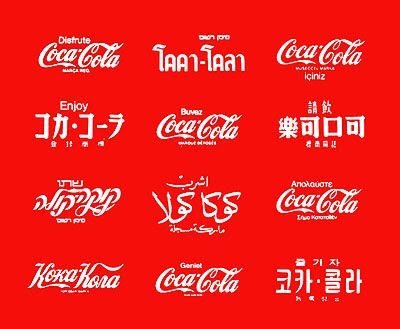
Companies spend large money developing a logo that speaks to the world. They are an integral part of brand recognition – who in the world doesn’t recognize the Coca Cola logo, even if they don’t speak English or use Roman script?
Who in the world doesn’t see the “golden arches” and immediately know that McDonald’s is close by?
These logos and these brands are worth millions if not billions of dollars, and they are ferociously protected and actively marketed around the world.
Some logos, however, are more than eye-catching; they’re supremely clever, some from equally powerful companies and some from local enterprises.
Amazon, of course, ships everything from A to Z and a lot of stuff in between. The arrow, in addition, looks very much like a smile, suggesting how pleased you’ll be with your order. Just don’t talk to the people who work there – they’re not terribly happy with their job conditions.
Baskin-Robbins prides itself on its 31 flavors (seen above in the logo) but not on their value as health food. Duh. John Robbins, son of founder and owner, left the empire for more wholesome pastures, and encouraged his father to step away from the inevitable when he got him to live a healthier lifestyle after the father had been diagnosed with diabetes, high blood pressure and heart disease. Years before, partner Burt Baskin had died from a heart attack.
Anyone who grew up with black-and-white televisions and saw color for the first time probably saw the NBC “proud as a peacock” logo:
Today’s stylized logo retains the peacock, even if you have to look for a bit to find it:
One of the cleverest logo inclusions is the one FedEx (or their designer) came up with. They want you to know that your package is on the way, and so that little subliminal arrow helps you understand that they move stuff, and quickly.
Never seen that arrow? Here it is:
Spartan golf clubs are represented by a man with a powerful swing – but if you look at the entire picture in a different light, you see a Spartan warrior in profile with his iconic helmet.
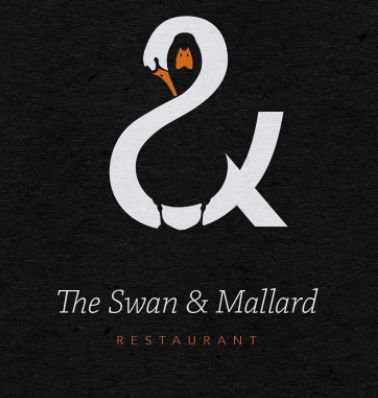
This is one of the most delightful recent designs I’ve seen, with a very creative use of positive and negative space – the swan, the mallard, and the ampersand (&) all combined into a very pleasing and evocative image. Artwork was created by John Randall.
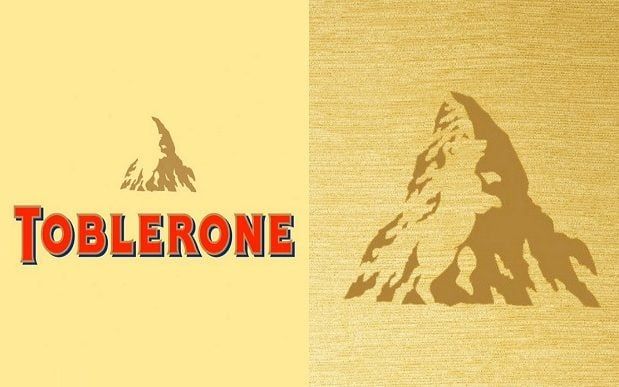
Ever look closely at the Toblerone logo? Seen the bear in that mountain? Berne, Switzerland, is notable for its bears, icon of the city.
But wait, there’s more!
Yes, the home city of Toblerone is also found in the name.
Then there’s the Tostitos logo. Look closely and you’ll see two folks sitting at a table with salsa, sharing a tortilla chip.
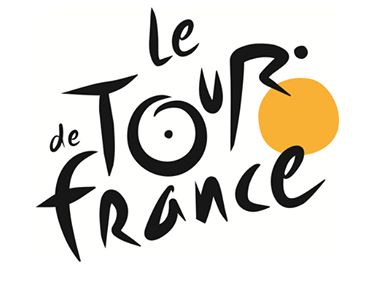
Le Tour de France logo clearly represents a person on a bicycle, with one wheel yellow, probably evoking the yellow jersey that the winner gets to wear. Unless he’s outed for massive doping, but that’s another story.
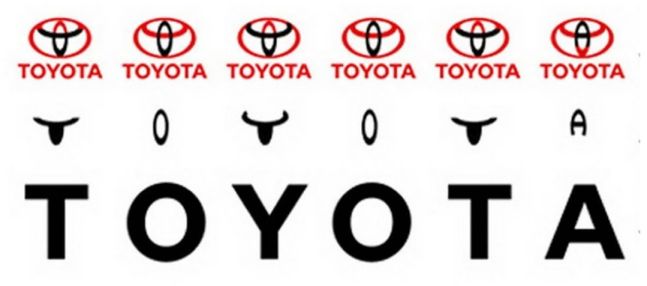
The official Toyota explanation of their logo is as follows:
In 1990, Toyota debuted the three overlapping Ellipses logo on American vehicles. The Toyota Ellipses symbolize the unification of the hearts of our customers and the heart of Toyota products. The background space represents Toyota’s technological advancement and the boundless opportunities ahead.
But whether or not they intended it, the image has an additional fillip of intrigue:
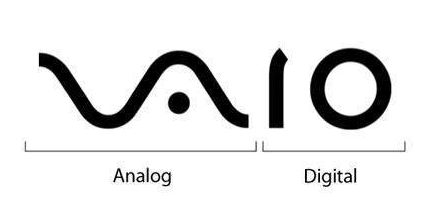
One of my earliest PC-type computers was a Vaio – and their logo is a brilliant blending of the analog computers of the past (represented by the sine wave seen on an oscilloscope ( and the digital computers of today, represented by the “1” and “0” of binary bits.
Yoga Australia managed to work the shape of their homeland into the image of a young lady in a yoga pose – Oi oi oi, mates!
Lastly – and there are many others that I haven’t touched on in this post, but these were some of my favorites – is the logo for Hitachi, which I have written about in detail.
Hitachi was once one of the most well-known brands in electronics; for more about this fascinating logo, click through.
Naturally, there is the other end of the scale – logos which are awful for any number of reasons.
This one just hurts to look at because of the clashing colors.
Many of the ones which have been called out can’t be shared here, as I try to keep this blog on a family-friendly plane – but if you’re interested, just do an image search on “the world’s worst logos” and you’ll see what I mean.
Logos, like domain names, can contribute to the success or failure of an enterprise, which is why companies are willing to spend significant amounts having their logos designed. If the stars align, a logo can be a tremendous and memorable success.
When I was a kid, I remember seeing cans of Hominy in the grocery store.
The fact that it looked like alien bloated corn that had been exposed to gamma rays and gotten very sick (oh wait, that’s huitlacoche) didn’t do much for my desire to ever try it.
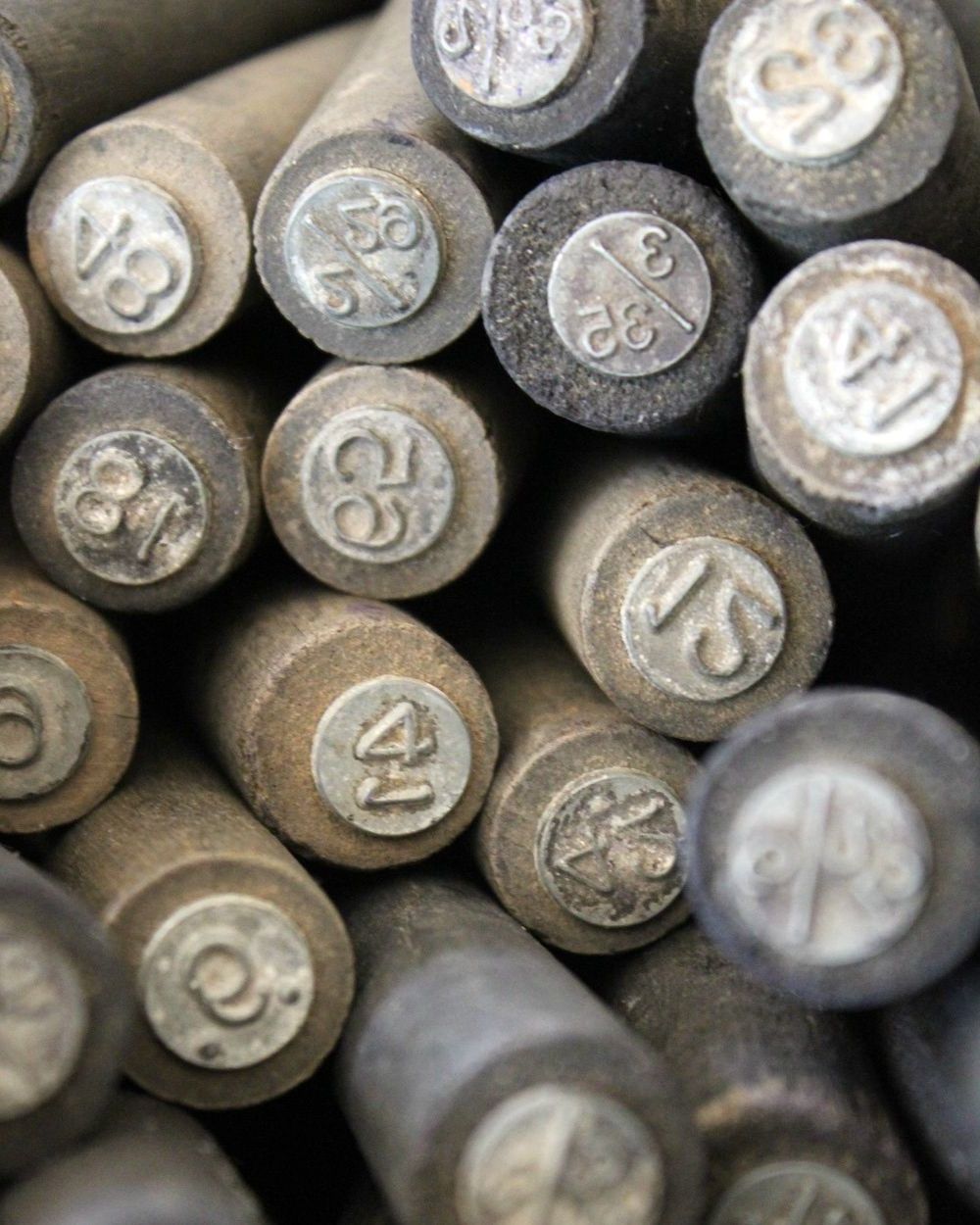
I became more aware of its presence because I worked at the Daitch Shopwell on 1st Avenue between 57th and 58th Streets in New York, and had to price cans with these stamps and purple ink:
But time heals all things… or at the very least tends to change things, particularly one’s tastes. You can visit my Banquet from Hell, and see why I was awarded the honorary title of “Grand High Culinary Inquisitor” by Howard Tayler, author of Schlock Mercenary.
I am passionately fond of Menudo, a wonderful, hearty Mexican dish which includes both tripe and hominy, and later fell deeply in love with grits, a porridge made with ground hominy and very popular in the south. Again, I had heard of this as a kid and had no desire to try it because it sounded like eating finely crushed gravel. Fool that I was.
Grits is related to the Austrian Grieß, although the latter is made with semolina and makes wonderful dumplings. Nothing is more warming and comforting on a cold morning than a steaming bowl of buttery, peppered grits:
You’ll notice that I use the singular when describing grits, and that’s because it’s not plural. Grits is singular, and grits is wonderful.
For authentic confirmation of this fact, I turn to a lovely oral essay by Kathryn Tucker Windham,¹ an American storyteller, author, photographer, folklorist, and journalist:
I never remember sitting down to breakfast in my childhood home in Thomasville without having grits. And it wasn’t the instant kind, either. My mother, before we went to bed at night, would put the grits on to soak, put the grits in the top of a double boiler, let the grits soak overnight, so it would be ready to cook in the morning. And oh, I guess it tasted… I was just accustomed to good grits.
And I will now stop a minute to carry on my campaign for trying to convince people that grits is a singular noun: you say “the grits is good, the grits is hot.” Just because it ends in an “s” doesn’t make it plural; it’s in the same category with “news” and “measles.” So bear that in mind.
But… on special occasions, sometimes for supper we’d have grits again. Cheese grits, sharp cheddar cheese, grated and stirred up and hot grits. Aah, it was marvelous. And if my brother had gone hunting and had come back with quail or dove we’d have grits with the dove and quail. There’s just no finer eating in the world than that on a cold weather’s day. And the baked sweet potatoes that were always better in the winter time. Just slathered with butter and baked until they were soft, and almost mushy inside. Slit ’em open and put butter that we got down at little Miz Anderson’s, bought butter from her, she had a good cow that had rich milk and wonderful butter.
And the soup that my mother used to make, vegetable soup, I’ve never had any as good as she made, and I don’t know how… I’m sure she didn’t have a recipe, she just used what was available – but sustaining, comfortable winter food and somebody would have a hog-killin’ and we’d get some of that fresh meat, the ribs and he pork chops, and the… oh, it was all so good, and that was … the hogs were killed only in the wintertime on a very cold day, and they were a treat to have, and I always looked forward to them. But it was the grits, that stuck to your ribs and was sustaining, comfort food. And if you want it really comforting, add cheddar cheese, sharp, and stir it up, and eat, and enjoy.
I heard this piece on NPR years ago, and you can still listen to it at WLRH in Huntsville. Add that beautiful, mellow southern accent and you can feel her joy in the memories of her childhood, and the rich goodness of the foods she relished… including grits.
Which is divine.
The Old Wolf has spoken.
¹ Many of Windham’s works, including audiobooks, are available over at Amazon.

 Just because reasons.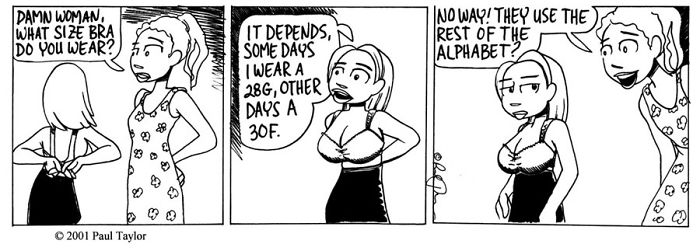





























 Brustle








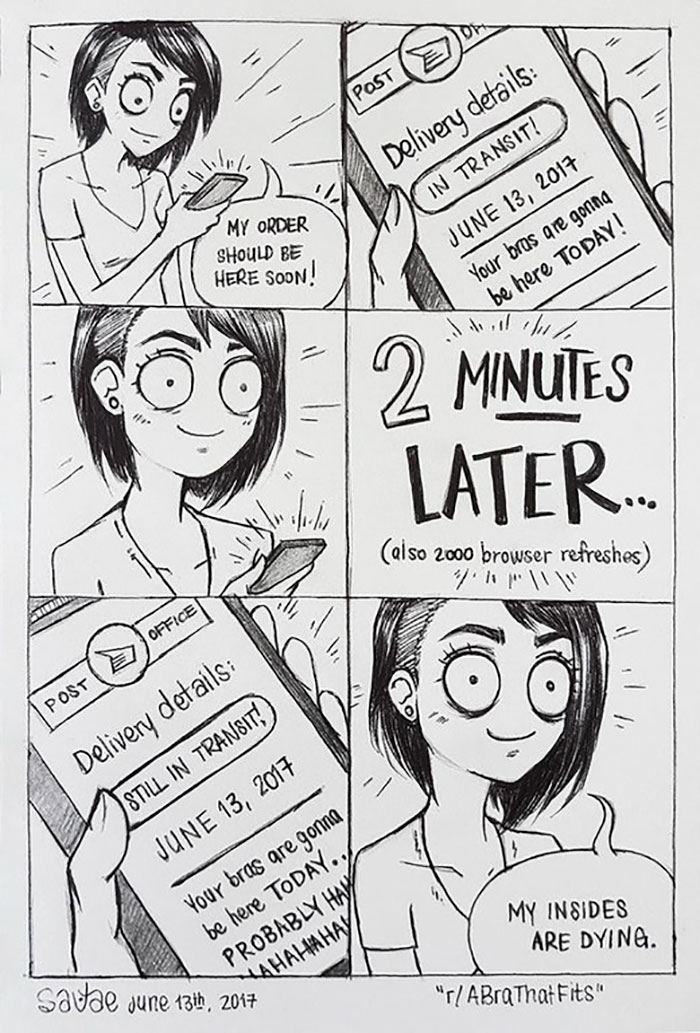 Savae
Savae



 do NOT under any circumstances call the number shown (888-710-4402). You’ll be connected to scammers in India who will tell you all sorts of incomprehensible things about your machine and ask you to let them connect with your computer.












/hominy-01-2500-56a20ff33df78cf772718937.jpg)

 Playing in the World Game