Microsoft “non-support” – I’m not just blowing smoke here.

In my previous post, I ranted a bit about Microsoft’s efforts to alienate their customers by making competing or foreign programs (like Chrome – horrors!) incompatible or forcing them to ask permission to run, every time. We’re talking Windows 10 here, the latest and greatest.

Here’s an old joke, but one which remains totally valid in the 21st century:

A helicopter was flying around above Seattle when an electrical malfunction disabled all of the aircraft’s electronic navigation and communications equipment. Due to the clouds and haze, the pilot could not determine the helicopter’s position and course to fly to the airport. The pilot saw a tall building, flew toward it, circled, drew a handwritten sign, and held it in the helicopter’s window. The pilot’s sign said “WHERE AM I?” in large letters. People in the tall building quickly responded to the aircraft, drew a large sign and held it in a building window. Their sign read: “YOU ARE IN A HELICOPTER.” The pilot smiled, waved, looked at her map, determined the course to steer to SEATAC airport, and landed safely. After they were on the ground, the co-pilot asked the pilot how the “YOU ARE IN A HELICOPTER” sign helped determine their position. The pilot responded “I knew that had to be the Microsoft building because, like their technical support, online help and product documentation, the response they gave me was technically correct, but completely useless.”

One would think that after all these years as the 900-lb gorilla in the software space, someone at Microsoft would wake up and realize that this is a critical failing that generates massive ill will toward the company.

No, I’m not blowing smoke. Here’s an example, related to my last post.

I went to the Microsoft support site today, and asked a simple question: “Why does Windows Firewall in Win10 block Google Chrome?”

Here’s the page that comes up – one relevant to Windows Vista, dated 2011.

Someone named “Samuthra G,” tagged as a Microsoft agent, replied:

Hi,As the issue is with Google Chrome I would suggest you to post your query in the Google forum for better assistance:
http://www.google.com/support/forum/p/Chrome

And this was designated as the “most helpful” response. Thank you so much, Microsoft and Samuthra G; nothing like blowing an unhappy customer’s problem off by blaming someone else.

Two months later, a user named “Karmana” followed up with the perfect response:

Why is it, over the years, that I have noticed the vast majority of supposed Windows or Microsoft higher-certified helpers cannot seem to actually read the questions asked by the original poster?  Samhrutha, your answer to QW_895 is not only unhelpful, but if you were/are a Microsoft employee, then it is also highly irresponsible to blow off the OP by saying, “It’s not our problem.”  Taking responsibility for one’s own products is a strong first step in positive Public Relations!

To this day, this is my boilerplate experience with Microsoft forums. First of all, the people who answer never give a relevant answer – it probably has to do with the fact that their first language is not English, and that they’re paid pennies per hour to respond to these questions. Second, if they do give a response that’s even on-topic, it’s almost always so technical as to be incomprehensible or un-implementable by the average user.

Today I tried contacting the Microsoft support site, just to see what happens:
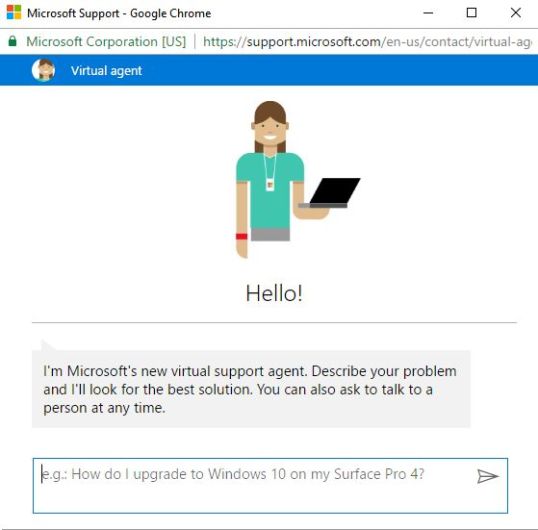
support

Having already tried a search without success, I figured I’d take advantage of their offer:
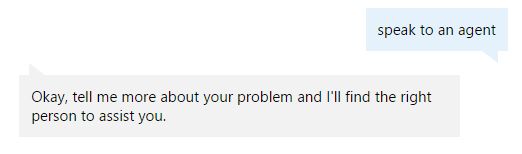
support-2

So I entered my question again: “Why does Win10 firewall block Chrome?” What I got was a list of articles – and once again, the most relevant hit is the worthless exchange I referred to above.
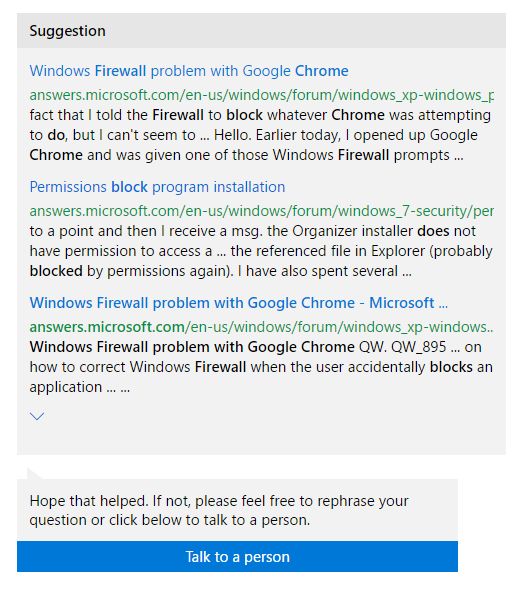
support-3

So I clicked the “Talk to a person” link, and was connected via Chat to a friendly Microsoft agent somewhere on the other side of the world.

“Clarisse” asked me some questions about which version of Windows I was using, provided a case number, and ended up suggesting that I uninstall and reinstall Chrome. So just for the hell of it, I gave that a try – predictably, without success. These agents in India or wherever are minimally trained, minimally paid, and working from scripts without much understanding of what’s happening under the hood.

If I wanted, I could pay $149.00 per year for premium Microsoft support, which would allow me to ask questions at any time and also enable remote desktop support, but I somehow feel that paying for support to solve problems that Microsoft generates is probably not the best allocation of my resources.

The challenge is that Microsoft is so widely accepted as the de-facto standard in the business world that people need it to conduct their daily affairs, and most people would rather muddle along with the best they can do rather than delve down into the guts of an operating system to try to find a fix or a workaround. Microsoft knows this, and based on results, they don’t care to spend any time, effort, or money to improve their byzantine and useless support system.

It’s sad. For myself, I don’t really feel like facing the Linux learning curve, and I’m seriously afraid of something like this:
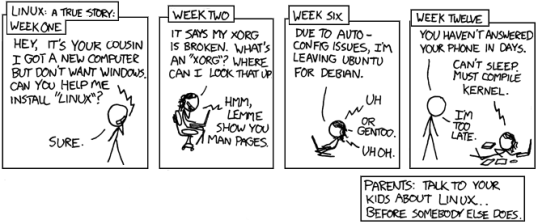
cautionary

As for Apple, I love the idea of the Macintosh platform, but unless the company brings their prices in line with PC hardware, I won’t be able to justify the expense. From a functionality standpoint, the lines between PC and Mac world have blurred considerably since 1984 when the Mac was introduced as the sexy computer for the rest of us, so the draw has diminished substantially.

Still not a happy camper.

The Old Wolf has spoken.

Dear Microsoft, are you *trying* to piss of your user base?

Really, this is beyond stupid.

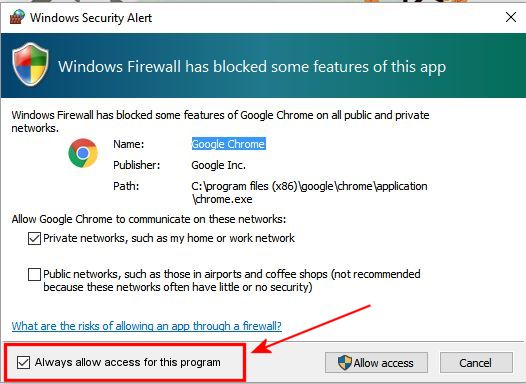
Example 1:

chrome

Google Chrome? Really? Is it not enough that the entire world knows that IE and Edge are the most execrable browsers around, now you have to block Chrome in Windows 10 every time it launches?

How hard would it be to do something like this?

chrome2

How screeching hard would it be? Unless someone with a brain the size of a walnut and the ethics of a honey badger sitting in some conference room somewhere said, “No, let’s make it as hard as possible for people to use competing products.” Oh wait, Microsoft would never do something like that.

Microsoft initially tried to eliminate the threat non-Microsoft browsers posed to the applications barrier to entry by attempting to bribe, and later threatening, Netscape into giving up its core Window 95 web-browsing business. Had Netscape accepted Microsoft’s market-division proposal, Microsoft would have succeeded in killing the browser threat in its infancy and likely would have acquired a monopoly over browsers. (US Department of Justice, U.S. v. Microsoft)

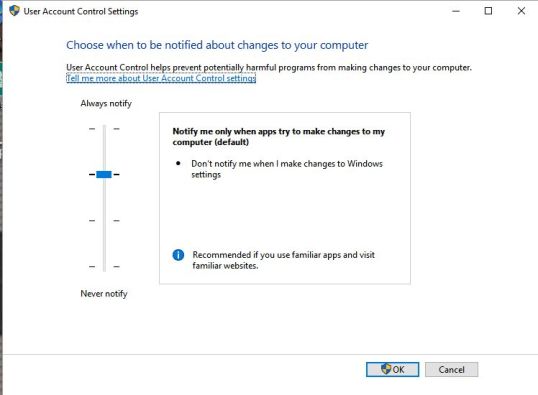
The only option is to modify your global security settings, which is generally a crappy option. There are reasons why this security warning is in place, and it can protect your machine from malicious things, so that’s a poor solution.

account-control

Example 2:

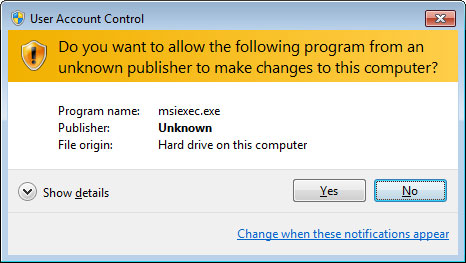
A popup I get when I try to run older software that used to work well in Win7 (these examples are for msiexec.exe, but the name changes depending on the program selected):

msiexec_exe_trojan

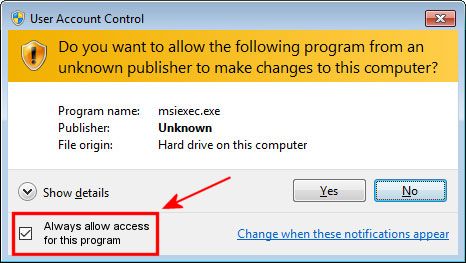
Again, Microsoft: would it have killed you to put something like this in your code?

msiexec_exe_trojan-2

This solution would be so simple, and yet in its absence, the solution is terribly complex and ultimately unsatisfactory. Microsoft support websites are typically run by people in other countries whose first language is not English, who have poor understanding of the questions asked, and who provide generally useless information.

Given these frustrations with Win10, I find this old gag somehow more relevant than ever.

If GM had developed technology like Microsoft, we would all be driving cars with the following characteristics:

1. For no reason at all, your car would crash twice a day.
2. Every time they repainted the lines on the road, you would have to buy a new car.
3. Occasionally, executing a manoeuver such as a left-turn would cause your car to shut down and refuse to restart, and you would have to reinstall the engine.
4. When your car died on the freeway for no reason, you would just accept this, restart and drive on.
5. Only one person at a time could use the car, unless you bought ‘Car95’ or ‘CarNT’, and then added more seats.
6. Apple would make a car powered by the sun, reliable, five times as fast, and twice as easy to drive, but would run on only five per cent of the roads.
7. Oil, water temperature and alternator warning lights would be replaced by a single ‘general car default’ warning light.
8. New seats would force every-one to have the same size butt.
9. The airbag would say ‘Are you sure?’ before going off.
10. Occasionally, for no reason, your car would lock you out and refuse to let you in until you simultaneously lifted the door handle, turned the key, and grabbed the radio antenna.
11. GM would require all car buyers to also purchase a deluxe set of road maps from Rand-McNally (a subsidiary of GM), even though they neither need them nor want them. Trying to delete this option would immediately cause the car’s performance to diminish by 50 per cent or more. Moreover, GM would become a target for investigation by the Justice Department.
12. Every time GM introduced a new model, car buyers would have to learn how to drive all over again because none of the controls would operate in the same manner as the old car.
13. You would press the ‘start’ button to shut off the engine.

Oh yeah, and all the owner manuals would be written in Danish.

Yarg. old_wolf_angry

The Old Wolf has spoken.

An old scam, resurrected

I previously posted about the most deceptive ad I had ever encountered in an article entitled “Selling It.”

Hall of Shame Advertisement

Take away all the mummery, and the thrust of the ad was, “throw away your old rabbit ears and buy our pretty rabbit ears.”

When it comes to separating suckers from their money, old ideas die hard. I mean, why throw away such a good concept if it works, right?

Saw this in WalMart just the other day:

20160914_161116

20160914_161101

Other than the fact that the old one was analog and this one is digital, it’s the same marketing pitch, with the same marketing weasel words. But the summum bonum of the product? “Works just like your old antenna, ONLY NOW with a sleek design.”

Well, that’s certainly sufficient incentive to throw away my old digital antenna and buy this one. Except for the fact that I haven’t watched broadcast TV for over 20 years, but that’s another story.

Save your money and don’t buy camel ejecta like this.

The Old Wolf has spoken.
Maine’s Ballot Initiatives

The following six questions will appear on Maine’s ballots this fall:

Question 1 Marijuana Legalizes, regulates, and taxes marijuana as an agricultural product
Question 2 Education Establishes a 3 percent tax on household income over $200,000
Question 3 Firearms Requires specific background checks for gun sales and transfers
Question 4 Minimum Wage Increases minimum wage to $12 per hour by 2020
Question 5 Elections Establishes statewide ranked-choice voting
Question 6 Bonds Issues $100 million in bonds for transportation projects

Here’s how I stand at the moment, and why. Opinion subject to change based on additional data.

Question 1: Marijuana: Legalizes, regulates, and taxes marijuana as an agricultural product
Prospective vote: Yes
Reasoning: The war on drugs has clearly failed. While I believe that human beings would be generally better off if they used no mood-altering substances, the social costs of legalization vs. prohibition and enforcement of marijuana specifically must be weighed. FBI data shows that of the roughly 700,000 arrests for marijuana-related charges in 2014, about 90 percent were for possession only, and while an arrest does not always lead to jail time, these arrests can have radiating consequences. Alcohol leads to far more societal costs in terms of violence, abuse, and other anti-social behaviors, and we saw how well the Eighteenth Amendment worked. What is needed is legalization and control in the same way alcohol is legal and controlled, taking revenue out of the hands of the cartels and crime syndicates. This would also clear the way for the legalization of industrial hemp, an astonishingly useful product which has vanishingly small quantities of THC (less than the amount of alcohol in NA beers, for example) but which has been lumped together with cannabis by government regulators out of fear and/or ignorance.

Question 2: Education: Establishes a 3 percent tax on household income over $200,000
Prospective vote: Yes
Reasoning: 1) Funding education is good. Schools are generally underfunded and teachers generally underpaid. This initiative would require a 3% surcharge on portions of income over $200,000, meaning if you earned $280,000 in a given year, you’d see your taxes go up by $2,400. If I had an income like that, I’d gladly pay double that as a surcharge and think I was getting off easy. 2) Anything Paul LePage opposes is most likely a good idea.

Question 3: Firearms: Requires specific background checks for gun sales and transfers
Prospective vote: Yes
Reasoning: This is a hot-button issue in Maine, where concealed carry doesn’t even require a permit. Lots of “yee-haw ‘Murica” sentiment up here. Don’t get me wrong, I’m a fervent 2nd Amendment supporter, and I won’t support any effort by any candidate to “come get your guns.” But I’m also a fervent supporter of common sense. The right to drive a car isn’t enshrined in the Constitution, but in order to drive a car, the following things have to happen:

  1. Driver must be of age, have operator training and be licensed
  2. Vehicle needs to be registered, inspected, taxed, and insured. Every vehicle, every year.

Once these requirements are met, you can own as many vehicles as you want. Why firearms should be exempt from the same type of safety-oriented requirements simply makes no sense.

Question 4: Minimum Wage: Increases minimum wage to $12 per hour by 2020
Prospective vote: Yes
Reasoning: I support this because we probably won’t get anything better through legislation in the near future, but I feel that it doesn’t go far enough. $15.00 would be better. And it’s being phased in too slowly. To have a minimum wage that people can’t live on is unconscionable, particularly when so many families are trying to get by on two wage-earners at this level.

Question 5: Elections: Establishes statewide ranked-choice voting
Prospective vote: Yes
Reasoning: From the League of Women Voters:

  • RCV allows voters to vote for their favorite candidate without fear of helping elect their least favorite candidate. It minimizes strategic voting and eliminates the spoiler effect.
  • RCV is most likely to elect a candidate with broad appeal. It ensures that winners enjoy majority support when matched against their top opponents.
  • RCV encourages candidates to run with new ideas and dissenting opinions.
  • It promotes civility in campaigns and encourages winning candidates to reach out to more people, reducing negative attacks.
  • Unlike traditional runoff elections, it accomplishes these goals in a single election. Traditional run-offs require candidates to raise much more money and are much prone to negative attacks ads.

Question 6: Bonds: Issues $100 million in bonds for transportation projects
Prospective vote: Undecided
Reasoning: Economic issues are complex. Clearly America’s transportation infrastructure is crumbling, and woefully underfunded. Maine’s roads are in poor shape, in part because of harsh winter weather. The bond has a lot of support; Mark W. Anderson, an economist and a writer for the Bangor Daily News, calls for an increase in fuel tax to more fairly distribute cost to heavy users of roads. I need to think about this one some more, and it’s not easy for a Wolf of Very Little Brain to get his head around things like this.

The Old Wolf has spoken.
Stop what you’re doing!

“Please stop what you’re doing and listen to this very important message. I’m going to give you access to a pre-recorded message that’s going to show you exactly how to start putting $10,000 or more in your pocket in the next 10 to 14 days and $10,000 or more every 10 to 14 days after that. This message will absolutely blow your mind! So press 1 right now if you want to find out exactly how to put $10,000 or more in your pocket every 10 to 14 days. I guarantee you have never seen anything like this up until now. So press 1 right now to get all the details, or press 9 to guarantee that you’ll never hear from us again.”

robocall1

I can’t count the number of times I’ve had this robocall, along with “Hi! I’m Kelly from Credit Card Services!” and a handful of others. But this one is especially obnoxious.

First of all, these calls blatantly ignore the National Do Not Call Registry. Second, pressing “9” only serves to guarantee that your number is registered as a “live” number, and will then be sold to other telemarketers. Lastly, they’re selling a weak-sauce multi-level marketing package of informational and motivational material for $1,000, plus a $299.00 annual membership fee, with a no-refund rider attached. You shell out, you’re sunk. This particular dodge is being run by Exitus, but I suspect the same come-on is being used by a number of shady operators. [Note: Here’s a breakdown of how the Exitus plan works, astonishingly without a link to “another, better system” as is common with so many of these affiliate marketers. Bash the competition, and then sucker people into your own nearly identical scheme.]

They claim you don’t have to do any calling. But you will need to send referrals to your own marketing page, for the automated system to work for you.

How are you going to get referrals? Clearly, by using one of those never-suffiently-to-be-damned robocalling systems that will bother millions of people in clear violation of the law.

If you are looking for a business model that depends on a foundation of not caring how many people you piss off, or leaving countless broken bodies in your wake to get one customer, then this opportunity is for you.

If you have ethics and morals, compassion and concern for the well-being of your neighbor, better look elsewhere.

Every time I get one of these calls, I have visions of lowering the person behind it into a wood chipper, slowly – despite working hard on being charitable to all. That tells you how annoying I find these seedy scams.

The Old Wolf has spoken.

Two lessons from bees

1) The Unwise Bee

liahonlp-nfo-o-72d
Elder James E. Talmage

Sometimes I find myself under obligations of work requiring quiet and seclusion such as neither my comfortable office nor the cozy study at home insures. My favorite retreat is an upper room in the tower of a large building, well removed from the noise and confusion of the city streets. The room is somewhat difficult of access and relatively secure against human intrusion. Therein I have spent many peaceful and busy hours with books and pen.

I am not always without visitors, however, especially in summertime; for when I sit with windows open, flying insects occasionally find entrance and share the place with me. These self-invited guests are not unwelcome. Many a time I have laid down the pen and, forgetful of my theme, have watched with interest the activities of these winged visitants, with an afterthought that the time so spent had not been wasted, for is it not true that even a butterfly, a beetle, or a bee may be a bearer of lessons to the receptive student?

A wild bee from the neighboring hills once flew into the room, and at intervals during an hour or more I caught the pleasing hum of its flight. The little creature realized that it was a prisoner, yet all its efforts to find the exit through the partly opened casement failed. When ready to close up the room and leave, I threw the window wide and tried at first to guide and then to drive the bee to liberty and safety, knowing well that if left in the room it would die as other insects there entrapped had perished in the dry atmosphere of the enclosure. The more I tried to drive it out, the more determinedly did it oppose and resist my efforts. Its erstwhile peaceful hum developed into an angry roar; its darting flight became hostile and threatening.

Then it caught me off my guard and stung my hand—the hand that would have guided it to freedom. At last it alighted on a pendant attached to the ceiling, beyond my reach of help or injury. The sharp pain of its unkind sting aroused in me rather pity than anger. I knew the inevitable penalty of its mistaken opposition and defiance, and I had to leave the creature to its fate. Three days later I returned to the room and found the dried, lifeless body of the bee on the writing table. It had paid for its stubbornness with its life.

To the bee’s shortsightedness and selfish misunderstanding I was a foe, a persistent persecutor, a mortal enemy bent on its destruction; while in truth I was its friend, offering it ransom of the life it had put in forfeit through its own error, striving to redeem it, in spite of itself, from the prison house of death and restore it to the outer air of liberty.

Are we so much wiser than the bee that no analogy lies between its unwise course and our lives? We are prone to contend, sometimes with vehemence and anger, against the adversity which after all may be the manifestation of superior wisdom and loving care, directed against our temporary comfort for our permanent blessing. In the tribulations and sufferings of mortality there is a divine ministry which only the godless soul can wholly fail to discern. To many the loss of wealth has been a boon, a providential means of leading or driving them from the confines of selfish indulgence to the sunshine and the open, where boundless opportunity waits on effort. Disappointment, sorrow, and affliction may be the expression of an all-wise Father’s kindness.

Consider the lesson of the unwise bee!

“Trust in the Lord with all thine heart; and lean not unto thine own understanding. In all thy ways acknowledge him, and he shall direct thy paths” (Prov. 3:5–6).

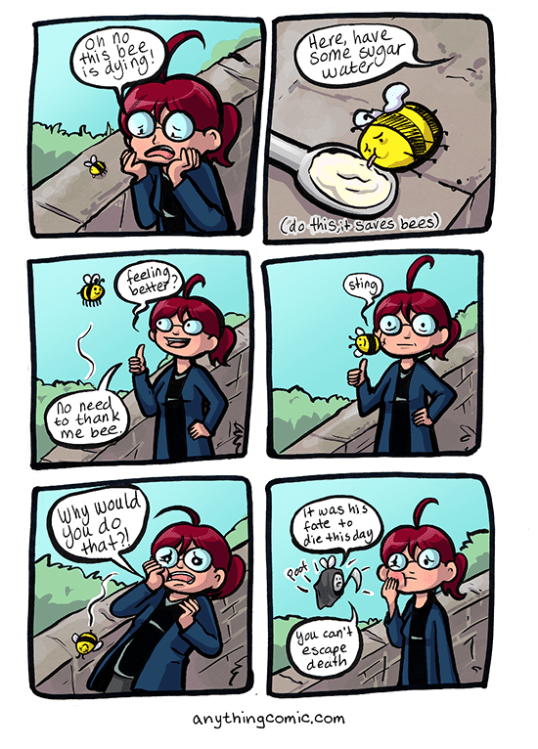
2) You can’t escape death

9856663b2ugch.png

Visit anythingcomic.com, and someone please think of the bees!

The Old Wolf has spoken.

Make a Translator Mad in Four Words

From a recent Facebook post. Having worked as a freelance translator, these responses spoke to my soul. Yes, a few of them are more than four words, but they’re all good – and they’re all real. I have seen many of these myself.

For what it’s worth, I no longer do this sort of work. The reasons will become obvious. I’ve included a bit of commentary here and there.

Cheap bastards

Agencies make money by charging high rates to clients and paying low rates to translators, reviewers, and proofreaders. They’re always jockeying for a better deal. That’s the nature of business, but when you’re an independent contractor, and your standard rate (calculated to earn you a living) is always being undercut, it’s frightfully annoying. The global access of the Internet means that professional, trained, educated translators must now compete with millions of people in India, China, and elsewhere who “speak a little English” and who are willing to work for 1¢ per word or less.

  • Best lowest rate required.
  • What’s your best rate?
  • Make your best rate.
  • Make me (a) good price.
  • Send your best rate.
  • We pay in visibility. (Visibility and $7.95 will get you a coffee at Starbucks.)
  • Our budget is limited. (So I’m supposed to subsidize your profit, right?)
  • Special rates apply to this client. (He’s paying us less, so we’re going to pay you less.)
  • A discount for volume. (We’re paying less because there’s a lot of work).
  • It’s the market rate. (Take it or leave it.)
  • 5¢ is not bad. (5¢ per word is shit.)
  • The others charge less. (Good, feel free to use them.)
  • Someone charges way less.
  • Our budget is only …
  • National Agreement Rate Please.
  • Could you proofread instead? (Read: Your rate is too high).

Cheaper bastards

Machine translation used to be cumbersome, expensive, and not very effective. Now it’s quick, easy, free, and only a bit more effective. While statistical translation models have made some exciting progress, people who don’t understand the intricacies of language assume that online translation is both free and reliable. Similarly, your neighbor may speak a bit of German, but don’t expect your translation to do well in the commercial arena. In the translation world, you still get what you pay for, and if you go cheap, you’re likely to get crap.

  •  Google Translate is cheaper.
  • We will Google translate.
  • I’ll do it myself.
  • I can do it myself.
  • Neighbour can do it.
  • Will it cost anything?
  • Is it for free?
  • That much? No way!
  • The font was wrong. (Followed by “Will you accept 50%?”)
  • I could do it, but…
  • Could do it myself, but…
  • You’re overpaid.

Cheapest bastards

It’s not uncommon for an unethical agency to get a job, break it up into 20 segments, offer the job to 20 translators and have them each do part of the work as a “test,” then award the bid to nobody.

  • Please do this test.
  • Please complete test assignment.
  • We require (a) free test.
  • Test translation without charge.
  • Download the test translation.
  • It’s for a tender. (We need your free translation to make the bid.)

Scheduling headaches

Contractors spend a lot of time juggling their resources against customer needs. Agencies don’t care.

  • We’d like it for tomorrow.
  • Have you begun yet?
  • Great, don’t proceed yet.
  • Client brought deadlines forward.
  • The client sent changes.
  • The client made changes.
  • 6000 words for tomorrow.
  • 20,000 words of light postediting.
  • We need it yesterday.
  • Can you deliver early?
  • Sorry, client cancelled assignment.
  • End client just cancelled.
  • Please send your invoice (then we’re going to have minor changes).
  • File should arrive midnight. (Deadline in 8:00 AM, of course.)
  • We have a glossary (10 minutes before deadline).
  • That didn’t need translating… (After you’ve spent a day and a half on “that.”)
  • Please use US English. (Halfway through a huge project meant to be in UK English!).
  • Please deliver tomorrow morning.
  • Translate in real time! (What does this even mean?)
  • Client isn’t in a hurry (Followed, 2 months later, by “Client needs it ASAP”).
  • The project is cancelled (in the morning of due date!).

Your skills are worthless!

Anyone can translate. It’s just typing in another language.

  • (It doesn’t need to be translated,) just type this in Portuguese
  • Everyone can do it!
  • So you teach English?
  • You’re a translator? Then why don’t you give English courses?
  • What is your work?
  • Please do the shopping.
  • Go get the kids.
  • Don’t think, just translate!
  • What’s your real job?
  • Do you also teach?
  • You have done nothing.

Technical Headaches

“You need to use our tools, yours are garbage.”

  • Trados is a must.
  • TRANSIT is a must.
  • Across is a must.
  • [Insert CAT tool name of choice] is a must.
  • Use our online TM-tool.
  • We only use Excel. (Translating in Excel is a nightmare, if you were wondering.)
  • Please translate into Excel.
  • Your file doesn’t open.

Not only that, in the world of translation, these CAT (Computer-assisted translation tools) are de rigeur. They can be useful in speeding up translation and improving terminological consistency, but agencies routinely take advantage of this and pay less than the full rate for things that the software has translated for you. This ignores the fact that the translator is responsible for the coherence of the entire job and must read and evaluate every bit and piece of the work for accuracy. This alone is the major reason I stepped out of the freelance translation world. My rate per target word is X¢, period. Pay it or go somewhere else. Translators who survive in the industry pretty much have to suck it up, but I wasn’t willing.

  • We don’t pay repetitions.
  • Pro-rated for fuzzy match.
  • 100% matches for free.
  • Discount for fuzzies applied.
  • Fractional Payment for Repetitions.

Payment Headaches

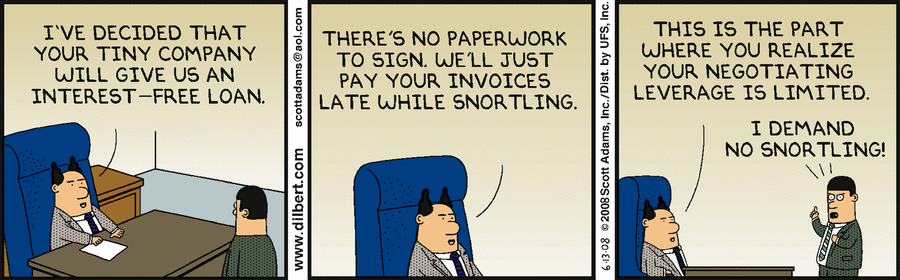
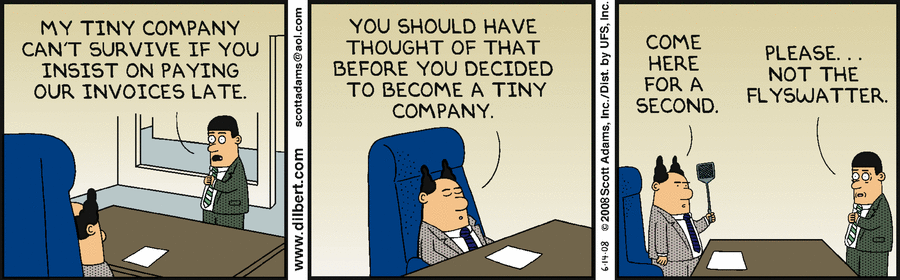
In the US, standard terms are 30 days net. Around the world, it’s not uncommon for translation agencies to expect translators to wait 60, 90, or even up to 180 days for payment of invoices (they usually claim that they’re waiting for their clients to pay them.) This is unethical in the extreme, but not an uncommon strategy in the business world.

dt080613
dt080614
  • We forgot your payment.
  • Did you send your invoice? (Yes, I did, 60 days ago.)
  • Net forty-five days.
  • The payment will delay.
  • Thanks for your patience. (After payment was delayed for a month).
  • Check’s in the mail. (Yes, people still use this one.)
  • Our accountant on vacation.

We know better than you.

Never mind your skills, the next person is always smarter.

  • Reviewer says you failed.
  • Is “the” necessary here?
  • Let me correct that.
  • I speak two languages.
  • (S)he knows better.
  • (S)he is a [language] teacher.
  • Proofreader does not agree. (Proofreaders know bupkis about translation.)
  • Changes made by proofreader.
  • My secretary edited it.
  • This translation is bad.
  • But Google translate says…

Creepy Clients

There is always one.

  • What are you wearing?

General Lies

“I have read and agree to the terms of service”

  • It’s a straightforward text.
  • It’s a piece of cake.
  • It’s short and easy.
  • It is not technical.
  • It’s not very technical.
  • Help me, it’s quick.
  • It only needs editing.
  • Just a quick question.

Translation Requirements, and Stupid Questions

Things that don’t fall into easily-defined categories.

  • Do you translate books?
  • Is Brexit affecting business?
  • Source text is JPG. (This means you can’t use your CAT tools for the job.)
  • It’s a PDF – handwritten.
  • Translate in sticky notes.
  • It’s mainly doctors’ handwriting.
  • Please check additional references.
  • (We know you’re busy but) we’re really shorthanded.
  • Here’s an XBench report.
  • It was machine translated.
  • Added to our database. (Don’t call us, we’ll call you.)
  • Read 50 pages of instructions (for a 100-word job)
  • Keep the original format.
  • You have to cook.
  • It’s a doctor’s prescription.
  • Don’t go into details.
  • Thanks for sharing.
  • Are you still translating?
  • Complete our six forms.
  • There’s no source text. (When proofreading a translation, you need to see the original text. If it’s not there, you’re just basically making wild guesses in the dark.)

About 30 years ago, an ad appeared on the bulletin board of the translation software company I was working at. It probably came from one of the trade publications, and showed a boss ripping an employee a new one. The text read, “Because you had your brother-in-law do the translation, our  ad says that our new camera exposes itself automatically!”

I’ve dealt with the risks of translation on the cheap before, and in this one thing has not changed: If you want good translations for your business, use a professional and pay them well – otherwise your product may just bite the wax tadpole.

The Old Wolf has spoken.
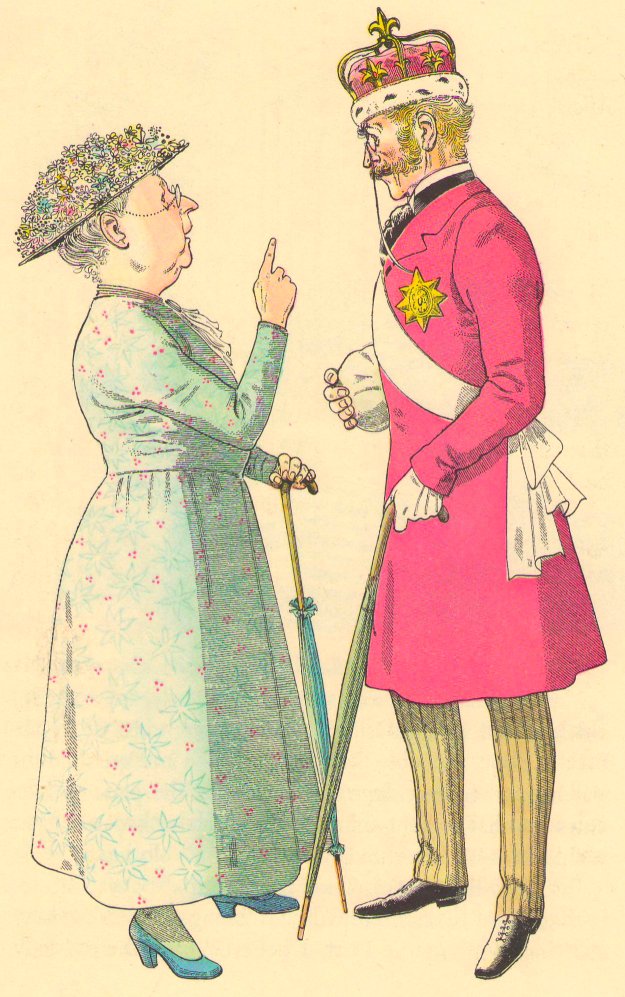
Hello Lucky Winner (Never answer emails like this)

Bullshit

Hello Lucky Winner,

This might come as a surprise but 100% legitimate, as David and Carol Martin has approved a donation sum of $900,000.00 USD from part of their National Lottery Win of £33,000,000.00 Pound Sterlings. I believe this will come in handy and with it you can also be of assistance to the under privileged within your own community.

To verify the genuineness of this email and our winnings, please see our interview by visiting the web page below;

http://www.bbc.com/news/uk-scotland-south-scotland-35297396 

Your email address was submitted to my wife and I by the Google Management Team and you received this email because we have listed you as one of the lucky beneficiary and all you have to do is get back to us with the below details so that we can direct our Bank to effect valid Bank Draft in your name to your operational bank account in your country.

============

  • Full Name:
  • State:
  • Country:
  • Occupation:
  • Age:
  • Sex:
  • Mobile/Tel:

============

SEND ABOVE INFORMATION ONLY TRHOUGH OUR CONTACT E-MAIL: madvcl@foxmail.com

Congratulations & Happy Celebrations in Advance


liar2

In case you were wondering, letters or emails or faxes like this are pure BS. Never respond, never send the money the scammers will invariably ask for (taxes, fees, bribes, you name it.)

Grandmarina

Be good then, and don’t!

The Old Wolf has spoken.

Fun with Linguistic Symposia

Academic symposia are great fun if you don’t have a reputation to defend. Listening to a presentation can be informative, but the true entertainment value arises when you watch numerous ivory-tower types begin to shred one another’s theories.

This bit of doggerel has been floating around in my humor files since the 70s (first pulled off a chain printer), and deserves to be appreciated by a new generation of linguists.

With no further ado, I present to you a collection of (allegedly) real interactions documented at early gatherings of linguists. First up:

A Taxonomy of Argument Schemata in Metatheoretic Discussions of Syntax
or
Name That Tune

I. Logical Argumentation

  1. If A = ¬A, then my position is true.
    Therefore, since A = ¬A, …
  2. A: ¬p.
    B: Since you agree that p, …
  3. P is absurd, therefore q.

II. Now you see it, now...

  1. Your argument supports my position.
  2. I’m aware of these putative counter-arguments, but…
  3. Let me rephrase that so that it agrees with my position…
  4. I think that is true, but I’m not sure it means anything.

III. The Reasoned Response

  1. I don’t see the argument.
  2. I don’t like your example.
  3. That’s not a problem in my theory.
  4. It’s my opinion, and it’s very true.
  5. I still say that…

IV. Papa Knows Best

  1. You say that, but you don’t believe it.
  2. You believe this, but you won’t say it.
  3. What you really believe is ____, and I agree with you.
  4. Our disagreement is merely semantic.
  5. Don’t be misled by the similarity between A and A. It’s merely a superficial identity.

V. Audience Participation: Let’s take a vote!

VI. The Pre-emption

  1. You’re right, but I said it first!
  2. What you say is wrong, and I said it first!

VII. The Putdown

  1. You can’t do it either
  2. That’s true, but uninteresting in the ____ sense!

VIII. Advancing to the rear

  1. I knew that analysis was wrong before I proposed it.
  2. Of course my analysis is wrong in detail – *all* analyses are wrong in detail.

IX. The Principled Argument

A: Shut up!
B: No, *you* shut up!
A: No, *YOU* shut up!


But wait, there’s more!

An Ancillary Guide To Understanding a Syntax Conference

 What the Speaker Says  What the Speaker Means
These examples are from Dyirbal, a widely discussed language, so I will assume familiarity. I don’t know the language well enough to answer questions, so don’t ask any.
When you stop to think about what you said, it doesn’t say anything.  I don’t understand it.
Some examples are vague; the others are simply wrong. I can’t quite put an argument together, but I still want to attack yours.
No one has ever studied “X”. I haven’t studied it, and neither have my friends.
I may have to retreat (there is a possibility), which is a wise thing to do when you are wrong. I assure you that you are a good guy if you say that you are wrong.
Nobody is going to be converted to another side at this conference. This is not a tournament in which someone will win the main prize. This is my excuse for not accepting anyone else’s argument, regardless of how valid it may be.
It is significant in an “interesting” way. I could possible squeeze an article or two out of it.

It’s been a long time since I’ve attended one of these conclaves, but I have no doubt that such things are still heard if you listen closely.

The Old Wolf has spoken.

“Indian Counting” – Een, teen, tether, fether, fip!

OK, caveat here: it’s may not be Native American counting, but that’s how it was presented to me by my math teacher (Mr. Sommerville, go ndéanai Dia trócaire air) in high school, around 1967. On the other hand, maybe it is.

The entire schema as he presented it was:

Een, teen, tether, fether, fip,
Satra, latra, co, tethery, dick,
Eendick, teendick, tetherdick, fetherdick, bump,
Eenbump, teenbump, tetherbump, fetherbump, didick!

Being testosterone-soaked boys, everyone laughed at hearing the word “dick” used as a number, and then life went on. I had heard it once, and remembered fragments of it forever.

Then came the Internet, where almost everything arcane has a tendency to show up if you wait long enough. I would search occasionally, and over time, bits and pieces appeared; now there is a full-blown Wikipedia article entitled “Yan tan tethera,” and the real story becomes quite complicated.

Over at Wovember Words, the matter is treated thusly (the whole page is worth a read):

The only reference we could find anywhere confirming connections between the counting words of Native Americans with those used in the North of England is in a musical written in 1957, called The Music Man. There is a scene in this play where the wife of the Mayor exclaims “I will now count to twenty in the Indian tongue! Een teen tuther featherfip!” Is this line in the play responsible for the idea that Native American peoples were using these old counting words with their Gaelic origins, or does it reflect that through the dark mechanisms of Imperialism the counting words were imposed onto Native American culture by the time the play was written?

Lincolnshire Shepherds counted:
Yan, tan, tethera, pethera, pinp,
Sethera, lethera, hovera, covera, di,
Yen-a-dik, tan-a-dick, tethera-dik, pethera-dik, bumfit,
Yan-a-bumfit, tan-a-bumfit, tuthera-bumfit, pethera-bumfit, figgit.

At the same time, around 1890, Native Americans were also using:
Een, teen, thuther, futher, fipps,
Suther, luther, uther, duther, dix,
Een-dix, teen-dix, tuther-dix, futher-dix, bumpit,
Anny-bumpit, tanny-bumpit, tuther-bumpit, futher-bumpit, giggit, Anny-gigit.

If you listen to the soundtrack of the movie version of “The Music Man” carefully, there’s a bit more:

Eulalie begins: Een teen tuther feather fip!
The chorus chants: Sakey, Lakey, Corey Ippy Gip (This may not be 100% accurate as these words do not appear in the screenplay)
Eulalie continues: Eendik Teendik Tetherdik Fethertik … (she is interrupted by a firecracker)

So we can see that it’s entirely possible that these counters, very similar to the Brythonic counting systems – too close to be coincidental – may have been transmitted very early by some oral channel to Native Americans, and that by folklore tradition a knowledge of these counters worked their way down cultural pathways to be included in the play and movie.

Language and its history are curious things, with enough puzzles and questions for lifetimes of study – even the whimsical bits.

The Old Wolf has spoken.