Upgrading my phone – A descent into Hell

Back in 2008, I bought a shiny new HTC Incredible II, an Android-powered phone.

htc_incredible_2_890440_g1

It was the cat’s pajamas – did everything I needed it for, and I loved it. Then, time passed, and as happens in the computer world – these smartphones are really just tiny computers, although more powerful in some ways than the mainframes I worked on in the 70s – the software surpassed its capability and it began to develop cruft that wasn’t clearable even with a factory reset. So it came time to upgrade.

I toddled down to my local Verizon store and compared the Samsung Galaxy S5 with the HTC M8, two comparable brands. My wife bought an S4 last year, so I ultimately decided on the Galaxy, although I was pretty much on my own – the very young salesman was totally unable to answer any questions I had as to the comparative merits of each model. I kept pumping him for an executive summary, based on “This phone is good if you want X, that phone is good if you want Y.” He spouted inane and vapid answers like, “This one comes in red,” until my eyes hurt from rolling so hard – although I tried not to let him know I thought he was a blithering idiot. I did ask him if there were anyone in the store who was intimately acquainted with both phones, and he offered to let me speak to his manager who uses the HTC. Sometimes half a loaf is better than no bread, but in this case I saw immediately that these people don’t really know what they’re selling – they just point to the little placards by the display and expect you to figure it out for yourself. I ultimately made my decidion based on the previous research I had done online, because the store personnel were no help at all.

When the time came to sign on the dotted line, the numbers didn’t add up. The total was too much, given the price of the phone and the screen protectors (I respectfully declined the protection plan, the case, the accessories, the bundle, the venus flytrap, the fresh haggis, the Johnnie Walker Blue, and everything else they tried to get me to buy at the same time. “You need a car charger.” “I have one.” “Oh, those old ones are no good, the fuse blows out and they overcharge the device.” “Wait, what? The fuse blows out but it keeps working? That makes no sense at all.” “I recommend a new charger.” And so on, ad nauseam. But back to the total: “Oh, there’s a $30.00 upgrade fee.”

Upgrade fee? What the hell is that? It’s a load of steaming horse crap, that’s what it is, and unethical. It’s just extra profit, but Verizon is too cowardly to call it that. I asked for it to be waived. No dice. They were willing to let me walk out of the store without a sale. The manager of the outfit was a total dickbag… he could have simply said, “Yeah, it’s just extra profit for Verizon, but I’m not authorized to waive it. That’s just the way it is.” But no, he was a coward, and kept spouting the corporate line that I was getting “wireless workshops, online educational tools, and consultations with experts” for my money, which is a festering pile of camel ejecta  – that fee is nothing more than a way of advertising a phone for $X, and when you go to pay, without even telling you the fee exists, charging you $X+30. It’s corporate highway robbery. CEO Lowell McAdam earned around $14 million in 2010 – about enough to waive that “upgrade fee” for 466,000 customers. Stuff like this makes my blood boil, and they can get away with it because it’s enough to make you mad, but not enough to kill the sale if you need a phone. And every carrier does it. So you’re basically fooked.

Then there’s that “protection plan.” When I bought my HTC, the coverage was $5.00 per month, with a $50.00 deductible. Now it’s $10.00 per month and a $100.00 deductible, and the cretin manager tried to tell me it had never been any different, and shame me into buying it on the spot. Again, more than the way it is, it’s the disingenuousness that gripes me. It makes me hate salespeople with the fiery passion of a thousand VY Canum Majorum.

Then there was the question of transferring my contacts and messages from the old phone to the new one. “We can only transfer your contacts. You can do the messages yourself with Verizon Cloud.” Great. I let them transfer my contacts – and as it turns out, they took everything from my Google links and put them on the phone, resulting in about 2500 duplicated entries that I had to delete by hand. And my messages? Well, there’s a little problem with that. See, my old phone is now deactivated…

All in all, I like my new phone.

Glam_Galaxy-S5_White_01

It’s got some neat features, many of which I have not explored yet – but I’m enjoying what I’ve found thus far. The little heart rate monitor on the back and the fingerprint-activated unlock are pretty spiffy.

But I’m still conflicted about whether I want to gamble on that protection plan or not – with insurance of any sort, you’re always gambling against the house, and the house always wins. But I feel ripped off, manipulated, and abused by the buying experience, and it shouldn’t be that way. It’s always unpleasant to deal with a company that has you by the short hairs and knows it. Sadly, there are really no better alternatives for my needs at the moment, or I’d be done with Verizon in a heartbeat just on general principles… and I know they don’t care, and wouldn’t miss me.

The Old Wolf has spoken.

Pompeii: The Movie

Pompeii was an interesting movie. I can see why the critics trashed it; the acting was not spectacular and there was way too much overblown drama and not much more than a sappy, derivative plot. That said: I lived in Naples for around 18 months, right under the shadow of Vesuvio. I spent many hours wandering the byways of both Pompeii and Herculaneum, trying to imagine what life was like there, and what the catastrophe must have been like. Seeing those ash-cast sculptures that used to be real, live people in the museum is terribly haunting; the CG representation of the eruption and its (possible) effects on the city was chilling in the extreme, because however it looked, it would have been terrifying.

Pompeii - December 1970 - 14

 Ash cast of a victim.

Pompeii - December 1970 - 10

 Pompeii – Temple plaza

Jun 1971 - Herculanium - Vesuvius.jpg

 Herculaneum and Vesuvius in the background. Herculaneum was buried more deeply and by hotter ash than Pompeii, hence has a different feel about it. Much has been learned since I was there in the 70s – at the time, it was thought that Herculaneum was buried by hot mud flows rather than ashfall, but this appears not to be the case.

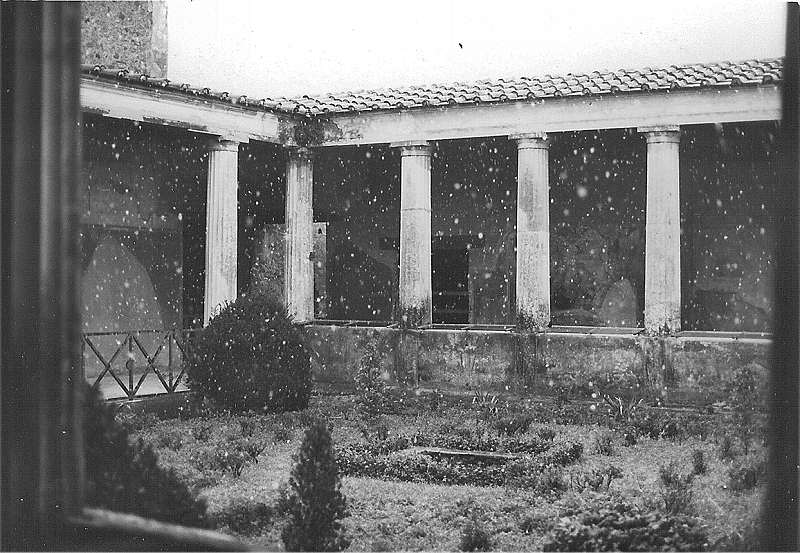
Pompeii - Snow 1

A very rare day of snow in a Pompeiian courtyard. 1970

tour_img-110394-48

The ruins of Pompeii with suburbs of modern-day Naples between it and Vesuvius. It is to be noted that if the mountain ever decides to get its rocks off again, the result could be more catastrophic than the eruption of 79 AD.

In the plus column: Jared Harris, with whom I fell in love as David Robert Jones and Moriarty; he’s always a pleasure to watch. I thought the development of the relationship between Milo and Atticus was one of the more satisfying parts of the film; I’d give it 4 stars out of 10 overall.

The Old Wolf has spoken.
Slum Life in New York City

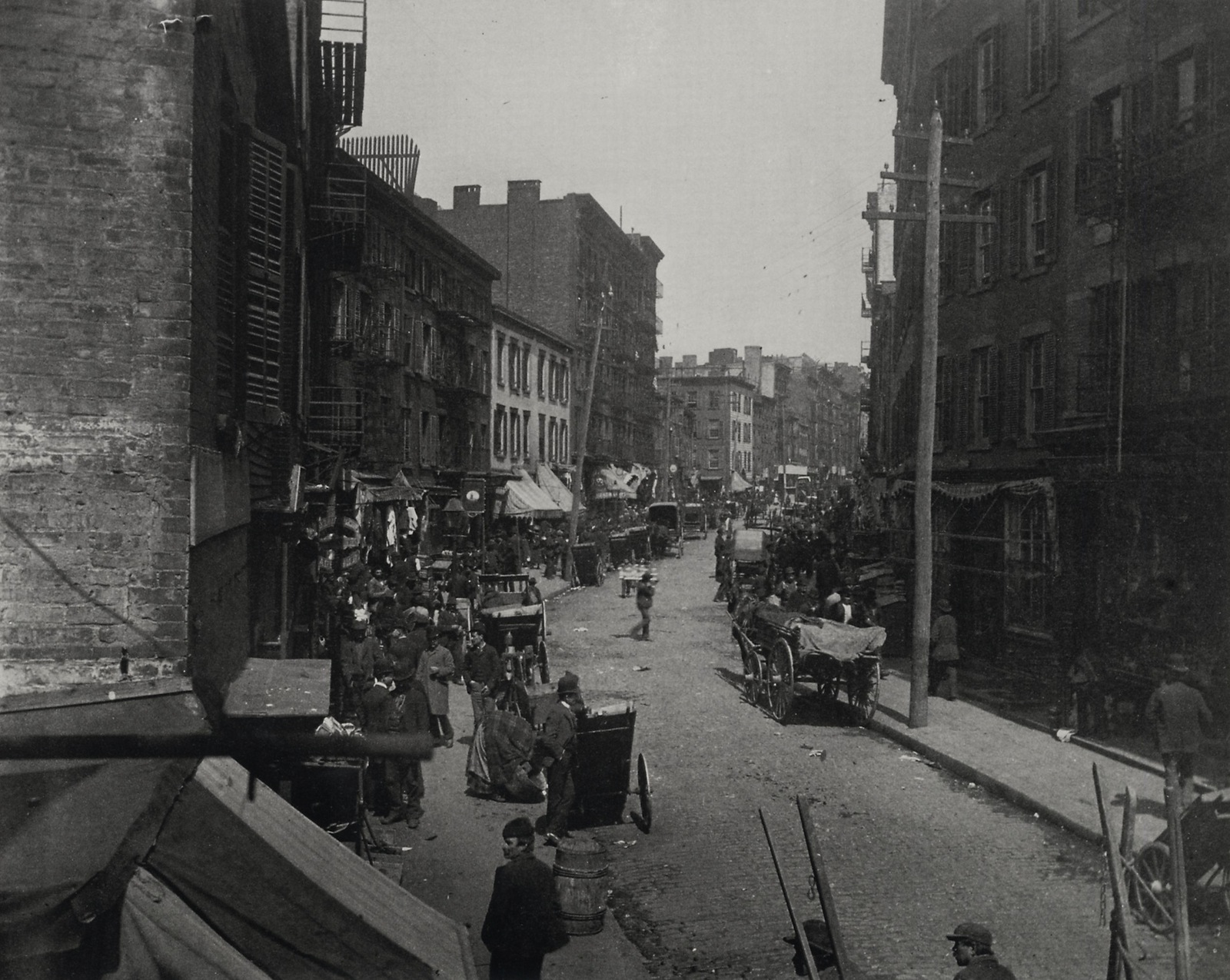
The collection of pictures found at io9 is extracted from the website I mentioned in this post, How the Other Half Lives – from a work by Jacob Riis.

py2dstujbxpvnxk0cnft

Mulberry Bend

ufznti2eh3k84uetgkxb

Lodgers in a crowded flat on Bayard Street. Rent: 5¢ per day.

It gives you a look at some of Riis’ work without having to dig through the online text, but I still recommend perusing the entire, impressive effort.

We have come far. We still have far to go.

The Old Wolf has spoken.
 

Eiffel Tower Construction

Nq1Lev4


I found this intriguing series of images over at /r/historyporn, and boy did it bring back some memories. No, not because I was there – I may be old, but I’m not that old – but because I remember when I was about 10 or 12 or so, my mother brought home a model kit of the tower for us to build together. I was into models, especially the great old monster models (like this one), but this looked like a great project.

It was a nightmare.

And thanks to the miracle of the Internet, here it is, exactly as I remember it.

tower 2

tower

Eiffel Tower, Pyro, 3 feet tall, No. 336-5.98

I seem to recall that the plastic it was made of, or the paint used to coat the plastic, wouldn’t hold your standard Testor’s glue. Mom was an actress, not an enginer, and I was too young to have either understanding or real patience, so I recall the project was an exercise in self-mortification. It did get done, and the thing stood in my room for a while, I remember it looked a bit skewed once we finally got the whole thing together. I’d love to find one and have another go at it, but I doubt I could find an unbuilt one at a reasonable price.

Memories…

The Old Wolf has spoken.
The 5-Cent Restaurants

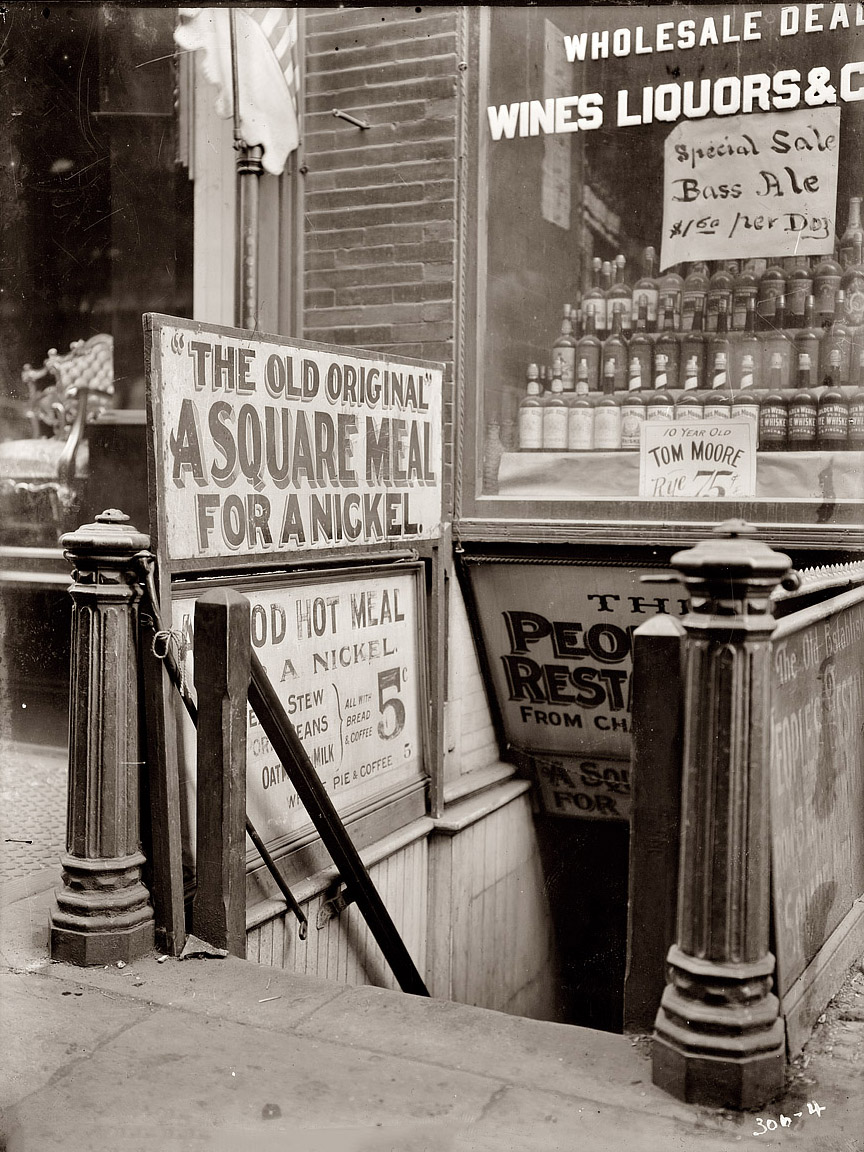
5-cent

Found at /r/historyporn, posted by /u/onlysame1

A wonderful explanation and sources were provided by /u/my_interests:

tl;dr: This wasn’t just an ordinary restaurant, it was was part of a charity to provide the poor and unemployed with hot meals. The meals were subsidized by the donations to the charity. They served many thousands of meals per day.

The People’s Restaurants were conceived of and operated by a charitable organization[1], the Industrial Christian Alliance, in 1893 to help feed the poor and the unemployed. J.P. Morgan[2] himself sat on the Board of Directors of the organization.

To eat at a Five-Cent restaurant, one needed a nickel or a meal ticket, which could be provided for free[3] (PDF), or purchased at People’s Restaurant headquarters (100 tickets for $5) often purchased by good Samaritans and churches to give away to the less fortunate. The restaurants had a capacity to serve 1,000 – 2,000 meals per day and were open from 7am to midnight.

The Peoples Restaurant started with a single lodging house and restaurant at 170 Bleeker Street[4] (which is now a Mexican restaurant[5]) and expanded eventually joining with other organizations[6] such as the Merchants’ General Committee to help grow and open additional restaurants and grocery stores.

By December 1894 they had grown and had the capacity to provide 25,000 meals per day[7]  According to this New York Times article[8] (PDF) from January 26, 1894 on average the restaurant was serving 1,000 – 1,300 meals per day and increasing.

Though they did much good, it wasn’t without controversy[9]. The 5-cent restaurants were popular and received a lot of press coverage. Other charities claimed that people from outside of New York City, hearing about how well the poor are taken care of, began to come to New York City to live.

According to this source[10], in total nine People’s Five-Cent Restaurants were opened in various parts of New York City, though these were the only confirmed addresses I could find.

Sources[14] 

These restaurants remind me of the Viennese W.O.K establishments, about which I have written previously.
The Old Wolf has Spoken.


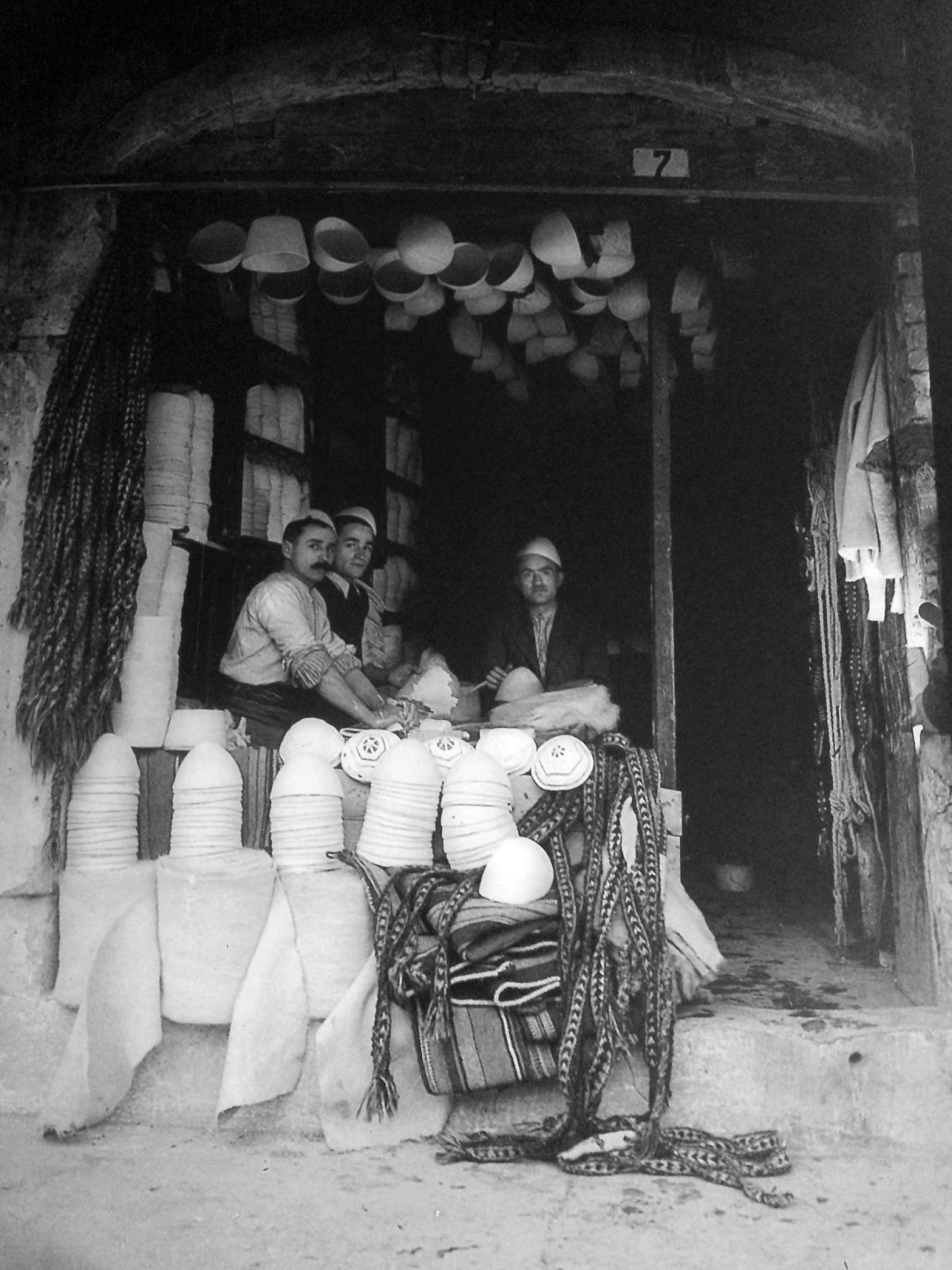
Albanian hatmakers in Shkodër, 1900-1920

Albanian Hatmakers

Hatmakers in Skhodër, Albania, 1900-1920. Photo by Kel or Pietro Marubi. Posted by /u/RMSEP at /r/historyporn.

Albania has a long, interesting and tortured history. I have a particular interest in the country, having visited there a number of times over the course of my career, and having gotten to know more than a few Albanians.

My interest in this small but intriguing Adriatic country was first piqued when I read “Albania, Alone Against the World,” an article in the October, 1980 issue of National Geographic. This was before the fall of the Iron Curtain (which, sadly, shows some signs of being raised again, given recent developments in Ukraine, but that’s another story) but Albania’s story seemed to stand out among that of other Communist countries – and at that time, North Korea was not as much in the news as it is today.

The article was written by Mehmet Biber, a Turkish photographer who was based in Istanbul, and is the product of his own visit and notes from that of a visit by Sami Kohen, another Istanbul resident. It contains some captivating photos of what life was like under the iron-fisted rule of Enver-Hoxha, the fiercely independent, brutal, and Stalinist leader of Albania from it’s liberation from the Nazis in 1944 until his death in 1985. From Wikipedia:

The 40-year period of Hoxha’s rule was politically characterized by the elimination of the opposition, prolific use of the death penalty or long prison terms of his political opponents and evictions from homes where their families lived and their internment in remote villages that were strictly controlled by police and the secret police (Sigurimi). His rule was also characterized by Stalinist methods to destroy his associates who threatened his own power.

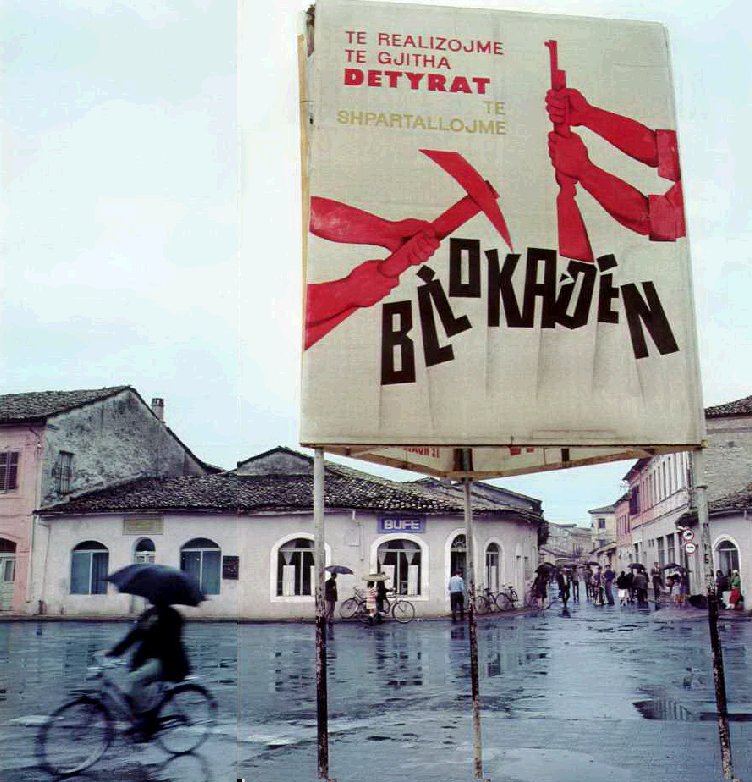
Shkoder

This photo from Biber’s article shows the town of Shkodër in 1980. The banner says, “Let us fulfill all our obligations and smash the blockade.” Of course, there was no blockade, and no interest in punishing or otherwise invading Albania, but Hoxha’s paranoia knew no bounds. He wasted his country’s resources on numberless bunkers, supposedly to protect the fantastic wealth and ideology of his impoverished nation from the evil hordes, both Communist and Capitalist, who would overrun Albania like wolves.

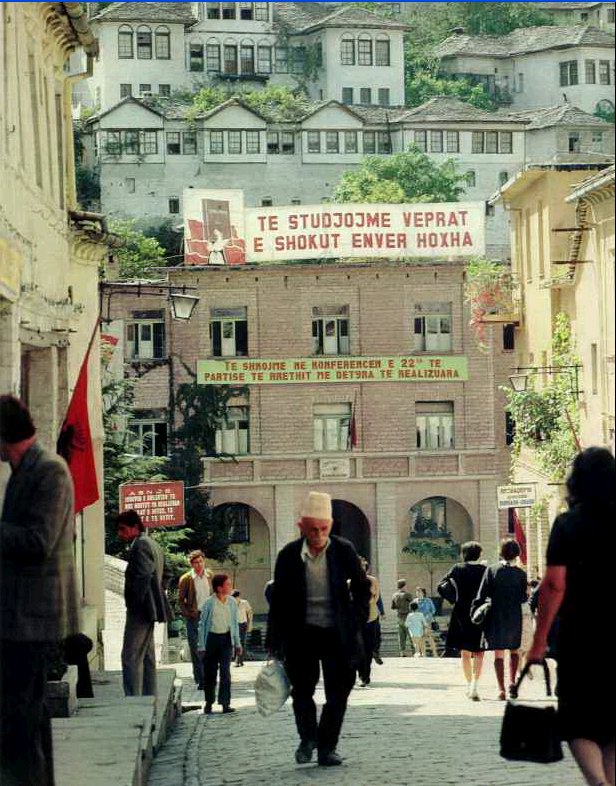
Hoxha

Gjirokastër, the hometown of Hoxha. The banner encourages residents to “Study the Works of Comrade Enver Hoxha.” Photo: Mehmet Biber

Then came the fall of communism, and Albania was subject to changes that shook the nation to the core. A country that had almost nothing in the way of free enterprise and commerce (centrally-planned economy) was instantaneously and disastrously changed into a market economy. On the upside, goods and services that had never been available were suddenly popping up like mushrooms; on the downside, corruption and crime exploded.

Private car ownership was reinstated and businesses re-established. However poor city lighting and road quality became major problems as mud, potholes, street floods, and dust became permanent features on the streets. However, all buildings and apartments were denationalized, second-hand buses introduced, and modern water, telephone, and electrical systems built during 1992–1996 which form the backbone of modern Tirana. Enver Hoxha’s Museum (Pyramid) was dismantled in 1991 and renamed in honor of persecuted activist Pjeter Arbnori. (Wikipedia:Albania)

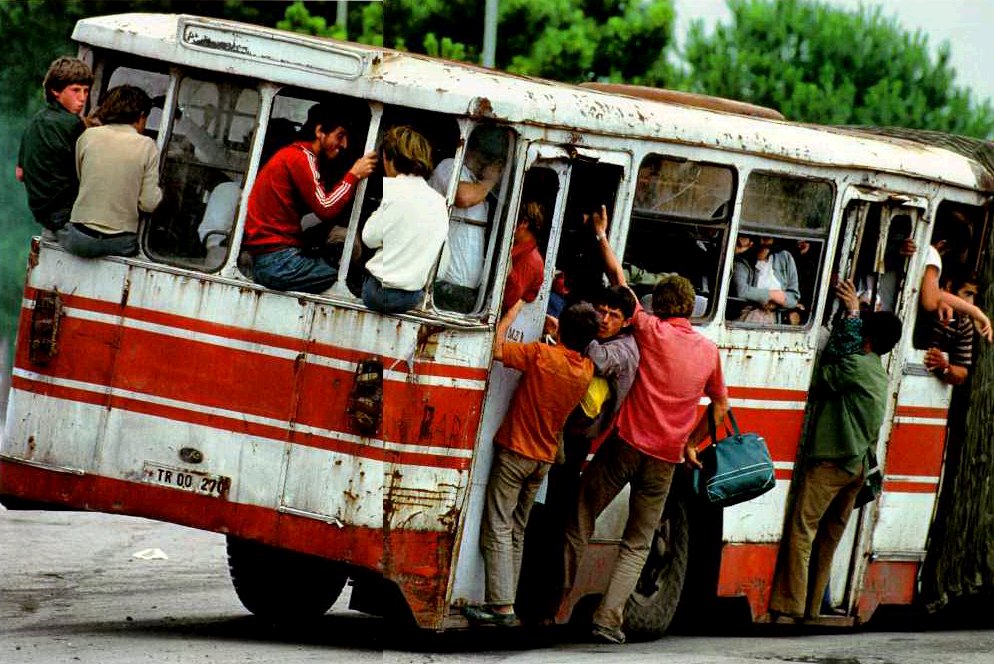
Bus

A bus in Tiranë, loaded almost past the breaking point, in 1992. Photo: Nicole Bengiveno, published in National Geographic, “Albania Opens the Door” by Dusko Doder, July 1992. This article gives a good overview of the change that hit Albania like a 16-ton weight.

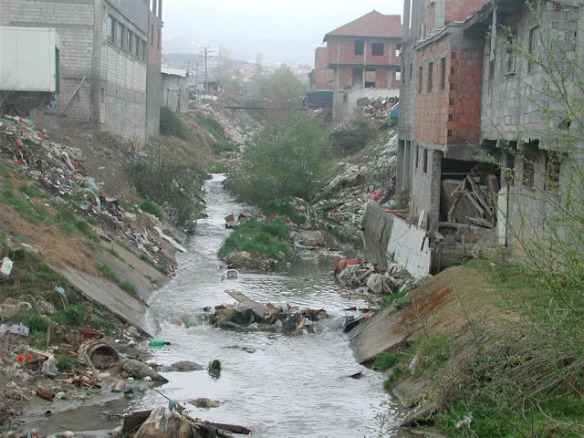
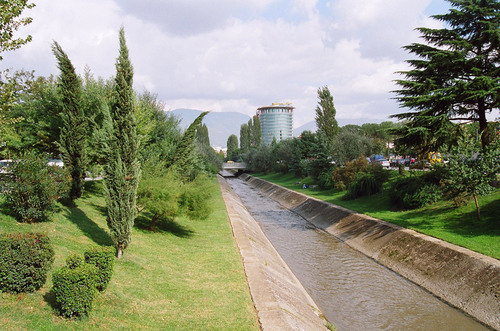
As I visited Albania over the course of several years from 1993 to 2000, I watched Tirana’s central park area and the banks of the Lena river (among others) become choked with illegal and dangerously-constructed buildings. People simply squatted on public land, built what they want in whatever way seemed good, and regulation was nowhere to be seen. Grease the palms of officials and police to look the other way, and presto, a new business was born. In 2000, efforts were made by Edi Rama, a former Tirana mayor, to demolish illegal buildings to return the area to its pre-1990 state, but public land continues to be under pressure from illegal construction, and there is no clear outlook or direction for Tirana’s future at the current time.

lana-river-before-restoration-12-04

Illegal construction on the Lana River in 2003

15172059

A similar scene, post-reconstruction

Devastatingly for much of the Albanian population, the financial shakeup of 1996-1997 included many Ponzi schemes, invested in by around 2/3 of the population; most of their investment was totally lost, and the resulting social upheaval was catastrophic. While things continue to improve slowly, it will take Albania generations to overcome residual problems in government and society.

Pyramid

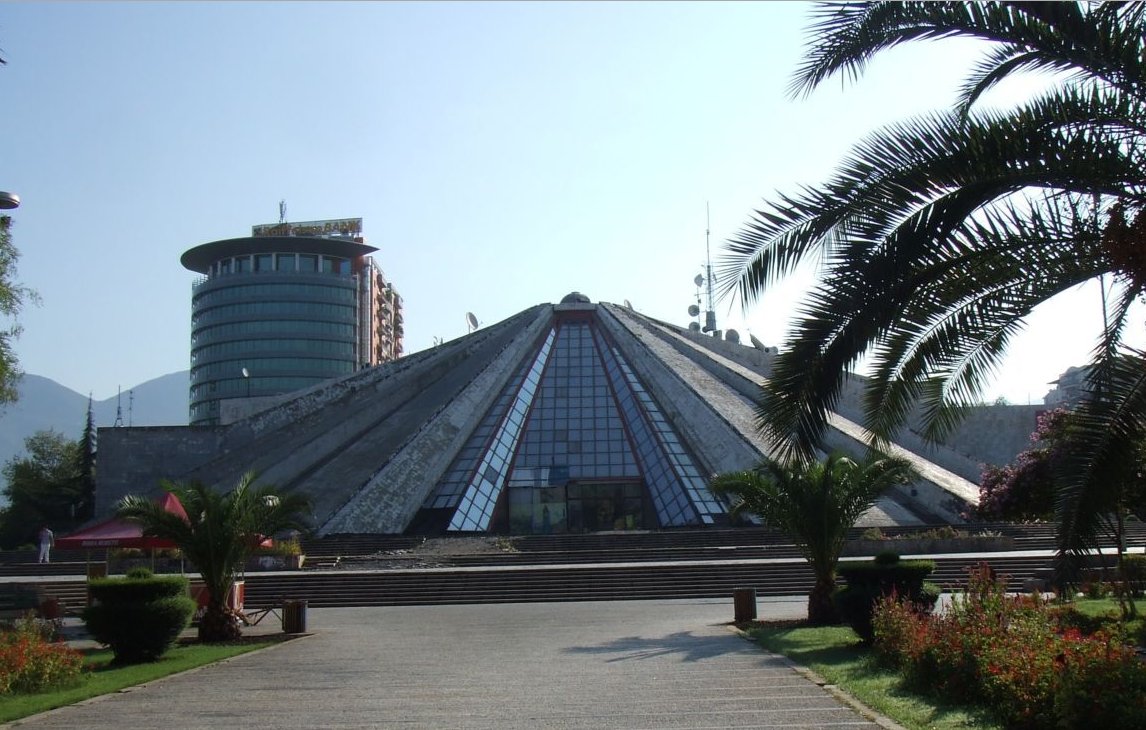
The Pyramid of Tiranë, slated to be Hoxha’s mausoleum, then a museum, then a convention center, now a crumbling, defaced eyesore and the subject of debate – preserve or demolish?

I would love to be able to get back to Albania, which is now wide-open to tourism, although there are parts of the country where even the authorities don’t like to go, run by clans that would make the Hatfields and the McCoys look like the Sesame Street crowd. That said, the country has much to offer in the way of natural beauty and culture, and I wish them nothing but good as they shoulder their way into the future.

theth

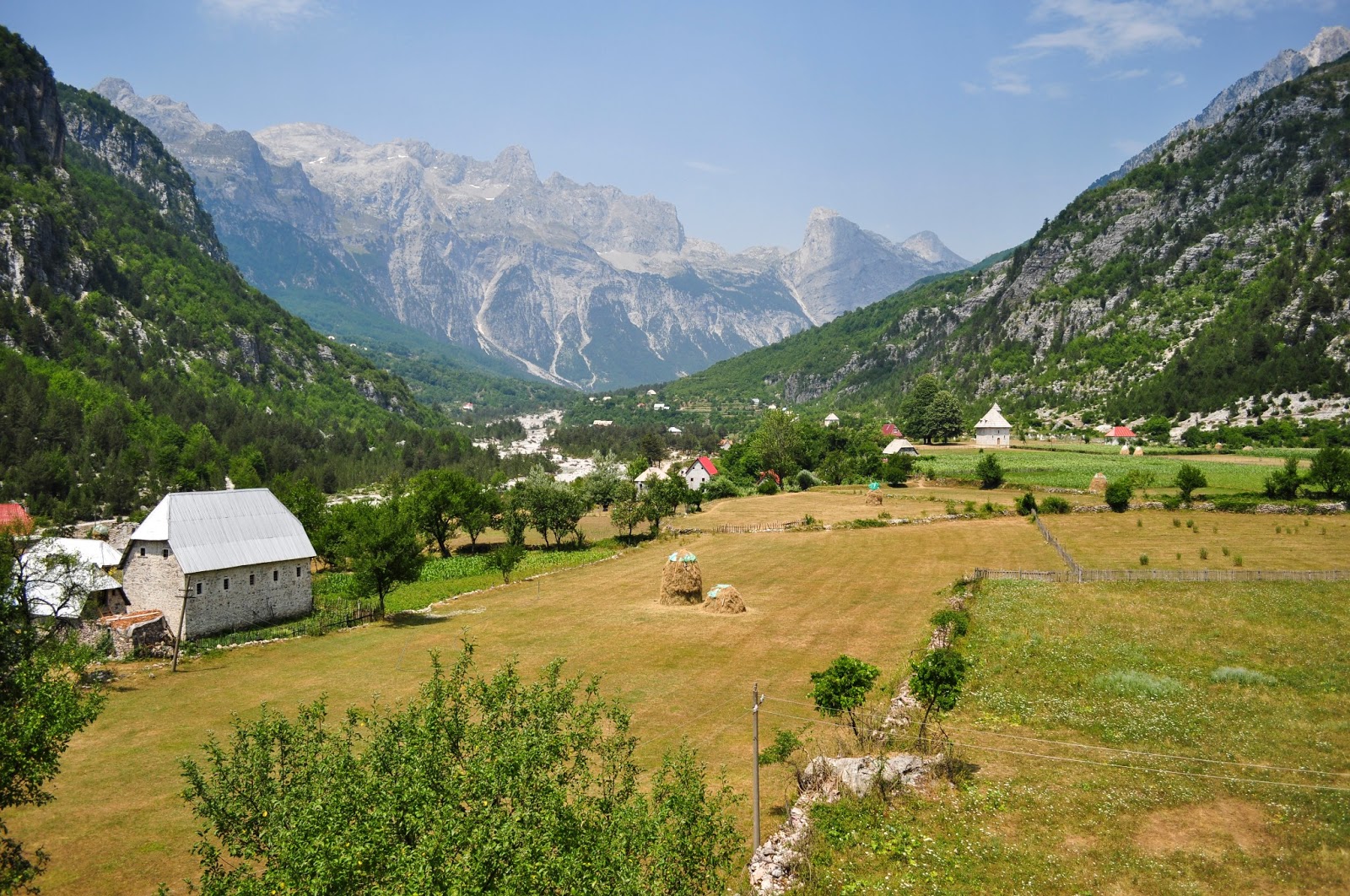
The beautiful town of Theth in Northern Albania – found at The Rom Rom.

The Old Wolf has spoken.